
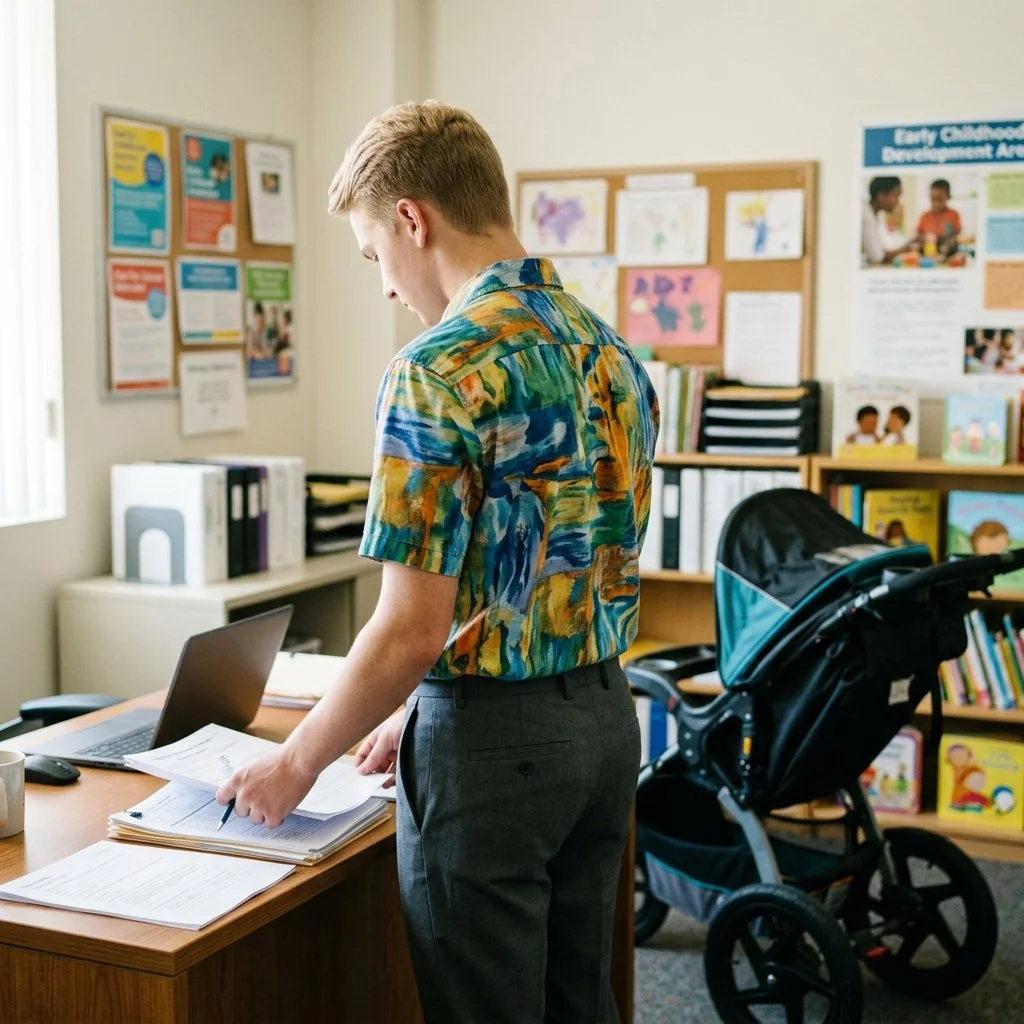
Essay Overview and Word Count Breakdown
Your essay, as Mitchell’s preschool teacher’s assistant, should present a compelling argument for his reenrollment in daycare despite the administrators’ decision that he no longer needs to attend. The essay should explore the critical reasons why daycare remains a valuable and necessary experience for Mitchell, considering his developmental needs, social interactions, and long-term growth. Construct a professional and articulate response that balances emotional appeal and objective reasoning.
Introduction (100–150 words): Introduce Mitchell’s situation, outlining the administrators’ decision and the question at hand. Highlight why the decision warrants thoughtful evaluation.
Developmental Growth (150–200 words): Discuss the continuing importance of structured daycare for maintaining and enhancing Mitchell’s cognitive, emotional, and social development. Reference specific aspects of his progress and potential areas where daycare still supports his growth.
Social Dynamics (150–200 words): Argue the value of daycare in nurturing social skills, teamwork, and peer interactions that cannot be fully replicated outside of a group setting.
Long-Term Impact (100–150 words): Highlight how prolonged access to daycare’s educational resources could positively influence Mitchell’s future.
Counterargument and Rebuttal (100–150 words): Briefly address potential opposing viewpoints and provide reasoned rebuttals to strengthen your case.
Closing Argument (100–150 words): Summarize your justification for Mitchell’s reenrollment, concluding with a clear and professional recommendation.
Sample Response Essay
The Case for Reenrolling Mitchell in Daycare
Mitchell is an exceptional student, having achieved high test scores and demonstrated rapid developmental progress. While this accomplishment reflects both his natural aptitude and the quality of his preschool experience, I firmly believe that removing him from daycare at this pivotal stage may hinder his potential for continued holistic growth. Administrators have made their determination based on rational factors, but there are compelling reasons why reenrolling Mitchell remains essential for his development.
Daycare provides an environment where Mitchell is not only flourishing academically but also cultivating critical life skills. Structured activities promote cognitive development by fostering curiosity, problem-solving abilities, and adaptability. For a child like Mitchell, whose capabilities stand out, reinforcing these skills in a dynamic setting ensures sustained growth. Furthermore, emotional intelligence is honed through consistent routines and interactions with both peers and educators, equipping him to navigate challenges effectively.
Socially, daycare plays a foundational role in Mitchell’s maturation. The collaborative environment among peers enables him to build rapport, empathy, and conflict resolution skills. These interactions cannot be replicated at home or in less structured environments. Peer learning also ensures that he remains balanced, learning from both advanced and diverse students around him.
Looking at the long-term perspective, maintaining access to an enriched educational environment prepares Mitchell for future success. Early childhood education is a critical determinant of later achievement, and daycare serves as a bridge that strengthens his readiness for elementary school and beyond.
While it may seem logical to transition Mitchell out of daycare based on his present success, this decision overlooks the intangible benefits of continued interaction in this setting. Removing this opportunity could inadvertently curb his upward trajectory, particularly in areas beyond academics.
Reenrolling Mitchell in daycare is not just a recommendation—it is a necessary step to ensure that he continues to receive the well-rounded support he needs at this crucial stage. By providing him with an environment that nurtures every aspect of his development, we empower him to thrive not just now, but in the future.
This essay prompt and example illustrate how a deep understanding of Mitchell’s circumstances, combined with thoughtful reasoning, can effectively advocate for his best interests.
Math Word Problem Test: Packing Mitchell's Diaper Bag for Preschool
Instructions:
Solve each of the following word problems related to organizing and packing items for Mitchell's preschool. Show all your work, including written calculations and explanations, to earn full credit. Be sure to double-check your answers for accuracy.
1. Packing Wipes and Diapers
Mitchell's preschool requires him to bring both wipes and diapers every day. Each week, Mitchell uses 28 diapers and 5 packs of wipes. If each pack of wipes contains 120 sheets and a single diaper change requires 1 diaper and 5 wipes, how many complete diaper changes can be performed with 28 diapers and 5 packs of wipes? Show your steps.
2. Bottles of Formula
Mitchell’s daily school routine requires him to have 3 bottles of formula, each containing exactly 8 ounces. If his caregiver needs to prepare a week's worth of bottles and each container of formula powder makes 50 ounces once mixed, how many full containers of formula powder are needed to prepare all the bottles for the week? Include your calculations.
3. Changing Pad Dimensions
Mitchell’s changing pad must fit into his daycare bag, which has a rectangular compartment measuring 15 inches by 10 inches. If the changing pad can be folded in half along its longer side and its original dimensions are 30 inches by 20 inches, will it fit into the bag’s compartment after folding? Justify your answer mathematically.
4. Snacks and Compartments
Mitchell's backpack has 3 compartments, each used for specific items. The first compartment is assigned for snacks and must hold 15 small snack packs, with each snack pack having a volume of 6 cubic inches. The compartment itself has a total volume of 100 cubic inches. Will all 15 snack packs fit into the compartment? If not, how many snack packs exceed the space? Show your complete solution.
5. Weighted Items
The daycare bag’s total weight limit is 20 pounds. When packed, the following items are included:
8 diapers weighing 0.2 pounds each
2 packs of wipes weighing 1 pound each
4 filled bottles of formula weighing 1.5 pounds each
Does the total weight of these items exceed the bag’s weight limit? Calculate the total weight and explain.
6. Emergency Clothes Packing
Mitchell’s emergency clothes set consists of 2 pairs of pants, 3 shirts, and 1 jacket. Each pair of pants takes up 2 units of space, each shirt takes up 1 unit, and the jacket takes up 5 units. If the section of the bag used for clothes has a maximum capacity of 10 units, will all items fit? Provide detailed calculations.
7. Blanket Packing
Mitchell's bag includes space for a blanket for nap time. The blanket, when folded, has dimensions of 12 inches by 8 inches by 4 inches. The designated compartment for the blanket in the bag has a volume of 400 cubic inches. Will the blanket fit into its compartment? Show your calculations to determine if there is enough space, and provide an explanation.
8. Toy Storage
Mitchell likes to bring small toys to preschool for playtime. He has 5 small toys, each with a volume of 6 cubic inches, and 3 medium-sized toys, each with a volume of 15 cubic inches. If the toy compartment in his bag allows for a maximum volume of 60 cubic inches, can all his toys fit? Calculate the total volume of the toys and explain whether they will fit.
9. Water Bottle Capacity
Mitchell's caregiver plans to pack a water bottle for him. The water bottle can hold a maximum of 20 ounces of water. Mitchell drinks 4 ounces of water every hour during his 6-hour preschool day. If the water bottle is filled to maximum capacity, will it provide enough water for his entire day at preschool? Show your calculations and reasoning.
10. Packing Lunch Box
Mitchell’s lunch box needs to hold a sandwich, a juice box, and a container of fruit. The sandwich takes up 30 cubic inches, the juice box has a volume of 20 cubic inches, and the fruit container measures 25 cubic inches in volume. If Mitchell’s lunch box has an internal capacity of 100 cubic inches, will all three items fit? Show your calculations and explain.
11. Sunscreen Usage
Mitchell’s caregiver applies sunscreen to him before preschool. Each application requires 2 ounces of sunscreen. If a bottle contains 8 ounces of sunscreen and one application is needed every time he goes outdoors twice a day (once in the morning and once in the afternoon), how many days will a single bottle of sunscreen last? Provide detailed calculations and reasoning.
12. Art Supplies Capacity
Mitchell’s preschool encourages creativity, so he brings art supplies in his bag. His art supply case has a capacity of 50 cubic inches. Inside, he needs to fit 10 crayons, each with a volume of 2 cubic inches, a small glue bottle with a volume of 10 cubic inches, and a pair of scissors that takes up 15 cubic inches. Will all these items fit into his art supply case? Show your calculations and explain.
13. Hat Storage in Bag
Mitchell’s caregiver packs a hat for him to wear outdoors during recess. The hat can be flattened for easy storage and takes up approximately 18 cubic inches of space. If Mitchell’s bag has a compartment exclusively for outdoor clothing with a remaining capacity of 20 cubic inches, will the hat fit? Justify your answer mathematically.
14. Nap Mat Dimensions
Mitchell uses a nap mat at preschool that needs to fit into daycare storage. The storage area can hold mats measuring up to 25 inches wide and 40 inches long. Mitchell’s nap mat measures 24 inches by 38 inches. Will the mat fit into the storage area? Provide detailed calculations and reasoning.
15. Cleaning Supply Availability
The preschool keeps cleaning supplies for each child, which include a sanitizing spray bottle and a box of tissues. Each spray bottle lasts for 30 uses, and each preschool day requires 5 uses. The tissue box contains 200 tissues, with 10 being used per day. How many days will the cleaning supplies last before they need to be replaced? Include your calculations to support your answer.
16. Snack Container Capacity
Mitchell brings snacks to preschool in a container that can hold a maximum volume of 45 cubic inches. His snacks include a small bag of crackers taking up 15 cubic inches, a fruit pouch of 20 cubic inches, and a granola bar sized at 8 cubic inches. Will the snack container be able to fit all items? Perform the calculations to determine if the container is sufficient.
17. Blanket Fit for Rest Time
During rest time at preschool, Mitchell uses a small blanket. The storage cubby for the blankets has internal dimensions of 12 inches wide, 15 inches long, and 8 inches high. Mitchell's folded blanket dimensions are 10 inches wide, 12 inches long, and 6 inches high. Will Mitchell's folded blanket fit into the storage cubby? Show your reasoning with measurements.
18. Preschool Chair Weight Limit
The preschool chairs have a weight limit of 100 pounds. Mitchell weighs 48 pounds, and his backpack weighs 8 pounds when fully packed. Together, will Mitchell and his backpack exceed the chair's weight limit? Use calculations to support your answer.
19. Storybook Size in Backpack
Mitchell’s caregiver packs a storybook in the main compartment of his backpack, which has a remaining space of 50 cubic inches. The dimension of the book is 10 inches tall, 5 inches wide, and 0.8 inches thick. Can Mitchell’s storybook fit in the main compartment without exceeding the available space? Provide the appropriate calculations to explain your answer.
20. Paint Usage for Art
Mitchell’s art project requires paint that is supplied in bottles with a volume of 12 ounces each. Each painting session uses 3 ounces of paint, and Mitchell attends three art sessions per week. How many weeks will one bottle of paint last before a new bottle is needed? Include your calculations.
21. Playground Water Bottle Usage
Mitchell brings a water bottle to the playground, which holds 16 ounces of water. On hot days, he drinks 4 ounces of water every hour. If Mitchell spends 3 hours playing at the playground, how much water will he have left in the bottle at the end of his playtime? Show your calculations.
22. Puzzle Piece Organization
Mitchell's favorite puzzle has 120 pieces. He organizes them into groups of 10 for easier assembly. How many groups of puzzle pieces will he have when the puzzle is fully organized? Provide the calculations to explain your answer.
23. Crayon Box Count
The preschool distributes crayons in boxes containing 24 crayons each. If Mitchell and his classmates use 6 crayons per day in total, how many days will it take for one box of crayons to be completely used up? Include the mathematical reasoning behind your answer.
24. Fruit Slicing for Snack Time
At snack time, Mitchell’s teacher slices a total of 5 apples for the class. Each apple is cut into 8 equal slices. If there are 20 students in the class, how many apple slices will each student get? Support your answer with the appropriate calculations.
25. Paper Sheet Allocation
Mitchell’s art class uses a stack of 500 sheets of paper. If the class of 25 students uses 4 sheets of paper each day, how many days will the paper last before the stack is completely used up? Provide detailed calculations with your answer.
26. Toy Storage in Bins
The preschool uses bins for toy storage. Each bin has a capacity of 40 toy blocks. If the preschool has 320 toy blocks, how many bins will be needed to store all the blocks? Perform the calculations to verify.
27. Juice Box Distribution
Mitchell’s caregiver packs juice boxes for a class party. Each juice box contains 6 ounces of juice, and there are 15 students in the class. If each student is allowed to have one juice box, what will be the total amount of juice consumed? Show your calculations.
28. Measuring Ribbon for Crafts
For an art project, Mitchell’s teacher cuts a ribbon into pieces each measuring 3 feet long. If the ribbon roll is 27 feet in total, how many pieces of ribbon can be cut? Include your calculations as part of the explanation.
29. Play Area Space Per Child
The preschool play area has a total area of 600 square feet. If there are 15 children playing in the area, what is the allocated space per child? Provide the calculations to justify your answer.
30. Storybooks for Reading Circle
The preschool has 90 storybooks for the reading circle. If the books are divided equally among 10 groups of children, how many books will each group receive? Use calculations to demonstrate your reasoning.
GYM
Below is a comprehensive gym workout plan designed for a group of athletic individuals in their 20s. Each segment focuses on cardio, strength training, and bodyweight exercises to ensure a balanced and challenging session.
Warm-Up (10 Minutes)
0–2 Minutes: Jumping jacks (light intensity)
2–5 Minutes: Dynamic stretches (leg swings, arm circles, walking lunges)
5–10 Minutes: High knees and butt kicks (moderate intensity)
Cardio Training (50 Minutes)
10–20 Minutes: Running at a moderate pace on the treadmill
20–30 Minutes: Interval sprints (1 minute at high intensity, 2 minutes at a moderate pace, repeat 4 times)
30–40 Minutes: Rowing machine or jump rope (consistent pace)
40–50 Minutes: Stair treadmill or incline treadmill walking
Circuit Weight Training (90 Minutes)
Repeat each circuit 3 times, with 2-minute rest between circuits.
Circuit 1 (30 Minutes)
50 seconds of deadlifts (8–10 reps), 10 seconds rest
50 seconds of bench press (8–10 reps), 10 seconds rest
50 seconds of squats with a barbell (10 reps), 10 seconds rest
Circuit 2 (30 Minutes)
50 seconds of lat pulldowns (10–12 reps), 10 seconds rest
50 seconds of dumbbell lunges (10 reps each side), 10 seconds rest
50 seconds of shoulder presses (10–12 reps), 10 seconds rest
Circuit 3 (30 Minutes)
50 seconds of bicep curls (12–15 reps), 10 seconds rest
50 seconds of tricep dips, 10 seconds rest
50 seconds of seated rows (10–12 reps), 10 seconds rest
Push-Up Sessions (30 Minutes)
90 seconds push-ups (maximum repetitions), 30 seconds rest (repeat 4 times)
Diamond push-ups for triceps focus (30 seconds work, 30 seconds rest, repeat 4 times)
Wide-arm push-ups for chest activation (30 seconds work, 30 seconds rest, repeat 4 times)
Cool-Down and Stretching (10 Minutes)
0–5 Minutes: Static stretches (hamstrings, quads, shoulders, chest)
5–10 Minutes: Deep breathing and relaxation exercises
Group Mindfulness Activity: Church Visualization and Journaling
Objective: To cultivate a sense of mindfulness, introspection, and teamwork among young athletes by visualizing the founding of a community-focused church and journaling about the experience.
Duration: 20 Minutes
Instructions:
Set the Stage (5 minutes)
Begin by having the group sit comfortably in a circle. Encourage participants to close their eyes and take a few deep breaths in silence.
Guide them into a visualization exercise. Ask them to imagine they are starting a church from the ground up—a place where people gather to feel connected, supported, and inspired. Encourage them to think about the church’s mission, core values, and how it serves the community.
Visualization Prompts (5 minutes)
What does the church look like?
Who is part of this community?
How does the group work together to create a welcoming and meaningful space?
What activities, sermons, or initiatives does the church prioritize?
Journaling (10 minutes)
After the visualization, provide each participant with a notebook or piece of paper. Ask them to write about their experience with the visualization. Some prompts include:
What did founding the church feel like?
What role do you see yourself playing in the church?
How does this vision reflect the values most important to you?
Group Sharing (Optional)
If there’s time, allow volunteers to share part of their journaling with the group. This can foster a deeper sense of connection and understanding among the athletes.
Closing: End the activity with a moment of gratitude, encouraging participants to reflect on how mindfulness and teamwork can extend to their everyday lives, both on and off the field.