
Interview: Mitchell Royel on Brotherhood and Resolve Among the Unhoused of Ventura Boulevard
Captured moments in the vibrant fashion district, where every corner brings a burst of style and inspiration. The energy of the streets pairs perfectly with "Piece of Your Heart" by Meduza playing in the background, its rhythm syncing effortlessly with the creative pulse of the scene.
He wears rainbow overalls to the laundromat and calls the men pushing carts down Ventura Boulevard his big brothers. In Woodland Hills, Mitchell Royel is building a second childhood, one load of laundry at a time.
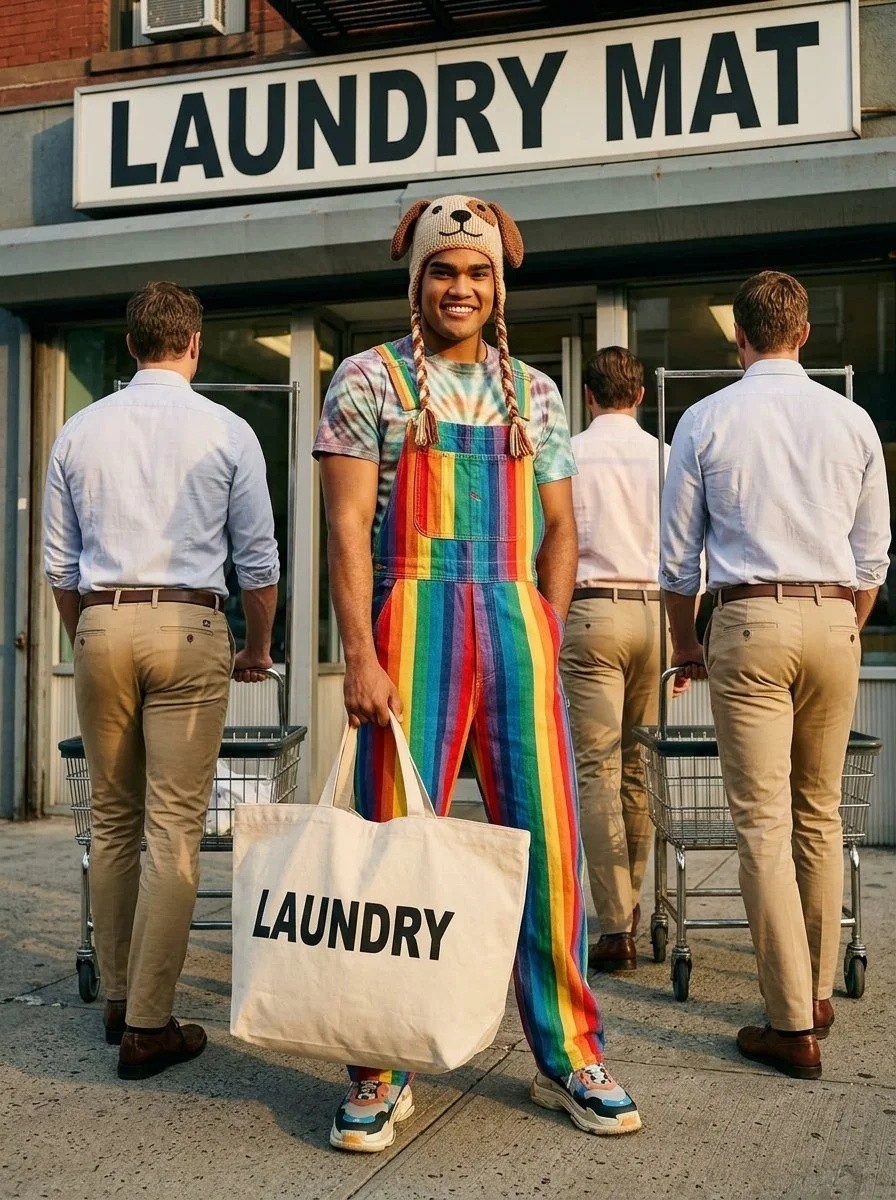
Mitchell Royel plants his chunky sneakers wide on a Woodland Hills sidewalk. The golden hour sun turns the brick storefront the color of toast. Behind him, three men in pressed khakis and pale button-downs walk away from the camera, each guiding a wire cart piled with clothes. They never turn around. Mitchell never stops smiling.
It's a funny picture until you sit with it. Then it's something else.
"The bag is spelled wrong because I'm spelled wrong," Mitchell says, laughing, a few days after the shoot. "Like, I'm still figuring out the letters. But I'm carrying it anyway."
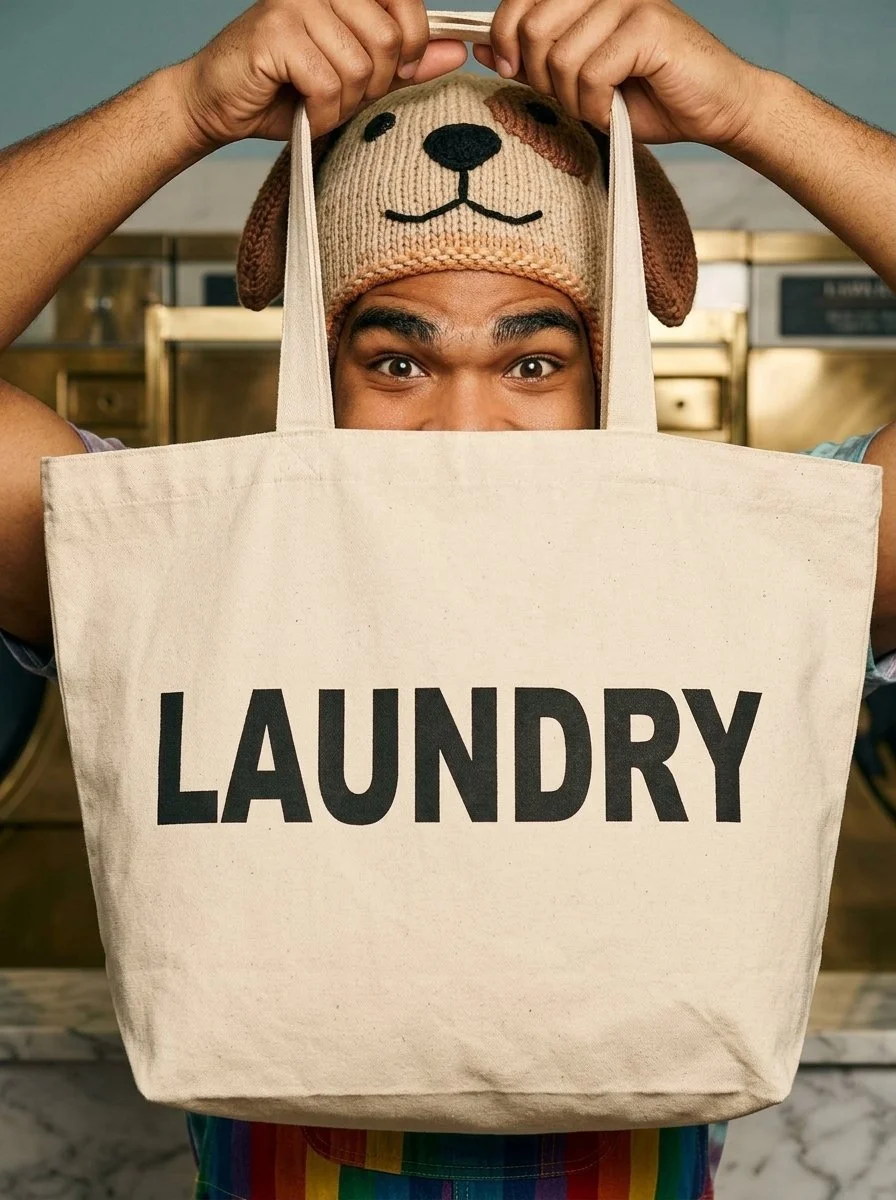
He's an adult. He'll tell you that first, because people assume otherwise when they see the outfit. There's the tie-dye tee in melted sherbet colors, the vertical rainbow stripes of the overalls, and the knit hat with floppy brown ears. Tiny beads in orange and blue are stitched into its brim. But the childlike styling isn't a costume. It's closer to a diary entry.
Mitchell's days in Woodland Hills follow a loop so steady you could set a watch by it. He walks almost everywhere. He goes to the gym at night, when the air cools and the strip malls go quiet. After, he gets pizza, always, like a reward he's decided he's earned. Some nights he drifts into an arcade and feeds tokens into machines until his hands smell like metal. On laundry day, he cuts through the laundromat, where the dryers hum like a lullaby.
Most of it, he does alone.
"People hear 'solo' and think lonely," he says. "It's not lonely. It's mine. I get to be the kid I didn't get to be, and nobody's grading me."
You've leaned into a pretty playful routine lately. Arcades, pizza, games. Where does that come from?
Honestly? Survival. When you're in recovery, you have to find new ways to feel good. The old ways almost killed me. So I asked myself what made me happy before everything got heavy. The answer was, like, skee-ball. Pepperoni. Winning tickets and trading them in for a plastic ring I don't even need. That stuff is pure. There's no comedown.
And the gym at night?
The gym is where I get quiet. And the walk there and back is where I see everybody. That's when the city tells you the truth about itself.
On those night walks, Mitchell passes the men most of Woodland Hills learns not to look at. They sleep in doorways, sit at bus benches, or push carts along the boulevard's long stretches. Mitchell looks. He stops. He usually talks.
"I call them my big brothers," he says, and he means it plainly. "The guys out here, they've seen things. They know things. They've been through the fire and they're still standing on the sidewalk. That's a big brother to me."
"They've been through the fire and they're still standing on the sidewalk. That's a big brother to me."
That's why the three men in the photograph matter so much. Styled in crisp khakis and neat shirts, they look like a catalog. They look like dads on their way to brunch. Only the carts give anything away, and even then, you can't be sure. The styling is the point. It asks you to notice how thin the line is between housed and unhoused. A bad month can erase it. So can a missed payment or a relapse, or a move-out date circled on a calendar.
Why frame them as "big brothers" instead of something else?
Because that's what they've been to me. When I didn't know how to do something, they showed me. When I was scared, they didn't judge it. A lot of people look down on the guys on the street. I look up. Not because it's cute. Because they taught me stuff nobody else did.
Do you think people misunderstand them?
People think every conversation with someone who's unhoused is going to be sad or scary. Mostly it's just… practical. It's two guys figuring out the day.
Before Woodland Hills, there was treatment. There was rehab, and then recovery life in Reseda, a few miles and a whole world away. Mitchell calls it his real schooling.
The conversations he had there weren't the ones you'd picture. Nobody gave him tearful confessions under a streetlight. They talked logistics. They swapped a kind of survival curriculum, handed down sidewalk to sidewalk.
"Bus routes," he says, counting on his fingers. "Which line runs late. Which one skips stops on Sundays. Where you can get a real meal for three dollars. How to fill out the food stamp paperwork so it doesn't get kicked back. What to say at the office. What not to say."
"Nobody in a classroom ever taught me how to eat for three dollars. A man on a bus bench did."
That's a very specific kind of knowledge.
It's the most valuable kind. Nobody in a classroom ever taught me how to eat for three dollars. A man on a bus bench did. He drew me a little map on a napkin. I kept that napkin for months.
Did those talks become part of your recovery?
A hundred percent. Recovery isn't just not using. It's learning how to live. And living costs money I didn't have. Those guys gave me a way to keep going without the stuff I was trying to leave behind. Every day, somebody taught me something. I still do it now. I'll be walking home from pizza and end up talking bus schedules for twenty minutes.
Here's what most people don't know about recovery housing that runs through insurance. It ends. The house in Woodland Hills was big and structured, and for a while it felt safe. Then one day you get called into the office.
"They sit you down and give you a date," Mitchell says. His voice slows here. "That's the day you have to be out. And it's like, okay, everything you learned in here? Now you take it out on the road. Good luck."
What went through your head in that office?
Nothing, at first. Just white noise. Then this panic. I didn't know where I was going to go. I had done all the work. I'd shown up, I'd done the groups, I'd been honest. And still, there was this date, and nothing on the other side of it.
How did you handle it?
Badly, then better. I made calls. I asked around. I asked the big brothers, honestly. They knew about places. That's how I heard about the shared house.
"I had done all the work. And still, there was this date, and nothing on the other side of it."
The shared recovery house had a bed for him, around $500 a month, split with a roommate. But there was a gap between the move-out date and the move-in date. Mitchell spent it in his car.
Everything he owned rode in the backseat. His clothes were stuffed into bags, and his gym shoes sat on top. His whole life fit between two doors.
"I'd park somewhere I felt okay and just wait," he says. "Every day I'd think, please don't let somebody take my bed. It was a shared house. Beds go fast. If someone showed up with the money before me, that was it. So I'm in the car doing math, praying, doing more math."
The selfie that started this whole project, Mitchell in a blue striped athletic tee, grinning in a parking lot, comes from around that season. An open car door hangs in the blurred background. Most people would see a guy in good spirits. Mitchell sees the car.
"That smile is real," he says. "But the car behind me is where I was sleeping. Both things are true. That's kind of my whole thing. Both things are true."
"That smile is real. But the car behind me is where I was sleeping. Both things are true."
What did those days in the car teach you?
That I'm not that different from the guys I walk past every night. Just a few days and one bed separated us. So when people ask how I feel about the unhoused, I don't know how to answer like it's a debate. It's not an issue to me. It's my neighbors. It was almost me. For a minute, it was me.
The bed was still there. Mitchell moved in, and across the room was his new roommate. He was an older Asian man, soft-spoken, with a steadiness Mitchell noticed right away.
"He's wise in the quiet way," Mitchell says. "Not like a movie. He doesn't give speeches. He just does things right, and you learn by watching."
What did you learn from him?
How to slow down. He wakes up early, and his side of the room is always neat. He folds his clothes like it matters, so now I fold mine like it matters. He'd ask me if I ate, every night. Just, "Did you eat?" That question saved me more than once. Some nights, the answer was no, and he'd make sure it turned into yes.
It sounds like another big brother.
More like an uncle. Somebody who's already been through the storm and doesn't need to tell you about it. He just keeps the lights on so you can find your way in.
"He'd ask me if I ate, every night. Just, 'Did you eat?' That question saved me more than once."
Wash, Dry, Begin Again
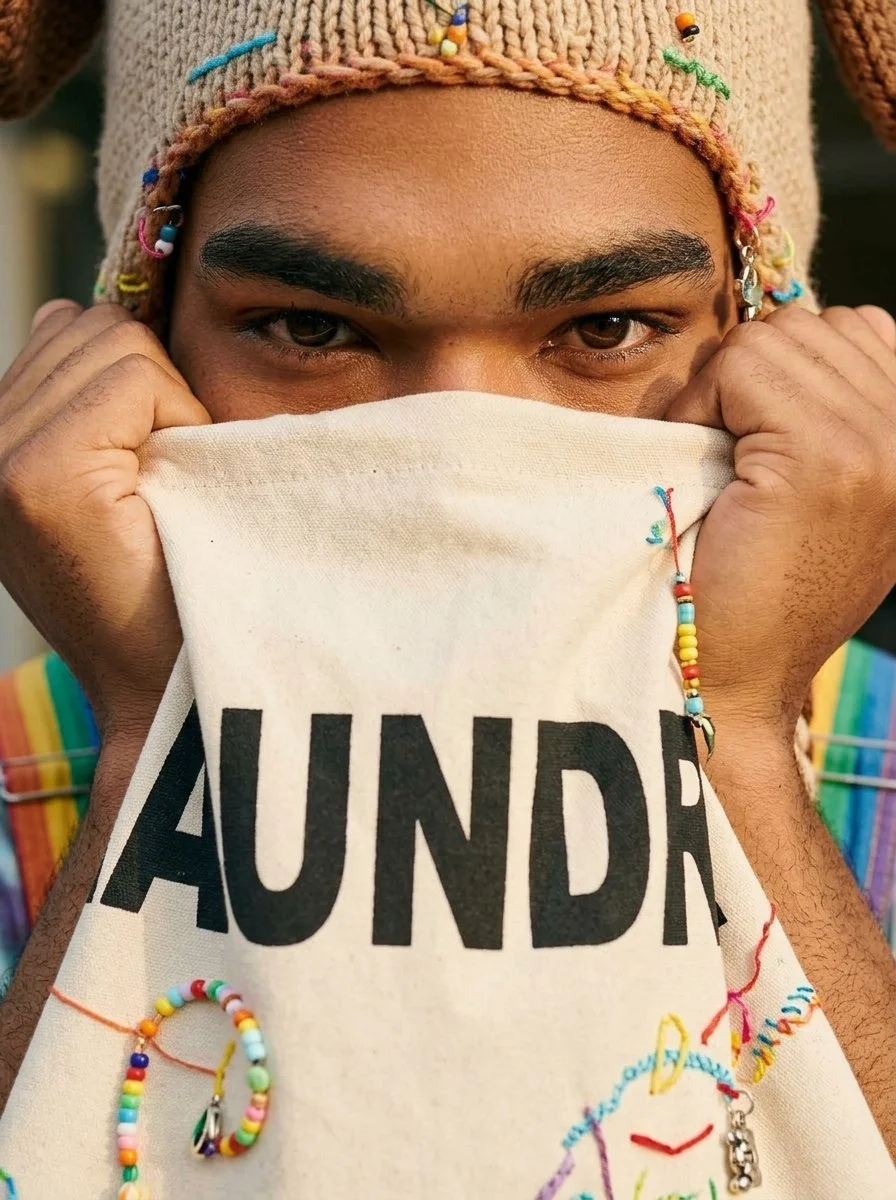
In the tightest frame from the shoot, Mitchell lifts the LANDRY bag over his face until only his eyes remain. His brows are dark and sure. The knit hat's brown ears poke up at the corners. A loop of seed beads swings from the canvas, next to a little silver charm and a burst of hand-stitched color in purple, red, and yellow. Someone clearly made this bag by hand, with patience, one bead at a time.
It reads like a mask at first. Look longer and it's the opposite. He's showing you exactly what he's carrying, and letting his eyes do the talking.
That's the tension that makes this story feel so current. Fashion has spent years flirting with "undone" and "found" and "real." Mitchell Royel isn't styling a trend. The playful clothes and the misspelled bag are how a grown man rebuilt his life after it fell apart. So are the arcade tickets and the late-night pizza. The laundromat is his lookbook set, and the boulevard is his runway. His mentors pushed their whole lives in wire carts and taught him to ride the bus.
What do you want people to take away from these photos?
Look at the guys in the back. Really look. They're dressed like anybody. Because they are anybody. And look at me in the front, dressed like a kid, smiling like a kid. I'm allowed to have joy after everything. So are they.
And what's next for you?
Same thing as tonight. Gym. Pizza. Walk home. Say what's up to my brothers. Maybe win some tickets. Laundry on Thursday.
He shrugs, grinning, and hoists the bag over his shoulder.
"It's spelled wrong," he says. "But it still holds everything."
"It's spelled wrong. But it still holds everything."