
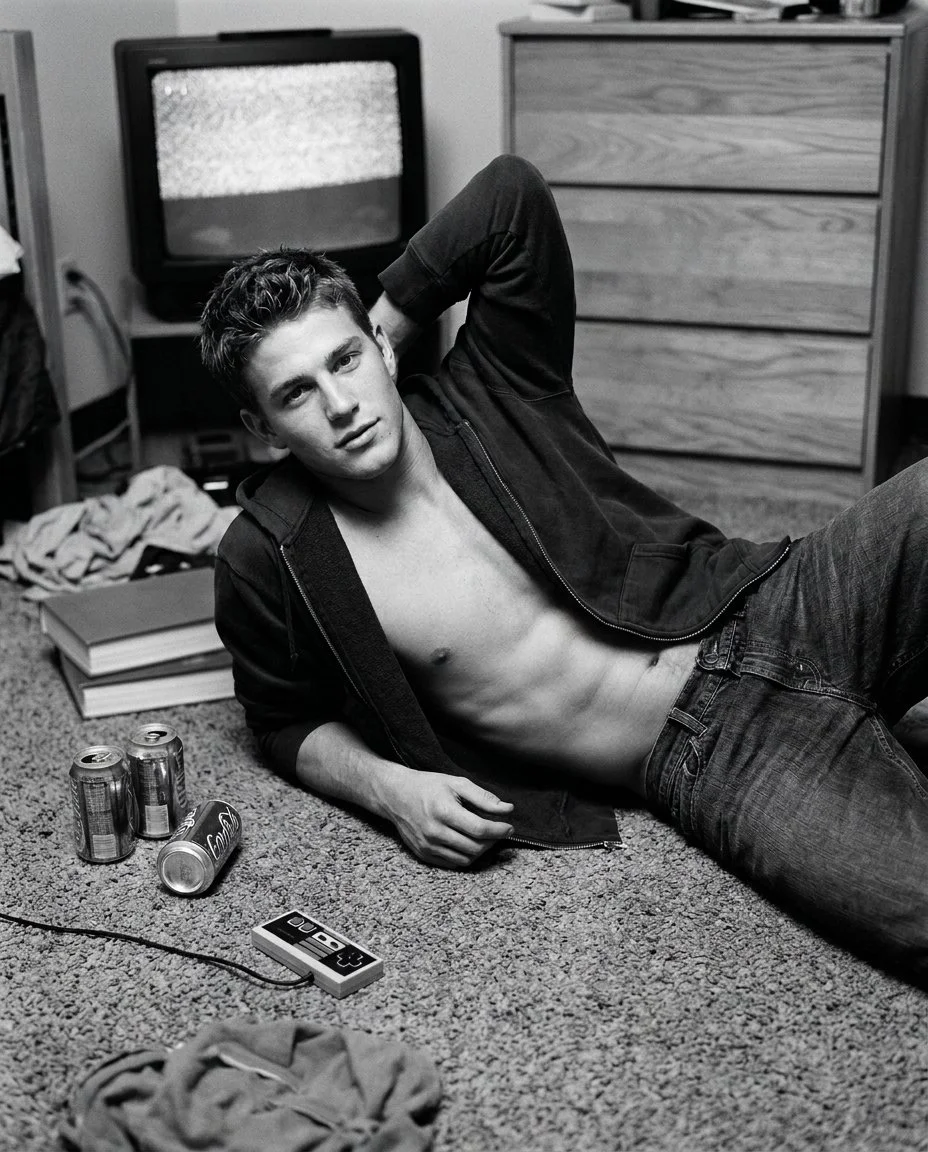
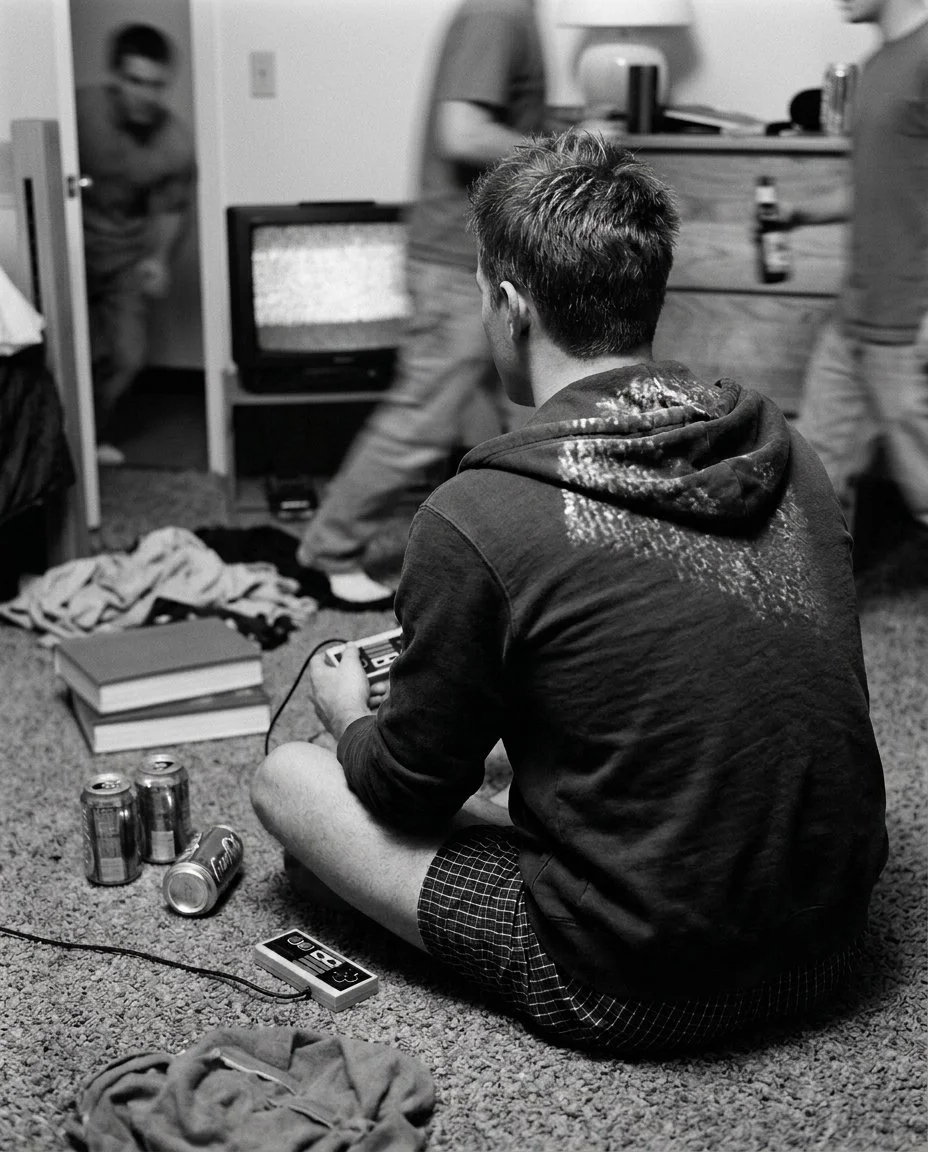
These images feel like a modern memory dressed in the language of an older mythology. Shot on iPhone by Mitchell Royel in the Fashion District, they borrow from the visual grammar of turn-of-the-century black-and-white Abercrombie & Fitch editorials: candid physicality, restless closeness, imperfect rooms, thrown-off clothes, the blur of movement under low light, and that charged balance between innocence and bravado. What makes them work is not imitation, but translation — the old heritage aesthetic reappears here stripped of polish and pushed through something more immediate, more intimate, more accidental. The result is a set of photographs that feel discovered instead of staged, nostalgic without becoming museum-like, and alive in the way only youth, mess, and late-night rooms can be.
The soundtrack to this moment lives in that same collision of seduction and fallout. “Addicted” by Zerb, The Chainsmokers, and Ink gives the images their pulse — hypnotic, reckless, euphoric, like the night stretching past the point it should have ended. “Done to Me” by Ames brings in the afterimage: the comedown, the ache, the quiet sense that something has shifted and can’t be put back. Together, they score the full emotional arc of the photos — desire, momentum, disorientation, and the strange beauty of consequences catching up to you.
“We follow a young man navigating a critical moment of moral and personal sacrifice within the tight-knit chaos of dorm life. Framed by the relentless closeness of a top bunk and the vibrant noise of his room below, he reflects on loyalty, consequence, and the weight of doing what’s necessary over what’s neatly right. When faced with a discovery that could jeopardize his roommate Danny's future — a bottom-bunk companion with everything to lose — the narrator chooses to take the blame, shouldering the fallout alone. This decision is steeped in quiet heroism, driven by an intimate knowledge of Danny's family, hopes, and struggles. Juxtaposed with the raw energy of late-night wrestling matches and broken bio books, the story is saturated with tension between innocent camaraderie and looming adult realities. It's a snapshot of youth, choices made in the margins, and the enduring ache of lifting a burden that isn't yours — but knowing, even through exhaustion, that it was the only choice for someone you care about.”
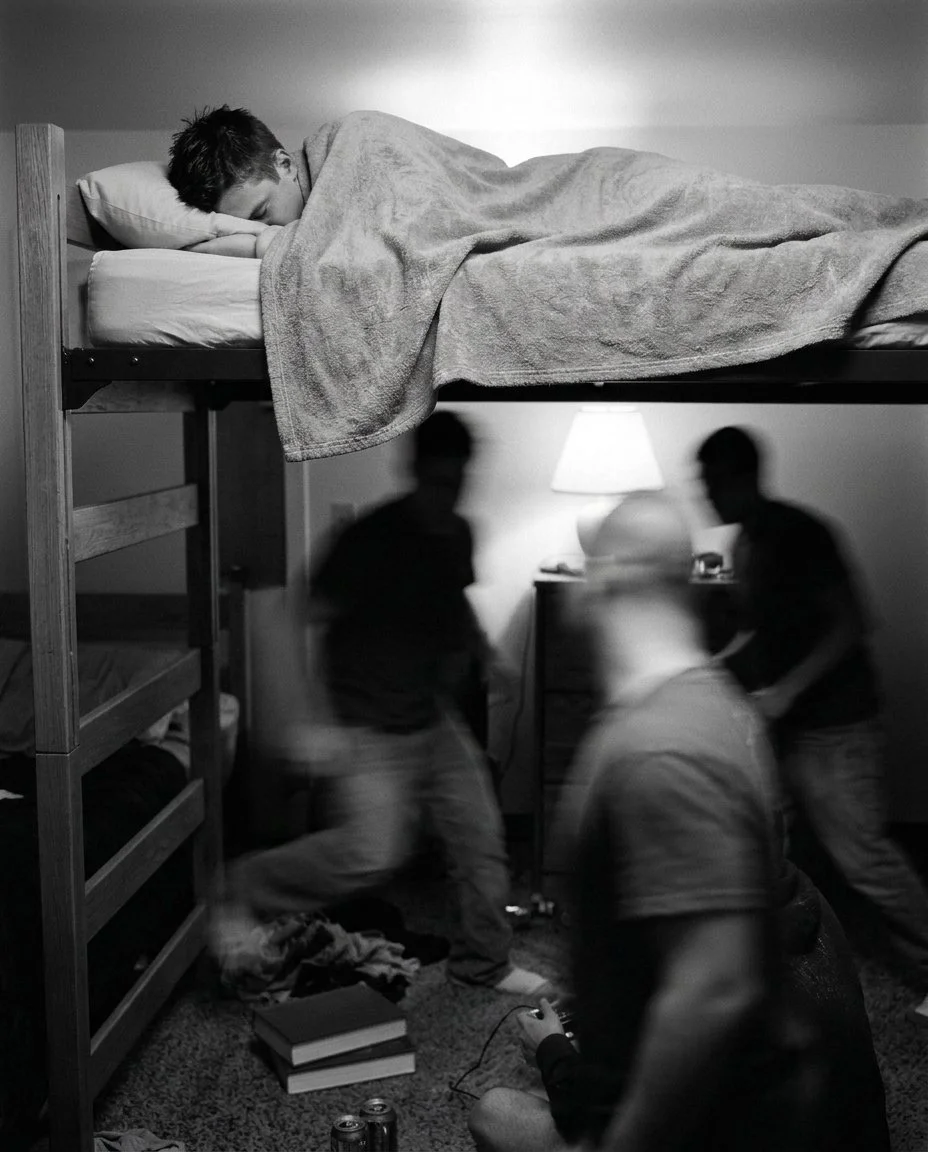
The ceiling is eleven inches from my face. I know because I measured it the first week, with a ruler I stole from Danny's desk. Eleven inches. That's how much room a guy gets up here in the top bunk. Enough to breathe, not enough to sit up straight. Enough to close your eyes, not enough to disappear.
And I'm not trying to disappear. I'm just gone.
Down there, the world is still going. I can feel it through the mattress, through the frame, through the steel bolts that rattle every time somebody hits the floor. Somebody always hits the floor. Tonight it's Brody. I hear the thud first — that heavy, full-body collision with carpet — and then the groan, and then the laugh. The laugh comes every time, without fail, like it's sewn into the same moment as the fall. Like you can't get one without the other.
"Tap out. Tap out, bro."
"Never in my life."
"Brody, your face is literally inside a sock."
"It's my sock. I'm comfortable. This is my home now."
There's a pause. Then the whole room breaks.
Somebody cracks a can. That sound. That little metallic hiss of pressure releasing — like a secret that's been held too long, finally getting told. Then another. Then the clink of two cans meeting somewhere in the middle of the room, a toast to nothing, to Tuesday, to being nineteen and dumb and completely, recklessly alive.
I'm under the blanket. The thin one. The one my mom packed in August with a folded note pinned to the corner that said for when it gets cold. She ironed that note. She probably cried after she wrote it. It's not cold tonight. I've got it pulled up past my chin anyway.
Here's what nobody tells you about the big moments in your life. They don't feel big.
You think they'll announce themselves. You think they'll come with stadium lights and a whole soundtrack. Some announcer voice in the back of your skull going fourth quarter, two seconds left, everything on the line, nobody else can make this call. You think you'll feel your heart try to hammer its way out of your chest and you'll know — you'll absolutely know — that this is the moment. The play that defines you.
It doesn't work like that.
It happens in a fluorescent office on a Thursday afternoon at 2:40, when the building is half-empty and the hallway outside smells like whatever they spray on the floor. It happens with a woman named Dr. Hollis folding her hands on her desk like she's about to deliver a verdict — which, as it turns out, she is. It happens with a manila folder landing in front of you, and inside the folder, a printout of an answer key. Folded into quarters. The creases soft from being handled too many times. Found in our room. Found under the mattress of the bottom bunk.
Bottom bunk.
Not mine.
She looks at me. She has these reading glasses that sit at the end of her nose, and she looks at me over the top of them, and she says, "Do you know whose this is?"
One second.
Maybe less.
The kind of second where your whole nervous system just goes offline. Where the blood stops moving and the air stops moving and the second hand on the clock behind her head stops mid-sweep. And in that stopped moment I saw the whole thing laid out like a topographic map. I saw Danny's dad. The delivery truck. The town where the main road is also the highway, where there's one stoplight and everybody knows when you've been gone and when you've come back. I saw the scholarship letter that Danny keeps taped inside his closet door, up in the top left corner so it's the first thing he sees when he opens it every morning. I thought about how he got that letter in the spring, and how he was on the phone in the fourth-floor stairwell the night it came through, sitting on a step with his elbows on his knees, talking to his mom. His voice cracked twice. He didn't know I was two flights up, lacing my shoes, trying not to listen.
I listened.
So when Dr. Hollis looked at me over those glasses, I looked right back.
And I said, "It's mine."
Down below, the NES is running. Or trying to. I can tell by the sound — that fuzzy, low roar of static coming through a TV that is older than everyone in this room, possibly older than the building. The thing barely functions. You have to blow into the cartridge, smack the side of the screen twice with an open palm, and then hold your breath and wait. Half the time it's just snow. Pure white noise pouring out of a cathode-ray tube like a transmission from nowhere.
They play anyway.
"It's doing something. That pixel moved."
"That's not a pixel. That's just static being weird."
"It's loading, give it a second."
"Man, it's been loading since 1989."
Laughter. That room-filling, body-shaking kind of laughter that only happens between people who've spent enough time crammed into the same 200 square feet to stop performing anything. Pure and unrehearsed. The kind you can't fake. Somebody kicks a textbook — probably bio — and it slides the full length of the shag carpet and smacks the leg of the dresser with a satisfying thunk. Nobody retrieves it. Nobody ever retrieves the bio book. It's a doorstop with a price tag and a highlight system that stopped being useful three weeks into the semester.
They've got cans scattered across the floor. I can hear them shift and roll when someone moves. I can hear the shuffle of a wrestling rematch starting up again near the foot of the bunk — the grunt, the slap of a grip getting locked in, someone going "nononono" before they hit the carpet. Outside the window, the campus is quiet. Someone's probably walking back from the library with their head down, carrying the weight of a future they're terrified of. In here, everyone is just trying to find the best hold.
I want to be part of it. I can feel the pull of it in my chest like a rope. But my body has gone offline. Two beers and three consecutive nights of two-hour sleep and a week of carrying something that belongs to someone else — my arms are empty, my legs are concrete, and I am somewhere above all of it, staring at eleven inches of water-stained drywall, listening to my friends.
You ever hear the story about the mother who lifts the car?
It gets told a lot. Becomes almost a myth. Some woman — Florida, Georgia, one of those flat states baked by the sun — her kid is pinned underneath a sedan. And she just grabs the bumper and lifts. No warm-up. No spotter. No chalk on her hands. Three thousand pounds of steel and she raises it enough for the kid to crawl free.
Scientists have a name for it. Hysterical strength. The idea is that your brain runs with a limiter — a governor, like the chip they put in a fleet vehicle so it can't blow past sixty. It keeps you from using your full output, because if you used everything your muscles were actually capable of, you'd destroy yourself from the inside. Rip tendons off bone. Snap your own spine in half trying to do something extraordinary.
But in the moment — the real moment — the limiter breaks.
And you do the impossible thing.
And then you pay for it. For weeks. For months. Maybe forever.
That's the part that doesn't make it into the story. The mom who lifted the car off her kid — she probably couldn't raise her hands above her shoulders for the rest of the month. Probably tore something up in there that the doctors shook their heads at. Probably wakes up on cold mornings and feels the ghost of it, deep in the socket. Something that wasn't the same after.
Nobody sits across from her and asks if it was worth it.
Because the kid is alive. Standing. Walking around with a whole future in front of him. So obviously it was worth it.
Right?
The problem with doing the right thing is that it's tidy. It fits in a frame. It looks good on a motivational poster in a guidance counselor's office. It's what Coach says in the locker room on game night, moving through the room slow, voice low and certain like he was born knowing things: Integrity is what you do when no one's watching.
Somebody was watching.
Dr. Hollis was watching. The folder was watching. The answer key with its soft quarter-fold creases was watching. And the right answer — the clean one, the one that fits on the poster — was to look at that folder, look at Dr. Hollis, and say the name of the person whose mattress it was found under.
Say Danny.
But the right answer has a problem. It doesn't do any arithmetic about who gets crushed.
Danny loses the scholarship, Danny's out. And it's not like he goes home to a gap year and a family trip to Europe to clear his head. He goes home to a duffel bag on a Greyhound. He goes home to his dad, who takes Tuesday-Thursday routes and gets home after eight, who is going to look at his kid in the kitchen doorway and ask what happened. And Danny is going to have to find the words for that. Out loud. At the kitchen table with the bad fluorescent light that's always buzzed slightly, in the town with the one stoplight.
Me? My family is going to lose their minds. My mom is going to cry. My dad is going to get very quiet in the particular way that means he's already on his phone finding a solution. They'll yell, then they'll strategize, then they'll find me another school with another bunk bed and another ceiling to stare at. I'll land on my feet because the ground beneath me is padded by people who have always made sure it was.
So I did the math. Not the right math. The best math.
The math that asks not what's correct, but what's necessary. Not what looks good, but what keeps the most people standing.
The best math said: take the hit.
There's been a song in my head for a week. Not the lyrics, really. Just the undertow of it. That feeling of being pulled toward something you can see is bad for you, toward something that is warm and dark and already knows your name. Like the ocean's got your ankles and the sand is shifting and the logical part of your brain is saying get out, now, go back to the beach — but the rest of you is so tired of fighting the current that you just... stop kicking.
That's this week. Every hour, another inch under. Every hour, a little more settled into the weight of a secret that isn't even mine.
And there's another one. Quieter. The kind of song that sounds like a confession someone makes to themselves in a parked car at the end of a long drive, hands still on the wheel. Look what this did. Not what you did to me. Not what they did. What this did — the choice, the moment, the one second that showed up unannounced and said, who are you?
I don't have an answer yet.
I just have the statement I already wrote. Three pages. Single-spaced. It says I found it. It says I'd been holding it. It doesn't say I'd never seen it before the moment Dr. Hollis slid it across her desk.
About an hour ago — maybe more, I've lost track of time the way you do when sleep isn't really sleep — there was a small tournament happening on the floor below me.
Brody and Cole were wrestling for real by then, not just goofing around. I could feel the vibration of it through the frame every time one of them hit the floor, could hear the slap of a lock getting broken, the sharp burst of breath when someone landed wrong. Cole is two inches taller but Brody is built lower, so it goes back and forth. It always goes back and forth.
Meanwhile, Danny had the second controller, playing whatever version of whatever wasn't just static tonight, narrating his own gameplay like a highlight reel broadcaster. "He sees the opening. He goes left. He explodes to the left—"
"You've been pressing the same two buttons for twenty minutes."
"I'm executing a strategy."
"The TV has snow on it, man."
"It's part of the strategy."
Somebody had stacked the textbooks into a pyramid in the corner that collapsed when Brody rolled into it, and everyone treated this like the greatest thing that had happened all semester. Someone's energy drink went over. Nobody cleaned it up. Nobody was going to.
This is the bottom bunk world. Full noise, full chaos, full life.
Up here is just me and the ceiling and eleven inches of silence.
"Yo — is he dead?"
That's Cole. Footsteps near the ladder. I can feel him looking up.
"He's breathing. Watch, the blanket's moving."
"Should we draw on him? Be honest."
"Touch him and I'll tell everyone about the dining hall thing." That's Danny. Quick. Firm.
"...fair."
"Leave him alone. He's had a week."
My stomach drops about three floors.
He doesn't know. He thinks I'm just buried under it — a rough midterm, a rough call home, too many late practices. He doesn't know there's a hearing Monday at nine a.m. He doesn't know I already turned in the statement. He doesn't know his name appears nowhere in it, not once, not even adjacent.
He's not going to know.
"Rematch," somebody says from the floor. "Loser runs the stairs."
"You're on."
The thud of two bodies hitting carpet in real time. The whole bunk frame rattles. Something rolls off the dresser — a pen, probably, hitting the floor in that plastic clatter way. Somebody lets out a battle cry that is completely unhinged for 11:30 on a Tuesday. Someone else yells "MY BIOLOGY BOOK" with the energy of a man who has lost everything he holds dear, and the room fills up with laughter so loud and so full and so present that for one long second I can feel myself trying to wake up just to be inside it.
Almost.
Not quite.
Here's what I keep coming back to, up here in the dark above everyone else.
You get maybe two or three of these moments in your whole life. The car-lifting ones. The ones where the limiter breaks and you find out you're capable of something that you absolutely shouldn't be capable of. Where your body does something your brain never cleared.
You don't get a schedule. Nobody puts it in your calendar. You don't get tape to study or a playbook or a coach walking you through it on a whiteboard. You just get the bumper in your hands and the weight and the choice — lift or don't. Hold or let go.
Maybe Monday goes sideways. Maybe Dr. Hollis and whoever sits with her in that hearing room pulls on a thread I didn't tie off right, and the whole thing unravels, and I pack my stuff into the same moving boxes I unpacked in August, and I drive home in the dark with the windows down because silence is better than thinking.
Maybe.
But Danny stays.
Danny stays on the bottom bunk. He wakes up Wednesday and walks to class and nods at people in the hall and opens that closet door in the morning and sees the letter right there in the top left corner where he put it. He stays. He keeps the future he was handed the night he cried in the stairwell when he thought no one could hear him.
The car's off the kid.
My arms are going to hurt for a long time.
Worth it.
Down below, the TV is still going. White noise wall to wall, no signal, no picture, just static — and four guys staring at it like it's the Super Bowl. Like the snow might clear at any second and reveal something worth waiting for.
Maybe that's just what you do when you're nineteen and the ceiling's too close and the night is too long and every bad thing is exactly three days away. You stare at the static. You wait for the picture. You crack another can and you stay in the room with the people who make you feel like whatever's coming next is something you'll be able to handle.
You stay.
The snow keeps roaring.
And underneath me, right now, somebody is winning.
-Deck
Epilogue: The hardest decisions are the ones made when no one is looking, without fanfare or affirmation. They’re not celebrated with final whistles or the euphoria of a captured moment; they are born in the quiet, under the weight of uncertainty, and shaped by an inner compass. These choices define the fabric of who we are — the silent resolve to carry what isn’t ours to bear, simply because it’s the right thing to do. This is where the heart of human connection lies — in the spaces where acts of care outshine any expectation of repayment. It’s the friend doubling back to make sure you got home safe, the sibling working an extra shift so you don’t have to, or the teammate staying late to help perfect a move or memorize a line, just because they know it matters to you.
For Danny, it wasn’t about being the hero in someone else's eyes — it was about stepping into a role, unseen and unheralded, when the weight shifted to his shoulders. That weight bore down most nights as he balanced practice, homework, and the knowledge of what waited for him at home. Books spilled open, scribbled notes sprawled across a chipped coffee table while drowsiness pressed its claim. Quiet grumbles about physics equations interspersed with the hum of old sitcom laugh tracks in the background, his small refuge against the momentum of adulthood creeping in. Decisions came quickly when his younger brother needed a second pair of cleats or when the lights flickered because the electric bill tiptoed past its due date — there was no pause, no committee to deliberate the best course of action. No fanfare, no applause. Just Danny, in the quiet, making the call.
At Mitch Leyor, this ethos is embedded in every thread of our work. We believe strength is found in those moments between the applause, in the quiet commitment to creating something better. It’s in self-awareness that asks, “What do we stand for when no one else is watching?” That belief drives us, inspiring integrity, connection, and purpose. Because the ripple of those small, unassuming decisions — the ones guided by values, not accolades — builds a world where doing what’s right outlasts the fleeting clamor of recognition. Danny wasn’t looking for recognition—what he did came from a deeper place, one rooted in commitment to something greater than himself. It speaks to the power of choice and the courage it demands.
Danny’s story stretches further than the outlines of his home, his school, or the wrestling mats that wore the dust of his persistence. It’s about the threads of tenacity and responsibility that weave through all aspects of his life, defining each step both large and small. Late nights didn’t just forge a bond between a brother and his family — they stitched together a story of resilience, of honoring the needs of others with deliberate care. And while his sacrifices might not have been seen on the grand stage, their echoes carried through the people around him, those closest to him, and left an imprint much stronger than any flashy finale.
The poignancy of these unspoken acts extends to something universal. Every detail, every unnoticed effort, builds toward a collective strength, a shared forward motion. This belief in unseen progress is why we design more than clothes; we design connection. Every thread, every stitch, reflects unwavering trust in the idea that integrity doesn’t just matter when it’s being acknowledged — it matters always. The foundations Danny acted upon mirror those beliefs, making his story a reflection of something greater. It isn’t his circumstances, unique as they are, that define his impact. Instead, it’s the way he chose to act in the shadows, defining grace and strength with dedicated simplicity.
When he stepped onto those mats, surrounded by chants and shouts in the heat of a meet, his focus shifted away from the faint cheers on the periphery toward the core of the challenge in front of him. The fight was never just about pinning an opponent or a victory tallied on the board — those were passing markers of accomplishments. The true strength showed in the endurance it took to get there, an endurance sharpened in the unseen, unspoken moments that lay just beneath the surface. Moments rooted in grit and unwavering resolve — themes that remind us of both our shared humanity and our capacity for something greater.
Every product we envision, every detail we shape, is inspired by the balance between performance and purpose. That’s why we focus on designs that amplify not just external achievements but the narratives woven beneath them. It’s not just about the final point scored, the game won, or the grades earned; it’s about the meaningful, often unseen choices that propel people forward even in life’s quieter spaces. With every design, we hold onto that reminder because just like Danny, we know that what happens between the flashes of recognition is what shapes the moments that follow. The sweat, the ache, the humility.
This isn’t just clothing or style. It’s a way of reflecting core values — resilience, authenticity, purpose. There’s a comfort in knowing that these aren’t shared simply as lofty ideals but as lived experiences. An unwavering commitment to what matters beyond scrutiny, beyond praise, and beyond fleeting attention. People like Danny remind us every day why the invisible moments hold the most meaning — because they strengthen not just individuals but entire communities tethered by shared values. Through quiet acts, a foundation is built for something more enduring than victory alone.
The ripple effect of small decisions guided by steadfast values builds not only into the stories of people like Danny but into a broader exploration of progress, humanity, and connection. It’s a commitment we make to design for lives beyond loud wins — where every choice reflects trust, where the unseen labors of strength and care ripple outward, embedding meaning into every detail. Strength in character parallels strength in craft — knowing that the integrity to do what’s right in private echoes farther and carries lasting weight.
All of this underscores one vital truth — it’s the strength found in those ordinary, pivotal moments between victories that transforms simple action into profound impact. Danny’s footsteps, deliberate and composed, resonate as a mirror of this brand’s heart — a reminder to anchor every moment, visible or not, in striving to create something better together. Because the quiet questions of “What do we stand for when no one else is looking?” might just be the most important ones of all. And the answers might be found when we connect, choose, and act knowing unwavering integrity leads us forward.