
Darkness. A low synth hum rolls in like fog off a midnight coastline. One beam of violet light cuts the stage in half. Somewhere behind the glass, a crowd breathes in time with the bass.
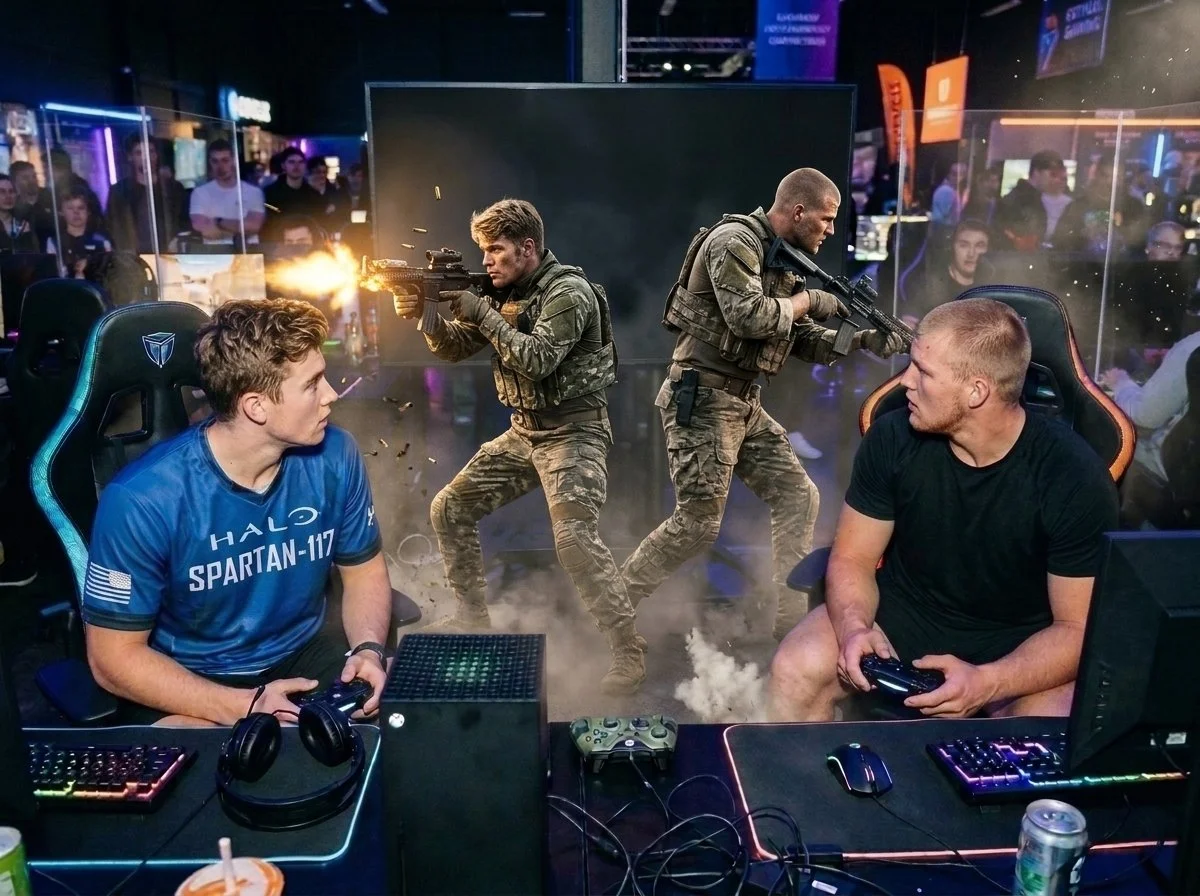
An arena. Neon washing purple and blue across the ceiling like a bruise that never heals. A long black desk, glossy under the lights. Keyboards glowing rainbow from underneath, every key a tiny sunset. In the center, an Xbox Series X stands upright, a matte-black monolith with a green pulse breathing from its crown. Steady. Patient. Like a heartbeat that doesn't belong to anyone in the room.
And three chairs.
High-backed. Ergonomic. Trimmed in light. Blue on the left. Pink and purple in the middle. Orange on the right. Each one humming like a stage built for a single performer.
Look at the first player.
Wavy light-brown hair. A bright blue athletic jersey, sharp and clean, with HALO stretched across the chest in that iconic font, and SPARTAN-117 stamped beneath it in bold white letters. A small American flag patch rides his sleeve. He wears a legend's number like a second skin. A headset rests on the desk in front of him, waiting. His eyes are locked to the right. Focused. Hungry.
Now the second.
Messy blonde hair. A dark green hoodie pulled loose, headphones slung around his neck like he forgot they were there. In his hands, a camo Xbox controller, green and grey, the pattern of a battlefield folded into plastic. A spare one sits on the desk beside the console, same camo, same promise. His mouth is wide open. Shouting. Or screaming. Or maybe just feeling everything at once.
And the third.
Buzz cut. Broad shoulders. A plain black crew-neck t-shirt, tight across the chest, no logo, no slogan, no explanation. He doesn't need one. A black headset clamped over his ears. A black controller in his grip. His face is stone. Silent. Locked in.
Three players. Three uniforms. Three stories stitched into cotton and light.
And behind them, rising out of the smoke, the soldiers.
The bass drops low.
Camouflage fatigues in olive and tan. Tactical vests heavy with pouches. Knee pads. Gloves. Dust curling around their boots like it's being pulled up from the desk itself.
And they have the players' faces.
The wavy hair.
The screaming mouth.
The buzz cut.
Same eyes.
Same jaw.
Same fire.
Let me be clear, right here, right now, while the lights are low and the room is listening. These soldiers are a metaphor. They are Xbox soldier games pulled off the screen and given flesh for one frame, so we can see what immersion really looks like. The rifles are pixels wearing a costume. We respect a conservative, responsible stance on gun ownership, the kind built on discipline and law. But this story does not celebrate gun violence. Not now. Not ever. Not in any form.
What we're talking about is something quieter.
Something colder.
That's the moment.
The one nobody warns you about.
Not the moment you lose. Losing is easy. Losing is a screen that flashes try again and a loading bar that fills itself back up. No. The real moment is when you realize you were never holding the controller at all.
You were the thing in the smoke.
The thing that kneels when someone else kneels. The thing that runs into the noise because someone else pressed forward. The thing that respawns, and respawns, and respawns, so somebody in a glowing chair can feel a little taller.
You were somebody's paradise.
And you didn't even know you'd been installed.
The synth climbs.
A slow build.
It never happens all at once.
It loops in.
First, the outfit.
Somebody hands you the jersey and tells you it fits. A number. A title. A legend's name stitched across your chest. This is who you are now. And you wear it, because the color is bright and the cut is sharp and everyone else is dressed for the show too.
Then, the map.
Somebody draws the boundaries. Here's where you walk. Here's where the walls are. Here's the edge of the world, and if you step past it, you fall. You believe it. You didn't build the map. You just woke up on it.
Then, the objective.
Capture this. Hold that. Win for the team. And the team always sounds like us, but you check the scoreboard and your name is never on the top line.
Then, the crowd.
The crowd is the hook. The crowd is the drop.
Because when you hear them roar behind the glass, you think, they're cheering for me. But they're not cheering for you. They're cheering for the spectacle. They'd scream just as loud if it were another face on that soldier.
You are replaceable in the most beautiful lighting money can buy.
Silence for one beat.
Then the pulse returns, softer.
Sit with that.
Because this was never about games. You know it. I know it. The soldier on the screen is just the shape the feeling takes when we don't have better words.
It's the job that grinds you down to a number and calls it opportunity.
It's the relationship where you only move when someone else's thumb twitches.
It's the feed that feeds on you. The headline that writes your character before you've said a word. The system that hands you a role and punishes you for asking who's holding the pen.
It's every joke you laughed at that was secretly about you. Every time you shrank so someone else could stretch out. Every room where you felt that strange cold pressure of being watched instead of seen.
That's the other side of the paradise.
On one side, someone leans back in a chair trimmed in orange light, sipping something cold from an aluminum can, living out a fantasy where they can't be touched.
On the other side, you.
Respawning.
Respawning.
Respawning.
And here's the cruelest part.
The part the movies never quite nail.
You start to like it.
Not the pain. Nobody likes the pain. But the script. The script is smooth. The script has a rhythm. When you're the character, you don't decide anything. The objective glows on the screen. The walls tell you where to stop. There's a kind of terrible peace in being told what you are.
So you start defending the game.
You start saying, that's just how it works.
You wear the jersey on your days off.
And you look at the guy in the next chair, the one in the green hoodie, the one in the black tee, and you see a rival instead of a mirror. You miss it completely. Same tired eyes. Same white knuckles. Same quiet dread that maybe this loop is all there is.
The game doesn't keep running because the player is strong.
It runs because the pieces forgot they were people.
The beat cuts out.
One flicker of light.
But then something happens.
Maybe not today. Maybe not with strings swelling underneath it. Maybe it's three in the morning and the screen goes black for half a second, and in that dark glass you catch your own reflection.
Not the soldier's face.
Yours.
Tired. Real. Unrendered.
And you think, wait.
Wait.
Who wrote this track?
That question is the crack in the glass.
The second you ask who wrote the story, you've stepped half an inch outside of it. You're not just the character anymore. You're reading the script. And once you can read it, you can see where the writing is lazy. Where the walls are painted cardboard. Where the edge of the world is just a line someone told you not to cross.
So here's how we fight back.
Not with weapons. Never with weapons. We're not trading one fantasy of power for another.
We fight back with names.
The pulse builds again.
Steady. Rising.
First, name the game.
Out loud. No flinch. This is a game, and I never agreed to play. So much of the machine runs on silence. The moment you say it, the neon looks cheaper. The crowd looks smaller. The music sounds canned.
Second, name the player.
Not to hate them. Hate just keeps you on their screen. Name them so you stop mistaking them for gravity. They're not the weather. They're not fate. They're a person in a chair with a little plastic in their hands.
And plastic breaks.
Third, the hard one. Name yourself.
Not the number on the jersey. Not the title on the chest. Not the color of the chair. Your name. The one you had before anyone handed you a costume. Before anyone drew their maps on you.
Say it in the dark if you have to. Say it until it sounds like yours again.
The drop.
Then you do the thing the game was never built for.
You put the controller down.
Not in defeat. In refusal.
You stop respawning on command. You stop running toward the noise. You turn to the guy in the green hoodie, the guy in the black tee, the guy in the blue jersey, and you really look. And you say, you too?
Because that's the secret the arena never wants you to hear.
There are more of us in the smoke than there are of them in the chairs.
Every soldier has a face. Every face belongs to someone. And the moment the pieces start talking to each other, the game stops being a game. It becomes a room full of people who finally noticed the door.
The crowd fades. Only the low hum remains.
So yeah. We've seen it in the movies. Over and over again.
The hero realizes he's been played.
But the movies always end with the hero winning the game.
I don't want to win their game.
I want to walk out of the arena with my own face on.
Neon behind me. Glass behind me. Into a world with no scoreboard, no spectators, no objective but the one I write myself, in my own handwriting, crooked and honest and mine.
They can keep the paradise.
I'm taking back the story.
And this time, nobody else holds the controller.
The green light on the console fades.
Lights out.
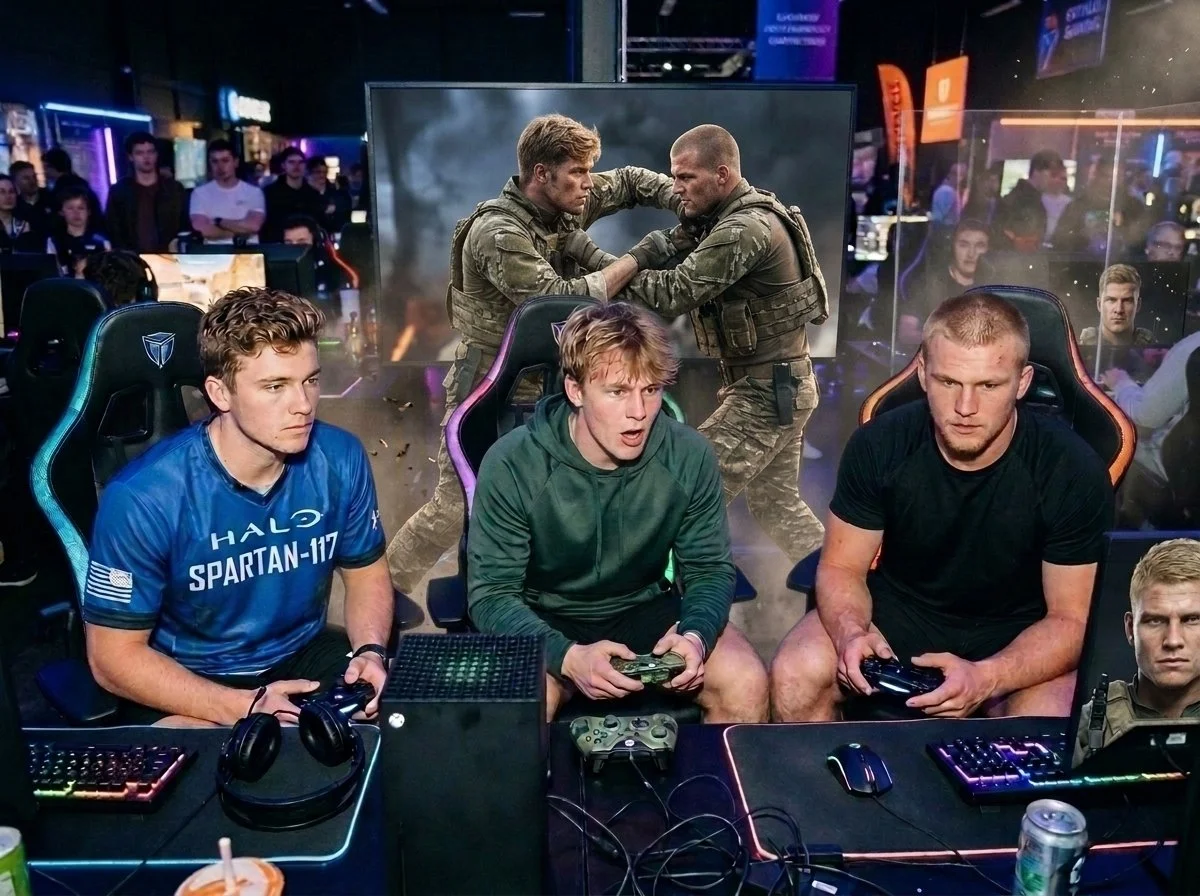
Inspired by storytelling giants Rockstar Games and the legendary creators of Halo, this moment blends grit, rebellion, and raw authenticity. Photos captured by Mitchell Royel in the Fashion District deliver a cinematic edge, rooting the visuals in a world where style meets narrative. Please note, the guns seen in these images are props and do not depict real firearms. The soundtrack to this electric moment is "Humiliation Ritual" by Kyra Machida—a track that drives the pulse of defiance and triumph.
(Rockstar Games is not behind Halo. Halo is a franchise developed by Bungie (originally) and now by 343 Industries, under the ownership of Microsoft. Rockstar Games, on the other hand, is known for creating iconic games like Grand Theft Auto and Red Dead Redemption, focusing on open-world and narrative-driven gameplay experiences. These are two distinct companies with different gaming legacies.)
A single light. A dark stage. The faint hum of a crowd somewhere behind glass.
We've seen it in the movies. Over and over again.
The hero wakes up in a world that looks almost right. The colors are a little too bright. The voices are a little too rehearsed. And somewhere in the second act, the floor drops out, and he looks up, and he sees the hand that's been moving him the whole time.
We always think that's a movie moment.
We always think that happens to somebody else.
But I want you to picture it with me. An arena. Neon bleeding purple and blue across the ceiling like a bruise that never heals. Rows of glowing keyboards, rainbow light pooling under every key. The cold blink of a console standing upright like a tiny black monolith. A crowd pressed behind clear walls, faces soft and blurred, watching. Always watching.
And in the center of it all, two players.
Controllers in their hands. Thumbs ready. Eyes locked.
And on the screen between them, a soldier rises out of the smoke.
He moves when they move. He kneels when they kneel. He runs into the noise because someone pressed forward.
And then you look closer.
And he has your face.
That's the moment. That's the one nobody warns you about.
Not the moment you lose. Losing is easy. Losing is just a screen that says try again. No, the real moment is when you realize you were never holding the controller at all. You were the thing on the screen. The thing in the smoke. The thing that spends its life ducking behind digital walls so someone else can feel a little bigger in their chair.
You were somebody's paradise.
And you didn't even know you'd been installed.
Let me tell you how it happens. Because it never happens all at once.
It starts with a costume. Somebody hands you the gear and tells you it looks good on you. A role. A title. A label stitched across your chest like a number on a jersey. This is who you are now. And you wear it, because it fits, sort of, and because the lights are bright, and because everybody else is wearing something too.
Then it's the map. Somebody draws the boundaries. Here is where you're allowed to walk. Here is where the walls are. Here is the edge of the world, and if you go past it, you fall. And you believe it, because why wouldn't you? You didn't build the map. You just woke up inside it.
Then it's the objective. Capture this. Defend that. Win for the team. And the team always sounds like us, but if you check the scoreboard, your name is never on the top line.
And then, finally, it's the crowd.
The crowd is the part that gets you.
Because the crowd makes it feel like it matters. The crowd makes it feel like a story. You hear them cheering behind the glass and you think, they're cheering for me. But they're not cheering for you. They're cheering for the spectacle. They're cheering for the fall. They'd cheer just as loud if it were someone else's face on that soldier.
You are replaceable in the most beautiful lighting money can buy.
I need you to sit with that for a second.
Because this isn't really about games. You know that. I know that. The soldier on the screen is just the shape the feeling takes when we don't have better words for it.
It's the job that wears you down to a number and calls it opportunity.
It's the relationship where you only ever move when someone else's thumb twitches.
It's the feed that feeds on you. The headline that writes your character before you've spoken a single line. The system that hands you a role in its story and then punishes you for asking who's holding the pen.
It's every time you've laughed at a joke that was about you. Every time you shrank so somebody else could feel tall. Every time you stood in a room and felt the strange, cold pressure of being watched instead of seen.
That's the other side of the paradise.
On one side, someone leans back in a glowing chair, warm and powerful, sipping something cold, playing out a fantasy where they're unstoppable.
On the other side is you.
Respawning.
Respawning.
Respawning.
And here's the cruelest part. The part the movies never quite get right.
You start to like it.
Not the pain. Nobody likes the pain. But the script. The script is comfortable. When you're a character, you don't have to decide anything. The objective is on the screen. The map is drawn for you. The walls tell you where to stop. There's a kind of terrible peace in being told what you are.
And so you start defending the game.
You start telling other people, this is just how it works.
You start wearing the jersey on your days off.
You look at the person next to you, the one in the other chair, and you see a rival instead of a mirror. You don't notice that the two of you have the same tired eyes. The same white knuckles. The same quiet dread that maybe this is all there is.
That's how the game keeps going. Not because the player is strong. Because the pieces have forgotten they're people.
The light flickers.
But something happens.
Maybe not today. Maybe not in a big moment with music swelling underneath it. Maybe it's small. Maybe it's three in the morning and the screen goes dark for half a second, and in that black reflection you catch your own face.
Not the soldier's face.
Yours.
Tired. Real. Unrendered.
And you think, wait.
Wait.
Who wrote this?
That question is the crack in the glass.
Because the moment you ask who wrote the story, you've stepped half an inch outside of it. You're no longer just the character. You're the one reading the script. And once you can read the script, you can see all the places where the writing is lazy. Where the walls are just painted cardboard. Where the edge of the world is just a line someone told you not to cross.
So I'm going to tell you how we fight back.
Not with weapons. Never with weapons. The rifles in this story were always made of pixels, and we're not trading one fantasy of power for another. We're done with fantasies of power.
We fight back with names.
First, we name the game.
Out loud. Without flinching. This is a game, and I did not agree to play it. You'd be amazed how much of the machine runs on silence. On nobody saying the obvious thing. The second you name it, the neon looks a little cheaper. The crowd looks a little smaller. The music sounds a little canned.
Second, we name the player.
Not to hate them. Hate is just another way of staying on their screen. We name them so we stop mistaking them for gravity. They are not the weather. They are not fate. They are a person in a chair with a little bit of plastic in their hands. And plastic breaks.
Third, and this is the hard one, we name ourselves.
Not the number on the jersey. Not the role. Not the title they stitched across your chest. Your name. The one that existed before anyone handed you a costume. The one you had when you were small and the world hadn't drawn its maps on you yet.
Say it in the dark if you have to. Say it until it sounds like yours again.
And then you do the thing the game was never designed for.
You put the controller down.
Not in defeat. In refusal.
You stop respawning on command. You stop running toward noise just because someone pressed forward. You stop treating the person in the next chair like an enemy, and you look at them, really look, and you say, you too?
Because that's the secret the arena never wants you to hear.
There are more of us in the smoke than there are of them in the chairs.
Every soldier on that screen has a face. Every face belongs to someone. And the moment the pieces start talking to each other, the game stops being a game. It becomes a room full of people who finally noticed the door.
The crowd noise fades.
So yes. We've seen it in the movies. Over and over again.
The hero realizes he's been played.
But the movies always end with the hero winning the game.
I don't want to win their game.
I want to walk out of the arena with my own face on.
I want the neon behind me. I want the glass behind me. I want to step into a world with no scoreboard, no spectators, no objective but the one I wrote myself, in my own handwriting, crooked and honest and mine.
They can keep the paradise.
I'm taking back the story.
And this time, nobody else gets to hold the controller.
Lights out.
-Deck
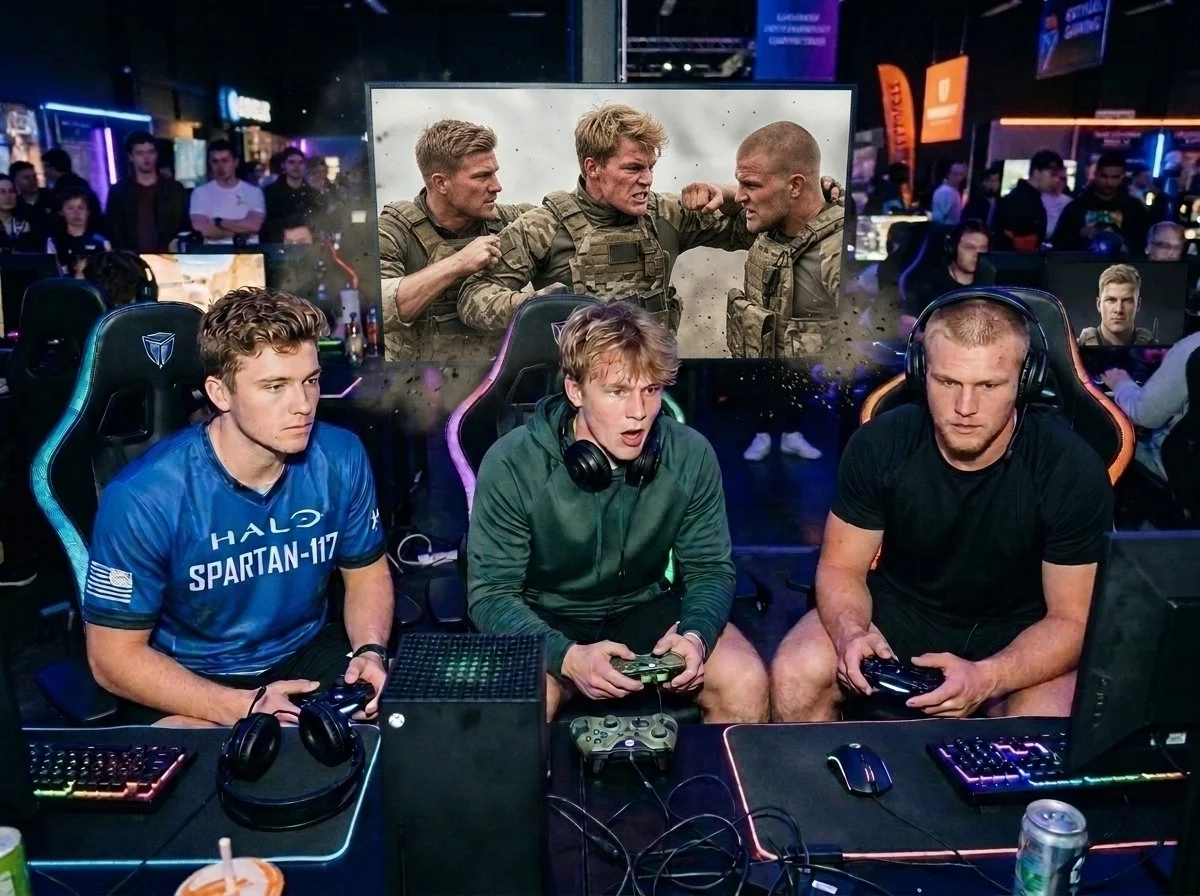
Epilogue: The stage is empty now. The lights are off. The crowd has gone silent. And in the stillness, there’s a weight that lingers—not of defeat, but of something unfinished. Because this isn’t where the story ends; it’s where it begins. The story of what happens when we leave the arena, when we look at the map we’ve been handed and decide to draw something new. It won't be easy. Building something honest never is. It’s slower than the game. It’s quieter than the crowd. The rewards don't flash on the screen. But out here, beyond the walls, the world becomes ours again.
And that’s the point, isn’t it? Not to trade one stage for another. Not to step into someone else’s idea of freedom. The point is to start over, with no script, no joystick, no rules that weren’t made for you. To look another person in the eye—not as a rival, but as a companion—and say, "We don’t have to play." To sit with them in the open air and sketch what the future might look like, where it curves, what colors to fill it with. A place you can call your own, where your name echoes back not as an instruction, but as a reminder of who you’ve always been.
And when we’ve built this future—when we’ve made it crooked, and alive, and stubbornly ours—that's when it will dawn on us. We were never pawns. We were never just pieces. We were the players all along. And now, the game is over.