

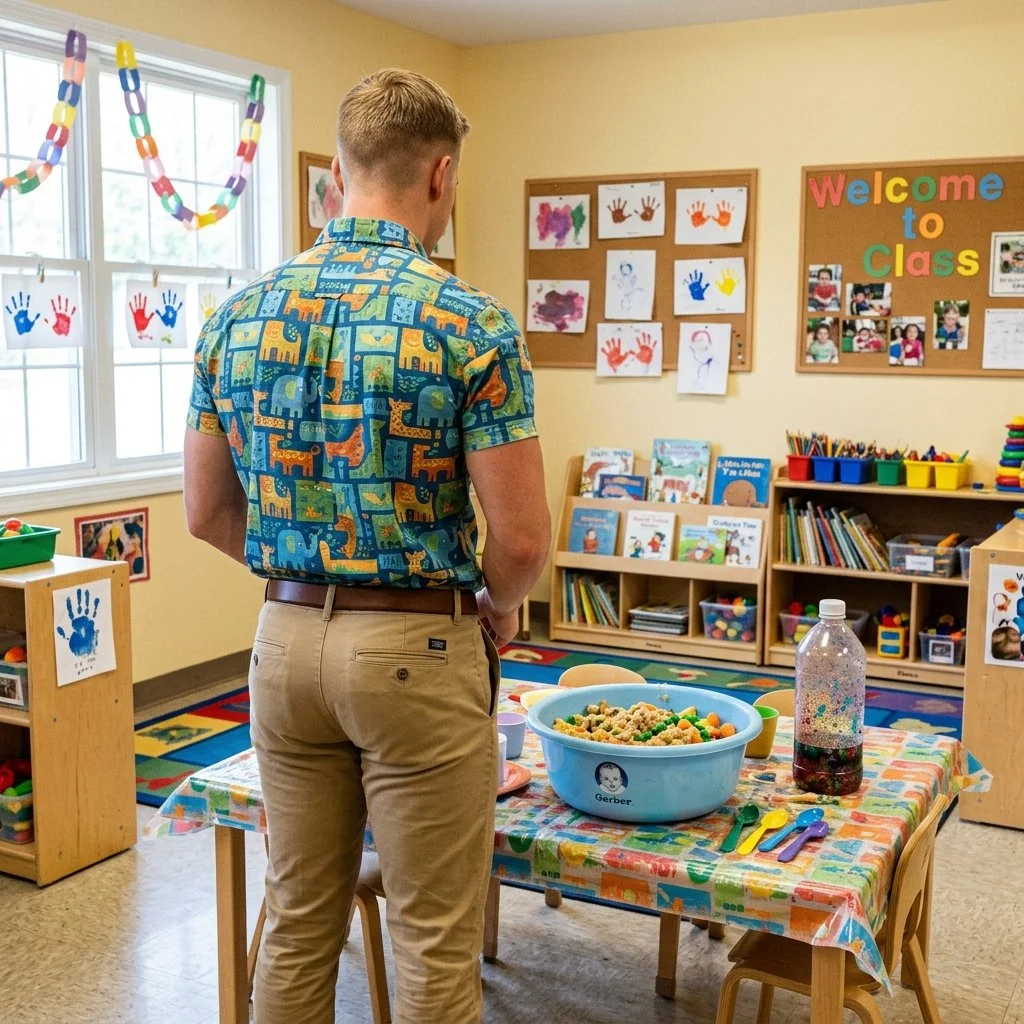
Today is a big day—not just for our class but especially for Mitchell. At 27 years old, he’s starting preschool. That might sound unusual, but Mitchell’s situation is unique; he has special needs that make some parts of life more challenging for him. While in many ways he’s a grown adult, in other ways, you could say he’s just a big baby. And you know what? That’s okay.
Our goal today is to help Mitchell integrate with the rest of the kids. He’s joining a class entirely made up of boys, which is turning out to be an energetic, boisterous group already. He’ll have support from me and our male teacher’s assistant, who’s just as excited as I am about making Mitchell feel welcome.
We’ve already started personalizing his experience, assigning him his very own cubby and working out a daily schedule that makes sense for him. Familiarity and routine will be key here. Sure, there’s going to be a learning curve—for him and the other boys—but that’s all part of the process. Today marks the beginning of a new chapter, and I can’t wait to see how Mitchell’s world expands as he becomes part of our little community.
Essay Prompt:
Topic: Planning Mitchell’s First Day of Preschool – Supporting a 'Big Baby' with Special Needs
Essay Description:
Imagine you are tasked with ensuring that Mitchell, a large child with special needs, has a smooth and welcoming first day at preschool. Your role is to create a detailed plan that addresses his unique requirements while fostering an inclusive environment for him and his peers. Use the prompts below to structure your essay and provide a full plan that highlights accommodations, scheduling considerations, and approaches for building positive relationships.
Word Count Breakdown and Guidelines:
Introduction (200-300 words)
Begin by introducing Mitchell’s specific needs and challenges. Discuss the significance of creating an inclusive and supportive preschool environment for children like him. Explain the importance of preparation and understanding in ensuring Mitchell feels safe, valued, and comfortable.Daily Routine and Schedule (400-500 words)
Create a detailed outline of Mitchell’s first day of preschool. Include elements like arrival and welcome, structured activities, free play, snack time, and any other key moments throughout the day. Discuss how routines will be adapted to meet his physical, developmental, and emotional needs. Consider factors like providing additional breaks, sensory accommodations, or modified activities to ensure he stays engaged and happy.Classroom Adaptations and Accommodations (400-500 words)
Explain how the classroom can be arranged to accommodate Mitchell’s needs. This can include assigned spaces, adaptive seating, visual schedules, fidget tools, or other helpful materials. Discuss how to implement strategies to manage sensory sensitivities, mobility challenges, or other potential obstacles. Suggest ways to support inclusion by educating classmates and fostering peer relationships.Team Collaboration and Communication (300-400 words)
Discuss the roles of teachers, aides, and parents in supporting Mitchell’s transition to preschool. Include ideas for ongoing communication with caregivers and specialists to monitor his progress. Explore how collaboration ensures consistency between school and home environments, which is essential for Mitchell’s success.Concluding Reflections (200 words)
Summarize the importance of creating a personalized and structured plan for Mitchell’s first day. Highlight how this not only benefits him but also his peers, as they learn to appreciate diversity and build meaningful connections.
By following the outlined structure, your essay will provide an insightful and thorough plan for making Mitchell’s first day of preschool a positive and enriching experience.
Reference:
Planning Mitchell’s First Day of Preschool – Supporting a 'Big Baby' with Special Needs
Introduction
For Mitchell, starting preschool at his age iis more than a significant milestone—it’s an opportunity for growth, connection, and discovery. Mitchell’s special needs make facets of daily life more complex, and while he may appear to be a grown adult, in many ways, he is still navigating the world with the innocence and emotional expression of a young child. This unique combination of factors makes it essential to craft an inclusive and supportive preschool environment that caters to his developmental needs. At the heart of this endeavor is preparation, understanding, and genuine care. A structured and tailored approach can ensure Mitchell feels safe, valued, and fully integrated into our preschool community. This plan will explore how to balance his specific needs with a warm, inclusive atmosphere, not only fostering his potential but also teaching his peers the importance of empathy and acceptance.
Daily Routine and Schedule
Mitchell’s first day of preschool will follow a thoughtfully designed schedule that emphasizes structure while allowing flexibility to meet his needs. The day will begin with an enthusiastic greeting from staff, helping him feel welcomed and reducing any potential anxiety. A male teacher’s assistant will accompany Mitchell to his personalized cubby, where he can explore familiar items from home that provide comfort and stability, such as his favorite toy or blanket.
The morning will feature a blend of engaging and manageable structured activities, like circle time with music or simple storytelling. These choices encourage social participation while not being overly demanding. We will incorporate sensory-friendly playtime midmorning, offering sensory tools such as textured blocks and quiet spaces, so Mitchell can explore his surroundings at his pace. When it’s snack time, accommodations like adaptive utensils and a calm seating arrangement will ensure he feels included without overwhelming him.
Free play is a critical moment for Mitchell to begin connecting with peers, facilitated by staff who model social interactions and encourage inclusive games. Regular breaks tailored to his emotional and physical needs will ensure he remains comfortable and happy throughout the day. The key to the schedule will be fostering a consistent routine that helps Mitchell feel secure while gradually encouraging him to explore and engage more fully.
Classroom Adaptations and Accommodations
To create a supportive learning space, the classroom will incorporate several adaptations geared toward Mitchell’s needs. His workspace will feature adaptive seating to promote comfort and stability. Visual schedules and colorful picture cues will guide him through transitions, helping reduce confusion or stress. Tools like fidget toys, sensory mats, and weighted lap pads will be readily available for moments when he may need to self-regulate.
Mitchell’s peers will also play a vital role in supporting his inclusion. Educating the other boys about Mitchell’s needs through stories or simple discussions will encourage empathy and understanding. Teachers can facilitate team-building activities where children work together, promoting camaraderie and a sense of shared purpose. By combining these adaptations, Mitchell can thrive within a space designed to accommodate both his needs and those of his classmates, creating a truly inclusive classroom dynamic.
Team Collaboration and Communication
Ensuring a successful transition for Mitchell requires a collaborative effort between teachers, aides, specialists, and Mitchell’s parents. Regular communication with his caregivers will allow the staff to stay updated on his progress, needs, and preferences. Weekly meetings or progress reports can keep everyone aligned on strategies, such as successful calming techniques or new developmental milestones.
Partnerships with specialists, including therapists or behavioral consultants, will help refine classroom strategies and provide additional tools for addressing specific challenges. Additionally, aligning classroom routines with those at home will create a seamless experience for Mitchell, reinforcing familiarity and consistency. By working together, the team can provide a supportive network that encourages Mitchell’s development while celebrating every step of his progress.
Concluding Reflections
Mitchell’s first day of preschool signifies the start of an exciting and profound chapter, not just for him but for everyone involved in his care. A personalized and structured approach ensures his unique needs are met while helping to foster connections with his peers. This plan not only enhances Mitchell’s development, but also enriches the classroom by teaching other children empathy, patience, and the beauty of diversity. By working together to support Mitchell, our team can create an environment where every child feels valued and empowered to succeed.
Math Word Problems: Packing Mitchell's Diaper Bag
Instructions:
Solve each problem below, carefully showing all your work. Remember to check your answers for accuracy.
Mitchell needs 6 diapers for the morning and 4 diapers for the afternoon. How many diapers does he need altogether?
Mitchell drinks 3 bottles of milk each day. If his caretaker packs 2 extra bottles, how many bottles will be in the diaper bag?
There are 10 wipes in a pack, and Mitchell’s diaper bag has room for 3 packs. How many wipes are packed in total?
If Mitchell needs 2 bibs per meal and there are 3 meals while he is out, how many bibs should be packed?
Mitchell’s caretaker packs 8 toys in his diaper bag, but he only uses 5. How many toys will still be in the bag?
Each diaper costs $0.40, and Mitchell’s caretaker buys 15 diapers. How much will he spend?
Mitchell uses 2 diapers per hour. How many diapers does he need for a 5-hour trip?
Mitchell eats 3 small snacks each day. If his caretaker packs a 7-day supply, how many snacks are packed?
There are 12 compartments in Mitchell’s diaper bag. If 4 compartments are used for clothes and 3 for toys, how many compartments are left?
Mitchell’s caretaker wants to pack enough bottles for 2 days. If Mitchell drinks 5 bottles a day, how many bottles should he pack?
There are 18 bottles of water in a pack. If Mitchell’s caretaker takes 6 bottles out to pack, how many are left in the pack?
Mitchell’s caretaker has a total of $10. If each diaper costs $0.50, how many diapers can he buy?
If Mitchell naps 3 hours daily and needs 2 blankets per nap, how many blankets should be packed for a 2-day trip?
Mitchell’s diaper bag has a weight limit of 20 pounds. If toys weigh 5 pounds, diapers 8 pounds, and snacks 6 pounds, does the total weight exceed the limit?
There are 24 wipes in a pack. If Mitchell needs 7 wipes every time he is changed, how many changes can 1 pack provide?
If Mitchell uses 3 pacifiers a day, and his caretaker wants to pack enough pacifiers for 4 days, how many should he pack?
A container of formula makes 6 bottles. If Mitchell needs 12 bottles, how many containers should be packed?
Mitchell needs 4 sets of clothes per day. If his caretaker packs enough for 5 days, how many sets of clothes are packed?
Each toy weighs 2 pounds. If Mitchell’s caretaker packs 10 toys, what is the total weight of the toys?
Mitchell’s caretaker buys 36 diapers and packs one-third in the diaper bag. How many diapers does he pack?
If Mitchell drinks 4 bottles a day and his diaper bag can fit 10 bottles, how many days will the bottles last?
Mitchell’s caretaker packed 12 snacks, but 5 snacks fell out. How many snacks are left in the bag?
Each diaper takes up 2 inches of space in the bag. How much space is needed for 10 diapers?
If Mitchell uses 5 bibs on Monday and 3 on Tuesday, how many bibs did he use in total?
A bottle of lotion holds enough for 15 uses. If Mitchell uses lotion 3 times a day, how many days will one bottle last?
Mitchell’s caretaker bought 25 bottles of water. If each pack contains 5 bottles, how many packs did he buy?
Mitchell’s diaper bag has 15 compartments. If 10 are already full, how many are still empty?
At a park, Mitchell changes his diaper 6 times and uses 8 wipes per change. How many wipes are used?
There are 9 pacifiers in a pack. If Mitchell loses 4 pacifiers, how many does he have left?
Mitchell’s caretaker packs 5 sweaters and 3 jackets. How many clothing items are packed in total?
Mitchell uses 2 jars of baby food a day. If his caretaker packs 14 jars on Monday, how many days will the jars last?
If a snack pack contains 10 pieces, and Mitchell eats 4 pieces daily, how many days will the snack pack last?
Mitchell drinks 2 bottles every 3 hours. How many bottles will he drink in 12 hours?
Diapers are packed in sets of 6. If Mitchell’s caretaker wants to pack enough for 3 days, and he uses 4 diapers a day, how many sets should he pack?
Mitchell eats 3 fruit pouches each day. How many pouches does he need for a 5-day vacation?
Each bottle takes up 3 inches of room in the diaper bag. If 9 bottles are packed, how much space do they occupy?
There are 20 wipes in a small pack and 60 in a large pack. How many more wipes are in a large pack than a small pack?
If Mitchell’s caretaker buys 48 bottles and divides them equally into 6 bags, how many bottles are in each bag?
Mitchell sleeps 9 hours a night and takes 3 naps of 2 hours each. How many hours does Mitchell sleep in one day?
If a pack of diapers contains 24, and Mitchell uses 18 in 2 days, how many diapers are left in the pack?
Four-Hour Gym Workout Plan
Are you ready to challenge yourself with a highly efficient and detailed four-hour gym workout? Below is a step-by-step breakdown to help you maximize strength, endurance, and flexibility while keeping you engaged throughout the session. Remember to stay hydrated and rest between sets!
Hour 1: Warm-Up and Strength Training
Dynamic Stretching (10 minutes): Focus on full-body movements such as arm circles, leg swings, and walking lunges to prepare your muscles and joints for the workout.
Compound Lifts (30 minutes):
Squats – 4 sets of 8-10 reps
Bench Press – 4 sets of 8-10 reps
Deadlifts – 4 sets of 8-10 reps
Core Activation (20 minutes):
Plank – 3 sets, hold for 1 minute each
Russian Twists – 3 sets of 25 reps (each side)
Hanging Leg Raises – 3 sets of 12-15 reps
Hour 2: High-Intensity Interval Training (HIIT)
Rowing Machine (20 minutes): Alternate between 1 minute of sprinting at maximum effort and 1 minute of steady pace.
Plyometric Circuit (20 minutes):
Box Jumps – 3 sets of 15 reps
Burpees – 3 sets of 20 reps
Jump Lunges – 3 sets of 12 reps (each leg)
Hour 3: Targeted Muscle Work
Upper Body (30 minutes):
Pull-Ups or Lat Pulldowns – 4 sets of 8-12 reps
Overhead Shoulder Press – 4 sets of 8-12 reps
Dumbbell Bicep Curls – 4 sets of 12-15 reps
Tricep Dips – 4 sets of 12-15 reps
Lower Body (30 minutes):
Bulgarian Split Squats – 4 sets of 8-10 reps (each leg)
Romanian Deadlifts – 4 sets of 8-10 reps
Calf Raises – 4 sets of 15-20 reps
Hour 4: Functional Training and Cool Down
Functional Training (40 minutes):
Kettlebell Swings – 4 sets of 20 reps
Medicine Ball Slams – 4 sets of 15 reps
Battle Ropes – 4 rounds of 1 minute each
Farmer’s Carry – 4 sets, 50 meters each
Cool Down and Static Stretching (20 minutes):
Hamstring Stretch – Hold for 30 seconds per side
Hip Flexor Stretch – Hold for 30 seconds per side
Chest Opener Stretch – Hold for 30 seconds
Child’s Pose – Hold for 1 minute to relax and unwind
This detailed four-hour workout plan covers all key aspects of fitness, allowing you to leave the gym feeling accomplished and refreshed!