
Let me set the scene, because this story doesn't work unless you can smell it first.
Reseda. San Fernando Valley. The kind of place that doesn't make it into the postcards but absolutely makes it into your bones. Mitchell grew up in an apartment complex off Sherman Way, one of those sprawling beige stucco fortresses with a courtyard in the middle, a pool nobody was technically allowed to swim in after 9 p.m. but everybody did anyway, and a parking lot that doubled as a basketball court, a bike track, and an open-air theater for every argument the neighbors ever had.
The complex had a heartbeat. You could feel it. Salsa music from the second floor on Saturdays. Somebody's grandmother yelling for somebody's kid in two languages at once. The smell of about nine different dinners drifting through nine different screen doors at six o'clock sharp. Mitchell knew every shortcut, every stairwell, every spot where the wall echoed just right if you wanted to hear yourself sing — and oh, did he want to hear himself sing.
Mornings were a whole production. Mitchell's family piled into one car, and the drive to middle school was its own little universe. His mom up front, controlling the radio with an iron fist. A backpack on every lap. The window down because the AC "used too much gas." And that drive — past the donut shop, past the laundromat, past the church that turned into a different church every few years — that drive was where Mitchell did most of his actual growing up. Backseat philosophy. Sibling negotiations over the last granola bar. The particular comfort of being driven somewhere by people who love you, half-asleep, watching Reseda slide by.
That's the world. Now here's the dinner.
The Gathering
There are nights a family decides, almost without saying it out loud, that the house is going to be full. Not just people-full. Soul-full. Pots-on-every-burner full.
This was one of those nights.
The apartment wasn't big. But somehow it always made room. Folding chairs appeared from closets like magic. The good plates came out — the ones with the little gold rim that only saw daylight on real occasions. And the food. Oh, the food.
The ribs came off the grill glistening, the sauce caramelized into something almost sacred, falling-off-the-bone tender, sweet and smoky and a little sticky in the way that makes you abandon your dignity and just use your hands. The fried chicken had that shattering, golden crust — the kind that crackles when you bite it and gives way to something impossibly juicy underneath. The collard greens had been simmering low and slow for hours, deep and savory and rich, the kind of greens that taste like patience. And the sweet potato pie sat waiting on the counter like the closing number of a perfect show, cinnamon-warm, custard-smooth, the whole apartment wearing its smell like perfume.
Mitchell had invited his best friend from the complex — a white kid from a couple buildings over, the one he traded video games with, the one he'd known since they were both small enough to fit in the same shopping cart. The family welcomed him in the way the family welcomed everybody: a plate already being fixed before he could ask, an instruction to "sit, sit, you're family here."
And the kid ate. Enthusiastically. Joyfully. The way you're supposed to eat food made with that much love. He cleaned his plate like it owed him money. Mitchell remembers feeling proud, honestly — there's a specific glow you get watching someone fall in love with your family's cooking.
Then it happened.
The kid set down his fork, leaned back, and at full volume — at the top of his lungs, like he was calling a play in the fourth quarter — he shouted:
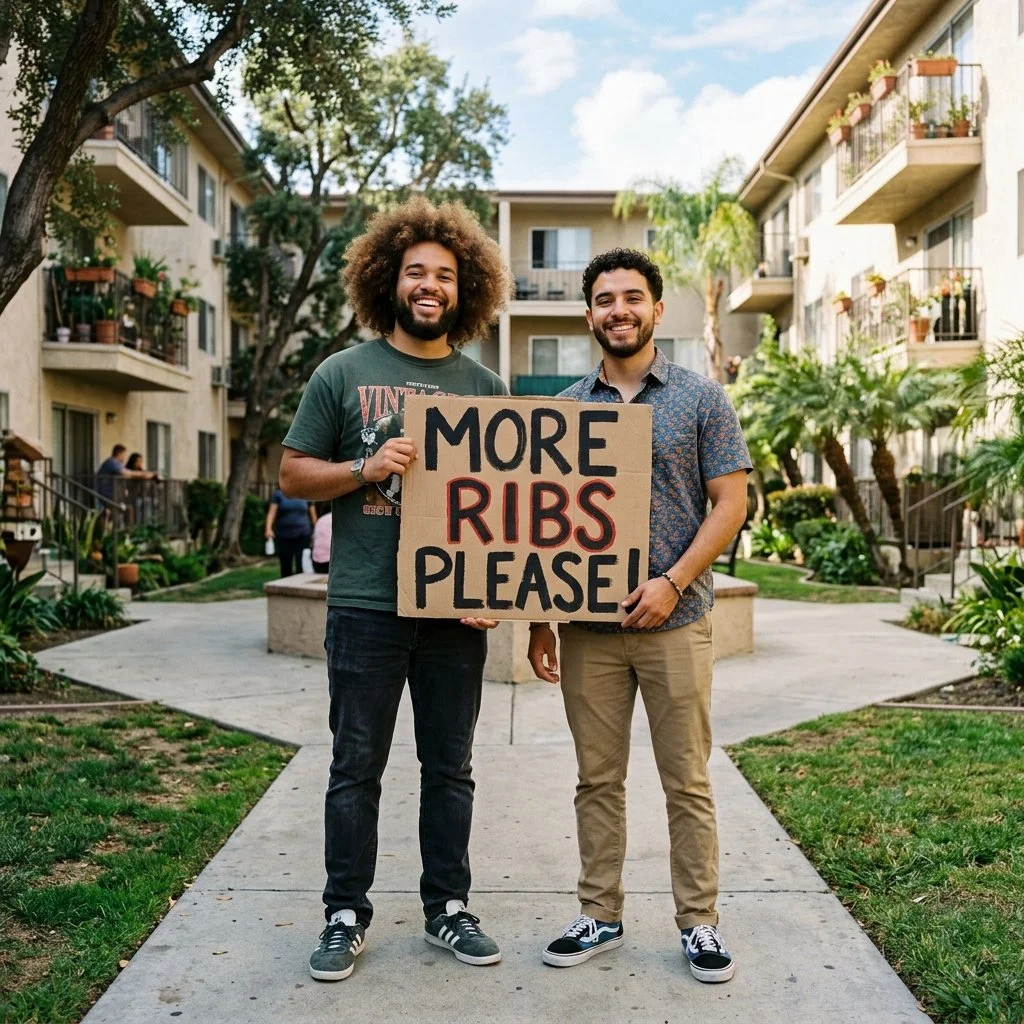
"MORE RIBS PLEASE!"
He wasn't being cruel. He clearly thought this was how it worked — that you announced your hunger to the room and the room delivered. And the room did deliver. Another round of ribs hit his plate. Smiles all around. He finished those too, thanked everybody, and headed home through the courtyard, completely happy, completely unaware that anything had landed wrong.
Because something had landed wrong.
After the door closed, the warmth in the room shifted into something quieter. Mitchell's family pulled him aside — gently, no anger, no big speech. They just said, in so many words, that maybe Mitchell shouldn't invite that friend back. The shouting for seconds, the demanding tone of it — to them, it read as rude. As entitled. And they weren't interested in policing somebody else's kid or having an awkward conversation about manners. They just wanted to sidestep the whole thing. Avoid the friction. Keep the peace.
Mitchell stood there caught in the middle — between a friend who'd done nothing he understood as wrong, and a family whose feelings were real and whose home it was.
And he never forgot it.
So Here's What I Want From You
This is where I hand the mic to you. Because the older I get, the more I think this little dinner-table moment is secretly enormous. It's about manners, sure. But it's also about love, intention, belonging, class, culture, and the quiet rules that govern every home — rules nobody writes down and everybody is somehow expected to know.
I want a real, thoughtful response. Sit with it. Here's your prompt.
The Essay Prompt (approx. 1,500-word reflection)
Core question: Was Mitchell's family right to ask that the friend not come back? Was the friend wrong? Was anyone? Build your answer slowly and honestly, and resist the urge to declare a tidy winner. Use the questions below as a map, not a checklist — wander where it gets interesting.
1. Intent versus impact (≈300 words).
Start here, because it's the heart of it. The friend almost certainly meant no harm — by every sign, he was thrilled. His shout was arguably a compliment delivered with terrible volume control. But impact is its own thing, independent of intent. Mitchell's family felt disrespected, and that feeling is valid too. So: how much should intent excuse impact? When someone's heart is in the right place but their behavior lands badly, who's responsible for the repair — the person who acted, the person who was hurt, or both? Can a moment be "nobody's fault" and still need addressing? Write about a time your own good intentions landed wrong, and what you wished had happened next.
2. Etiquette as a language (≈300 words).
Every household runs on an unspoken grammar. In some homes, asking loudly for seconds is the highest compliment — proof the food was a triumph. In others, you wait to be offered, and asking is a small breach. Neither is correct in any universal sense; they're dialects. Explore the etiquette you grew up with. What were the unwritten rules at your family's table? What would have gotten you a look? Now imagine a guest who'd never been taught your dialect. How much grace would you extend before you decided they were "rude" rather than simply fluent in a different language? Where, honestly, is your line?
3. The host's right to comfort (≈250 words).
Here's the part people skip. It was their home. A family doesn't owe anyone an open door, and choosing peace over confrontation isn't automatically cowardice or cruelty — sometimes it's just self-protection. They didn't badmouth the kid. They didn't scold him. They quietly decided to spend their limited energy elsewhere. Is that fair? Is avoiding a hard conversation a reasonable choice, or does it rob the friend of the chance to learn and do better? Consider both: the dignity of a host setting boundaries, and the cost of a boundary set silently, where the other person never even knows what happened.
4. Class, culture, and the things we read into a moment (≈350 words).
Now the careful part — and I want you genuinely thinking, not performing a take. Two kids from two different backgrounds, sharing a table, and a small collision over manners. Were there cultural or class dynamics underneath it? Maybe. Soul food carries deep cultural history and pride; a meal like that isn't just dinner, it's heritage on a plate, and how a guest receives it can feel weightier than the guest realizes. At the same time, it's worth asking whether we sometimes load a kid's clumsy outburst with more meaning than a kid's clumsy outburst can hold. Hold both possibilities at once without collapsing into either. When is it fair to read culture into a moment, and when are we projecting an entire history onto one twelve-year-old who just really liked the ribs? What's the difference between naming a dynamic and assuming the worst?
5. Mitchell in the middle (≈200 words).
Finally — Mitchell. He didn't get a vote, not really. He loved his friend and he loved his family, and he was asked to quietly let go of one to keep the other comfortable. That's a heavy thing to hand a kid. What would you have done in his place? Pushed back and defended his friend? Honored his family's wishes without argument? Found some third path — maybe coaching the friend privately, maybe keeping the friendship but moving it out of the house? And the bigger question: what does this moment teach Mitchell about belonging, loyalty, and the impossible math of loving people who don't understand each other?
How to write it.
Aim for roughly 1,500 words. Write it like you mean it — first person, specific, honest. Bring in your own table, your own family's unwritten rules, your own moment of being the guest who got it wrong or the host who quietly closed a door. Argue with yourself at least once. The strongest responses won't crown a hero and a villain; they'll sit in the discomfort and find something true in it.
Because here's the thing I keep landing on: this was never really about ribs.
It was about how hard it is to share a table across a difference — and how the warmest rooms in the world can still hold a moment that nobody knows how to fix.
So. Pull up a chair.
More ribs, please — but this time, tell me what you think.
Kids Version:
Sharing at the table can be tricky for everyone, even for little kids like you. Imagine this scenario: Mitchell’s friend came over for dinner and enjoyed the food so much that he excitedly yelled, “More ribs, please!” But here’s the thing—Mitchell’s family wasn’t used to shouting at the table, and it left them feeling a little upset. What do you think? Is it okay to yell for more food at the table? How could Mitchell help his friend better understand his family's rules in a kind and respectful way? Remember, everyone’s household has different rules, and sometimes we might make mistakes. If that happens, how can we show kindness and work together to make things better? Take a moment to think about this and write your response in at least 100 words.