
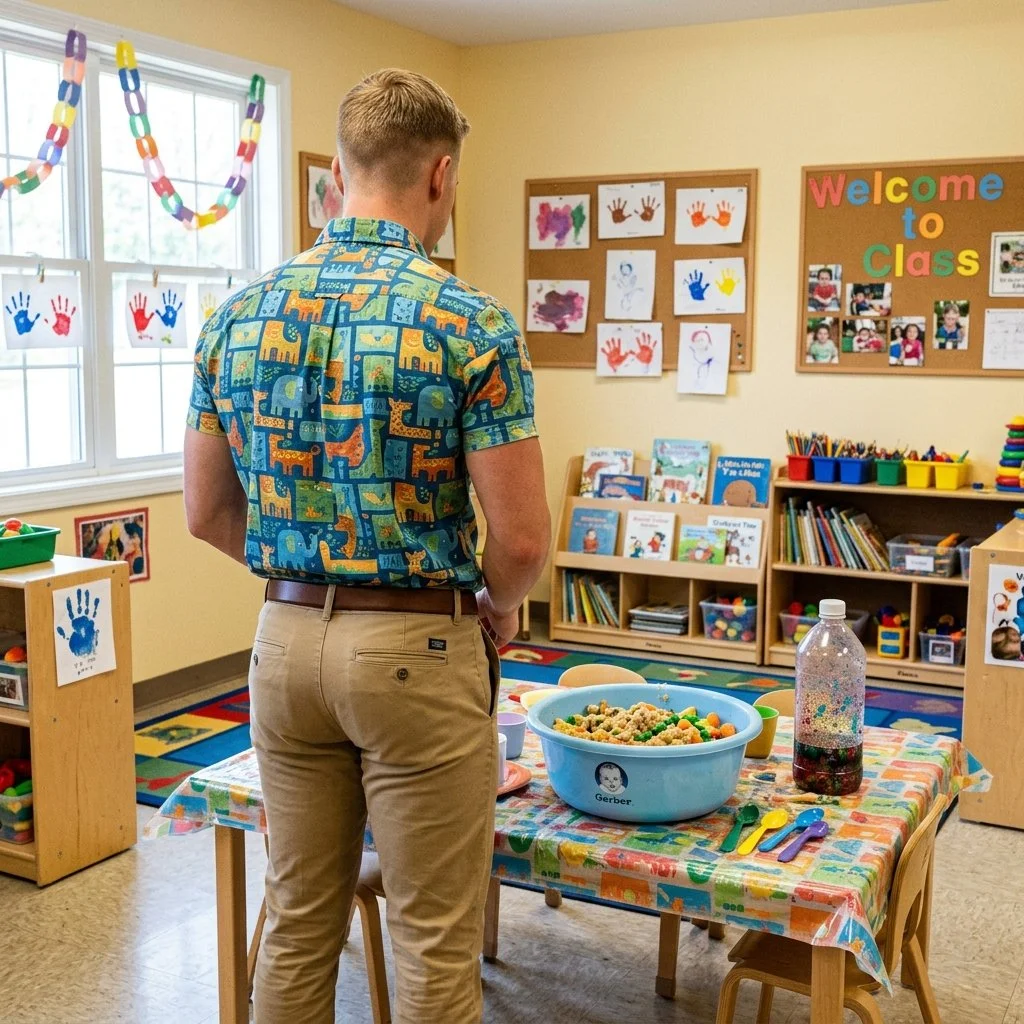
You know, Mitchell’s transition into preschool has been nothing short of an adventure—and honestly, it’s a bit like managing two sides of the same coin. On one hand, he’s navigating the world around him like any other preschooler, finding his rhythm and testing boundaries. On the other hand, he’s still clinging to certain comforts—like his Gerber meals and trusty gas-bottle—that make him, well, uniquely Mitchell. It’s kind of why I say he’s an adult in many ways and a big baby in others.
Right now, we’re playing around with food routines that match his vibes for the week. Some weeks, we’re keeping it simple with no solids—sticking to the familiar, easy stuff that helps ease his digestion and keeps him comfortable. Other weeks, it’s a free-for-all with some fun snacks like Kraft-canned mac and cheese, SpaghettiOs, Twinkies, and other playful bites. You should see how excited he gets for those snacks—it’s pure joy. The gas-bottle is always by his side, though, because, well, it works like a charm when he needs to pass a little gas.
We’re switching it up because, honestly, variety keeps Mitchell happy and helps him adjust. It’s tough to jump straight into big changes, and the range of meals helps him feel in control while adapting to new things in preschool life. At the end of the day, it’s all about balance—between what’s comforting and what’s exciting—so he can stay his curious, bubbly self. Watching Mitchell grow and handle this process his way? It’s a wild ride, but one that’s pretty amazing to be part of.
Essay Prompt
Title: Balancing Nostalgia and Nutrition in Mitchell’s Transitional Diet
Task Description:
This week, we’re introducing a shift in Mitchell’s diet to include a mix of junk foods and snacks alongside his usual Gerber and hourly bottle routine. The aim is to incorporate enjoyable, novel options while maintaining nutritional balance and fostering Mitchell’s comfort during this transition.
Here are the guidelines and word count breakdown for your essay:
Introduction (150 words):
Provide an overview of the dietary change, the inclusion of snack foods or fast-food options, and the overarching rationale for this mix. Highlight how this plan aligns with adaptability and enjoyment during Mitchell’s current preschool life phase.Snack and Fast Food Choices with Rationale (400 words):
Detail the specific fun foods you plan to include in Mitchell’s diet. Explain how these choices balance enjoyment, variety, and nutritional considerations. Examples might include toddler-friendly snacks like goldfish crackers, fruit gummies, or small portions of fast foods like chicken nuggets or soft-serve ice cream. Provide an explanation of portion control and why these foods were selected.Schedule with Justification (300 words):
Describe a weekly food schedule that integrates these snacks and fun foods alongside Mitchell’s usual diet. Explain the thought process behind the timing and frequency of incorporating the fun food options, ensuring meals remain balanced.Behavioral Management (350 words):
Analyze how fun foods could be used as a reward system and the potential consequences of tying these foods to behavior. Address what should happen if behavior issues arise, and examine whether denying fun foods is a productive or counterproductive response.Benefits and Reflection (300 words):
Reflect on the benefits of introducing Mitchell to a variety of foods, the importance of fostering positive food relationships, and the expected outcomes of this diet plan.
Sample Reference Essay
Balancing Nostalgia and Nutrition in Mitchell’s Transitional Diet
Introducing a mix of snacks and junk food into Mitchell’s diet is more than just an indulgence; it’s a step toward fostering variety and adaptability during his formative years. This transitional approach symbolizes how small changes in diet can carry large psychological benefits for a toddler learning to balance the familiar with the new. Our goal is to ensure Mitchell enjoys his mealtimes without compromising nutrition or positive associations with food.
The snacks we’ve selected include toddler-friendly treats like goldfish crackers for their mild flavor and crunch, fruit snacks that add a splash of sweetness with minimal mess, and healthier junk food options like baked potato chips for texture. From the fast-food menu, manageable servings of items like chicken nuggets provide protein paired with bite-sized fun, and an occasional dairy-based treat like a small soft-serve cone introduces moderation with indulgence. These choices aim to strike a balance between his curiosity and dietary needs.
Mitchell’s schedule will feature a weekday plan with two snack slots, one after his mid-morning play and the other post-nap to sustain energy until dinner. Additionally, a modest fast-food treat can appear weekly as a Friday surprise, aiding in reinforcing the week’s schedule. By anchoring these additions not as regular staples but exciting highlights, we’ll maintain an emphasis on his core Gerber diet and bottle intervals.
Fun foods can also double as rewards tied to specific behaviors, like finishing an art activity or patiently following instructions during clean-up. However, we must tread cautiously when ties between food and discipline form, so any behavior issues should focus on reinforcing positive conduct rather than using food as punitive leverage. Alternatives like playtime-based rewards may prove more effective.
Ultimately, this approach is about more than nutrition; it’s about helping Mitchell grow into a confident, flexible eater who enjoys foods without rigidity. Giving him room to experience these new flavors, within a controlled and intentional framework, makes for an exciting chapter in his preschool learning journey.
Word count for the essay should total approximately 1,500 words, with each section carefully developed to meet the task requirements.
Instructions:
Below you will find 40 math word problems that revolve around packing Mitchell's diaper bag and related scenarios. These problems are designed for an 8th-grade level, requiring at least three steps to solve. Be sure to show all your work clearly, including the steps for solving equations, simplifying expressions, and checking results.
Mitchell's diaper bag contains 6 diapers, but he uses 2 diapers every outing. How many outings can Mitchell go on before needing more diapers if no additional diapers are added?
If Mitchell's diaper bag weighs ( 2d + 5 ) pounds, and each diaper weighs ( 1.2 ) pounds, how many diapers, ( d ), are in the bag?
Mitchell's parent adds five bottles of formula that each weigh 0.8 pounds. If the diaper bag starts out weighing 4 pounds, how much does the bag weigh now? Use ( b ) to represent the weight of all bottles combined.
There are 8 compartments in the diaper bag, and each compartment should contain an equal number of wipes. If there are ( 5c ) packets of wipes total, how many packets are in each compartment?
Diapers are stacked 3 in each stack in Mitchell's bag, and there are ( 4x + 2 ) total diapers. How many stacks of diapers are there?
Mitchell's snack pouch contains ( s^2 + 3s - 10 ) snacks. If each outing consumes ( s + 5 ) snacks, how many outings can Mitchell's snacks last?
Mitchell's backpack has two sections labeled ( 3c + 5 ) and ( 4c - 7 ), respectively. Find the total number of items, ( c ), in both sections combined.
Each diaper costs $1.25, and Mitchell's parent buys ( d ) diapers to last a month. If the total cost is ( 15d + 10 ), determine the value of ( d ).
Mitchell's bag weighs ( y - 3 ) pounds after removing 4 packages of wet wipes, each weighing ( y/2 ) pounds. How much did the wet wipes weigh altogether before removal?
The small compartment holds ( 10 ) diapers for emergencies, while the main compartment holds ( x^2 - 2x + 3 ) diapers. Find the total number of diapers.
Mitchell's weight affects the overall weight of the stroller with the bag. If the stroller weighs ( 2x ), the diaper bag weighs ( x + 5 ), and Mitchell weighs ( x/2 + 7 ), what is the total weight?
If Mitchell drinks ( z - 4 ) ounces of milk per feeding and there are ( 5z ) ounces in the bottle, how many feedings are possible?
The diaper bag's main compartment has 3 diapers less than twice the number of bottles it carries. If it has ( x ) bottles, find the number of diapers in the main compartment.
If Mitchell's parent takes ( 2x + 3 ) minutes to pack the bag and ( x - 2 ) minutes to organize it, what is the total time spent?
Each formula box contains 3 bottles. If ( x ) boxes are packed and each bottle weighs 1.5 pounds, what is the total weight of the bottles?
The large wipes container contains ( y^2 - 5y ) wipes after using ( 2y ) wipes from ( y^2 ). Find the remaining wipes.
Mitchell's lunch box weighs ( x/3 + 4 ) if ( x ) equals the weight of the lunch container minus 5 pounds. Solve for the total weight.
The side pocket is designed to hold 1 bottle and 2 packages of snacks. If 3 identical bottles and 5 identical snack packages weigh ( p + 14 ), how much does each weigh individually?
After daily use, ( x ) wipes are used on day 1, ( x + 3 ) wipes on day 2, and ( x + 6 ) wipes on day 3. If ( 3x + 9 ) wipes are consumed, find ( x ).
Mitchell's trainer cups contain ( z + 7 ) ounces of liquid altogether. After he drinks ( 14 ) ounces, how much is left in the cups?
The extra set of clothes in Mitchell's bag is folded into ( y - 2 ) parts, with each part weighing ( 3 ) pounds. If the total weight is ( x + 10 ), solve for ( x ).
If one diaper weighs ( 2t ) ounces and there are ( 6t + 4 ) diapers in the bag, what is the total weight of diapers?
The wipes pouch contains ( 5k - 3 ) layers of wipes. Three layers are used during an outing. How many layers will remain?
Each wet item uses ( b ) wipes for cleaning. By the time a pack of ( 12 \times x ) wipes is finished on outings, how many messes were cleaned?
Mitchell's feed includes solid and liquid portions in a ratio of 2:3. If the solid food weighs ( 6 ) ounces less than the liquid, what is the weight of each?
A small bag includes ( b + 8 ) smaller pouches. If each pouch holds ( 2b ) ounces of snacks and the entire snack contents weigh ( 64 ), find ( b ).
For emergencies, Mitchell must carry double the weight of snacks as diapers. If the total weight of diapers is ( x + 2 ), what is the weight of his snacks?
The stroller accommodates Mitchell's diaper bag holding ( x ) pounds. If 3 smaller sections each hold ( x/3 + 1 ) pounds, solve for the individual weight distribution.
The inner bottle pouch has room for 9.5 liters, divided into compartments of equal size ( x^3 ). Find the capacity of each, expressed as ( x ).
When wipes are bulk-packaged and their cost formula is expressed as ( c/0.75 ), for every dollar budget ( c )... (continue refinably).
### Four-Hour Gym Workout Plan
This comprehensive workout plan is designed to optimize your four-hour fitness session by targeting strength, endurance, flexibility, and cardiovascular health. Each segment includes detailed guidance to ensure you make the most of your time, but adjustments can be made to suit your personal goals and fitness level. Completing the full four-hour session is essential, so pace yourself and stay hydrated throughout.
Warm-Up (20 minutes)
Start with a dynamic warm-up to prepare your body for the workout ahead and reduce the risk of injury. Options include light jogging, or using a rowing machine at a moderate pace. Incorporate dynamic stretches like leg swings, arm circles, and torso twists to improve mobility and activate key muscle groups. Aim to gradually elevate your heart rate and loosen up stiff joints.
Strength Training (1 hour and 30 minutes)
This segment is dedicated to building muscle and improving overall strength. Split your time into 30-minute intervals to focus on different areas of the body:
Upper Body (30 minutes) – Perform exercises like bench presses, pull-ups, push-ups, overhead presses, and barbell rows to target your chest, shoulders, back, and arms.
Lower Body (30 minutes) – Focus on leg-dominant movements such as squats, deadlifts, lunges, leg presses, and calf raises to build power and stability.
Core and Stabilization (30 minutes) – Strengthen your core with exercises such as planks, Russian twists, hanging leg raises, and stability ball rollouts to enhance balance and control.
Use rest periods of 60–90 seconds between sets, and ensure proper form for each exercise to maximize effectiveness and prevent injury.
High-Intensity Interval Training (HIIT) (30 minutes)
Boost your cardiovascular fitness and burn calories with a challenging HIIT session. Alternate between intense activity and recovery periods in intervals. For example:
Perform 30 seconds of burpees, sprinting, or kettlebell swings.
Rest for 15–30 seconds before moving to the next set.
Repeat this cycle for 30 minutes, customizing exercises based on your fitness level. HIIT is highly effective for improving endurance and engaging multiple muscle groups quickly.
Flexibility and Mobility (20 minutes)
Spend this time improving your flexibility and aiding post-workout recovery. Perform static stretches for major muscle groups, such as hamstrings, quads, shoulders, and back. Incorporate mobility-focused exercises like hip openers, cat-cow stretches, or thoracic rotations. Use foam rollers or massage balls to release muscle tightness and promote relaxation. Breathing exercises can also help reduce tension and center your focus after intense activity.
Endurance Training or Active Recovery (1 hour)
Conclude your session with exercises designed to build stamina or provide active recovery. For endurance training, options like running on a treadmill, stair climbing, swimming, or rowing are excellent choices that maintain a steady-state aerobic effort. If you prefer active recovery, engage in lighter activities such as walking, yoga, stretching, or bodyweight exercises to cool down muscles while staying active.
By following this structured plan or tailoring it to your personal preferences, you can effectively utilize the full four hours to improve your fitness. Pay attention to your hydration and energy levels, and listen to your body to avoid overexertion. Push yourself while prioritizing proper recovery and enjoyment of the process!