
(Reflection, Math, Fitness, Mindfulness) Importance of Standardized Testing Before Teaching
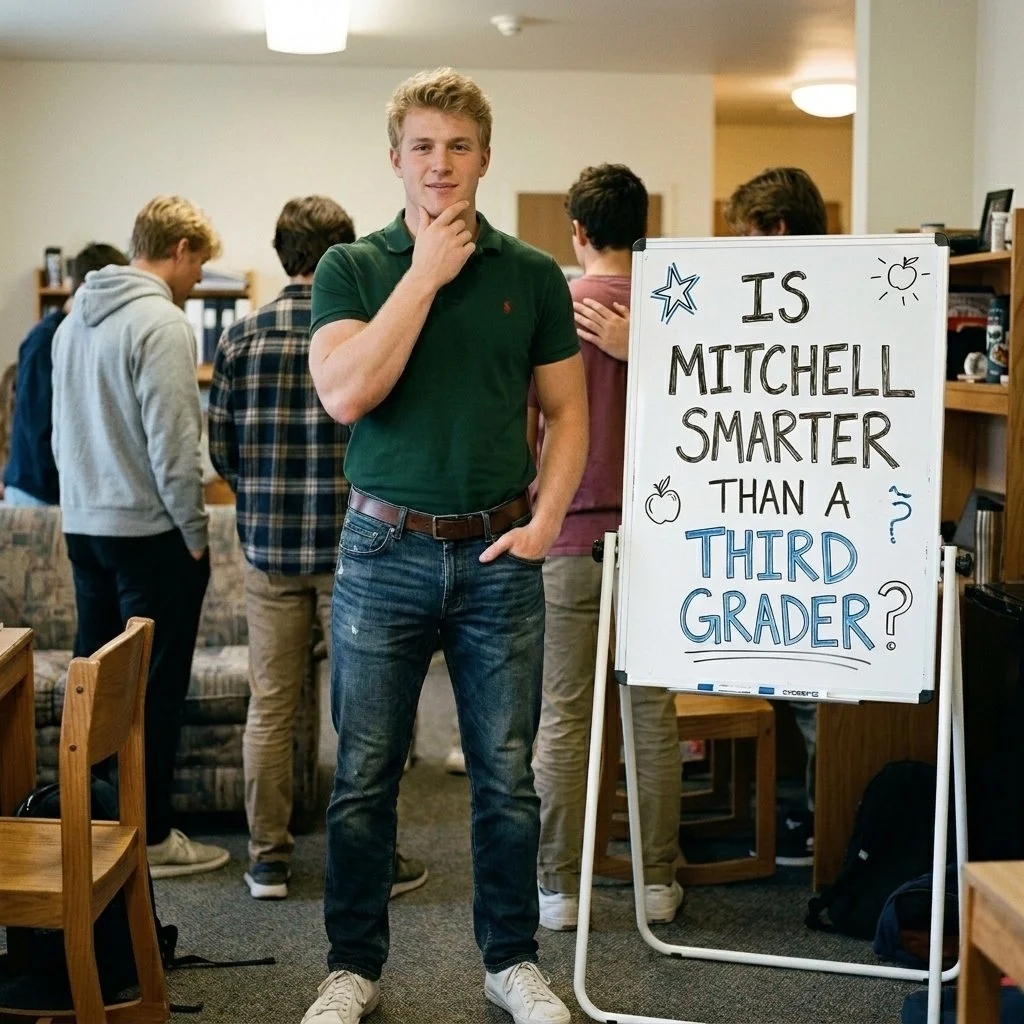
Hey, so sit tight while I explain why Mitchell’s situation is so unique and, honestly, incredible in its own way. Mitchell isn't your average adult — let's just make that clear right off the bat. Sure, he sports Pampers, chugs down milk like a pro, and has a soft spot for Gerber meals, but he's definitely over 18 years old. Yep, you heard that right. Despite those little quirks, his age is legally adult-level, and I'd argue that makes his learning development process all the more fascinating and significant.
Now, here’s the thing — we gotta talk about testing Mitchell at a third-grade level before jumping straight into any preschool work. At first, it might seem weird or even redundant, right? I mean, he’s already doing preschool-level stuff with another caretaker, so why backtrack? But here's the deal. Learning is like building a tower. You can't stack blocks haphazardly and hope it won't tumble down. Testing Mitchell for a third-grade understanding doesn't deny where he's currently at — it just gives us a way to validate where his base level stands. After all, in the world of education, it's "third grade, then second, and then first," not the other way around.
I know it might feel irritating, even frustrating, to go about testing someone like Mitchell who’s already got some learning patterns established. But this isn’t just about repeating work for no reason. It’s about being methodical, thorough, and intentional to ensure that the future efforts aimed at teaching Mitchell will actually stick. To ignore this approach would be underestimating the importance of identifying the right foundation. Testing acts as a map, and without it, how can we find the best route to support his growth? This is why caretakers — the awesome ones Mitchell has now or will connect with in the future — are so important. They aren't just babysitters or aides; they're the architects of his learning path.
And honestly, it’s kind of special to think about. The people working with Mitchell begin by recognizing the dude he already is! They’re helping to create educational systems for him that actually fit — like figuring out his intellectual shoesize. Whether it means revisiting core foundational skills from grades one through three or continuing to reinforce preschool-level learning, his caretakers are building a layered and sustainable framework.
Essay Prompt - 1500 Words
Prompt: Why is it essential to test Mitchell at a third-grade level before administering preschool work, and how does this help establish his educational base level? Break down the answer into manageable sections with logical transitions and reasoning.
Word Count Breakdown
Introduction (200 Words):
Briefly introduce Mitchell’s situation, highlighting his unique learning needs.
Explain why testing his current level is not about labeling but assisting accurate intervention.
The Role of Educational Testing (350 Words):
Elaborate on how testing works as a tool for understanding learning capabilities.
The significance of third-grade testing as a reference point — why this grade matters in particular.
Creating a Structured Learning Path (400 Words):
Discuss how knowing one’s base level informs tailored curriculum decisions.
Show how caretakers and educators bridge gaps from one skill set to the next.
The Importance of Sequential Learning (300 Words):
Focus on the “third grade, second grade, first grade” progression and how it mirrors real-world scaffolded learning.
Why skipping steps or overlooking current progress might cause setbacks later on.
Supporting Mitchell Holistically (200 Words):
Highlight how attention, care, and persistence can foster both mental and emotional growth.
Acknowledge the collaboration between caretakers, professionals, and Mitchell himself.
Closing Remarks (50 Words):
Reaffirm why these steps are key to Mitchell’s success and future independence.
Reference Essay (Short Example)
Mitchell’s educational progress isn’t about rushing or assuming — it’s about understanding. Testing at a third-grade level provides a baseline for caregivers and educators to identify his current capabilities while addressing any potential gaps. With this foundational knowledge, Mitchell’s caregivers can bridge the distance between his present and future achievements. The beauty of education lies in its adaptability, and Mitchell’s path is a testament to reshaping learning for individualized needs.
Word Problems on Packing Mitchell's Diaper Bag for Preschool
Solve each word problem below by showing all your work. Remember, these problems are designed to explore practical scenarios while practicing 9th-grade math concepts related to proportions, measurements, and basic arithmetic.
Packing Wipes
Mitchell’s caregivers estimate that he uses 12 wipes each day at preschool. If wipes come in packs of 60, how many days will one pack last? Show your work.Diaper Supply
Mitchell uses an average of 4 diapers per school day. If his bag currently contains 16 diapers, how many days will this supply cover before caregivers need to restock? Show your work.Diaper Bag Compartments
Mitchell’s diaper bag has 3 large compartments, and each can hold up to 5 items. If there are 11 items already packed, how many more items can the bag hold? Show your work.Packing Snacks
Snacks are packed in small containers, and each container holds 1.5 ounces. Mitchell’s caregivers want to pack 9 ounces of snacks in total. How many containers will they need to pack? Show your work.Extra Clothes Packing
Mitchell’s caregivers packed 2 extra sets of clothes, each set weighing 1.8 pounds. If the diaper bag can hold a maximum weight of 10 pounds, how much weight remains for other items? Show your work.Milk Bottles
Mitchell drinks 8 ounces of milk per bottle. If his caregivers pack 3 bottles of milk for the school day, how many total ounces of milk are they bringing? Show your work.Blanket Folding
Mitchell’s blanket occupies 3 cubic feet when folded. If the entire space in the diaper bag is 15 cubic feet, how much space is left for other items after packing the blanket? Show your work.Labeling Supplies
Mitchell’s caregivers need to label 18 items for school. If it takes 3 minutes to label each item, how long will it take to label all the items? Show your work.Restocking Schedule
If Mitchell’s caregivers pack enough supplies for 5 school days in each restocking session and there are 20 school days in a month, how many times will they need to restock in one month? Show your work.Snack Sharing
Mitchell’s caregivers pack 24 crackers for him to share equally over 3 snack breaks during the day. How many crackers does he get for each snack break? Show your work.Diaper Disposal Bags
One diaper disposal bag is used for every two diapers. If caregivers pack 6 disposal bags, how many diapers does this prepare for? Show your work.Packing Efficiency
Mitchell’s caregivers packed 24 items into his diaper bag in 8 minutes. What is the average number of items packed per minute? Show your work.Water Bottles
Each water bottle holds 17 ounces, and caregivers want to send Mitchell with enough water for two refills. How much water in total should they bring? Show your work.Temperature-Appropriate Clothing
Mitchell’s caregivers pack 3 layers of clothing. If each layer protects against 10 degrees of cold weather and the outside temperature is 40°F, what is the lowest temperature Mitchell will be comfortable in when wearing all layers? Show your work.Bag Dividers
Mitchell’s caregivers divide his items into 4 sections inside his bag. If there are 36 total items to pack, how many items go into each section, assuming an even distribution? Show your work.Snack Packing
Mitchell’s caregivers pack 5 snacks per school day. If Mitchell goes to school 4 days this week, how many snacks in total do they need to pack? Show your work.Diaper Stock
Mitchell’s caregivers pack 6 diapers per day. If they are preparing for 3 school days, how many diapers should they pack? Show your work.Wipes Calculation
Each pack of wipes contains 50 sheets. If Mitchell uses 10 sheets a day, how many packs will the caregivers need to pack for him to last 7 days? Show your work.Juice Boxes
Mitchell drinks 2 juice boxes every school day. If there are 5 school days in a week, how many juice boxes should the caregivers prepare for the week? Show your work.Extra Clothing Sets
Mitchell’s caregivers pack 2 sets of backup clothing for emergencies. If they need to prepare for 3 weeks, how many total sets of backup clothing should they pack? Show your work.Diaper Bag Weight
Each item in the bag weighs 0.5 pounds, and the caregivers pack 20 items. What is the total weight of the diaper bag before carrying it? Show your work.Toys for Comfort
Mitchell’s caregivers pack 3 small toys per day for school. If Mitchell attends school for 10 days, how many small toys will they pack in total? Show your work.Shoe Covers
Caregivers prepare 4 pairs of shoe covers for muddy weather. If Mitchell uses 1 pair daily, how many days will the shoe covers last? Show your work.Books to Pack
Mitchell wants to carry 2 books every day. If his caregivers are preparing for 8 days of school, how many books will they need to pack? Show your work.Labeling Supplies
Mitchell’s caregivers label 15 items in his diaper bag. If each label takes 2 minutes to attach, how long will it take to label all the items? Show your work.Packing Masks
Each school day, Mitchell uses 2 masks. If they are packing for 6 days, how many masks do the caregivers need to prepare? Show your work.Blanket for Nap Time
Mitchell’s caregivers pack 1 blanket per day for nap time. If one blanket weighs 2 pounds, how much would 5 blankets weigh in total? Show your work.Sunscreen Bottles
Each sunscreen bottle can last 15 uses. If caregivers apply sunscreen twice daily, how many bottles will be finished in 10 days? Show your work.Pocket Money
Mitchell gets $2 in pocket money daily for school snacks. If his caregivers plan this for a 14-day school period, how much money in total do they need to set aside? Show your work.Hand Sanitizer Usage
Mitchell uses 4 pumps of hand sanitizer daily, and each bottle contains 200 pumps. How many days will a single bottle last before it’s empty? Show your work.
240-Minute Gym Workout Plan
This comprehensive weight-based gym workout is designed to build strength, endurance, and stamina. The session concludes with an intense marathon cardio burst on the treadmill to push your limits. Follow the minute-by-minute breakdown below:
Warm-Up (Minutes 1–15)
Minutes 1–5: Dynamic stretches (arm circles, leg swings, torso twists).
Minutes 6–10: Light jogging (or brisk walking) on the treadmill to elevate heart rate.
Minutes 11–15: Bodyweight exercises:
10 air squats
10 push-ups
10 lunges (5 per leg)
Strength Training (Minutes 16–120)
Lower Body (Minutes 16–45)
Minutes 16–25: Barbell back squats – 4 sets of 8-10 reps (rest 60 seconds between sets).
Minutes 26–35: Romanian deadlifts – 3 sets of 10-12 reps (rest 60 seconds between sets).
Minutes 36–45: Weighted step-ups – 3 sets of 10 reps per leg (rest 30 seconds between sets).
Upper Body (Minutes 46–90)
Minutes 46–55: Bench press – 4 sets of 8-10 reps (rest 60 seconds between sets).
Minutes 56–65: Bent-over rows – 3 sets of 10-12 reps (rest 60 seconds between sets).
Minutes 66–75: Overhead barbell press – 3 sets of 10 reps (rest 30 seconds between sets).
Minutes 76–85: Pull-ups (assisted if necessary) – 3 sets of 8-12 reps (rest 60 seconds between sets).
Minutes 86–90: Dumbbell lateral raises – 2 sets of 15 reps (rest 30 seconds between sets).
Core (Minutes 91–120)
Minutes 91–100: Plank holds (3 x 1-minute holds with 30 seconds rest in between).
Minutes 101–110: Russian twists with weight – 3 sets of 20 reps (10 per side).
Minutes 111–120: Hanging leg raises – 3 sets of 12-15 reps.
Active Recovery (Minutes 121–135)
Minutes 121–130: Foam rolling and static stretches (focus on quads, hamstrings, shoulders, and back).
Minutes 131–135: Gentle walking and deep breathing exercises to prepare for the cardio burst.
Marathon Cardio Burst (Minutes 136–240)
Minutes 136–140: Warm-up walk on the treadmill at a 2–3 mph pace.
Minutes 141–170: Start running at a moderate pace (5–6 mph), maintaining steady breathing.
Minutes 171–200: Gradually increase speed every 5 minutes by 0.5 mph, pushing yourself steadily.
Minutes 201–230: Run at your maximum sustainable pace (7–9 mph). Focus on maintaining form.
Minutes 231–240: Cool down with a slow jog or brisk walk, letting your heart rate return to normal.
This workout is designed to challenge every major muscle group while building cardiovascular endurance, making it suitable for both intermediate and advanced gym-goers. Remember to hydrate throughout the session and listen to your body.
Mindfulness Exercise: Connection Through Prayer
Practicing mindfulness can involve connecting with a higher power to find purpose, clarity, and strength. Begin by finding a quiet space where you feel comfortable. Sit or lie down, close your eyes, and take a few deep breaths, allowing your body to relax. Reflect on a higher power or sense of something greater than yourself—whether it’s within your faith, the universe, or a personal sense of spirituality.
Spend the next 5–10 minutes in silent prayer or contemplation. Focus on expressing gratitude for the positive aspects of your life, seeking guidance through challenges, or simply being present in the moment. If your mind wanders, gently bring your attention back to the intention of your prayer. This practice is not about perfection but about opening yourself to a sense of connection and trust.
Journaling Prompt:
After completing the mindfulness exercise, take 5 minutes to answer the following in your journal:
What does connecting with a higher power mean to you?
How did this exercise influence your mood or mindset today?
What aspects of your life are you most grateful for?
Journaling Prompt:
During group mindfulness, reflect on the collective energy and shared experience of prayer. Take 5 minutes to answer the following in your journal:
How did praying as part of a group impact your sense of connection with others?
What feelings or insights arose from sharing this spiritual practice in a community setting?
How can collective prayer deepen your understanding of gratitude and compassion?