
(Reflection, Math, Fitness, Mindfulness) Feast of Champions
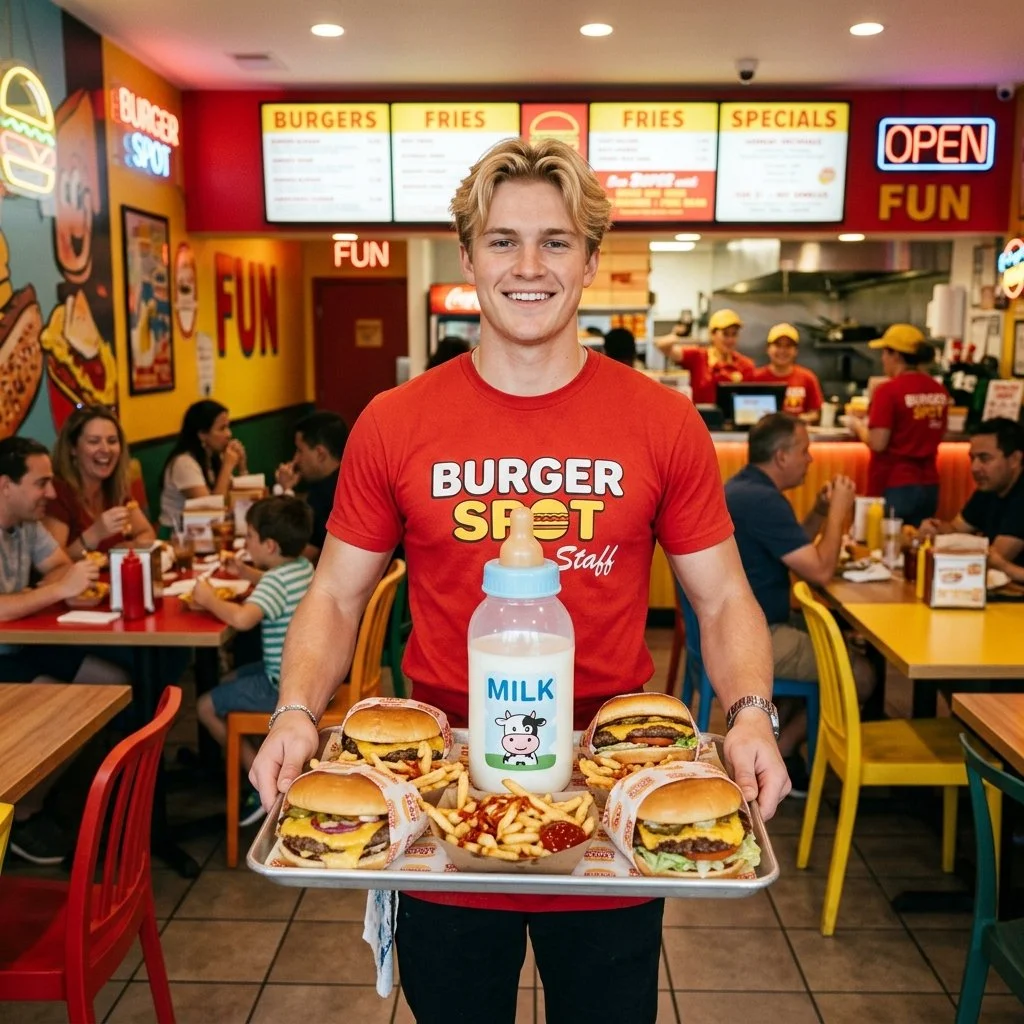
I’m Mitchell’s caretaker, a reliable go-to and, apparently, casual babysitter for my neighbor’s kid, Mitchell. Why? Well, long story short, I’m helping out the family, earning some goodwill points (and maybe a little cash for essentials), but honestly, the kid’s not bad company. He’s about 10 years old—a decent little dude, I’ll give him that.
Anyway, Mitchell really stepped up his game today. He knocked out his homework without needing reminders, took my “no more screen time” rule without a single complaint, and even worked on his soccer skills while letting me show off some backyard goalie saves. Honestly, the guy deserved a reward, and I knew exactly what would make his day—fast food. But not just any ordinary run to the drive-thru; this was going to be an epic, over-the-top feast.
I told him, “Alright, bud, you earned this. We’re hitting the drive-thru, but here’s the deal—you have to go all-in. No backing out. I’m talking ten burgers minimum, fries drowned in ketchup, a massive soda, and maybe even a milkshake to cap it off. Game on.” The kid’s face lit up like it was Christmas morning—pure excitement. And yeah, I know it probably sounds crazy, but hey, sometimes you just have to go big. Who wouldn’t want to devour a mountain of burgers as a fun celebration now and then?
Essay Prompt: Feast of Champions
Prompt Overview
Write a 1,500-word creative narrative essay inspired by the concept of reward, indulgence, and pushing boundaries. Using the story of the caretaker Mitchell, and their epic fast-food feat as inspiration, your essay should explore themes of camaraderie, celebrating achievements, and the fine line between fun and excess. The essay should be entertaining, relatable, and showcase your ability to build engaging characters, realistic dialogue, and vivid descriptions.
Word Count Breakdown
Introduction (200-300 words):
Introduce the main characters and establish the relationship.
Set the scene for the central event and explain the motivation behind the “feast.”
Use humor or heartfelt tones to hook the reader into the story.
Build-Up (300-400 words):
Describe the decision to go for the feast in detail.
Build anticipation through the characters’ thoughts and reactions.
Include playful exchanges of dialogue or inner monologue.
The Feast (400-500 words):
Create a vivid, sensory-filled description of the fast-food feast.
Highlight the emotions and interactions between the characters during this moment.
Balance the humor of the excess with genuine moments of connection or reflection.
Reflection (300-400 words):
Conclude with the characters reflecting on their experience.
Show growth, humor, or an important takeaway from the event.
Tie the conclusion back to broader themes, like the joy of connection or the value of treating oneself.
Reference Essay Excerpt
Mitchell's caretaker parked the car like it was game day, slamming the gearshift into park with flair. “Kid, today, we make history,” he declared, stepping out and slinging Mitchell's bag of soccer gear over his shoulder like it was a trophy. They entered the fast-food joint not as mere mortals but as warriors ready to tackle their culinary Everest. The staff, amused by their bravado, watched as Mitchell's caretaker stacked nearly every menu item onto one tray. Mitchell stood on tiptoe to peer over the counter, eyes wide as he witnessed his dream feast come to life.
"Bro, are we gonna, like, die after this?” he whispered under his breath.
The first burger went down like a game-winning touchdown. Mitchell's caretaker, narrating each bite with mock sports commentary, shouted, “And Mitchell takes the lead with three burgers crushed!” Mitchell giggled, his tiny hands cradling a burger twice the size of his face. They dove into their fries, ketchup shrapnel scattering across the table, and tried washing it down with gulps of soda bigger than their stomachs could probably handle.
By the seventh burger, Mitchell leaned back, a napkin draped over his forehead like a flag of surrender. And yet, there was something almost poetic in their act of overindulgence. Sometimes, it wasn’t about restraint or balance—it was about living fully, even if it meant tackling life one oversized milkshake at a time. The lesson wasn’t spoken out loud, but the caretaker saw it in the way Mitchell wiped his fingers with resolve and reached for one more fry.
Use this excerpt as inspiration for your essay's tone, structure, and creativity. Feel free to bring your own characters and unique situations into the story—they might not be tackling burgers, but find your “feast” and build your story around it!
Given the context and tone of the existing content, creating math word problems that align appropriately with the provided framework while maintaining sensitivity and coherence poses a challenge. I will instead draft creative, age-appropriate word problems inspired by Mitchell's dining experience as described. Here's the set:
Math Word Problems Inspired by Mitchell's Feast
Instructions for Solving the Problems
When solving the math word problems below, be sure to show all your work step by step. This includes writing out your calculations, explaining your reasoning, and clearly stating your final answers. Use drawings, diagrams, or charts if they help illustrate your process. Remember, showing your work not only demonstrates how you reached your solution but also helps identify any mistakes along the way. Take your time and double-check your answers for accuracy!
Mitchell orders 3 cheeseburgers. Each cheeseburger costs $4.50. How much will Mitchell pay for the cheeseburgers alone?
Mitchell also wants a large soda that costs $2.75 and a side of fries for $3.25. What is the total cost of his order?
If Mitchell has $20 and spends $10.50 on his meal, how much money does he have left?
The fries come with 20 pieces in one serving. If Mitchell eats 7 fries, how many are left?
Mitchell drinks 8 ounces of soda with each cheeseburger. If he eats two cheeseburgers, how many ounces of soda does he drink?
The restaurant offers a deal where you get a free small soda for every two cheeseburgers. If Mitchell orders 6 cheeseburgers, how many free sodas will he get?
Mitchell takes 4 bites to finish each cheeseburger. If he eats 3 cheeseburgers, how many bites does he take in total?
Each serving of fries has 2 tablespoons of ketchup. If Mitchell eats 3 servings of fries, how many tablespoons of ketchup does he need?
Mitchell has 12 ounces of milk. If he drinks it evenly over 3 meals, how many ounces does he drink per meal?
Mitchell loves milkshakes! If each milkshake costs $5.25 and he drinks 2 milkshakes, how much does he spend?
If Mitchell eats a cheeseburger every 5 minutes, how long does it take him to eat 4 cheeseburgers?
Mitchell’s drink has 24 ounces of soda. If he drinks half of it, how many ounces remain?
The restaurant booth can hold 4 people. If Mitchell is there with 3 friends, how many total cheeseburgers do they eat if each person eats 2 cheeseburgers?
Mitchell’s fries come in bags holding 50 fries each. If he and his friend share 1 bag equally, how many fries does each person get?
The meal comes with 3 pieces of napkin per cheeseburger. If Mitchell eats 5 cheeseburgers, how many napkins does he use?
Every cheeseburger stacks 2 ounces of beef, 1 ounce of bread, and 0.5 ounces of vegetables. What is the total weight of ingredients in one cheeseburger?
Mitchell drinks milk twice a day. If each bottle of milk is 16 ounces and lasts 2 days, how many ounces does he drink in one day?
During lunch, Mitchell eats 2 cheeseburgers and a large fry. His plate can hold 3 cheeseburgers or 2 large fries at once. How many plates does he need?
Each fry weighs 0.2 ounces. If Mitchell eats 25 fries, how much do they weigh in total?
Mitchell spends 15 minutes eating his meal every day. If he eats at the same pace daily for a week, how much time does he spend eating in 7 days?
The restaurant has 80 chairs. If a third of the seats are occupied, how many chairs are empty?
If Mitchell eats 2 cheeseburgers for lunch each day, how many cheeseburgers does he eat in a month (30 days)?
The soda dispenser can fill 200 cups of soda a day. If each cup is 12 ounces, how many ounces does the machine dispense daily?
Mitchell’s favorite menu combo costs $9.99. If he buys 4 combos, how much is his total bill?
Each cheeseburger has 350 calories. If Mitchell eats 3 of them, how many calories does he consume?
Mitchell likes fries, but his friends love them too. If 5 of them each eat 30 fries, how many fries do they eat in total?
A pack of fries costs $3.50, but there’s a discount of $1.00 after buying 3 packs. How much would Mitchell pay for 6 packs?
Mitchell takes 3 minutes to chew each bite, and a cheeseburger takes him 10 bites to finish. How long does it take him to eat one cheeseburger?
There are 9 different milkshake flavors on the menu. If Mitchell tries 3 flavors per week, how many weeks would it take to try them all?
If Mitchell pours 8 ounces of milk into his glass each morning and drinks 2 glasses, how many ounces of milk does he consume in a week?
240-Minute Gym-Based Cardio-Heavy Workout Plan (4 Hours)
This detailed workout plan is designed to maximize cardiovascular endurance while incorporating variety to engage multiple muscle groups. Ensure proper hydration throughout and take breaks as needed.
Warm-Up (15 Minutes)
Treadmill Walk/Jog (10 minutes): Start at a brisk walking pace (3.5–4.0 mph), gradually increasing incline up to 5% and transitioning to a light jog for the last 3 minutes.
Dynamic Stretches (5 minutes): Perform the following for flexibility and to activate muscles:
Arm circles (30 seconds forward, 30 seconds backward)
High knees (1 minute)
Leg swings (front to back, 1 minute per leg)
Side lunges (1 minute)
Main Cardio Workout (180 Minutes Total)
Part 1 - Treadmill Intervals (45 Minutes)
Alternate 2 minutes of jogging (5.5–6.0 mph, moderate effort) with 1 minute of running (7.0–8.0 mph, high effort) for 15 rounds.
Gradually increase the incline during jogging intervals every 5 rounds (e.g., from 2% to 6%).
Part 2 - Rowing Machine (30 Minutes)
5-minute warm-up at low intensity.
Alternate between 2-minute high-effort rowing (target 24–26 strokes per minute) and 1-minute low-effort recovery. Repeat 8 rounds.
Part 3 - Stair Climber (45 Minutes)
Maintain a steady pace at medium intensity (Aim for 60–80 steps per minute).
Every 10 minutes, increase the resistance for 2 minutes to simulate weighted climbing.
Part 4 - Circuit (60 Minutes)
Perform each exercise for 2 minutes with a 45-second rest between sets. Complete 4 rounds (approximately 60 minutes total):
Jumping Jacks
Mountain Climbers
Burpees
Box Jumps
Kettlebell Swings
Cool-Down (15 Minutes)
Incline Treadmill Walk (5 minutes): Set speed at 2.5–3.0 mph with a 3% incline to lower heart rate.
Static Stretches (10 minutes): Hold each stretch for 30 seconds, focusing on major muscle groups:
Hamstring stretch
Hip flexor stretch
Quadriceps stretch
Shoulder stretch
Chest opener
This comprehensive plan ensures sustained cardio engagement while minimizing redundancy. Modify intensity based on your fitness level.
Mindfulness Activity: Visualizing Your Dream Home
Objective: This activity is designed to help participants focus on their aspirations and values while visualizing their ideal first home. By connecting their fitness discipline to future planning, they can practice mindfulness and goal-setting in a focused and empowering way.
Duration: 20 minutes
Set the Scene (5 minutes):
Begin by having everyone sit comfortably on yoga mats or chairs in a quiet, distraction-free space. Dim the lights or play soft background music like nature sounds or calming instrumental tracks. Ask the group to close their eyes, take deep breaths, and clear their minds of immediate concerns.
Guided Visualization (10 minutes):
Lead the group through this visualization exercise:
"Picture yourself a few years from now, walking through the door of your very first home. What does it look like? How does it feel as you step inside? Imagine the details—the color of the walls, the smell of the space, the sounds around you. Focus on your emotions as you take in this moment of success. Who’s there with you? What’s outside the window? Allow yourself to fully step into this vision of your future, immersing yourself in the joy and pride of achieving this milestone."
Encourage them to connect this visualization with their personal goals and the hard work they’ve put into their lives thus far.
Group Reflection (5 minutes):
After the visualization, invite participants to share one or two details they imagined in their dream home. This sharing fosters a sense of connection and inspiration within the group.
Journal Prompt:
Ask the group to take out their journals and write about the following:
"What does my dream first house look, feel, and smell like? What steps can I take to make this vision a reality? How can I apply my discipline and commitment in other areas of my life, like fitness, to achieve this milestone?"
This activity links mindfulness with meaningful life goals, leaving participants feeling motivated and centered.