
Act Your Age Mitchell: Raise the Standard: Wake-Up Call for Mitchell's Counselors - Student Essay
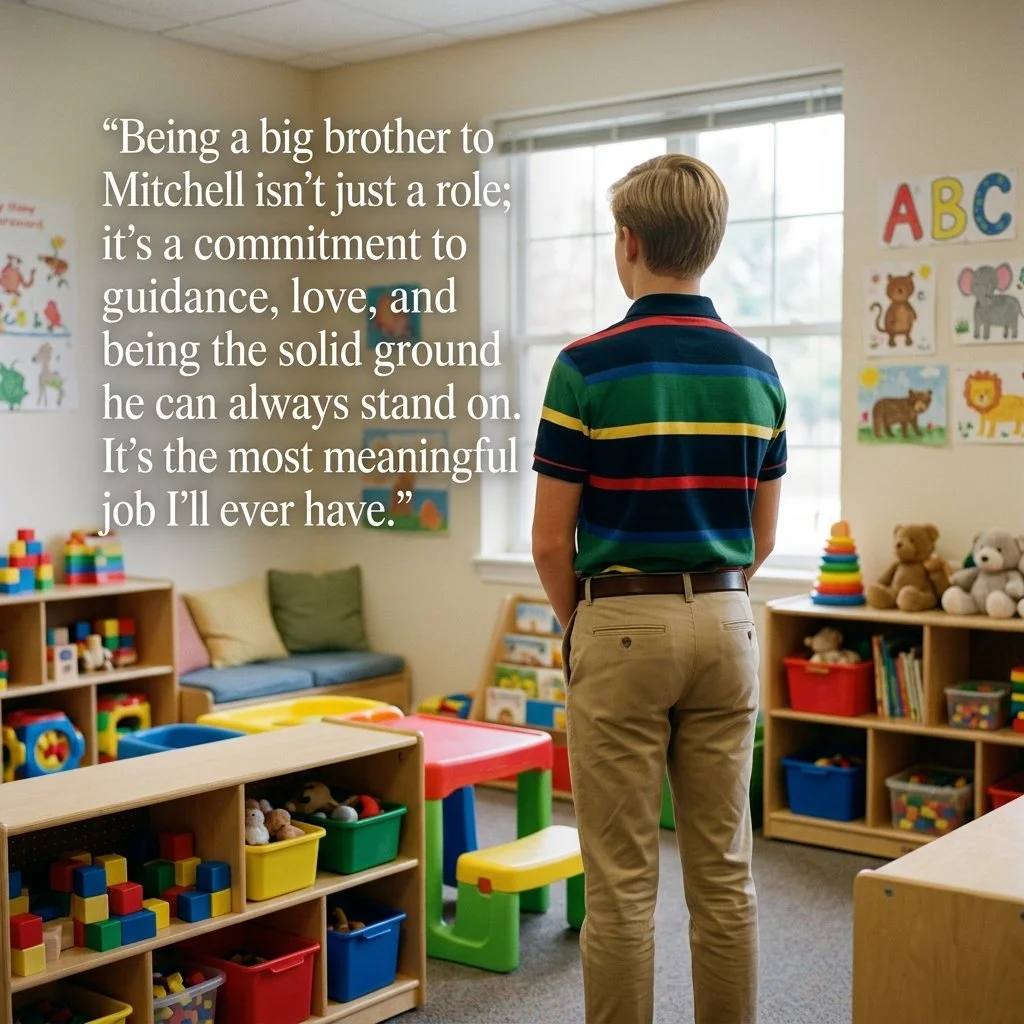
Everybody stand up. No, seriously. Get out of your chairs. Shake out your hands. Bounce on your toes a little.
Good. Now breathe in. Hold it. And let it out.
You feel that? That's energy. That's the stuff you're going to need for the next few minutes, because I'm not here to make you comfortable. I'm here to make you better.
My name doesn't matter. My age does, a little. I'm thirteen. I know what you're thinking. "What does an thirteen-year-old know about leadership? About responsibility? About counseling?"
Here's what I know. I know what it feels like to be a little kid who needs someone to be the rock. I was a little kid like five minutes ago. I remember. And I've been watching. I've been watching the people around Mitchell, and I have something to say.
Mitchell is two. He's a toddler. He's got sticky hands, a laugh like a car alarm, and the attention span of a goldfish on a sugar high. He's amazing. He's also completely, one hundred percent depending on the people around him to show him how the world works.
And right now? The people around him are dropping the ball.
Let me be clear about something. The counselors around Mitchell are not bad guys. They're fun. They're friendly. They give high fives. They let him have the extra cracker. They let him climb the bookshelf "just this once." They let him skip cleanup because he looked so cute when he said "no."
And everybody thinks that's kindness.
It's not.
It's avoidance wearing a smiley face.
Here's the thing nobody tells you: being nice and being good are not the same. Being nice is easy. Being nice is free. Anybody can be nice. A golden retriever is nice. But a golden retriever is not going to teach Mitchell that when you hit somebody, there's a consequence. A golden retriever is not going to teach him that bedtime is bedtime. A golden retriever is not going to show him what it looks like to keep a promise.
That's your job.
And I'm going to tell you something that might sting a little. The reason it stings is because you already know it's true.
Here's where it gets interesting. These counselors? They've got it. They've got leadership. I've seen it.
I've seen one of them get a whole room of kids to sit down in under ten seconds when he wanted to start a game. I've seen another one calm down a meltdown just by kneeling down and talking low and slow. I've seen them take charge when a field trip went sideways and somebody lost a shoe in a pond.
That's leadership. That's real. That's the raw material.
So don't tell me you can't be consistent. Don't tell me you can't set a boundary. You already do it when it's convenient for you. When it's your game, your schedule, your plan, you're a general. You're a captain. You're running the ship.
But the moment Mitchell pushes back? The moment he cries or flops on the floor or gives you those big wet eyes? You fold. You cave. You hand over the wheel to a two-year-old.
Think about that. You are handing the wheel of the ship to someone who still tries to eat crayons.
Here's my rule, and I want you to remember it: The more potential you have, the less excuse you have.
If you couldn't lead, I'd cut you some slack. But you can. I've watched you do it. So when you don't, that's not an accident. That's a choice.
And choices? Choices come with accountability.
Now, some of you just tensed up. I saw it. Your shoulders went up to your ears when I said "accountability." Like it's a punishment word. Like it means you're in trouble.
Relax. Breathe. Drop those shoulders.
Accountability isn't punishment. Accountability is ownership. It means you look in the mirror and say, "That's mine. I did that. I can fix that."
It means somebody's going to check in. Somebody's going to ask, "Hey, what's the plan for Mitchell this week? What boundaries are you holding? What's working? What's not?" And you're going to have an answer. A real one. Not "uh, he seemed happy."
Happy is great. But happy isn't the whole goal. A kid eating ice cream for dinner every night is happy. Until he's not.
Accountability is the bridge between who you are and who you could be. And you, my friends, are standing on the wrong side of the bridge.
So here's what's going to happen. You will be held accountable. Not because somebody's out to get you. Because Mitchell deserves it. Because the standard has to go up. And because, deep down, you want somebody to believe you're capable of more.
I believe it. That's why I'm up here yelling.
Let me clear something up before anybody runs off and starts acting like a drill sergeant.
Strict does not mean scary. Strict does not mean yelling. Strict does not mean taking away every toy and making a toddler sit in a corner for an hour.
Strict means consistent.
It means when you say "two more minutes," it's two more minutes. Not ten. Not "okay, fine, whatever."
It means when you say "we don't throw blocks," and he throws a block, the block goes away. Calmly. Every single time.
It means snack time is snack time and nap time is nap time and the rules on Monday are the same as the rules on Friday.
You know why that matters? Because toddlers are tiny scientists. Every day, Mitchell is running experiments. What happens if I scream? What happens if I run? What happens if I say no? And every time you give in, you're teaching him the experiment worked. You're teaching him the rules are fake.
But when you're consistent? You're giving him something incredible. You're giving him a world that makes sense. You're giving him walls he can lean on. And a kid who feels safe is a kid who can grow.
Structure isn't a cage. It's a launchpad.
Okay. I want you to do something for me. I want you to ask yourself three questions. Out loud if you want. Nobody's judging. Well, I am a little, but in a loving way.
Question one: What am I tolerating?
Because whatever you tolerate, you teach. If you tolerate Mitchell hitting, you're teaching hitting. If you tolerate yourself being late, being lazy, being "eh, good enough," you're teaching that too. Kids don't learn from what you say. They learn from what you allow.
Question two: Who am I becoming?
Every day you lead or don't lead, you're building yourself. You're either building a guy who steps up when it's hard, or a guy who slides out the side door. There is no standing still. You're climbing or you're slipping.
Question three: What would the best version of me do right now?
Not the tired version. Not the "I just want him to stop crying" version. The best version. The one with the clear voice and the steady hands. That guy already exists inside you. I've seen him on the field trip. I've seen him running the game. Go get him. Bring him to work.
Why a Kid Is Saying This
You might still be wondering why I'm the one up here. Why not some grown-up with a clipboard and a fancy title?
Because sometimes it takes somebody small to see something big.
I'm close enough to being Mitchell's age that I remember what it felt like when the grown-ups around me didn't have a plan. I remember how scary it was when nobody seemed in charge. I remember testing every limit, not because I wanted to break things, but because I wanted to find out if anyone would catch me.
The best counselor I ever had? He was tough. He didn't let me get away with anything. And I thought he was the greatest person on the planet. Because I knew where I stood. I knew he cared enough to say no.
That's the kind of guy Mitchell needs. That's the kind of guy you can be. Starting today. Starting right now.
The Decision
Here's the truth. Your life changes in a single moment. The moment you decide.
Not the moment you think about it. Not the moment you plan to do it. The moment you decide, with your whole chest, that the old way is done.
So decide. Decide that "just this once" is over. Decide that you're going to be the steady one. Decide that your leadership isn't just for games and field trips. It's for the hard moments, the messy moments, the moments when a two-year-old is lying on the floor screaming because his sock feels weird.
Those are the moments that make leaders. Not the easy ones.
Mitchell is watching you. He's learning from you right now, today, whether you mean to teach him or not. In twenty years, he's going to be a grown man, and some piece of who he is will trace back to the people who stood around him when he was small.
What piece are you going to be?
So let me leave you with one question. Don't answer it fast. Sit with it. Let it bug you a little on the drive home.
If the little kid in front of you could see exactly who you'll become by the choices you make today, would he be proud to follow you?