
Jungle Gym Special: Shepherds home Daycare - What’s Next For Mitchell?
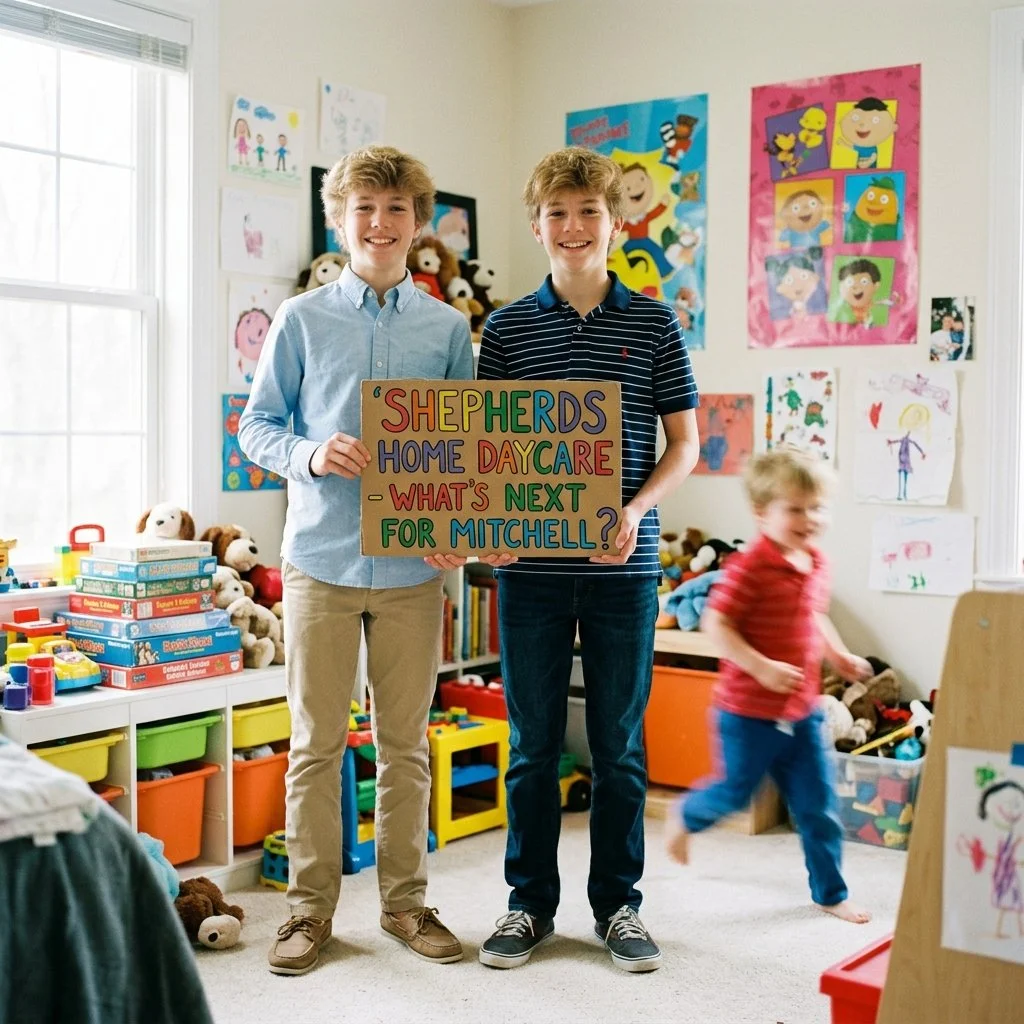
A photo captured earlier this morning in the Hollywood Hills by Mitchell Royel exemplifies the creativity and initiative we strive to encourage. The Hollywood Hills School District invites boys aged 7-14 to participate in this project. While older participants are welcome, we emphasize the importance of fostering collaboration and allowing younger boys the opportunity to contribute their perspectives and explore their creative ideas.
John held up his end of the cardboard sign and tried not to laugh. His arms were a little tired, but he wasn't about to say so.
"Hold it steady, would you," he said to his brother. "The paint's still a bit tacky in the corner."
Luke grinned and shifted his grip on the other side. "It's steady. You're the one wobbling." He nodded down at the big hand-painted letters they'd spent the whole morning making. Orange, red, blue, green, and purple — every color from the bottom of the marker bin. SHEPHERDS HOME DAYCARE – WHAT'S NEXT FOR MITCHELL?
The playroom around them was alive in that warm, ordinary way that good rooms are. Sunlight poured through the big window on the far wall, sliced into soft stripes by the white blinds. Along the low shelves sat rows of plastic bins — yellow, green, orange — spilling over with toy cars and blocks and the odd rubber dinosaur. A tower of board games leaned in one corner, threatening to topple. On top of the shelf, a pile of stuffed dogs kept watch over the whole scene. The walls were papered floor to ceiling with children's drawings: crayon houses, wobbly suns, families of stick people holding hands. A pink poster of cartoon faces smiled down from the back wall.
"Look at this place," John said, glancing around. "It's a beautiful kind of mess."
"It's Mitchell's whole world," Luke said. "Or it was."
Right on cue, a blur shot past them — a barefoot toddler in a red-striped shirt and blue pants, running full tilt from one side of the room to the other, laughing at nothing and everything. That was Mitchell. Three years old and made entirely of energy. He didn't stop to look at the sign. He didn't know yet that it was about him.
The brothers watched him go.
"He's fast," John said.
"He's got somewhere to be," Luke laughed. "He just doesn't know where."
That, really, was the whole point of the sign. Mitchell was moving on. He was leaving Shepherds Home Daycare and stepping into something new — a proper home preschool, gentler than a big school with long hallways and loud bells, but still a real change. New days. New routines. A new caretaker to build his mornings and afternoons with care.
"You know what people assume about a kid like Mitchell?" Luke said, leaning against the shelf. "He lives up in the Hollywood Hills. Big house, pool, the whole postcard. They think a kid like that must be different somehow. Softer. Fancier. Living some sort of magazine life."
John shook his head. "But he's not. Look at him." Across the room, Mitchell had dropped to the floor and was gravely stacking three blocks, then knocking them down with pure delight. "He cries when he's tired. He melts down when he's hungry. He loves that raggedy stuffed dog more than anything money could buy. He needs a nap or the whole afternoon falls apart."
"Same as any kid anywhere," Luke agreed.
"Exactly the same. The hills and the sunshine don't change a thing about what a little boy actually needs. Underneath all of it, he's just a small person who wants to feel safe, and full, and loved. Same needs. Same feelings. Same chaos." He nodded at Mitchell, now sprinting again. "Same joy."
They stood in the warm light for a moment, two brothers holding a sign, watching a barefoot boy tear happy circles around a room full of toys.
"So," John said slowly. His eyes got that spark they always did before a good idea. "What is next for Mitchell? Somebody has to plan his days. Somebody has to build the whole thing — snacks, naps, playtime, all of it."
Luke looked at his brother. "You're thinking a project."
"A proper one. A real schedule for his home preschool. Three days to design it. Something a caretaker could actually pick up and use."
"Something we'd be proud to hand over," Luke said.
And so, standing there beneath a wall of crayon suns, with the little fridge of snacks humming somewhere behind them and Mitchell laughing across the room, the two brothers set the sign down and got to work. Here is exactly what they came up with — a project for young planners everywhere.
The Assignment: Design Mitchell's Home Preschool Schedule
Who this is for: Boys and kids ages 7–13
Time to complete: 3 days
Total word count goal: About 1,500 words
Your mission is to design a full daily schedule for Mitchell's home preschool. This is a real, useful plan. A caretaker could actually read your work and use it to guide Mitchell's whole day. That means your ideas need to be kind, smart, and easy to follow.
Think about what a little kid needs. Food when he's hungry. Rest when he's tired. Play so he can learn. Time to laugh. Time to calm down. And here's the big secret: it doesn't matter one bit that Mitchell lives up in the Hollywood Hills. He needs the same things every toddler everywhere needs. Your job is to fit all of that into one gentle, well-planned day.
Day 1: Research and Big Ideas
Spend your first day thinking and learning. Don't write the final schedule yet. Just gather your ideas.
Ask yourself these questions and write short answers:
What does a 3-year-old need in a day?
How long can a little kid focus before they need a break?
Why are snacks and naps so important?
What activities help toddlers learn and grow?
Talk to a grown-up if you can. Watch how a young child spends their morning. Notice how quickly their mood changes when they're hungry or sleepy — like Mitchell, sprinting one minute and melting down the next. These small clues will make your plan much stronger.
Write about 300 words for Day 1.
Day 2: Build the Schedule
Now it's time to build the actual day. Create a timeline from morning drop-off to afternoon pick-up. Break the day into blocks of time. For each block, write what happens and why.
Here is an example to guide you:
8:00 AM — Welcome and Free Play. A soft start helps Mitchell feel safe. He can grab a toy car or a stuffed dog and settle in.
9:00 AM — Morning Snack. Fuel for a busy little body.
9:30 AM — Learning Time. Colors, shapes, numbers, or a story.
10:30 AM — Outside Play. Fresh air and room to run — his favorite thing.
12:00 PM — Lunch.
1:00 PM — Nap Time. Quiet and calm for a good rest.
3:00 PM — Craft or Music. Maybe a new drawing for the wall.
4:00 PM — Wind Down. Books and gentle play before the day ends.
Make it your own. Add your own activities. Explain each choice in a sentence or two. Remember, the caretaker running Mitchell's day needs to understand your thinking.
Write about 700 words for Day 2.
Day 3: Review and Add Special Touches
On your last day, read over your plan. Fix anything that feels off. Then add three special touches that make Mitchell's day extra warm:
A comfort idea for when Mitchell feels sad or misses home.
A fun tradition, like a "song of the day" or a special goodbye handshake.
A safety note the caretaker should always remember.
Finish by writing a short paragraph explaining why your schedule is good for Mitchell. What makes it balanced? What makes it kind?
Write about 500 words for Day 3.
Section Word Count Breakdown
Section
Word Count
Day 1: Research and Big Ideas
300 words
Day 2: Build the Schedule
700 words
Day 3: Review and Special Touches
500 words
Total
1,500 words
How Your Project Will Be Judged
Care and kindness: Does your plan feel warm and safe for a little kid?
Balance: Did you mix play, rest, food, and learning?
Clear thinking: Can a caretaker read and follow your plan easily?
Effort: Did you take all three days to do your best work?
Reference Essay:
Why a Good Schedule Matters
A daily schedule might sound like a boring list of times. But for a young child, a schedule is a kind of comfort. It's a promise. When Mitchell knows that snack comes after playtime, and that nap follows lunch, the world starts to feel safe and steady. He doesn't have to wonder what happens next. He can simply be a happy little kid.
Young children thrive on routine because their brains are working hard all day long. Everything is new to them. A good schedule breaks the day into small, friendly pieces. It gives them time to focus, then time to rest. It never asks too much at once.
Here's something worth remembering. Mitchell lives up in the Hollywood Hills, where the sun shines bright and the views go on forever. People might guess that a kid like that lives some fancy, faraway kind of life. But watch him for five minutes and you'll see the truth. He runs barefoot across a messy playroom. He guards a stuffed dog like treasure. He falls apart when he's tired and lights up over a snack. Underneath the hills and the sunshine, Mitchell is exactly like every other little boy anywhere in the world. Same needs. Same feelings. Same chaos. Same joy. That's why a plan built for him works just as well for any child — because all toddlers, everywhere, are made of the same wonderful stuff.
The best caretakers understand this. They know that a hungry child can't learn and a tired child can't play well. So they plan snacks, meals, and naps with real care. They leave room for laughter and mistakes. They build the day around the child, not the other way around.
When John and Luke stood in that bright playroom, holding their cardboard sign and asking "what's next for Mitchell?", they weren't just filling in time slots. They were thinking about a small friend they cared about. That's the heart of this project. A schedule is more than a plan. It's a way of showing love through good, thoughtful choices.
So take your three days. Think carefully. Build something Mitchell would be lucky to have. And remember what the brothers saw that afternoon at Shepherds Home Daycare, with the sun coming through the blinds and a barefoot boy sprinting past in a blur: the smallest people in our lives, no matter where they live, deserve the very biggest care!
Math Test: Packing Mitchell's Diaper Bag for Preschool
To ensure that the boys fully understand the concepts and develop good problem-solving habits, remind them to show their work for each problem. Whether it's calculating how many diapers Mitchell might need for a half-day at preschool or figuring out how to evenly distribute snacks in his bag, documenting their thought process is essential. Showing their work helps identify areas of difficulty, ensures accuracy, and builds a strong foundation for approaching similar problems in the future.
Mitchell’s caretaker has 3 sippy cups and needs 7 total for preschool. How many more sippy cups are needed?
There are 12 diapers in a pack. If Mitchell needs 4 diapers every day for preschool, how many days will the pack last?
Mitchell’s teacher asks for 10 baby wipes each day. If his caretaker packs 50 wipes, how many days can these wipes be used?
The diaper bag holds 5 jars of baby food, but Mitchell’s caretaker has 9 jars. How many jars won’t fit in the bag?
Mitchell needs 2 sets of clothes each day. If his caretaker packs 6 sets, how many days of clothes have been packed?
A snack container can hold 15 pieces of cereal. If Mitchell wants to take 45 pieces, how many snack containers does he need?
There are 20 crayons to pack, but Mitchell wants to share 4 with his friends. How many crayons will go in the diaper bag?
Mitchell has 18 small toys but only 3 fit in the side pocket of his diaper bag. How many toys are left outside the pocket?
If Mitchell eats 2 pouches of applesauce a day and there are 10 pouches in the pantry, how many days will they last him?
The preschool day includes 8 activities. If Mitchell participates in 5 of them, how many activities does he have left?
Mitchell’s shoes have 4 Velcro straps each. If he has 3 pairs of shoes, how many Velcro straps are there in total?
The diaper bag has 6 pockets. If 4 pockets are already filled, how many empty pockets are left?
There are 24 building blocks in a box. If Mitchell uses 8 blocks to make a tower, how many blocks are left in the box?
Mitchell has 5 stickers in his collection. If his teacher gives him 10 more, how many stickers does he have now?
A box of cookies has 20 cookies. If Mitchell eats 3 cookies, how many cookies are still in the box?
Mitchell has 6 pacifiers. If 2 go missing, how many pacifiers does he have left?
The preschool needs 15 worksheets for class, and Mitchell’s caretaker brings 9. How many more worksheets are needed?
A book Mitchell likes has 30 pages. If his teacher reads 10 pages to him, how many pages are left?
Mitchell’s lunchbox has space for 4 items. If 2 sandwiches and 1 yogurt are packed, how many more items can fit?
There are 15 pencils in a box. If 5 pencils break, how many are still usable?
Mitchell has 7 toy animals. If he trades 3 with his friends, how many animals does he still own?
A bottle of juice holds 10 ounces. If Mitchell drinks 4 ounces, how much juice is left?
A puzzle has 25 pieces. If Mitchell finishes 10 of them, how many pieces are left to complete?
Mitchell’s blanket has 20 colorful squares. If 4 squares get stained, how many clean squares remain?
There are 50 beads in a craft set. If Mitchell uses 15 beads to make a necklace, how many beads are left?
Mitchell’s caretaker buys 6 bananas. If Mitchell eats 2, how many bananas are left?
Mitchell’s teacher asks for 5 sets of markers. If they already have 3 sets, how many more are needed?
The classroom has 36 books. If 12 are being read, how many are still on the shelves?
Mitchell sees 9 birds at the park. If 2 birds fly away, how many birds are still there?
Mitchell needs 4 napkins for lunchtime. If his caretaker packs 10 napkins, how many extra napkins are there?
If Mitchell uses 2 glue sticks every week and there are 8 sticks available, how many weeks will they last?
Mitchell has 25 toy cars. If he lends 7 to his friend, how many cars does he have left?
The teacher has 15 chairs in the classroom. If 10 children are sitting, how many chairs are unoccupied?
Mitchell’s bottle holds 8 ounces of water. If he drinks 6 ounces, how much water is left?
The bag of pretzels has 100 pretzels. If Mitchell eats 20, how many pretzels remain?
Mitchell makes a block tower using 18 blocks. If 5 blocks fall off, how many blocks are still standing?
There are 9 cubbies in Mitchell’s classroom. If 7 cubbies are being used, how many cubbies are empty?
Mitchell’s art project needs 10 colored feathers. If he has 8 feathers, how many more does he need?
A box of juice boxes contains 12 cartons. If Mitchell drinks 3, how many cartons are left?
Mitchell’s class has 20 students. If 15 students are playing outside, how many are still inside the classroom?
Mitchell has 6 toy blocks. If he builds a tower using 4, how many blocks are left?
There are 30 pieces of string in the craft kit. If the teacher uses 12, how many are left?
Mitchell has 10 apples. If he shares 4 with his friends, how many does he have left?
Mitchell’s toy train has 6 cars. If 2 cars break, how many cars are still working?
A jar contains 40 marbles. If Mitchell uses 25 to play, how many marbles remain?
Mitchell has 3 storybooks at home and brings 2 to school. How many books does he now have at school?
The class has 18 crayons. If 5 crayons are lost, how many are left?
Mitchell plays with 10 toy trucks. If he gives 4 away, how many toy trucks does he keep?
If the diaper bag has 20 items and Mitchell uses 7 during preschool, how many items are left?
Mitchell’s teacher writes 5 assignments on the board every day. If 2 days pass, how many assignments are there total?