
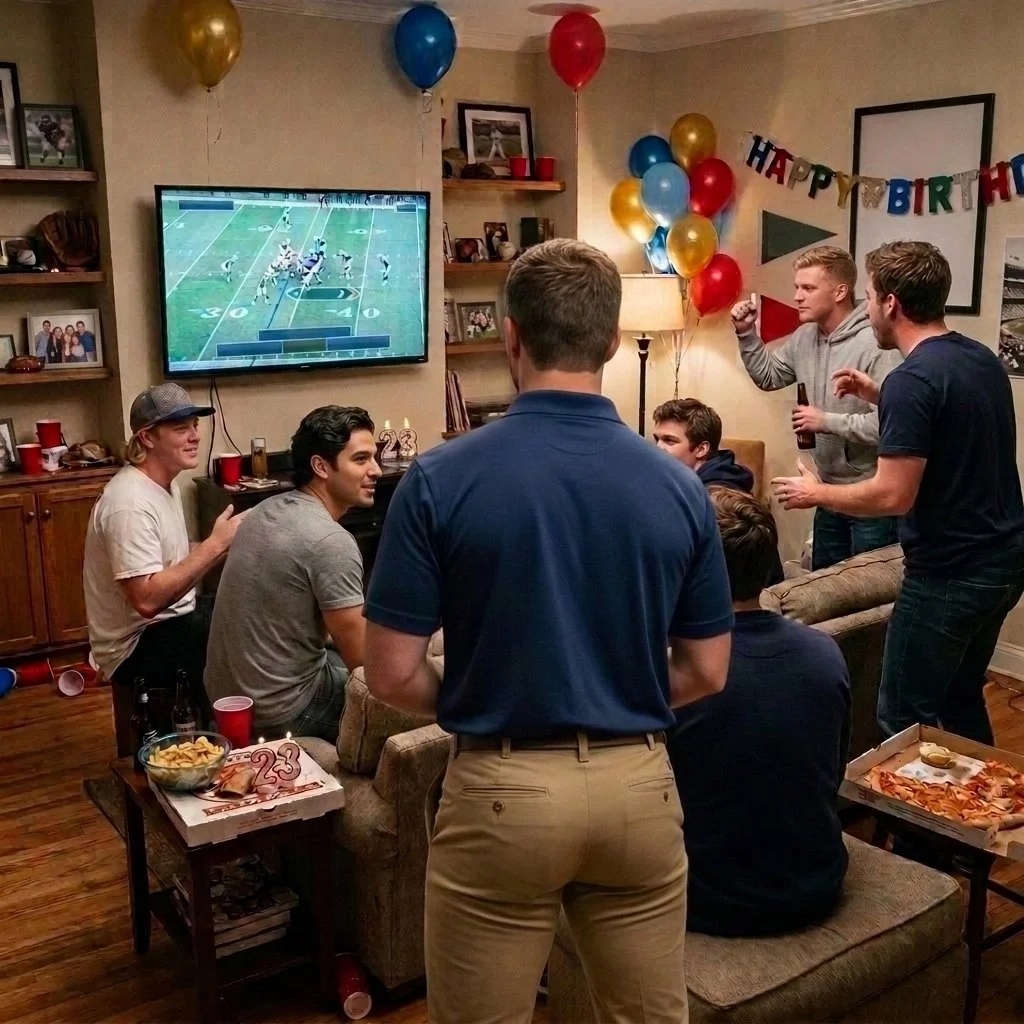
Man, what a night this is shaping up to be. After finishing another shift slinging burgers and slicing up pie at the All-American Diner, I’m walking straight into what might just be the most chaotic evening of my week. Tonight’s the night we celebrate Jack hitting the milestone age of 23—a proper get-together with the guys, snacks, wings, and the game on full display. Sounds relaxing enough, right? Wrong. Just when I thought I had the night mapped out, fate threw in a little curveball named Mitchell, my two-year-old. Yup, I’m on babysitting duty tonight too.
Now, juggling a group of twenty-somethings with beers in hand and a crawling toddler is a challenge worthy of its own survival show. But hey, I’m not sweating it. I’ve got a plan, and Mitchell’s about to have one of his most hardcore toddler nights yet.
Step one? Turn my living room into Mitchell’s personal fortress. I’ve cleared out the space—no stray chargers, shoes, or party debris lying around to trip him up. He’s got the liberty to roam free without obstacles, more like his own toddler kingdom smack in the middle of our hangout zone. No pants tonight either; I’m letting him lounge in just his pamper for extra ventilation and ultimate relaxation.
Dinner for Mitchell is prepped and ready—cold mac and cheese served on his favorite cartoon plate, paired with a bottle of milk and a side of Gerber that he practically inhales every time. While he’s chowing down, the guys and I will tackle wings, pizza rolls, and the timeless chips and dip, cheering passionately as the game unfolds on the screen. The living room might literally split into two vibes—laid-back NFL commentary on one side and pure toddler energy on the other.
But you think that’s all? Nope. I’ve got a cake game plan too. Jack might get the big candles and cheers from the crew, but Mitchell’s got a surprise slice coming his way. Sure, he probably won’t appreciate the meaning of a birthday yet, but the sugar rush will be his highlight for the night.
It’s a delicate dance—keeping the party atmosphere alive for us and making sure Mitchell has the time of his tiny life. Balance is the name of the game, and honestly? I’m all in for this wild ride. Wish me luck, because this night is going to be nothing short of legendary.
Essay Prompt:
For this essay, your task is to explore the complexities and challenges of balancing two very different responsibilities in one evening—a lively birthday party for a group of twenty-somethings and simultaneously babysitting a two-year-old toddler. This narrative should capture the logistical juggling, emotional rollercoasters, and the unexpected joys that arise from blending these two contrasting worlds.
Your essay should balance humor, creativity, and reflection on themes like adaptability, responsibility, and the value of shared moments. Use vivid descriptions and anecdotes to bring the evening to life while also integrating introspection on how such situations can teach us about flexibility and human connection. Below is a suggested word count breakdown for planning your essay:
Introduction (200 Words):
Introduce the scenario by setting up the context of the night—celebrating a twenty-something friend’s birthday with the added twist of babysitting a two-year-old toddler.
Highlight the contrasting dynamics between partying with friends and babysitting, setting the tone for the essay with humor and anticipation.
Planning the Night (400 Words):
Discuss the preparations needed to pull off a night like this. Explain your approach to creating a toddler-safe environment while allowing space for adult fun.
Detail the food and entertainment considerations for both Mitchell (the toddler) and the twenty-something crowd. Include any funny or unexpected challenges faced during planning.
The Party in Action (500 Words):
Describe the course of the evening as it unfolds—how you juggle keeping Mitchell entertained while making sure the party atmosphere doesn’t falter.
Share specific anecdotes, like Mitchell’s reaction to seeing Jack’s cake, or the guys’ playful interactions with the toddler. Explore moments of chaos and hilarity when these two worlds intersect.
Reflections and Lessons (300 Words):
Reflect on the challenges of managing such a night and how you adapted to the circumstances. Highlight emotional takeaways, such as the joy of seeing Mitchell having fun or strengthening friendships during unexpected moments.
Discuss how scenarios like this encourage personal growth, foster multitasking skills, and emphasize the importance of finding joy in the chaos.
Conclusion (100 Words):
Summarize the night’s events, tying together its themes of balance and adaptability.
End on a lighthearted or poignant note, celebrating the memories made and lessons learned from a truly legendary night.
Reference: Balancing Chaos and Connection
Some nights are destined to be legendary, and this one was no exception—a 23rd birthday bash fused with the unexpected twist of babysitting a two-year-old. You know, because what's a party without a little unpredictability? The challenge was simple in theory, near impossible in execution: keep the high-energy group of twenty-somethings entertained while simultaneously wrangling a pint-sized human who, at any given moment, could decide SpongeBob was more important than birthday cake. It was the ultimate multitasking experiment where balance, adaptability, and a decent sense of humor were absolutely non-negotiable.
The preparation phase felt like planning a military operation. First up? Toddler-proofing the battlefield—also known as my apartment—while sneakily preserving its party-friendly vibe. Outlet covers, fragile object relocations, and a stash of toddler snacks strategically placed within reach became non-negotiable. Meanwhile, the more "mature" crowd required their evidence of adulthood—craft beer, an obnoxiously large cake, and enough chips to feed a small army. Music playlists had to walk the line between head-bopping beats for Mitchell, the two-year-old DJ in my life, and throwback bangers for the guests—because apparently, “Baby Shark” wasn’t going to fly with this crowd for long.
When the night finally kicked off, the dichotomy of responsibilities hit full force. The moment was chaotic in the best way—Mitchell, wide-eyed with a frosted cupcake smeared across his face, became the accidental star of the party. The guys took to teaching him a toddler-fied version of beer pong (with juice boxes). Meanwhile, I oscillated between leading a conga line in the living room and expertly wielding a bottle of milk during an emergency tantrum detour. The unpredictable hilarity of it all? Pure gold. Watching worlds collide—twenty-something chaos meets toddler wholesomeness—was a kind of magic I never expected to witness.
At the end of the night, it wasn’t just about surviving babysitting or throwing a memorable party. It was about moments that snuck up on you—Mitchell cracking up at something ridiculous, a friend who’s never around suddenly bonding with him over building block towers, and the sheer realization that doing something messy and chaotic can be unexpectedly fulfilling. That night wasn’t perfect, but maybe that’s the point. It’s those rare nights, where chaos reigns but connection emerges, that teach you how to find joy in the mess, adaptability in the madness, and laughter in every corner. It was, in every sense of the word, legendary.
Math Word Problem Test: Packing for the Party
Instructions:
Mitchell and his male friends are preparing for a party, and they’ve got a lot to figure out! These word problems will test your ability to solve real-world math problems. Read each question carefully, and be sure to show all your work for full credit. Assume no parents are involved in this story, and focus only on the details provided.
You will face a mix of problems related to packing Mitchell's diaper bag for the party and handling his stroller during down times. Use algebra, arithmetic, and problem-solving skills to find the solutions. Remember, no answers are given - so double-check your calculations!
Good luck!
Word Problems:
Mitchell's diaper bag can fit a maximum of 18 items. If he needs to pack 5 diapers, 3 bottles, and 4 toys, how many additional items can he add until the bag is full?
A pack of diapers contains 42 pieces. If Mitchell uses 6 diapers per party hour and the party lasts for 5 hours, how many diapers will be left in the pack after the event?
Mitchell's stroller has a weight limit of 40 pounds. If Mitchell weighs 32 pounds and the diaper bag weighs 7 pounds, is the stroller suitable? If not, how much over or under the limit is it?
While pushing stroller overtime at the party, one friend notices he covered a distance of 1.2 miles in 30 minutes. Calculate his speed in miles per hour.
Mitchell's diaper bag contains 3 snacks - each weighing 0.5 pounds. If he trades one snack with a friend’s toy weighing 1.2 pounds, how much will the bag now weigh in snacks and toys combined?
At the party, a bouncy castle is set up. If each bounce Mitchell does burns 3 calories and he bounces 40 times during the party, how many calories does he burn in total?
A bottle warmer at the venue takes 6 minutes to heat one bottle. If Mitchell needs 5 bottles warmed, how long will it take to complete them all, assuming only one warmer is available?
Mitchell’s party stroller route is 0.8 miles in a circle. If one friend completes 5 loops around the route, calculate the total distance he pushed the stroller.
A package of baby wipes contains 80 sheets. If Mitchell uses 2 wipes per diaper change and he has 10 diaper changes during the party, how many wipes are left over?
Mitchell’s blocks are packed into a bag. Each block weighs 0.3 pounds and there are 15 blocks in total. What is the total weight of the blocks in the bag?
If Mitchell’s stroller fits into an elevator with a maximum load of 500 pounds and Mitchell, the stroller, and the diaper bag weigh a combined 95 pounds, how many additional friends weighing 160 pounds each can fit?
Mitchell drinks 6 ounces of formula per hour at the party. If his bottles each hold 4 ounces, how many bottles must you pack for a 5-hour party?
A gift bag contains 25 small toys to share with 5 children at the party. If each child receives an equal amount, how many toys does each child get?
One friend pushes the stroller uphill for 200 feet in 5 minutes and calculates his effort as 20 pounds of force. How much work (in foot-pounds) has he done? (Work = Force × Distance)
If Mitchell’s party outfit consists of 3 clothing layers (shirt, pants, and jacket) and he changes outfits 4 times during the event, how many clothing items were changed in total?
Mitchell’s chair at the party tips over unless the weight is evenly distributed. If two legs of the chair weigh 2 pounds each and the other two legs weigh 3 pounds each, is the overall structure balanced?
Stroller wheels cover about 4 feet per full rotation. If Mitchell’s party stroller route is 2640 feet long, how many rotations do the wheels complete in one trip?
Mitchell uses 5 balloons for each table at the party, and there are 12 tables in total. How many balloons are used altogether?
At the party, a game requires dividing 60 candies equally among 8 children. How many candies does each child get, and how many are left over?
If Mitchell’s party favors cost $3.50 each and he buys 25 of them, what is the total cost of the party favors?
Mitchell prepared a playlist with 15 songs, each lasting 4 minutes. How long is the entire playlist in total?
A birthday cake at the party is cut into 18 slices. If each guest eats 2 slices and there are 7 guests, how many slices are left over?
The venue for Mitchell’s party has 10 rows of chairs, each with 6 chairs. How many chairs are there in total?
Mitchell decorates the space with 20 strings of lights, each string being 10 feet long. What is the total length of the lights?
Drinks for the party are served in cups that hold 8 ounces each. If there are 75 cups of drink prepared, how many ounces of drink are there in total?
Mitchell decides to fill party bags with 4 toys each. If there are 28 toys available, how many complete party bags can be made?
A photo booth at the party fits 3 people at a time. If 45 guests want to use the booth, how many groups will be needed?
Mitchell hires a magician who performs 5 tricks every 10 minutes. If the performance lasts 30 minutes, how many tricks are performed in total?
The party has a piñata filled with 150 pieces of candy. If it is split evenly among 25 children, how many candies does each child receive?
Mitchell orders cupcakes for the party, with each box containing 12 cupcakes. If he orders 10 boxes, how many cupcakes does he have in total?
Four-Hour Gym Regimen Workout Routine
If you're looking to build strength and challenge your limits, this four-hour workout routine focuses on heavy weightlifting to target various muscle groups. You can follow this structured plan or customize one based on your fitness goals. Remember to warm up properly and maintain form throughout the workout to avoid injuries.
Warm-Up (0-10 minutes)
0:00–5:00: Light cardio (treadmill walking/jogging or jumping jacks).
5:00–10:00: Dynamic stretches (leg swings, arm circles, shoulder rolls).
Workout Routine (10–240 minutes)
Chest & Triceps (10–70 minutes)
10–25 minutes: Bench Press – 5 sets of 5 reps (increase weight gradually).
25–40 minutes: Incline Dumbbell Press – 4 sets of 6–8 reps.
40–50 minutes: Tricep Dips – 3 sets of 12–15 reps.
50–70 minutes: Overhead Tricep Extension – 4 sets of 10 reps.
Back & Biceps (70–140 minutes)
70–85 minutes: Deadlifts – 5 sets of 5 reps (focus on proper form).
85–100 minutes: Barbell Rows – 4 sets of 8–10 reps.
100–115 minutes: Pull-Ups/Assisted Pull-Ups – 4 sets to failure.
115–140 minutes: Barbell Bicep Curls – 5 sets of 8 reps.
Legs (140–210 minutes)
140–155 minutes: Squats – 5 sets of 5 reps (increase weight progressively).
155–175 minutes: Bulgarian Split Squats – 3 sets of 10 reps each leg.
175–190 minutes: Romanian Deadlifts – 4 sets of 8–10 reps.
190–210 minutes: Calf Raises – 3 sets of 15–20 reps.
Shoulders (210–240 minutes)
210–225 minutes: Overhead Press – 5 sets of 5 reps.
225–240 minutes: Lateral Raises and Front Raises Superset – 4 sets of 12–15 reps each.
Cool-Down (240–250 minutes)
240–245 minutes: Light cardio (slow walking or jogging to lower heart rate).
245–250 minutes: Static stretches focusing on all major muscle groups.
This comprehensive regimen is designed to enhance strength and endurance over time. Prioritize rest, hydration, and recovery after completing such an intensive workout.
Mindfulness Exercise for Career Mapping and Reflection
Objective
To guide participants in their early 20s toward meaningful career exploration while integrating mindfulness practices, group collaboration, and reflective journaling to enhance personal, professional, and mental well-being.
Duration: 60 minutes
Materials Needed
Blank papers or notebooks for journaling
Pens or markers
A calm and quiet space for group activities
Exercise Outline
Introduction and Grounding (0–5 minutes)
Begin with a short mindfulness breathing exercise.
Ask everyone to sit comfortably and close their eyes.
Guide the group to take deep, slow breaths in through the nose and out through the mouth.
Encourage them to focus on the present moment, letting go of external distractions.
After 2–3 minutes, gently transition into the activity by discussing the importance of mindfulness during career mapping.
Career Vision Mapping (5–30 minutes)
Step 1: Silent Reflection (5 minutes)
Prompt participants to spend 5 minutes reflecting individually on these questions:
What kind of work makes me feel fulfilled?
What are my personal values, and how could they align with my career?
What skills and passions do I currently have that I can leverage?
Step 2: Group Sharing (10 minutes)
Divide participants into small groups (3–4 people).
Encourage each individual to share their reflections and discuss how they envision their future career.
Step 3: Career Path Brainstorming (10 minutes)
Within the small groups, brainstorm potential career paths based on the shared reflections.
Use blank paper or a whiteboard to map out possibilities visually, placing key values, passions, and skills at the center.
Reflection Journaling (30–60 minutes)
After the group discussion, transition into a focused journaling session.
Provide the following prompts for participants to write about individually:
What career paths discussed today resonate most with me, and why?
How can I incorporate mindfulness or balance into my long-term professional life?
What small steps can I take today to move closer to the career I want?
How can I support my mental and emotional well-being throughout my career journey?
Encourage participants to be honest, open, and nonjudgmental in their responses.
Closing Discussion (55–60 minutes)
Regroup and invite participants to share any key insights or takeaways (optional).
End with a collective deep breathing exercise to reinforce calm and focus as they move forward.
Encourage participants to revisit their journals periodically for self-reflection and to track their growth over time. This practice fosters a mindful connection between their personal and professional aspirations, promoting both success and well-being.