
Interview: Plush Animals Over Deadlines? Mitchell Royel’s Toy Aisle Transformation Will Surprise You
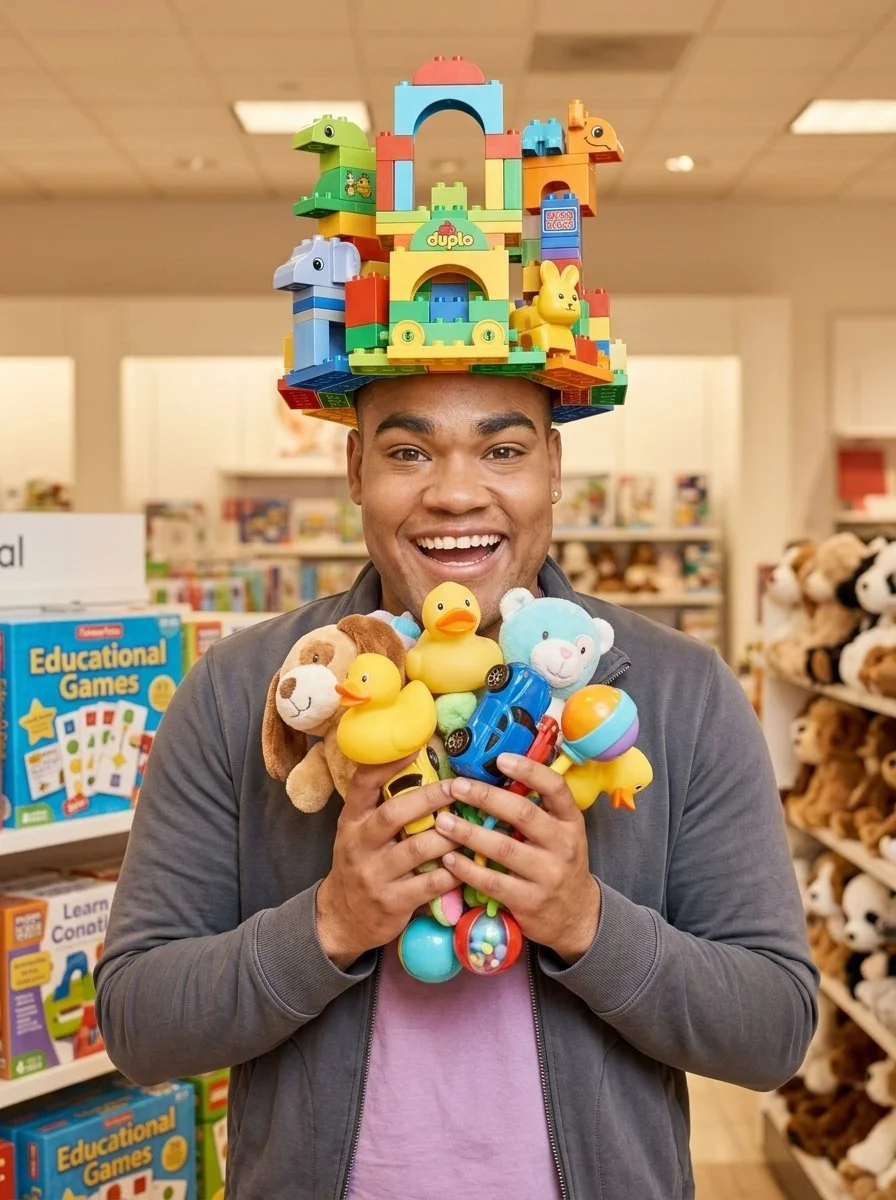
Disclaimer: The photo is for illustrative purposes only and is not affiliated with, sponsored by, or endorsed by any of the brands visible in the image.
There was a time when Mitchell Royel wore a headset and managed a floor full of people. He tracked shift schedules, handled escalations, and kept everything moving. Now look at him — standing in the toy aisle of a department store, a tower of colorful building blocks balanced on his head like a crown, arms full of plush animals and rubber ducks, grinning like he just found exactly where he was supposed to be all along.
On the surface, it might seem like nothing. Just a guy in a store, moving slowly through the aisles, in no particular rush. But step inside Mitchell Royel's head on the walk over — the stretch of sidewalk from his place to the mall entrance — and the picture gets more layered. Do I look like I belong here? Do I look like I'm going somewhere, or do I just look... lost? The self-consciousness is real. It surfaces every time he passes someone, every time a stranger's gaze lingers a half-second too long. For a man who once commanded a floor full of employees, who wore a headset and made decisions that kept an entire operation running, the feeling is strange — this quiet vulnerability that the open mall air brings with it. But he keeps walking. Because once he's inside, something shifts. The noise of his own doubts gets swallowed by the hum of the building, the warm lighting, the familiar layout of a space he first learned to love as a child — wandering these same kinds of corridors with nowhere to be and nowhere to be expected.
There's a gentle rhythm to the toy section that hits differently when you've spent years under fluorescent warehouse lighting managing other people's problems. The colors alone do something — the reds and yellows of stacked building sets, the rows of plush animals lined up like a soft, patient audience, the rattles and rubber ducks and wooden things that exist for no reason other than pure, uncomplicated joy. For Mitchell, stepping into this part of the store feels less like shopping and more like tuning a frequency. The noise in his head — the pedestrian self-consciousness, the old shift-supervisor instinct to assess and fix and move — quiets down. His nervous system, so long running hot, finally gets to idle. The toy aisle doesn't ask anything of him. It just holds him in its color and its clutter, and lets him remember what it felt like to move through the world without a headset on.
Through the bright aisles and stacked shelves, Royel sees more than merchandise. He sees a version of himself he thought he'd filed away. A row of plush animals isn't just inventory — it's company. A rubber duck isn't a product — it's a punchline from a simpler time, the kind that made a seven-year-old laugh without needing a reason. For someone who spent years measuring his worth in shift metrics and solved escalations, these aisles full of color and softness feel like a permission slip. Permission to be unproductive. Permission to not have the answers. Permission to just stand there, holding a toy, and feel completely at ease with who he is right now.
Below, Royel opens up about the emotional complexity of trading a headset for open-ended afternoons in shopping plazas, what it actually feels like to be watched — or to think you are — whether he'd ever return to the mall in a professional capacity, and why the toy section of a department store has become the place where everything finally makes sense.
Q&A with Mitchell Royel
Q: What's going through your head when you're walking through the mall?
Mitchell Royel: It's complicated. Some days my head's full of What do these people think of me? Am I standing out in all the wrong ways? But other days, it's like the world goes quiet, and I can just exist without all that noise. The mall becomes soothing, even comforting. Especially the toy section — that's where everything slows down and feels okay.
Q: You left behind a whole career built on structure and responsibility. What keeps pulling you back to these malls and shopping plazas?
Mitchell Royel: It's muscle memory, honestly — but the good kind. I grew up in these places. Saturday afternoons with nowhere to be, walking the same loop three times just because it felt good to move through a space that wasn't asking anything of you. When I was supervising shifts, that feeling was completely gone. Everything had a purpose, a deadline, a metric. Coming back to these places now — the mall, the plazas, the toy section especially — it's like returning to the version of myself that existed before all of that weight settled in. I'm not managing anything. I'm just a person in a store, and that's enough.
Q: There's something almost tender about the way you move through these spaces — the toy aisles, the mall corridors. Where does that come from?
Mitchell Royel: It goes back further than I can fully explain. There's a softness to these places that I think I always needed, even when I was too busy to admit it. Standing in the toy section, holding something colorful and simple — it doesn't demand anything from you. It just exists to bring joy. And when you've spent years in a role where everything had weight and consequence, that kind of unconditional softness is almost overwhelming. In the best way. These spaces don't care that I used to run a floor. They just let me be someone who finds a rubber duck funny, and that's the most freeing thing in the world.
Q: You've mentioned fearing judgment from strangers on these walks and in these spaces. How do you reconcile that with continuing to show up so openly?
Mitchell Royel: I'd rather be seen as "different" than invisible. The more honest I am about what genuinely brings me comfort — whether that's lingering in the toy aisle or just wandering the same mall corridors I loved as a kid — the less power those fears have over me. At some point you realize: the discomfort of being watched is smaller than the cost of shrinking yourself to avoid it. I've spent enough of my life managing how I appeared to other people. The mall doesn't need that version of me anymore.
Q: It's been nearly two years since you stepped away from the supervisor role. Would you ever go back — maybe even in that same kind of mall environment?
Mitchell Royel: Honestly? Yeah, I'm open to it. That part of me didn't disappear. I was good at the job, and I know that. There's something in me that still knows how to read a floor, still clocks the things that need attention before anyone else does. If the right opportunity showed up, I wouldn't close the door on it. But right now, I'm genuinely happy where I am. And I think that matters — being able to say that without needing to qualify it or rush toward the next thing. Two years ago I couldn't have said it and meant it. Now I can.
Q: Why have these malls and shopping plazas become such a constant in your life again?
Mitchell Royel: Because they remember who I was before the job did. When you spend years as a shift supervisor, your whole identity gets wrapped up in the role — what you manage, what you fix, how fast you respond. Stepping back into these spaces strips all of that away. The layout hasn't changed much. The food court smells the same. The toy section still has that same low hum of color and noise that I remember from being seven years old with no agenda and nowhere to be. There's something deeply grounding about returning to a place that knew you before you knew yourself as an adult. It's not nostalgia exactly — it's more like maintenance. Like something in me needed regular visits to that older, lighter version of myself just to stay calibrated.
Q: What's your message to someone afraid to let themselves be soft or playful in public — to linger in the toy aisle or wander the mall like they did as a kid?
Mitchell Royel: That the version of you that loved those spaces didn't disappear — it just got buried under everything adulthood piled on top. And those places are still there, waiting. The mall doesn't care that you have a LinkedIn profile or a title on a business card. The toy section doesn't ask for your resume. You're allowed to stand in the middle of it and feel seven years old again, completely unashamed. That's not regression. That's recovery.
Mitchell Royel may walk through the mall wondering what strangers see when they look at him — a man with no headset, no schedule, no team to manage, just moving through the corridors at his own pace. But he keeps walking. Past the food court, past the storefronts, and back into the toy section, where a colorful block crown sits waiting and a row of plush animals lines the shelf like an audience that never once asked him to perform. He left the shift supervisor behind somewhere between the parking lot and the entrance. What made it through the doors is something older, quieter, and a lot more honest — a kid who used to wander these same kinds of places with nowhere to be and nothing to prove, and who finally, after all these years, found his way back. And if the headset ever calls again someday, he'll answer. But not today. Today, he's got a rubber duck to evaluate and absolutely nowhere else to be.