
Interview: Mitchell Royel Bought Nothing New This Year — This Is What Happens When Thrift Culture Meets Childhood Nostalgia
Some people announce themselves with a logo. A designer name stitched somewhere loud, screaming its price before the person even opens their mouth. Mitchell Royel does the opposite. He walks into a room and dares you to guess where a single piece came from — and the answer, every single time, is someone else's closet first.
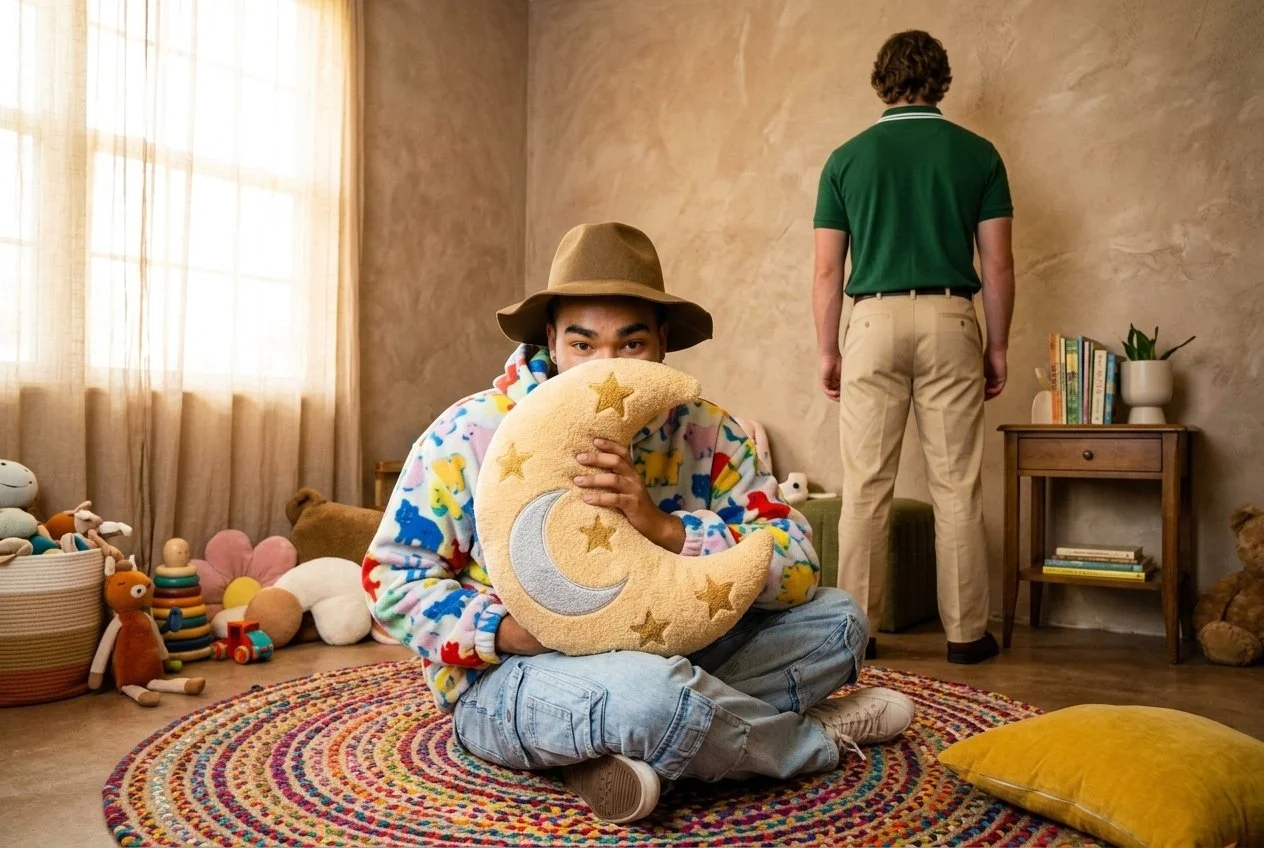
Look at the photo. Really look. There he is, cross-legged on a braided rug that swirls through every color a rug has any business being, one arm wrapped around a plush crescent-moon pillow dotted with embroidered stars. He's staring straight into the lens like he already knows what you're thinking and he's several steps ahead of you. And he probably is.
The outfit is a masterclass, and not one piece of it was bought new.
Start at the top: a wide-brimmed brown felt fedora, soft with age, the kind of hat that's clearly lived a few lives before landing on his head. Under it, a white fleece hoodie exploding in an abstract animal print — blues, reds, yellows, greens all tangled together like a fever dream someone had about a zoo. Then light-wash cargo jeans, the pockets deep enough to hide secrets, faded exactly the way denim only fades when it's actually been worn. And off-white sneakers that have walked further than any factory floor ever intended.
This is not a costume. This is a philosophy wearing a hat.
Here's the part most people miss. Mitchell doesn't do the digging himself — not always. His babysitters do.
Picture the young man in the background of the photo: dark green polo, crisp khakis, dress shoes that mean business. He looks like he wandered in from a completely different story, and in a way, he did. Because when he's not standing quietly in the frame, he's out there, sleeves rolled up, elbow-deep in bins and racks and dusty shelves, hunting.
These caretakers — young guys, sharp eyes, endless patience — treat thrifting like a sport. They go out looking for the hoodie nobody else understood. The fedora that got donated because someone gave up on it. The plush moon pillow waiting in a pile of forgotten toys. They bring back stuffed animals with slightly worn ears, wooden stacking rings missing their original box, cushions shaped like clouds and flowers that used to belong to a nursery three towns over.
And then the magic happens.
Upcycling gets thrown around like a buzzword, so let's be clear about what it means in Mitchell's world. It's not just buying used and calling it a day. It's rescue and reinvention.
A stuffed giraffe with a loose seam gets stitched back together and given a place of honor. A scuffed wooden toy train gets cleaned, sanded smooth, and rolled back into rotation. A faded pillow gets a fresh cover sewn from another thrifted find. Nothing is thrown away when it can be made whole again. The babysitters aren't just shopping — they're restoring, mending, breathing second life into things the world already gave up on.
That's the heart of it. Every object in that room carries a history, and instead of hiding it, Mitchell puts it on display. The braided rug, the toy basket, the side table stacked with well-loved books — it all adds up to a space that feels lived-in because it is lived-in, just not by him first.
Now here's where it gets genuinely interesting. Mitchell is an ABDL — someone whose comfort and identity live in the tender, playful, unguarded space of childlike things. And rather than treat that as something to tuck away, he braids it right into the sharpest hipster instincts you've ever seen.
Think about it. The whole hipster ethos is built on the same bones as the ABDL aesthetic: authenticity over polish, the handmade over the mass-produced, the old thing loved harder than the new thing. Vintage. Analog. Sincere in a world that's terrified of sincerity. Mitchell sits at the exact center of that Venn diagram, and he sits there cross-legged, hugging a crescent moon.
The whimsy isn't a contradiction to the cool. It is the cool. A grown man in a thrifted fedora surrounded by upcycled toys isn't hiding — he's the most honest person in the room. Everyone else is performing adulthood. He's just being exactly who he is, and letting every secondhand thread say it for him.
Below, Royel talks racks, rescues, the babysitters who hunt on his behalf, and why the best version of yourself might already exist in someone else's donation pile.
Q&A with Mitchell Royel
Q: There's a giant felt fedora on your head in this photo. Let's talk about that.
Mitchell Royel:
Honestly, it felt completely natural. If you spend as much time thinking about thrifted fashion as I do lately, eventually the right hat ends up on your head. That's just how it goes.
But also — look at it. It's perfect. The brim, the color, the way it's softened over the years, all of it exactly the way it should be. I have a lot of respect for whoever wore it before me. They understood the assignment.
Q: You could buy anything new. How did thrifting become your whole thing?
Mitchell Royel:
It was an accident, genuinely. For years I thought new meant better. That was the whole mindset. Then one day one of my sitters brings back this hoodie — wild animal print, a little worn, basically free — and I put it on and something clicked.
And that was it. That one secondhand piece cracked the whole thing open. I stopped pretending the best stuff only comes with a tag.
Q: So one thrifted find changed the trajectory?
Mitchell Royel:
Completely. I keep telling people this and they don't believe me. It wasn't some designer piece. It wasn't an experience. It was the cheapest possible version of the thing, and it still got me.
That's the part I love. It didn't need to be expensive to open my eyes. It just needed to have a story. And once you start seeing the stories, you're done. There's no going back to buying blank.
Q: Tell me about the babysitters doing the hunting. Why not just shop online yourself?
Mitchell Royel:
Because the hunt is part of it. It always has been. It would be a completely different thing if it just showed up in a box.
My sitters go out there, dig through the racks, and come back with things I never would have picked. Some days it's an outfit. Some days it's a stuffed animal that needs a little fixing. Some days it's both. That moment when they walk in with a find — knowing someone went looking for me — an app can't give you that. A checkout button can't give you that.
Q: What kinds of things are they bringing back now?
Mitchell Royel:
Oh, all of it. That's the problem. Once you start, the whole world opens up.
Right now I'm deep into the plush stuff — a moon pillow with little embroidered stars that's incredible. Wooden toys when I want something with real weight to it. Soft cushions when I want the room to feel gentle. And the room decor? That's a whole separate category. That's not shopping, that's world-building.
Q: New or secondhand?
Mitchell Royel:
Secondhand, every time, and I refuse to apologize for it. Vintage when I want the history and the character. Upcycled when I want something reborn into a better version of itself. Both are valid. Anyone who tells you new is automatically better is selling something.
Q: Do you have a go-to spot?
Mitchell Royel:
I have a rotation, but I'm loyal to whoever's treating the pieces right on any given day. That's the real test. Condition matters. Care matters. If the seam's torn and nobody bothered to fix it, the whole thing falls apart. Literally and emotionally.
Q: "Literally and emotionally" — that's a strong reaction to a thrifted find.
Mitchell Royel:
Look, if you're going to rescue something, you have to commit. You can't half-do it. A neglected, falling-apart piece left to rot is a betrayal of everything upcycling stands for. I stand by that. I will always stand by that.
Q: You lean into childlike, whimsical things while also being deeply into hipster thrift culture. Is that deliberate?
Mitchell Royel:
Completely. That combination is its own thing. It's quieter than people expect. There's no crowd doing exactly what I'm doing. The two worlds are usually pulling in opposite directions, but for me they line up perfectly.
There's something valuable about being sincere and soft when everything else in the world is trying to make you sharp and cynical. The whimsy is my pushback against all of that. The thrifting just made the whole thing feel more honest.
Q: The plush moon pillow in your arms — is that the closest you can get to wearing your whole identity?
Mitchell Royel:
It might be, yeah. I haven't found a more direct way to express it yet, but I'm open to suggestions.
Honestly, though, there's something I love about it. A grown man in a thrifted fedora holding a crescent moon covered in stars. It's tender. But it also just feels right. Like, of course that's where I ended up. Where else would I go?
Q: What do you think a fully thrifted, upcycled wardrobe says about a person?
Mitchell Royel:
That they're open. That they're willing to see the value in something everyone else overlooked. I was a new-is-better guy for years, and one secondhand hoodie taught me to look closer. A thrifted piece is never pretending to be something it isn't. It's just trying to be loved again, in a hundred different ways. I respect that enormously.
Q: Last question: what do you want people to take away from the photo — the one on the rug with the moon pillow?
Mitchell Royel:
That you're allowed to be all of it at once. Soft and stylish. Childlike and sharp. The thing you were told to hide can become the thing that defines you, and that's not weird, that's freedom.
I came for the clothes. I stayed for everything they let me be. There's no rule that says your identity has to fit in one clean box. Mine keeps expanding, one rescued piece at a time, and it's the best thing that's happened to me in years.