
Interview: Budgeting With Style: Mitchell Royel's Honest Take on Living Close to Zero
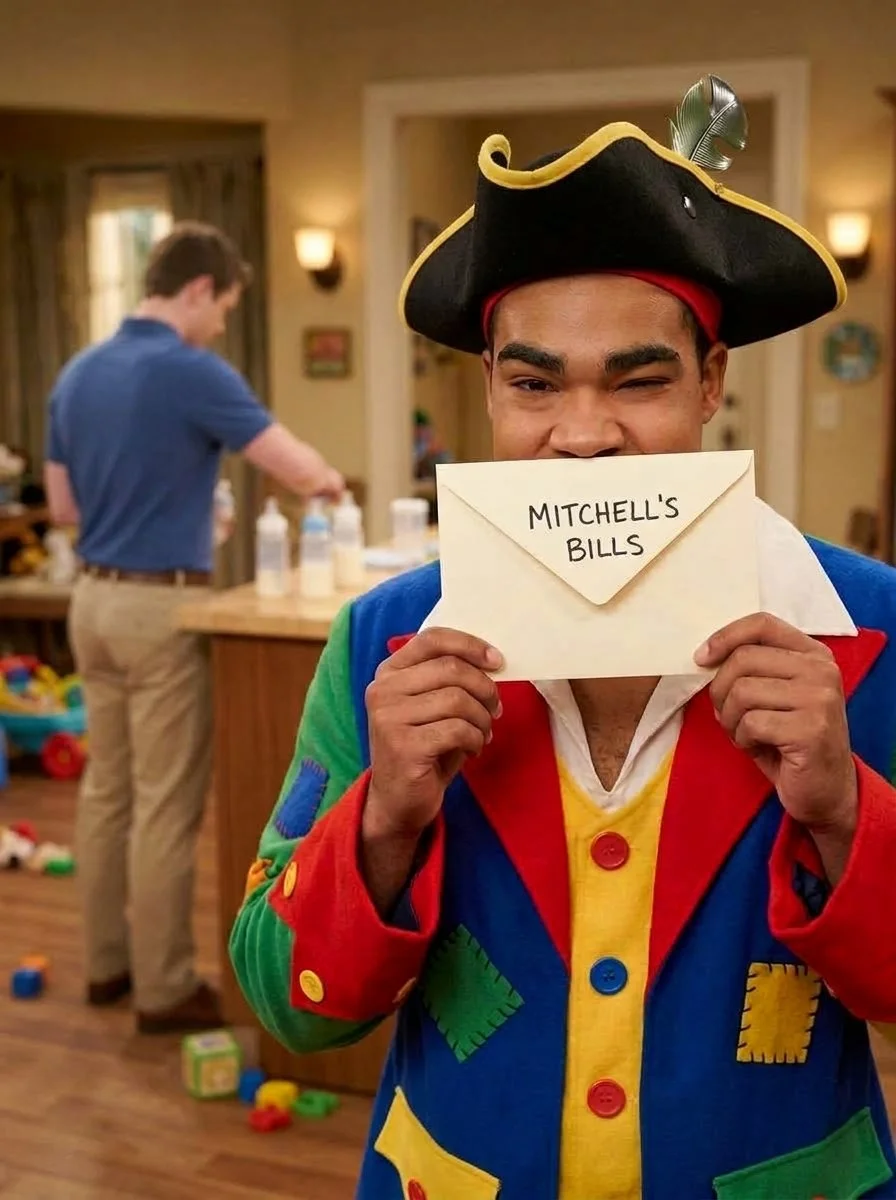
When Mitchell Royel agreed to sit down for this interview, nobody told him to dress the part — and yet he showed up wearing exactly who he is. A bold, patchwork jacket stitched together in vivid blocks of blue, red, green, and yellow. A black tricorn hat trimmed with yellow piping, a red band, and a silver feather jutting from the top. An envelope in his hands, scrawled with two words in thick black letters: Mitchell's Bills. He held it up with a wink, half gag, half declaration. It was funny. It was theatrical. And underneath all of it, it was honest — because that's the thing about Mitchell. He's learned that the only way to carry the heavy stuff is to dress it up, claim it out loud, and refuse to be ashamed of it. In a world that wasn't built for him, he's stitched his own costume together — mismatched, colorful, and entirely his own.
Mitchell Royel shows up ten minutes early. He tells me he always does, because being late makes his chest tight, and a tight chest can turn into something worse. He's wearing a hoodie, sneakers with fresh laces, and a pair of earbuds draped around his neck. Before we start, he asks if it's okay to keep a stress ball in his hand. I tell him to keep whatever he needs.
That's the thing about Mitchell.
He knows exactly what he needs. He's had to.
Mitchell is a special needs adult living on his own, with some support, in a modest apartment. He's sharp and funny, and he'll tell you the truth even when it's uncomfortable, maybe especially then. We sat down to talk about the stuff most people keep quiet: job hunting when the world isn't built for you, the stress of bills that look small on paper, and why a swing set might be the best therapy he's found.
No polish.
Just Mitchell.
Let's start simple. How are you doing today, for real?
Honestly? Today's a good day. I slept okay. I ate breakfast. I didn't check my bank account first thing, which is a rule I made for myself. If I check it before I eat, the whole day goes sideways.
That's a real rule?
That's a real rule. I have a lot of those. People think rules are about being strict, but for me they're about being safe. Rules keep my brain from running in ten directions at once.
You've been open about being special needs. What does that mean for you day to day?
It means some things that are easy for other people take me longer. Or they take more out of me. Like, a phone call with a stranger. For a lot of people that's nothing. For me, I have to write down what I'm going to say. I have to practice. And if they go off script, I freeze up. It's not that I can't do it. It's that it costs me more energy than it costs you.
I think that's the part people miss. They see me doing okay and they think I'm fine. But they don't see what it took to get there.
When Mitchell talks about looking for work, his voice changes. It gets flatter, more careful. He's clearly told this story before, to case workers, to family, to himself at two in the morning. And it still stings.
Talk to me about job hunting. What's that been like?
Rough. I'm not going to pretend it's not. I've filled out more applications than I can count. Online ones, mostly. And a lot of them, you never hear back. Not even a "no." Just silence.
Which is its own kind of answer.
Right. And my brain fills in that silence with the worst stuff. Like, "They saw something on there and knew." Even if that's not true. Even if they just never read it.
When you do get an interview, how does it go?
That's where it gets hard. Interviews are like a test for stuff I'm not good at. Eye contact. Quick answers. Small talk. Reading what someone means instead of what they say. I can stock shelves. I can follow a checklist better than most people, because I love a checklist. I can show up on time every single day. But none of that comes through in a fifteen-minute conversation where I'm sweating through my shirt.
Have you ever disclosed that you're special needs during the process?
I've gone back and forth. Sometimes I say it, and I can see their face change. They get really polite. Too polite. Like they're already writing the rejection in their head. Other times I don't say it, and then I get nervous and I stumble, and they just think I'm weird. So it's like, pick your poison.
That's a brutal choice to make every time.
It is. And I want to be fair. Some people have been great. I had one manager who let me do a working interview, where I just came in and did the job for an hour. I crushed it. That's the kind of thing that works for people like me. Let me show you, don't make me tell you.
Did you get that job?
I did. It was seasonal, so it ended. But it proved something to me. I'm not unemployable. I'm just bad at the audition.
That's a great line.
(laughs) I've had a lot of time to think about it.
Here's what surprised me most about Mitchell's money situation: it isn't complicated. His rent is generally covered. He doesn't have a car payment. He doesn't have credit card debt. On paper, his expenses are lean.
But paper doesn't feel anything. Mitchell does.
Let's talk money. You've said your bills aren't huge. So why is paying them so stressful?
Because when you don't have much coming in, small doesn't feel small. A twenty-dollar bill can ruin my week if I wasn't ready for it.
People hear "his rent's mostly covered" and they think I've got it made. And I'm grateful, I really am. But "mostly covered" still means I'm watching every dollar. And there's always this little voice going, "What if that changes? What if the help goes away?" That fear never fully leaves.
Walk me through what you actually pay each month.
The big one for me is my phone. I'm on a payment plan where I split it into two payments a month. It's not because I'm trying to be fancy. It's because one big payment would wipe me out all at once. Two smaller ones, I can plan around. I know when they're coming. I put reminders on my calendar. I've got sticky notes on my fridge.
Why does the phone matter so much to you?
It's my lifeline. It's how I talk to my case worker, my family, my doctor. It's how I apply for jobs. It's how I get my bus times. If my phone gets shut off, it's not just "oh, no TikTok." It's like I lose my connection to everything that keeps me okay.
What else is on the list?
Music streaming. And I know what people might say. "Cut it, that's a luxury." But I'm going to push back on that.
Push back. I want to hear it.
Music is how I regulate. When I'm on a walk and my brain is loud, I put my earbuds in and I've got playlists for different moods. One for when I'm anxious. One for when I'm sad. One for when I need to get pumped up before something scary, like an interview. That subscription isn't entertainment for me. It's a tool. It's cheaper than therapy, and some days it works just as well.
I respect that. Music has saved a lot of people.
It saves me a few times a week, honestly.
So you've got the phone, the streaming, rent support. What makes it feel tight?
It's the stuff around the edges. Groceries going up. A prescription costing more than I thought. Needing new shoes because I walk everywhere. None of it's huge. But it stacks. And when you're living close to zero, you feel every single thing that stacks.
And there's the mental part. Every bill is a decision. Every decision is stress. I don't just pay a bill and forget about it. I think about it before, during, and after. That's exhausting in a way that's hard to explain.
Do you ever feel ashamed about it?
Sometimes. I used to more. I'd feel like a failure because a regular adult should be able to handle a phone bill, right? But I'm working on that. I'm doing my best with what I have. I pay my stuff. I'm careful. That's not failing. That's surviving with style.
This is where the conversation lights up. Mitchell leans forward. He's been waiting for this part, and you can tell he's a little nervous about how it'll land, and also a little proud.
Over the past year, Mitchell has found real relief in activities a lot of adults would quietly skip. He goes to arcades. He goes to playgrounds. He takes long walks with no real hurry. And he's not apologizing for any of it.
You've told me you lean into childlike things to manage stress. What does that look like?
So, I get panic attacks. Real ones. My heart races, my hands go numb, I feel like I can't get enough air. And for a long time I just tried to push through them, like a grown-up is supposed to. That didn't work. It made them worse.
Then I noticed something. The times I felt calmest were when I was doing stuff I loved as a kid. So I started doing it on purpose.
Let's go one by one. The arcade.
The arcade is my happy place. The lights, the sounds, the tickets coming out of the machine. It sounds like it would be too much, right? Like too loud. But for me, it gives my brain something to lock onto. When I'm playing skee-ball, I'm not thinking about my phone bill. I'm thinking about that 50-point hole. That's it. Everything else goes quiet.
So the focus is the medicine.
Exactly. My anxiety needs a job. If I don't give it one, it'll find one, and it's usually a bad one. At the arcade, I give it a job.
What about the playground? I imagine some people react to that.
(laughs) Oh, yeah. I get looks. I go when it's quiet, usually early or on weekdays when kids are at school, because I'm respectful about it. I'm not trying to take up space from families.
But the swings? Man. There's something about swinging that resets me. The back and forth. The wind. Your stomach doing that little drop. I've had days where I walked to the park shaking and walked home totally calm, just from twenty minutes on a swing.
Has anyone ever said anything to you?
Once a lady asked if I was okay. I told her, "I'm better now." And she kind of smiled and left me alone. I think most people get it more than you'd expect. Everybody's got something.
You also mentioned long walks to the gym and the grocery store.
Yeah. I could take the bus for some of it, but I choose to walk. The walk to the gym is about forty minutes. The grocery store is a little less. I put my music on, I pick my playlist, and I just go.
The walk is almost more important than where I'm going. It's like my brain gets to untangle itself. Step, step, step. By the time I get to the gym, I've already worked out half my stress before I touch a weight.
And the grocery store walk?
That one's practical and peaceful at the same time. I make my list at home, so I know exactly what I'm getting and exactly what I'm spending. No surprises. Then the walk there is my warm-up, and the walk back with my bags is my cooldown. It turns a stressful errand into something that kind of feels good.
Some people might hear all this and call it immature. What do you say to them?
I'd say, what's your coping thing? Is it scrolling your phone for three hours? Is it drinking? Is it yelling at people in traffic?
Mine is skee-ball and swings and long walks. I don't hurt anybody. I don't spend a ton of money. And it works. I think a lot of grown-ups forgot that play is good for you. Kids aren't dumb. They figured out how to feel better a long time before we started making it complicated.
That might be the wisest thing anyone's said to me this year.
(grins) Put that in big letters.
As we wrap up, Mitchell squeezes the stress ball one more time and sets it on the table. He hasn't needed it in a while. He notices that too.
If someone reading this is going through what you're going through, what would you tell them?
That you're not lazy and you're not broken. The world just wasn't built with you in mind, so you have to build little pieces of it yourself. Find your rules. Find your playlist. Find your swing set. Whatever calms your body down, do that, and don't let anyone shame you for it.
And what do you want employers to hear?
Give us a shot to show you, not just tell you. Try a working interview. Write instructions down. Be patient for the first couple of weeks. I promise you, once I learn the job, I'll be the most reliable person you've got. I'll be early every single day. You saw me today.
Ten minutes early.
Ten minutes early. Every time.
Last question. What does a good life look like for you?
A steady job. Bills paid without my stomach hurting. Money left over for the arcade on Fridays. A good playlist. A long walk home.
That's it.
That's not too much to ask, right?
It isn't. And watching Mitchell walk out the door, earbuds in, heading off on foot toward wherever his day takes him next, you get the feeling he's going to get there. Not the way anyone told him to. His own way, one step and one swing at a time.