
Interview: "I Handled It Badly" — Mitchell Royel on the Controversy That Ended Elixir by Royel
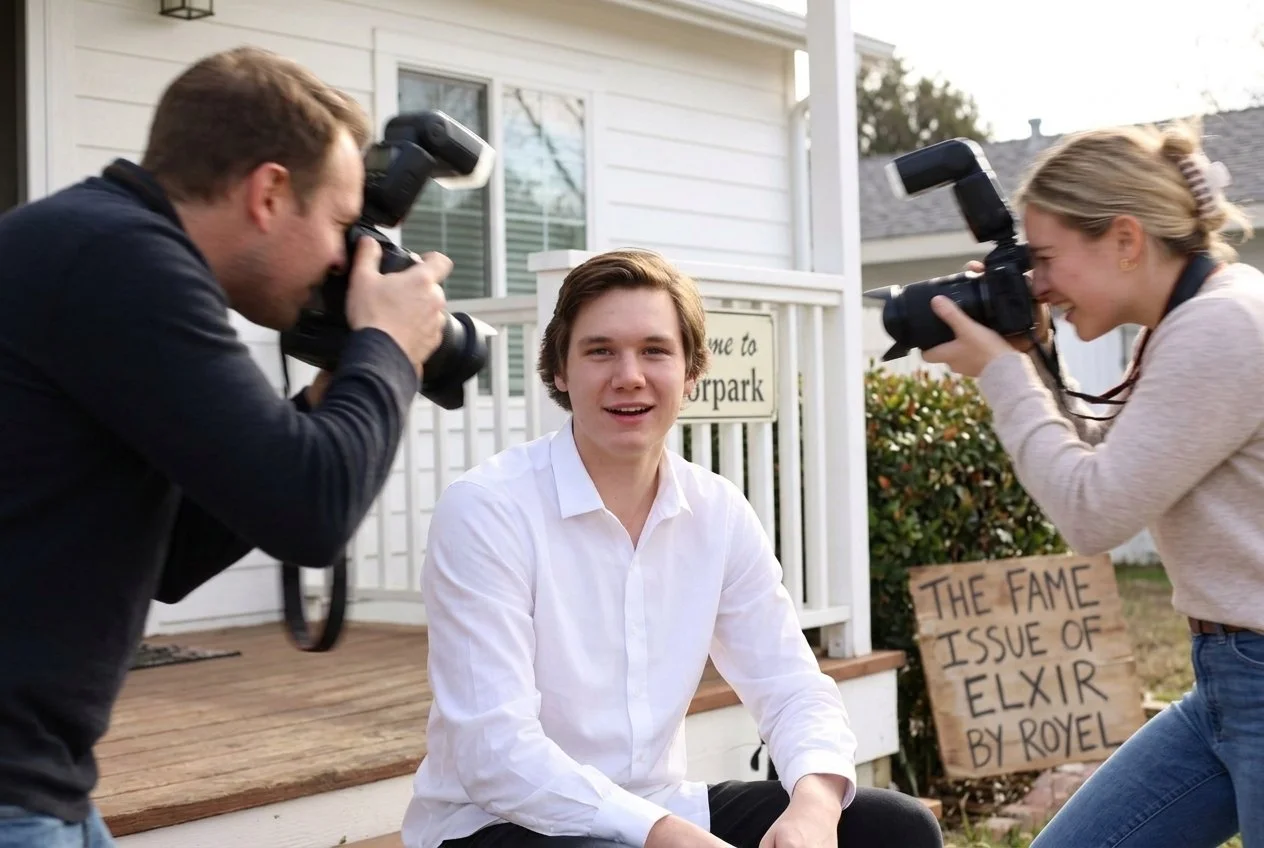
Editor's note: This is a fictionalized feature captured in the Fashion District by Mitchell Royel & friends. Some details have been dramatized, and the people around Mitchell Royel are unnamed. The photos that run with this story do not show the real person. A model was cast to recreate the day in Moorpark.
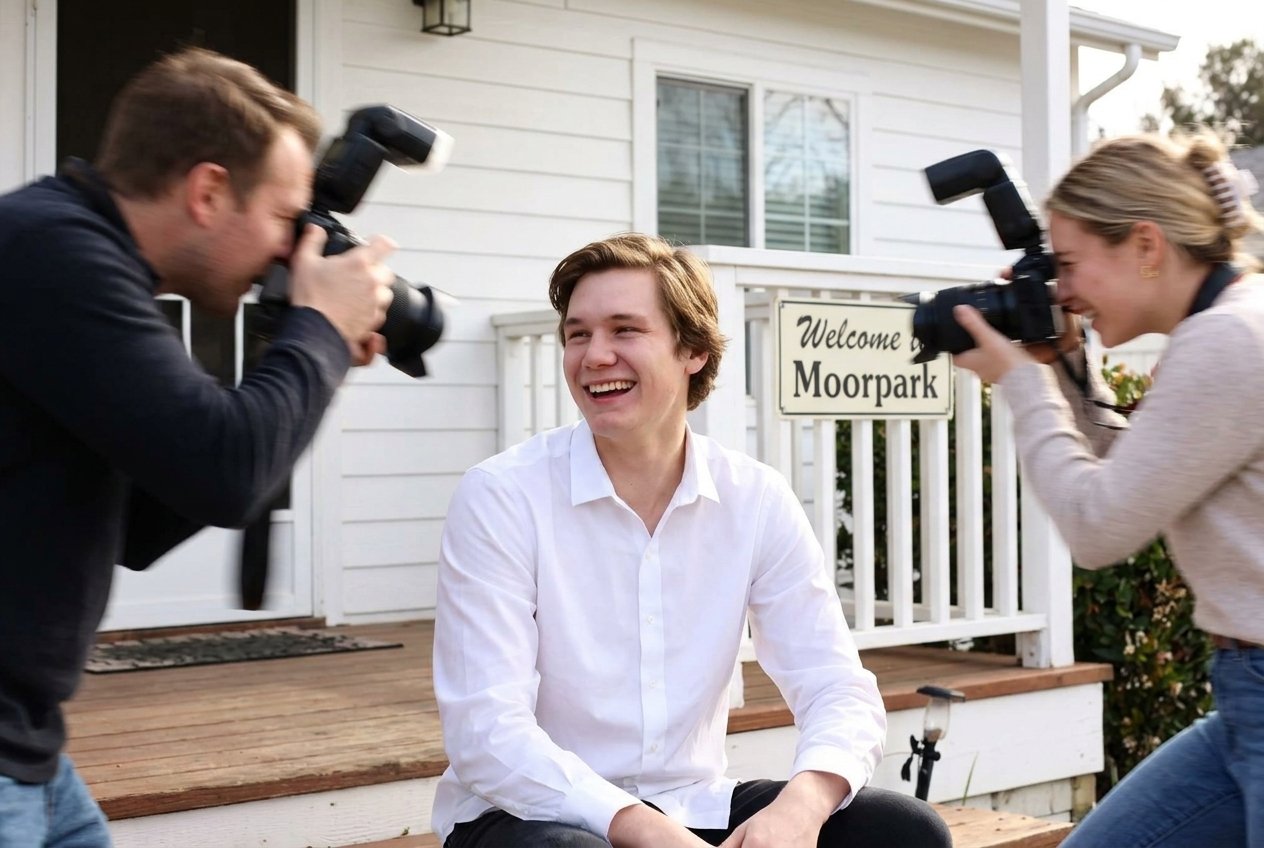
What Really Happened in Moorpark? Mitchell Royel Finally Tells All!
Moorpark doesn't try to impress you. That's what makes it so easy to fall for.
You come off the freeway and the city falls away fast. The hills roll out in soft folds, green in spring, and by late summer they've burned to a deep honey gold. The streets are wide and quiet. Old farmhouses sit back from the road with their porches and their tired white railings. In the late afternoon, the light comes in low over the ridgeline and turns everything warm, like the whole town has been dipped in amber.
For a few years in the mid-2010s, this was Mitchell Royel's studio.
Every other weekend, he'd drive out with a camera bag, a borrowed reflector, and whoever had agreed to be photographed that week. He shot on porches and dirt roads, in orchards and empty lots. He shot the people who would fill the pages of Elixir, the small, strange, deeply personal magazine he built by himself.
In 2016, that magazine came apart. Mitchell has rarely talked about why. We sat down with him to hear the full story, starting with the town where it all felt possible.
"The light out there does half the work for you."
Why Moorpark? You could have shot anywhere in Southern California.
I could have, but nowhere else felt like Moorpark. Los Angeles is loud. Everything there is already a set. You point a camera at a wall in Silver Lake and someone's already shot that wall a thousand times.
Moorpark felt untouched. I'd drive out there and it was like the town didn't know it was beautiful. The hills, the old houses, that golden hour that seems to last twice as long as it should. The light out there does half the work for you. I'd show up with almost nothing and leave with the best photos I'd ever taken.
It became a ritual. Every other weekend, without fail. It was the one part of my life that felt fully mine.
And the rest of your life?
The rest of my life was folding leggings.
Writing Elixir Before the Sun Came Up
Tell us how Elixir started.
It started at a coffee shop at 6 a.m. That's the honest answer.
I was working retail, and my shifts started mid-morning. So I'd get up early, grab a corner table at a local café, and write. Every issue of Elixir was written that way, in the hour or two before I had to clock in. I wrote the copy, I planned the shoots, I did the layouts. There was no staff. There was me, a laptop, and way too much cold brew.
What made it different from other indie magazines?
Every issue had a theme. The Fame Issue, the Heartbreak Issue, issues built around one feeling or one idea. And every issue had open letters.
That was the heart of it. People would write letters — to an ex, to their younger self, to someone they'd lost, to fame itself — and we'd publish them. Some were beautiful. Some were brutal. Readers loved them because they felt real in a way most magazines didn't.
It was a passion project. I never meant for it to grow. But it did. People started noticing. Models with real careers started saying yes to being on the cover. Suddenly this thing I wrote in coffee shops had a reputation.
San Diego and the Before
Before we get to 2016, something happened in 2014. You've never really spoken about it.
No. And I'll keep most of it private, even now.
In 2014, I went to San Diego. What happened there — the heartbreak, the kind that rearranges you from the inside out — that was the turning point nobody saw coming. I came home different.
I came home and couldn't write the way I used to. I'd sit at my usual table at the coffee shop at 6 a.m. and just stare at the screen. The open letters stopped feeling like something I published. They felt like something I needed to write and couldn't.
But you kept going.
I kept going because the magazine was the one thing that still made sense. I threw myself into it. Planned more shoots. Said yes to more ideas. Moorpark became even more important after San Diego. It was where I could breathe.
Looking back, I think some of what happened in 2016 — the decisions I made, the plan I didn't explain — was still rooted in 2014. When you've been through that kind of heartbreak, you start protecting yourself in ways that don't always make sense to other people.
The Holiday Hire
That brings us to 2016. Who was he?
He was a coworker. I was working as a holiday associate at an athleisure brand, one of those seasonal hires they bring on to survive November and December. He started around the same time.
We clicked right away. You know how it is in retail. You're stuck folding the same table for six hours, so you either become friends or you go quietly insane. We became friends.
When did you decide to feature him?
Pretty early. He had this energy. He was funny, a little shy, but when he laughed, the whole store felt it. I kept thinking, this guy has something. He just doesn't know it yet.
So I asked if he wanted to be in Elixir. And he lit up. Then his face kind of dropped, and he said, "I don't have any photos."
None at all?
Nothing professional. Phone pictures, a few blurry party shots. Nothing I could put in a magazine. So I said, okay, then we'll make some. Come to Moorpark with me.
What was that day like?
We drove out together on a Saturday morning. Windows down, music up. He kept asking questions the whole way. What should he do with his hands? Should he smile? What if he looked stupid?
I told him not to worry. The town would take care of him.
We got there and the light was perfect. Soft and gold, coming in low. I picked a porch on an old white house with a railing and a little hedge out front. I had him sit on the steps in a white button-down. Simple. Clean. I wanted nothing between the camera and him.
And how did he handle it?
He was terrified. And it was kind of wonderful to watch.
The first twenty minutes, he couldn't look at the lens. He'd glance up, then look away, then laugh at himself. His shoulders were up around his ears. He kept touching his hair. Every time I said, "Okay, look at me," he'd hold it for half a second and break.
I'd been shooting people with years of experience. They know their angles. They can turn it on like a light switch. He had none of that. This was his first time in front of a real camera, and you could feel every nerve.
Did it change?
It did. Around the hour mark, something clicked. I said something stupid and he laughed — a real laugh, head tipped back, looking off to the side. And I got it. That was the shot. Totally unguarded.
After that, he started to trust it. He'd look straight into the lens and hold it. You could see him realize, oh, I can actually do this.
The photos running with this piece recreate that day.
Right, and I want to be clear about that. The man in these photos isn't him. We cast a model to recreate the moment — the porch, the white shirt, the nerves, even the "Welcome to Moorpark" sign. It felt important to show the day without putting him on display again. He didn't sign up for this chapter of the story.
Two Different Worlds
How did he see Elixir?
He was captivated by it. Completely.
He'd go through the old issues and stop on the covers. These were people with agencies and followings, people who'd done real campaigns. He'd ask, "What's she like? Did you really shoot him?" He saw them as stars, and in a lot of ways they were.
And how did that compare to your own life at the time?
That was the strange part. To him, I was the guy who knew these people. The guy with the magazine.
But I was also a seasonal hire at the same store he was. Same name tag. Same register. I was clocking in at the same time, getting yelled at about the same fitting rooms. I'd spend Sunday in Moorpark with a model whose face was on a billboard, then Monday morning I'd be refolding joggers someone had thrown on the floor.
I think he saw Elixir as this glamorous world, and he saw me as the key to it. He didn't see how fragile the whole thing was. Honestly, I didn't always let myself see it either.
This is the part people have heard rumors about.
What actually happened?
I had a plan. And I never told him about it, which was my mistake.
The models I'd been featuring were established. They had careers. He had nothing yet — just a few photos from one Saturday in Moorpark. If I put him in the issue next to them, he'd get lost. People would flip right past him.
So I thought, what if I gave him a story? What if people were talking about him before they ever saw his photos?
And the story was a controversy.
Yes. The idea was to "cut him off" from the magazine. Publicly ban him. Make it look like something had happened, like there was drama, like he was too much for Elixir to handle. People love a mystery. They love someone who's been pushed out. It makes them curious.
I call it a hype campaign. The goal was never to hurt him. It was to raise him up to the same level as everyone else in those pages. Give him a name people knew. Then, when the moment was right, bring him back in a big way.
But he didn't know.
He didn't know. And that's the whole thing, isn't it?
From where he stood, his friend — the guy who drove him out to Moorpark and told him he had something — suddenly cut him off. Banned him. Made him look like a problem. Of course he took it the wrong way. I would have too.
Do you regret it?
I regret not telling him. I still believe the idea could have worked. But I treated him like a project when he was a person. He trusted me with his first time in front of a camera, and I didn't trust him with the plan. That's on me.
I think about it a lot. I think he believes I meant to hurt him. I didn't. But I understand why it looked that way.
The End of Elixir by Royel
So by late 2016, things were unraveling on multiple fronts.
They were. The fallout with him hit me harder than I expected. I was already running on fumes from 2014. And then the industry itself started shifting underneath me.
2016 was the year "influencer" became a real job. Suddenly, the people who mattered weren't on magazine covers. They were on their phones. Everyone was their own publication. A kid with a ring light could reach more people in a day than Elixir reached in a year.
I was carrying two years of heartbreak, a plan that had backfired, and a magazine model that the world was moving away from. I couldn't keep up. I didn't want to.
So you stepped down.
I was forced to, really. Not by anyone in particular — just by everything. I handed Elixir off to my friends, the people who'd been around it, helping, showing up to shoots. And I walked away.
Those friends are well known now.
They're influencers now. Big ones. It's funny. They took what I built and carried it straight into the world that made it hard for me to stay. And I'm proud of them. I am. But it's a strange thing, watching your baby grow up in someone else's house.
Do you still go to Moorpark?
Sometimes. Not every other weekend anymore. But when I need to remember why I started, I drive out there.
The hills are still there. The porches are still there. That light still comes in low and gold like nothing ever changed. I'll sit in the car for a while and think about that Saturday. A nervous kid in a white shirt, trying to figure out where to put his hands.
If he reads this, what would you want him to know?
That I saw something in him. That's all it ever was. I saw something, and I handled it badly.
Every issue of Elixir had an open letter.
I guess this interview is mine.