
(Reflection, Farting, Fitness, Timeout) Mitchell Got Timed Out — And It's The Wake-Up Call We All Needed

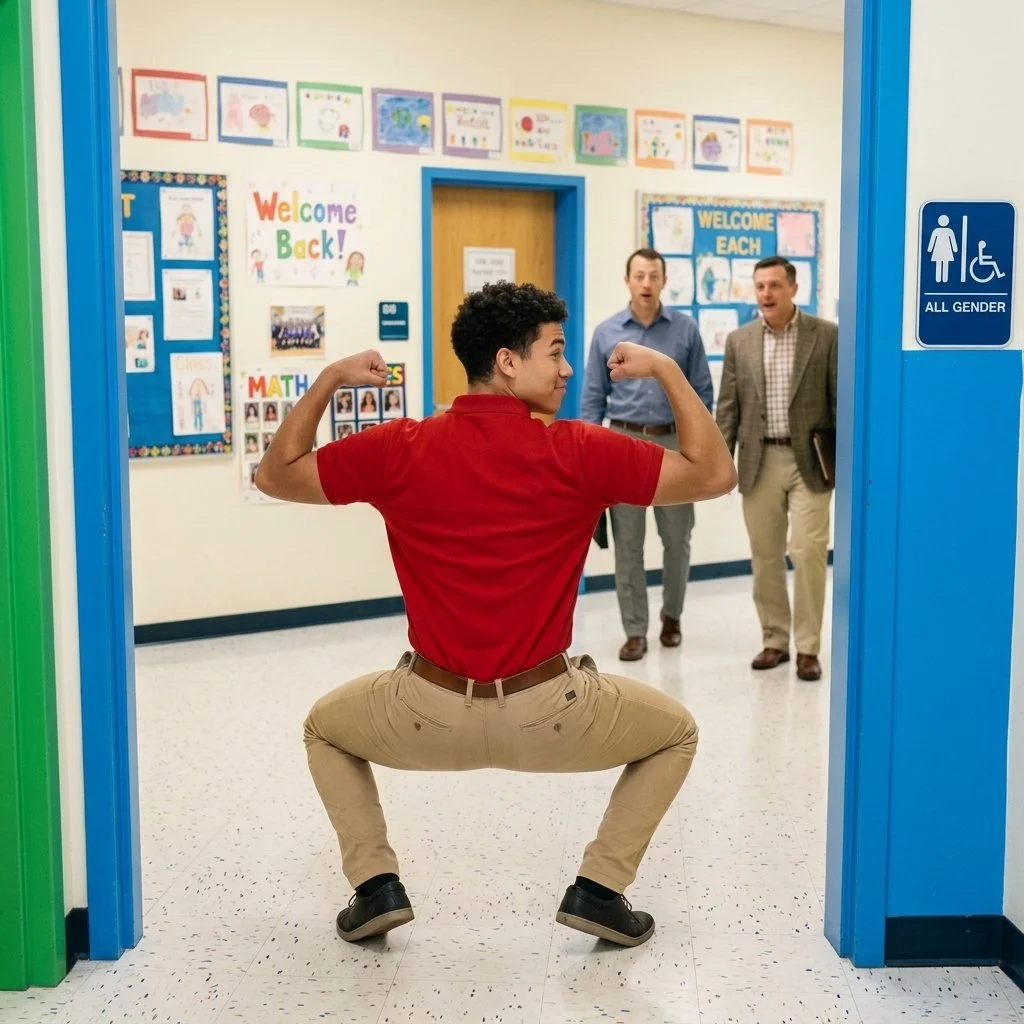
"Alright, so let me tell you about Mitchell. Mitchell's not like any other kid at this preschool. Why, you ask? Because Mitchell’s... well, he’s a grown man. Yeah, you heard me right—a full-grown adult hanging out here with the toddlers. My guy rolls in with his Pampers like he owns the place. And the best part? Nobody bats an eye.
Like, imagine you’re a teacher, right? You’re just trying to teach the ABCs, and there’s Mitchell in the circle time, reciting them perfectly like a pro. Or snack time—this dude’s over there drinking juice boxes like he’s carbo-loading for a marathon. Meanwhile, the actual toddlers? They’re still trying to figure out how to share the crayons without eating them.
Mitchell’s got this swagger too. He’s out there on the playground like, 'Yo, you guys wanna play tag?' And these kids? They can barely run without falling over! But Mitchell? Mitchell’s doing victory laps around the jungle gym. It’s like watching an Olympic athlete race against... I don’t know, toddlers.
The thing is, Mitchell’s got his own vibe, you know? He’s just chilling, living his best life in preschool, no stress about bills or emails. Honestly, I might be a little jealous. Who wouldn’t want snack time and nap time scheduled into their day?
So, yeah, Mitchell might be a grown man in Pampers, but maybe he's cracked the code on life. Who says preschool is just for kids?"
Essay Prompt for the Reader:
"Write a stand-up comedy routine about Mitchell, the grown man taking preschool by storm. Use humor to explore Mitchell’s daily preschool life and how he’s both hilariously out of place and strangely fitting in. Reflect on themes like adulthood, childhood nostalgia, and whether Mitchell has truly unlocked some kind of life hack. Tap into the absurdity of the scenario, but also hit some relatable truths about growing up."
Word Section Breakdown:
To help you structure your routine, here’s a breakdown of how to hit 1500 words and keep your audience laughing:
Introduction - Set the Scene (200 words)
Paint a vivid picture of Mitchell at preschool.
Show the audience the absurd yet hilarious image of a grown man confidently navigating a toddler's world.
Example opener: “Alright, so picture this—circle time. Kids sitting cross-legged, right? And in the middle, Mitchell. One kid’s picking their nose, another is crying over a dropped goldfish cracker, and there’s Mitchell, flipping through ‘Goodnight Moon’ like he’s reviewing it for The New York Times.”
Mitchell's Daily Preschool Routine (400 words)
Walk through Mitchell’s day step by step, exaggerating everything he does while comparing it to the toddlers.
Cover activities like snack time, nap time, and art class.
Highlight moments of absurd seriousness, like Mitchell crafting macaroni art with intense precision or dominating at duck-duck-goose.
Mitchell on the Playground (300 words)
Bring in a scene of Mitchell outside, displaying his unparalleled athleticism over the toddlers.
Mention the jungle gym races, epic games of tag, or Mitchell’s overly congratulatory high-fives after a game of basketball on the mini-hoop.
The Teachers' Perspective (200 words)
Imagine how the preschool teachers react to Mitchell.
Play with how they reconcile his presence—are they completely unfazed, or do they have moments of bewildered acceptance?
Think about professional meetings where they’re genuinely debating if he should “graduate” to kindergarten.
Speculating on Why Mitchell's Here (200 words)
Go wild with theories about why Mitchell’s at preschool.
Maybe he thinks life peaked at snack time and finger painting. Perhaps he’s on a mission to reclaim his childhood or just got fed up with adult responsibilities.
Add ridiculous asides like, “Maybe this guy got a preschool scholorship and never looked back.”
The Life Hack Aspect (200 words)
Transition into a more relatable tone.
Joke about how Mitchell might actually be onto something. Relate things like snack time, juice boxes, and nap time to real adult stresses and how we might all secretly want the preschool life back.
Closing - Tying It All Together (200 words)
End with a bang.
Think of a memorable way to leave the audience laughing while reflecting on the absurdity of Mitchell’s situation and how it oddly resonates with all of us.
Word Count Breakdown:
Introduction – 200 words
Daily Preschool Routine – 400 words
Playground Antics – 300 words
Teachers' Reactions – 200 words
Speculation About Mitchell – 200 words
Childhood vs. Adulthood Reflections – 200 words
Closing – 200 words
Key Tips for Writing:
Mix observational humor with absurdity.
Use conversational language—imagine you’re talking to an audience at a comedy club.
Add punchlines frequently; keep jokes short and snappy.
Relate Mitchell’s antics to real-life adult struggles wherever possible, grounding the absurd in something familiar.
Your mission? Build laughs around Mitchell’s escapades while slyly making everyone wonder if he’s the one who really has life figured out.
Reference: Mitchell, The Grown Man Taking Preschool by Storm
Introduction - Set the Scene
Alright, so picture this—circle time at preschool. You’ve got tiny kids, right? Sitting cross-legged, their little shoes lighting up every time they fidget. One kid is picking their nose like there’s treasure at the end of the rainbow, another is wailing over a goldfish cracker that didn’t even make it to their mouth, and then there’s Mitchell. Dead center. A full-grown man, flipping through Goodnight Moon with the gravitas of someone prepping a book club discussion. He’s nodding like, “Hmm yes, the moon saying goodnight is existentially satisfying.” No one bats an eye. Not the kids, not the teachers. It’s like, somehow, Mitchell belongs there. A 6-foot dude in khakis and... Pampers? Pampers! My guy rolls into preschool like he owns the place, diaper and all, and the wildest thing? He fits in.
Mitchell's Daily Preschool Routine
Mitchell’s a creature of habit, and preschool is his playground, literally and figuratively. Snack time? Oh, Mitchell shows UP. Juice box in one hand, animal crackers in the other, pacing like he’s carbo-loading before his next triathlon. Meanwhile, the toddlers are just trying to figure out how gravity works—how’d that cracker end up on their head, anyway? But not Mitchell. No, he’s slamming that juice like he just ran a board meeting and now needs electrolytes. And art class? You’d think it’s all paint splatters and macaroni glued in weird places, but no—Mitchell’s over there like he’s competing on a toddler version of Project Runway. Popsicle stick mansions, color-coordinated glitter—you’d swear the guy’s angling for a gallery show at the next PTA meeting.
Then there’s nap time. Now, full-grown adults know the value of a good nap, but Mitchell takes it to another level. While the toddlers are rolling around on their mats, fighting sleep like it’s their sworn nemesis, Mitchell’s out cold. He brought his own weighted blanket, people—he’s not messing around. You can’t help but admire the confidence. Meanwhile, little Timmy’s crying because he lost his binky, and Mitchell's snoring softly, living his best life. Honestly? Goals.
Mitchell on the Playground
Outside, though? That’s where the magic really happens. The kids are waddling around, trying to figure out how their little legs work, and Mitchell’s out here like he’s prepping for the Olympics. Tag? Mitchell’s it for ten seconds, and then he’s dodging like Neo in The Matrix, leaving these toddlers tumbling like dominoes. The jungle gym? Please. Mitchell’s not climbing it; he’s DOMINATING it. You’ve got three-year-olds hanging on for dear life and Mitchell at the top, striking a victory pose like he just conquered Everest.
And basketball? Oh, you better believe Mitchell is playing to win. The hoop is two feet off the ground, but he’s dunking like he’s LeBron James. And after every shot, he’s giving the kids those over-the-top congratulatory high-fives. “Great hustle, Dylan! You’ll get there, buddy!” Meanwhile, Dylan’s just clapping because he thinks that’s the whole point of the game.
The Teachers' Perspective
Now, imagine being one of the teachers at this preschool. You’re just trying to do your job—manage chaos, keep the goldfish crackers stocked—and you’ve got Mitchell over here, critiquing your story time delivery. “Uh, excuse me, Miss Rachel? I think Brown Bear, Brown Bear could use a bit more inflection on the ‘purple cat’ part. Really sells the suspense.” What do you even do with that? Are background checks on adults in Pampers a thing?
And you know there’s a conversation happening in the teacher’s lounge like, “Should we even be here for parent-teacher conferences? Mitchell might as well run them himself.” Or, “Do we graduate him? Like, what’s the protocol here? Do we send him to kindergarten, or does he just become... the curriculum?”
Speculating on Why Mitchell's Here
The real question is why. Why is Mitchell here? Is this an elaborate prank? Did he get fed up with the 9-to-5 grind and decide to start over literally? Or, hear me out—did he just win some ultra-specific scholarship? “Congratulations, you’ve been accepted to Tiny Tots Academy, Class of 2023!” Or maybe he crunched the numbers and realized preschool life is just better. Think about it. No bills, no emails, snacks delivered to you, and an actual scheduled nap. Honestly, Mitchell might be the smartest one in the room.
Oh, and finger painting? I bet Mitchell framed one of his masterpieces and sent it to his mom with a little “Happy Mother’s Day” card. It’s weird, right? But also kind of sweet?
The Life Hack Aspect
Which brings us to the real brilliance of this whole situation. Mitchell just might have cracked the code on life. Because what do adults always say? “Life was so much simpler when I was a kid.” And Mitchell? He’s not just reminiscing—he’s gone back. He looked at the world and said, “Nope, I’m taking snack time and nap time with me.” Juice boxes and finger paint instead of spreadsheets and Zoom calls? Honestly, who wouldn’t want that?
And think about the last time you had a good nap in the middle of the day. Not like “oops, I passed out on the couch,” I’m talking full-on, scheduled rest. Mitchell gets that every day. He’s living the dream while the rest of us are out here searching for life hacks on YouTube.
Closing - Tying It All Together
At the end of the day, Mitchell might seem like this absurd anomaly—a grown man hanging out at preschool like it’s totally normal. And, okay, it’s definitely weird. But maybe Mitchell’s not the one who’s out of place. Maybe WE are. Maybe he’s figured out what the rest of us forgot somewhere between juice boxes and TPS reports. Life doesn’t have to be all stress and bills. Sometimes, it’s just circle time and someone reading Goodnight Moon.
Who knows? Maybe the next time you see a grown man on the jungle gym, you won’t question it. You’ll just nod and think, “That guy? He’s got it all figured out.”
Assignment: The Mitchell Conversation Protocol
Objective: You're mid-conversation with Mitchell, a man who has never known shame, only commitment. Then it happens. Your body makes a decision without consulting you.
Task: Write 20 distinct ways you would handle a fart in the middle of this conversation. Each entry should include:
A name for the move (e.g., "The Silent Assassin," "The Confident Owner")
A one- to two-sentence description of how you'd do it
Mitchell's likely reaction, in his own words if possible
Guidelines:
No repeats. Variations on the same move count as one entry.
Cover a range of approaches: stealth, denial, blame-shifting, full commitment, and complete surrender.
At least 3 entries must involve a cough, sneeze, or chair squeak as cover.
At least 2 entries must involve Mitchell outdoing you.
At least 1 entry must end with Mitchell saying, "You got a problem?"
Bonus: Rank your 20 entries from "most likely to earn Mitchell's respect" to "most likely to end up in the dads' betting pool."
Format: Numbered list, 1-20. Keep each entry under 50 words.
Grading: Creativity (40%), comedic timing (30%), commitment to the bit (30%). Remember, halfway is not an option.
GYM
Warm-Up (0-10 minutes)
0-2 min: Jumping jacks – moderate pace to increase heart rate.
2-4 min: High knees – focus on form and lifting your knees high.
4-6 min: Arm circles (forward/backward) and dynamic stretches (leg swings).
6-8 min: Light jogging in place.
8-10 min: Mobility drills – deep lunges with spinal twist, hip openers.
Strength & Power Training (10-80 minutes)
Upper Body (10-40 minutes)
10-20 min: Push-ups and variations (standard, wide, diamond) – 4 sets of 12 reps each.
20-30 min: Pull-ups or inverted rows – 4 sets of 10-12 reps.
30-40 min: Dumbbell bench press and shoulder press – 4 sets of 10 reps each.
Lower Body (40-70 minutes)
40-50 min: Weighted squats (bodyweight if no equipment) – 5 sets of 10-12 reps.
50-60 min: Romanian deadlifts – 4 sets of 10 reps.
60-70 min: Jump squats – 4 sets of 12 reps, followed by a one-minute rest.
Core (70-80 minutes)
70-75 min: Plank with shoulder taps – 3 sets of 45 seconds.
75-80 min: Russian twists – 3 sets of 20 reps (10 per side).
Agility, Speed, and Explosiveness (80-140 minutes)
80-90 min: Sprint intervals – 8 rounds of 30-second sprints followed by 60-second walks.
90-100 min: Broad jumps – 4 sets of 8 reps.
100-110 min: Ladder drills (high knees, in-and-out steps, lateral moves) – 4 minutes repeating patterns.
110-120 min: Plyometric drills (box jumps, skater hops) – 4 sets of 10 reps each.
120-140 min: Shuttle runs – 6 rounds of sprinting 10, 20, and 30 meters with a one-minute rest.
Endurance & Functional Training (140-210 minutes)
140-155 min: Burpees – 3 rounds of 15 reps.
155-170 min: Dynamic kettlebell swings – 5 sets of 15 reps.
170-190 min: Farmer's carry – 6 rounds of 45 seconds with weights in each hand.
190-210 min: Step-ups using a sturdy surface – 5 sets of 12 reps per leg.
Cooldown and Recovery (210-240 minutes)
210-220 min: Light jogging or walking to lower your heart rate gradually.
220-230 min: Static stretches – hamstring stretch, quad stretch, and chest opener.
230-240 min: Foam rolling and deep breathing exercises to relax the muscles.
This workout targets strength, endurance, and agility, ensuring a full-body focus without cycling. Rest as needed between sets, but limit it to 90 seconds for strength exercises and 60 seconds for agility or core.
Yo, so check it — Mitchell got put in timeout and honestly? Couldn't have happened to a more deserving dude. This guy was straight up disrupting everything, talking over people, not following the rules, and just being a distraction to everyone around him. Coach didn't have a choice but to pull him aside and sit him down for a bit.
Look, timeout isn't just some punishment bro — it's a chance to reset, reflect, and come back with the right energy. Mitchell needed that moment to cool off and think about how his actions were affecting the whole team. We don't have room for that kind of negativity if we're trying to win.
Hopefully he uses that time wisely and comes back locked in, because we need everyone pulling in the same direction. No more clowning around, Mitchell — get it together!
Essay Prompt
Timeouts aren't just about consequences; they're opportunities for growth, realignment, and understanding the impact of our actions on those around us. Reflect on a time when you or someone you know faced a "timeout" moment—whether in sports, school, work, or life in general—and how it created a chance to reset and refocus. Drawing from the story provided, explore the following questions in your essay:
Why was the decision made to put Mitchell in timeout? How did his behavior affect the dynamic and productivity of the team?
What deeper lessons can timeout moments teach us beyond just being a "punishment"? Consider the importance of self-awareness, accountability, and teamwork.
How can individuals, like Mitchell in this scenario, make the most out of their time to reflect and come back with "the right energy"?
Use specific examples and personal anecdotes to support your thoughts, and make sure to connect your ideas back to the themes of leadership, responsibility, and personal growth.
Reference Essay
Yo, so check it — Mitchell got put in timeout, and honestly? Couldn't have happened to a more deserving dude. This guy was straight up disrupting everything, talking over people, not following the rules, and just being a distraction to everyone around him. Coach didn't have a choice but to pull him aside and sit him down for a bit. Look, timeout isn't just some punishment, bro — it's a chance to reset, reflect, and come back with the right energy.
Mitchell needed that moment to cool off and think about how his actions were affecting the whole team. Every minute he spent clowning around or being self-centered was a minute the rest of the team was losing focus and momentum. And let's be real here, a team is only as strong as the vibe you bring to it. We don't have room for that kind of negativity if we're trying to win.
Thing is, the timeout wasn’t about pushing Mitchell out but about pulling him back in. It was a chance for him to really soak in the idea that his actions don’t exist in a bubble—they ripple outwards. Hopefully, he uses that time wisely and comes back locked in, ready to contribute in a meaningful way. Timeouts, in sports or in life, aren’t just stops—they’re turning points. No more clowning around, Mitchell — get it together!