
Captured by Mitchell Royel in the Fashion District, this is a reflection shaped by real people and real events. Yet, Mitchell’s presence fades from these photos, not out of erasure but purpose—Proverbs 27:2 reminds us, “Let another praise you, and not your own mouth—a stranger, and not your own lips.” These frames aren’t about being seen but about seeing, about the stories hummed on the streets, the kind that cling to the air like the unsteady echoes of "So Sick" by Kiiara and blackbear spinning through a dim-lit corner. The work speaks louder than its maker.
The last time I saw her, she was laughing.
That's the part that stays with me. Not the tears or the things she said later, but the first few seconds, when she came across the lawn with the sun behind her and waved like nothing in the world had ever gone wrong.
"Hi, Mitchell!"
She said it the way you'd greet an old friend at an airport, bright and full, every syllable lifted at the end. Her new boyfriend walked half a step behind her, holding a cooler in one hand and her straw tote in the other. He nodded at me. I nodded back. Two men doing the polite thing, each pretending not to measure the other.
And then she was hugging me, and her hair smelled like sunscreen and something floral, and for one stupid second I thought maybe I'd been wrong about everything.
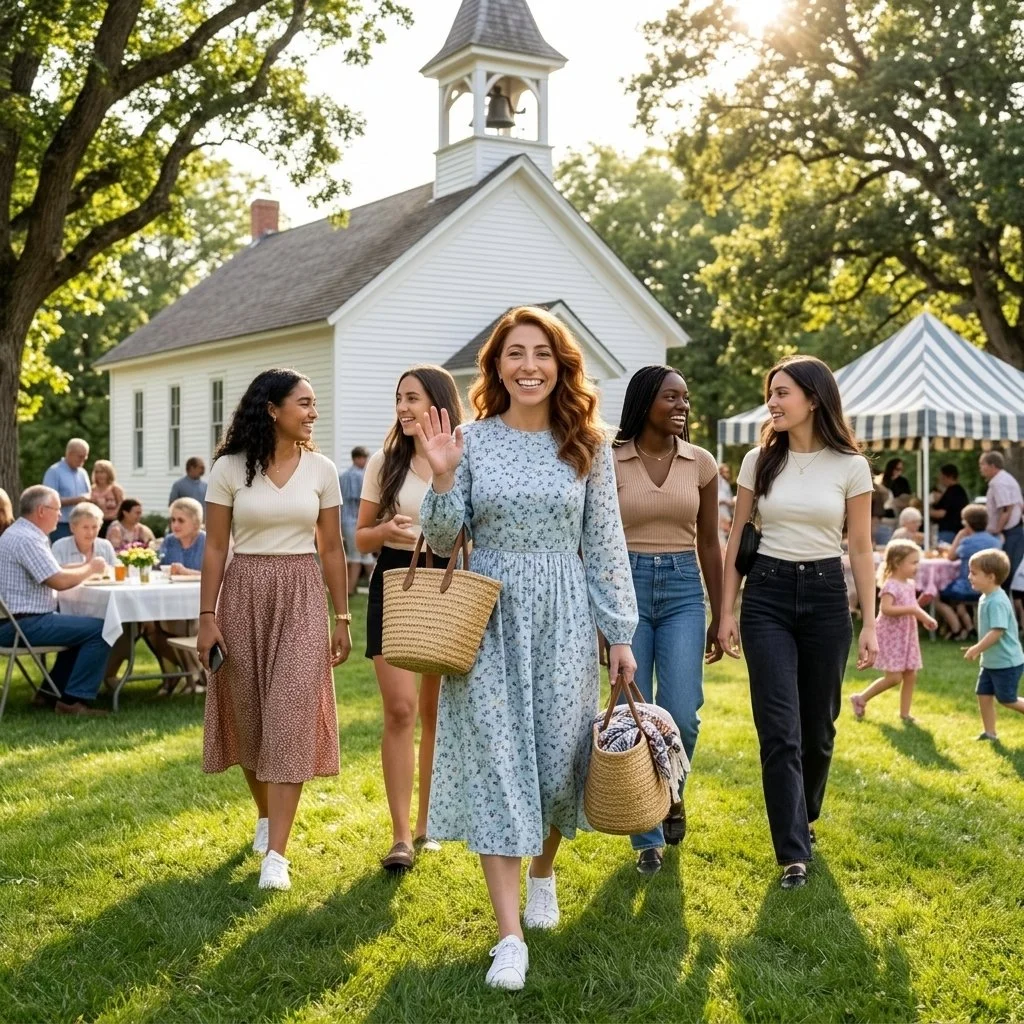
It was the kind of church picnic you'd see on the cover of a brochure. The grass was so green it looked painted. The old white chapel sat at the edge of the field with its little bell tower poking at the sky, the paint fresh, the windows clean. Someone had put up a big tent with green and white stripes, and under it the casseroles waited in neat rows, foil peeled back just enough to show off. The older members sat at a long table covered in a white cloth, fanning themselves with folded bulletins and nodding along to stories they'd heard a hundred times.
Everyone was in their Sunday best. Pressed shirts. Sundresses. Smiles polished to a shine. The laughter was just loud enough to announce that everyone was fine. Maybe even blessed.
It was late afternoon, the golden hour, when the light turns everything soft and forgiving. It caught in the trees and spilled over the lawn like honey. It made the whole scene look warm and holy and true.
But the air was thick that day. The humidity pressed down on all of us like a hand on the back of the neck. It made the smiles harder to hold. It made the masks slip.
I wasn't really supposed to be there. I'd drifted away from that church a while back, and I knew a few people would notice and say something about it later. But I came anyway, because she would be there. The girl I wrote poems about.
I had one folded in my back pocket. I'd scribbled it at red lights on the drive over, pressing the paper against the steering wheel, crossing out lines and writing them again. It was the kind of poem you write when you believe words can do what you can't. Cut through the noise. Say the thing out loud without you having to say it.
I never gave it to her. I still have it.
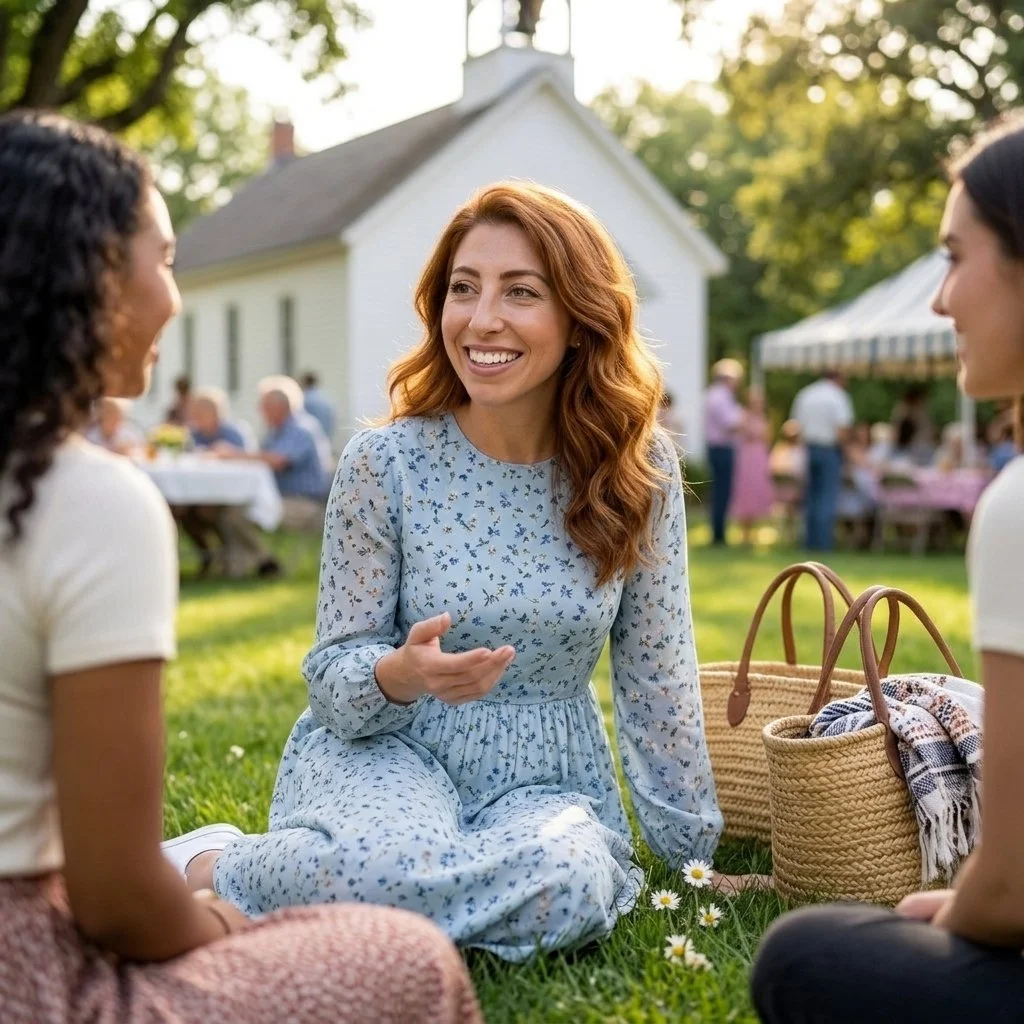
She sat down on the grass with two girls from the young adults group, one with dark curls and a rust-colored skirt, the other with long straight hair and a white tee. Her boyfriend wandered off toward the tent to find drinks. She tucked her legs under her light blue dress, the one with the tiny gray and blue flowers and the puffed sleeves, and she started talking with her hands the way she always did.
From where I stood, it looked perfect. Three friends in the sun. A striped blanket peeking out of a straw bag. Little white daisies scattered in the grass around them. If you'd taken a picture, it would have gotten a hundred likes and a few heart emojis. Someone probably did take a picture.
In my poems, I'd always written her as golden. Blonde, almost, all light and ease. But sitting there in the actual sun, her hair was redder than I remembered. Auburn. Darker at the roots. I remember thinking that it was strange how long you can look at someone without seeing the color of their hair.
I should have taken that as a warning.
It happened fast. One minute she was laughing with the girls. The next, she was standing beside me, her hand on my elbow, steering me away from the tent, past the long table of older folks, toward the shade near the side of the chapel where the paint was starting to peel.
Her smile was gone. Not faded. Gone, like a light switched off.
"I'm not who you think I am," she said.
Her voice was low, but it cut through the hum of the picnic like a blade. It felt like she'd snapped a cord I didn't even know was tied between us.
I didn't say anything. I didn't know what to say.
"I'm just out of treatment," she told me.
Her voice cracked on the last word. It broke in places she couldn't hold together, like fault lines running under a town that looks fine from the street. Then she smiled again, but this smile was different. It wasn't effortless. It was heavy. It had the weight of a battlefield in it.
"I probably should go back," she said, and she laughed, low and bitter, the corners of her mouth pulling tight.
What came next wasn't a conversation. It was a flood.
She told me about the bathroom at her old apartment. The lines on the edge of the sink, cut with a library card because it was the only one she had. How she'd do them before Wednesday night small group so she could sit through it smiling. How she'd come home afterward and the high would drain out of her like bathwater, and she'd sit on the floor with her back against the wall until the sun came up.
She told me about the nights she cried herself to sleep. She didn't say it dramatically. She said it like a weather report. Like it was just a fact of the climate she lived in.
And as she talked, I started to see it.
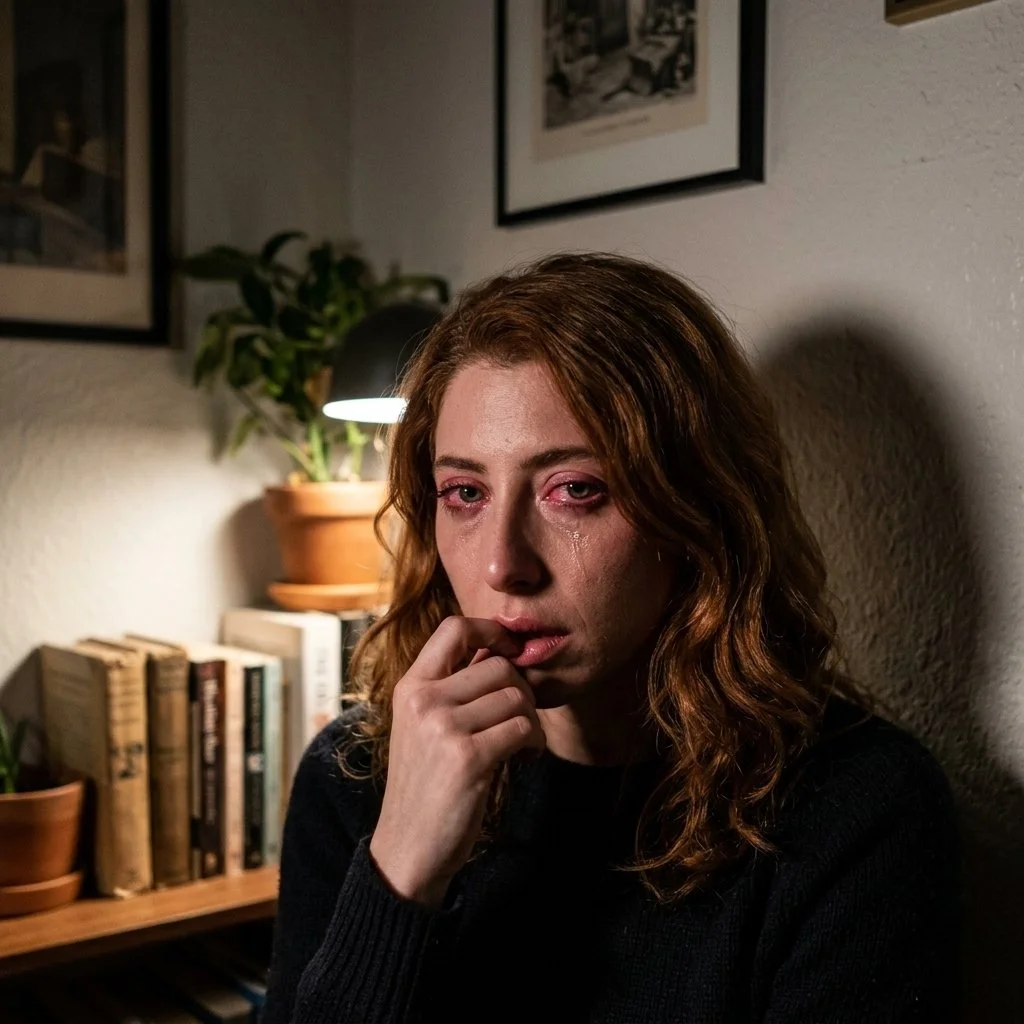
I pictured her in that apartment I'd never been inside. A small room, lit by one dome lamp on a wooden bookshelf. A row of old hardcover books with faded spines. A little terracotta pot with a plant she probably forgot to water. The lamp throwing warm light across half her face and leaving the other half in shadow. Her eyes swollen and red. One tear sliding down her cheek. Her fingers pressed to her lips, not to stop herself from talking, but to stop herself from making a sound. Because even alone, she'd learned to be quiet.
That was the girl behind the girl at the picnic. That was the room behind the brochure.
It was as if someone had peeled back the version of her I'd built in my head, the perfect posture, the easy laugh, the golden hair, and for the first time I saw someone real standing in the middle of her own storm.
I've heard a lot of sermons in my life. None of them hit me as hard as that.
It didn't take long for the girls to notice.
We were tucked against the side of the chapel, half-hidden, and that was enough to draw attention. The two from the blanket came over first, then a third. Their voices were loud and sweet, sugar on top and something sharp underneath.
"Everything okay over here?" one of them asked, tilting her head. Her eyes moved from my face to hers and back again, collecting evidence.
It wasn't concern. It was surveillance dressed up as kindness. I'd seen it my whole life in that church. The casserole after a funeral that comes with a question. The prayer request that's really a rumor with a bow on it.
She didn't even turn around.
"Don't talk to me."
Quick. Flat. Final.
The girls blinked. One of them laughed a little, the kind of laugh you use to pretend you weren't just slapped.
Then she turned on them, and the polished surface of that afternoon cracked straight down the middle.
"I didn't want to go on that trip," she said. "I didn't want to get baptized. I did it because everyone was watching and I didn't know how to say no. And I wish you'd stop showing everyone those photos."
I knew the photos she meant. Everyone did. Her in a white T-shirt, standing waist-deep in a lake, arms crossed over her chest, a pastor's hand on her back. Water streaming from her hair. Smiling. Those pictures had been passed around on phones for months, held up as proof of something. Proof of God working. Proof of a soul saved.
Now I wondered what that smile had cost her. I wondered if she'd gone back to that lamp-lit room the same night, still smelling like lake water, and sat on the floor.
She looked at me. "You know Pastor X?"
I hesitated. "Yeah."
"Well." She drew in a breath, and when she spoke again, the words hit like bricks thrown through stained glass. "He's a raging alcoholic. And so is she." A nod toward someone near the tent. "And him. And that whole table, half of them. You think this church is authentic? Everyone's fake."
Somewhere behind us, a kid shrieked with laughter. A screen door banged. Someone called out that the peach cobbler was ready. The picnic kept going, sunny and oblivious, like a movie still playing in an empty theater.
The girls tried again. Their voices were higher now, faster, a little desperate. It wasn't about her anymore. It was about restoring order. About putting the lid back on before anyone else smelled what was inside.
"We just think maybe you should sit down and—"
"I'd appreciate it," she said, cutting through them cleanly, "if you'd stop interrupting Mitchell and me. Please."
That please was the most devastating word I heard all day. It was so polite. So perfectly Sunday-school polite. She'd turned their own weapon around and handed it back to them.
They left. Slowly, with looks over their shoulders, already composing the story they'd tell later. I could practically hear it. We were worried about her. We tried. Bless her heart.
She turned back to me, and her hair swung across her shoulder like punctuation at the end of a long, brutal sentence.
"Things change," she said. Her voice was softer now, like she'd spent everything she had on those last few blows and had nothing left but the truth. "People get involved. And the past you think you know, it starts to blur."
I knew she was talking about us. About whatever we had been, or almost been, before treatment and lakes and new boyfriends carrying coolers across the grass. I felt the poem in my back pocket like a stone.
For a second, I thought she would cry. Her eyes went glassy. Her chin trembled once.
But she didn't cry. She laughed, a short, huffing sound that was more surrender than joy.
"You think you'll figure it all out?" she asked. "That there's some kind of closure waiting for you at the end of all this?"
She looked right at me then. Searching. Like she was trying to find someone in my face who would understand.
"There's no closure," she said. "There never will be."
Across the lawn, her boyfriend was coming back from the tent with two plastic cups of lemonade, squinting in the light, looking for her.
She saw him. And just like that, her face rearranged itself. The smile came back. Not the battlefield smile. The brochure smile. Bright and practiced and flawless.
Before she walked away, she did one last thing. She looked at me, raised one finger, and pressed it to her lips.
Shh.
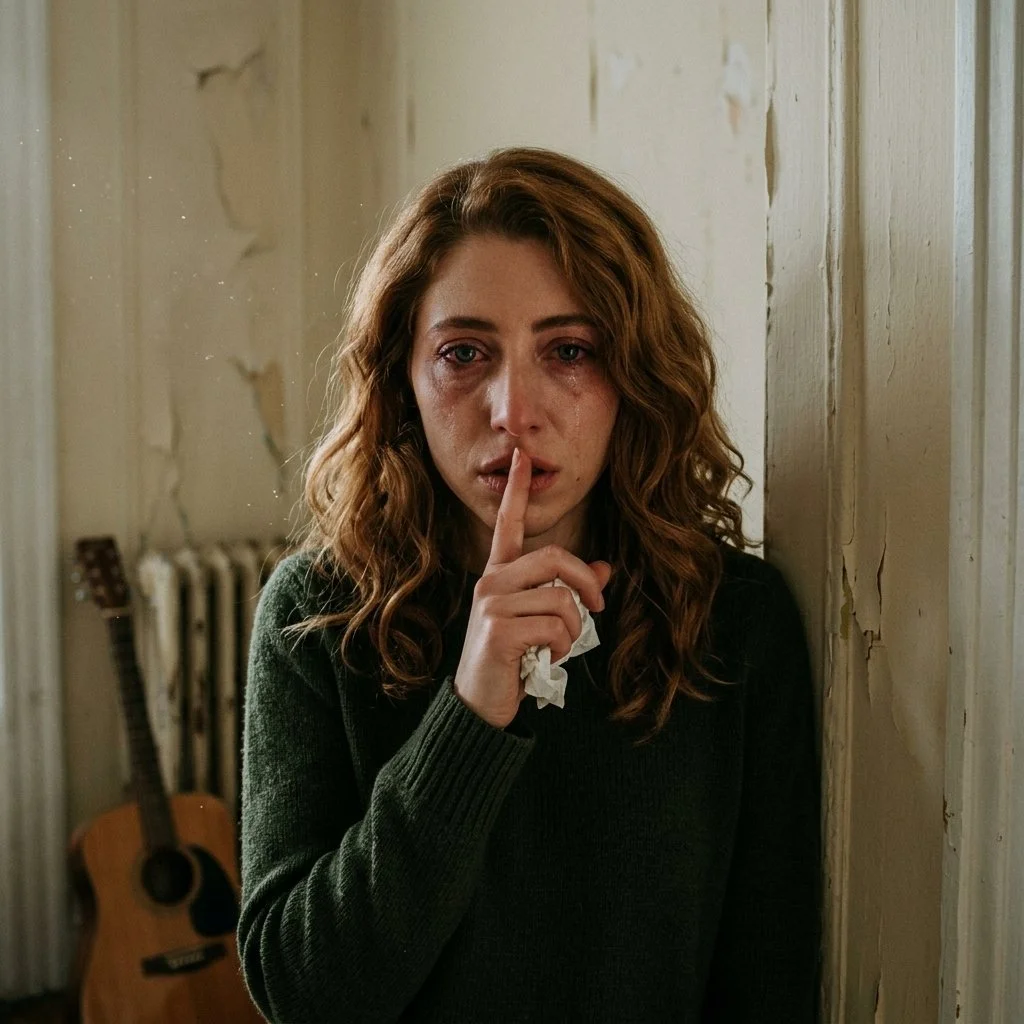
It was a small gesture. Almost playful, if you didn't know. But I knew. And in that moment I could see her somewhere else entirely. A rundown room with peeling walls, an old radiator, a guitar leaning in the corner. Dust floating in a beam of weak light. Her in a dark green sweater, a crumpled tissue between her fingers, tears on her face, and that same finger pressed to her lips. Telling the whole world to be quiet. Telling herself.
Then she turned, took the lemonade from his hand, and laughed at something he said. The sun caught her hair and turned it gold again.
I stood in the shade of that white chapel for a long time after she left.
The picnic went on. People ate cobbler. Someone started a game of cornhole. The older folks at the long table stretched and gathered their things. The bell tower stood against a sky that was going pink at the edges. Nothing about the scene had changed. It was still beautiful. Still warm. Still the kind of picture you'd frame.
But I couldn't see it the same way.
Every smile looked like it had a room behind it. Every laugh sounded like it was covering something up. I looked at the pastor flipping burgers under the striped tent and wondered what was in his travel mug. I looked at the girls on the blanket, whispering with their heads close together, and wondered what they cried about when the lamps were off.
Maybe it wasn't just our church. Maybe it wasn't just her story or this one afternoon. Maybe the whole thing had slipped into some hazy, alternate version of reality, and we'd all agreed not to notice. Maybe we were all living inside a lovely illusion, passing the potato salad and saying amen while the floor quietly gave way beneath us.
I thought about Neo in The Matrix, sitting in that leather chair, a pill in each open palm. Blue, and you wake up in your bed and believe whatever you want to believe. Red, and you see how deep the rabbit hole goes.
I wanted the red pill. I wanted to see what was real, no matter how much it hurt.
But here's the thing nobody tells you about the truth. It doesn't wait for permission. It doesn't ask which pill you'd like. Sometimes someone just pulls you behind a chapel on a golden afternoon and hands it to you, and by the time you understand what you've swallowed, it's already working.
The truth can break you.
Standing there on that impossibly green grass, with a poem I would never give her folded against my back, I realized it already had.
-Pastor Mitchell Royel