
WE WERE ALWAYS LEAVING, EVEN WHEN WE STAYED
Captured moments today in the Fashion District, 9/5/26—a mix of faces, textures, and fleeting stories held together by the rhythm of steps and shutter clicks. Rocket in the Sky by Benassi Bros and Naan played in the background, syncing perfectly with the rush and glow of the city, like it knew exactly how to soundtrack the energy we didn’t know we were searching for.
We used to treat Thursday nights like they were military operations designed by idiots.
Not dangerous idiots, exactly. Just the kind of idiots who think showing up to a kickback with six guys in one car and a half-dead phone battery counts as “making memories.” We were that very specific breed of suburban feral where nothing good ever starts with, “Yo, what if we go to another town?”
And obviously, that was always how it started.
We were kickback routey. Basement routey. Standing in somebody’s kitchen pretending to know the song routey. Disappearing for twenty minutes and coming back with our hair worse and our moral record somehow worse too. The kind of routey where somebody’s making out in a bathroom with a broken lock while the rest of us are outside debating whether the host’s dog is judging us. Which it was. That dog had seen evil.
But there was always something better about leaving.
That was the move. Crossing into other towns, other school districts, like idiots in a stolen war movie, except nobody stole anything except maybe somebody’s hoodie and the last shreds of our dignity. There was just something about being where nobody really knew us. We got to be mysterious for, like, twelve minutes. Which is huge when in your own town your reputation is basically, “Aren’t you the guys who got banned from the rec center vending machine area?”
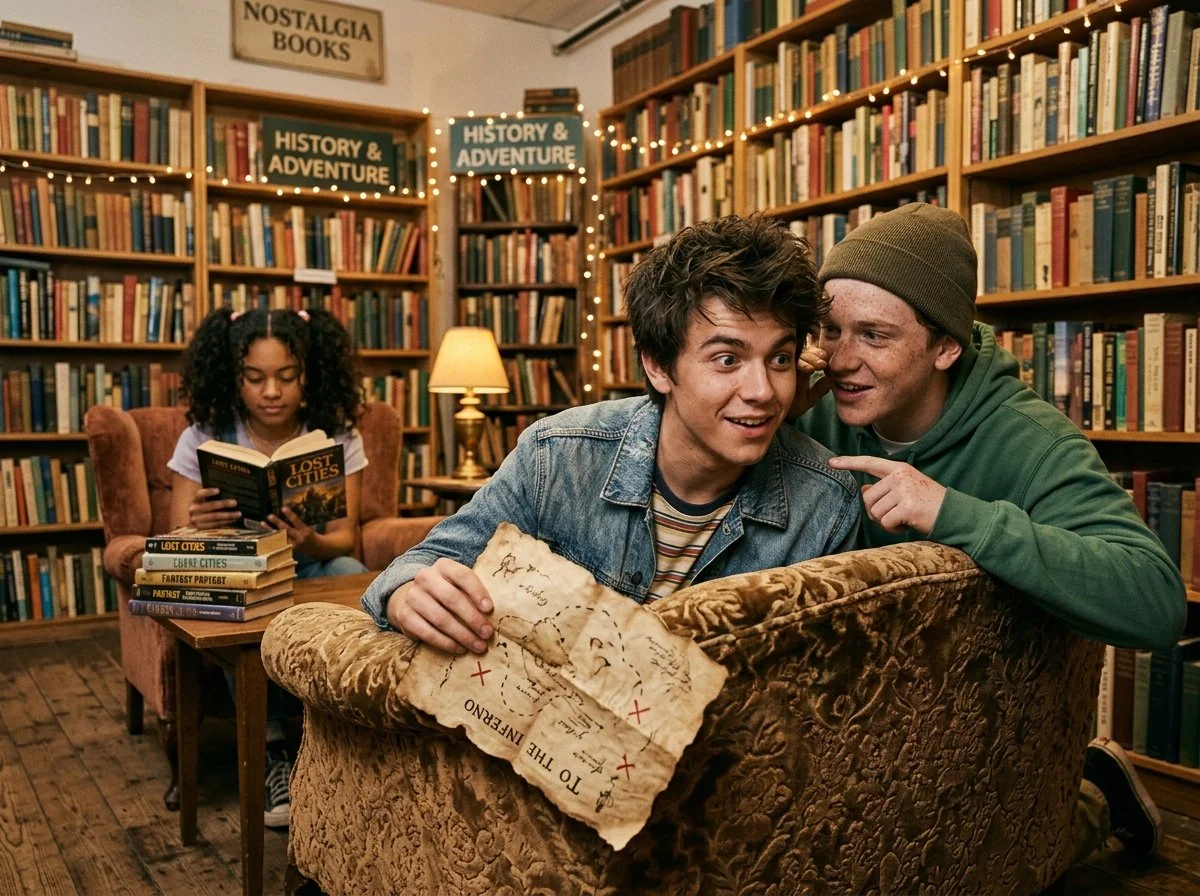
And somehow we’d end up at the bookstore.
Always the bookstore.
Because of course we were the kind of morons who’d go half feral at a kickback, then wander into a fluorescent cathedral of self-improvement and overpriced journals like we were men of literature. Just six badly supervised prophets leaning on shelves, acting like we had deep thoughts because one of us picked up a copy of Dostoevsky and said, “This guy looks upset.”
And we knew the types. We absolutely thought we knew the types.
We’d see the after-school bookstore girls like it was birdwatching for the emotionally unserious. The one speed-walking in with her backpack still on, like she was only there because home was too loud. The one sitting cross-legged in the corner absolutely obliterating a cinnamon tea while reading something with a tragic cover and zero joy. The one who shuttles there after school and clearly wants to be left alone—which, for the record, means leave her alone. Even we knew that. We were reckless, not stupid. There’s a difference. Thin difference. Medical-paperwork difference. But still.
And then there was always that one girl.
The one who wasn’t broadcasting anything. Wasn’t performing mysterious. Wasn’t begging to be figured out. She was just… elsewhere. In her head in a real way. Not in the fake, movie-scene, messy-bangs way. More like she had an entire second city running behind her eyes and the rest of us were standing outside with fake IDs trying to get in.
That kind of different messes with you.
Because suddenly the joke dies for a second. Suddenly nobody wants to do the dumb bit. You stop being a pack of hyenas in vintage zip-ups and for one weird moment you just want to level with her. Not impress her. Not run game. Just say, I don’t know, “Hey. You ever feel like everybody in our age group is doing a group project on self-destruction and nobody read the instructions?”
That was the dangerous part.
Not danger-danger. Not knives, not sirens, not the sort of thing our parents imagined when we said we were “just hanging out.” I mean emotional danger. The kind where a bunch of unserious guys accidentally become serious for ten seconds in the philosophy aisle. Horrible scene. Disgusting. Somebody should’ve called the cops.
Because we were funniest when we didn’t care. That was our whole religion. Everything was irony, deflection, fake confidence, group laughter that covered up the fact that most of us had no clue what we were doing. We were boys held together by gas station snacks, borrowed cologne, and the sacred oath of never admitting a moment affected us.
But then some quiet girl in a bookstore looks like she actually has an interior life, and now suddenly we’re all developing consciousness against our will.
Brutal.
That was the real dark humor of it. We could survive kickbacks, bad decisions, sketchy bathrooms, drives to nowhere, all of it. But one girl looking like she’d rather be anywhere else—while also somehow seeming more alive than anyone at the party—would humble us instantly. Six idiots with the social rhythm of a shopping cart, brought to spiritual ruin between Fiction and Memoir.
We liked to act like we were hunting for adventure, but really we were just orbiting anything that felt more real than us.
That’s why we kept going to other towns. Other districts. Other bookstores. Not because we were smooth, because we were absolutely not smooth. We moved like a council of cursed youth pastors. But because every now and then, in the middle of all the noise, you’d spot somebody who made you want to drop the act for a second.
And that’s rare when you’re us.
Because us, we were a mess. A coordinated mess, sure. A stylish mess on good days. But still a mess. The kind of guys who treated every weekend like a low-budget coming-of-age film directed by somebody with unresolved issues and access to a Honda. We were there for the kickback, the jokes, the disasters, the bathroom scandals, the drives, the convenience store pilgrimages, all of it.
But secretly?
We were also there for that weird, quiet hope that in some random bookstore, in some random town, we might run into a person who made us tell the truth for once.
Even if only in our heads.
Even if only for the length of one aisle.
Even if we immediately ruined it by saying something unbelievably dumb after.
Which, to be fair, we would.
Because that’s us.
-Deck

Epilogue: But that’s the thing. We were the girls in the bookstore. The cross-legged ones with tea stained lips and stories that reddened the page. The ones running fingers along spines like they might press them open and spill out on the floor. We were too quiet to be mysterious, too loud in our heads to stay home, carrying the weight of borrowed words like keys to some other place—even if the doors never promised to open.
Thursday nights weren’t made for cities like ours, but we tried anyway. Tried to build a world on parking lot neon and gas station coffee. Half-charged phones buzzing with plans that felt urgent but never were. We weren’t reckless so much as restless, hoping the next town over would care less about who kissed who, who said what, who shattered who the week before. Hoping there, we might breathe easier, speak clearer, or not speak at all—just for a minute.
The boys would crash in, loud, their energy this strange mix of tragedy and comedy, like they knew they were embarrassing and leaned into it. We had a radar for them, the six or seven of them who trickled into whatever quiet corner we’d claimed, thinking they were stealthy as they watched us like we were planets they didn’t have the math to reach. And honestly, it was harmless. Stupid. Kind of charming in the way puppies falling over their own legs are charming. But you’d catch one of them in your periphery, and... sometimes there’d be that pause.
The bad jokes wouldn’t land, because he wouldn’t make them. His friends might be orbiting the caffeine paperback display like it was Jurassic Park, but he’d hesitate. He’d do that thing where he looked at you like he was trying to understand everything and nothing at the same time. And for a second, you wouldn’t hate it. For a second, you’d feel the smallest warmth—the dangerous kind. That little wonder of being seen when you didn’t mean to be.
But nothing lasted longer than a second on those nights. Not the thrill of driving over the county line, not the half-spilled gossip, not even the melody of the last song stuck in your head. We’d leave the bookstore when they’d leave the laughter. Everything was disposable. That was the whole point, wasn’t it? To feel weightless? A little fake? To step out of your usual orbit and into somebody else's, if only for a fleeting, fluorescent-lit moment.
And maybe they went back to their car, and maybe we went back to ours. Maybe their friends made noise about the cute bookstore girls who didn’t look at them twice, and maybe our friends laughed about how those boys had less game than a thumb-wrestling contest. But secretly? Secretly we wondered.
What would they have said if they’d had the courage? What would we have said if we had the time? Would those stolen glances have amounted to anything more? Or was the magic only in the almost—not in who we were but who we imagined each other to be, for just the length of an aisle.