
Look at this photo.
Really look at it.
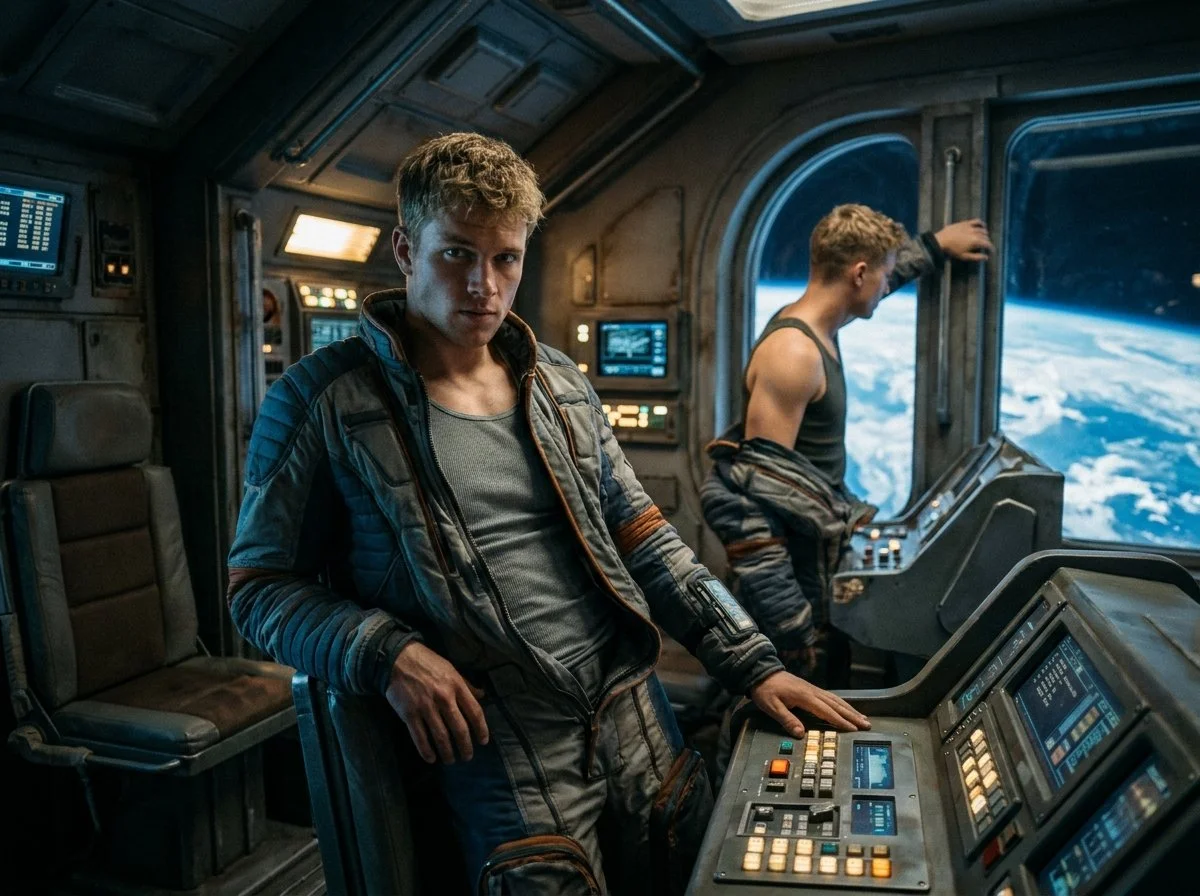
Two guys. A spacecraft cockpit. Earth hanging outside the window like it's waiting on them. Amber light cutting through the cold blue. One of them leaning into that pilot's chair like he's already been through something. The other standing at the glass — one hand pressed flat against it, holding on, or maybe just reminding himself it's real.
That's not a pose. That's a posture you earn.
I've been thinking a lot lately about what it means to go through something with someone. Not beside them — with them. The kind of with where you stop counting who did more and you just go. Where the plan falls apart and you don't look for the exit, you look at each other. That's the picture. That's what Mitchell caught. Two people on the other side of something hard, still standing, still shoulder to shoulder, staring at the world they almost didn't get back to.
The inspiration wasn't complicated. It never is when it's real. We weren't trying to make something cinematic — we were trying to tell the truth about what loyalty actually looks like when the pressure is on and nobody's watching and the people who were supposed to help you have gone quiet. It looks like this. Industrial light. Flight suits half-off. Earth in the window. And two people who decided — without saying it out loud — that they weren't going anywhere without each other.
Photos captured by Mitchell Royel in the heart of the Fashion District channel the vibrant energy of the original Kernkraft shoot, blending motion, light, and mood in every frame. The atmosphere was electric as we listened to "Kernkraft 400 (A Better Day)" by Topic and A7S, "Belly Dancer" by Imanbek and BYOR, and "Sad" by Chico Rose and Afrojack—each track influencing the rhythm of the scenes, adding layers of sound to the visual pulse of the city
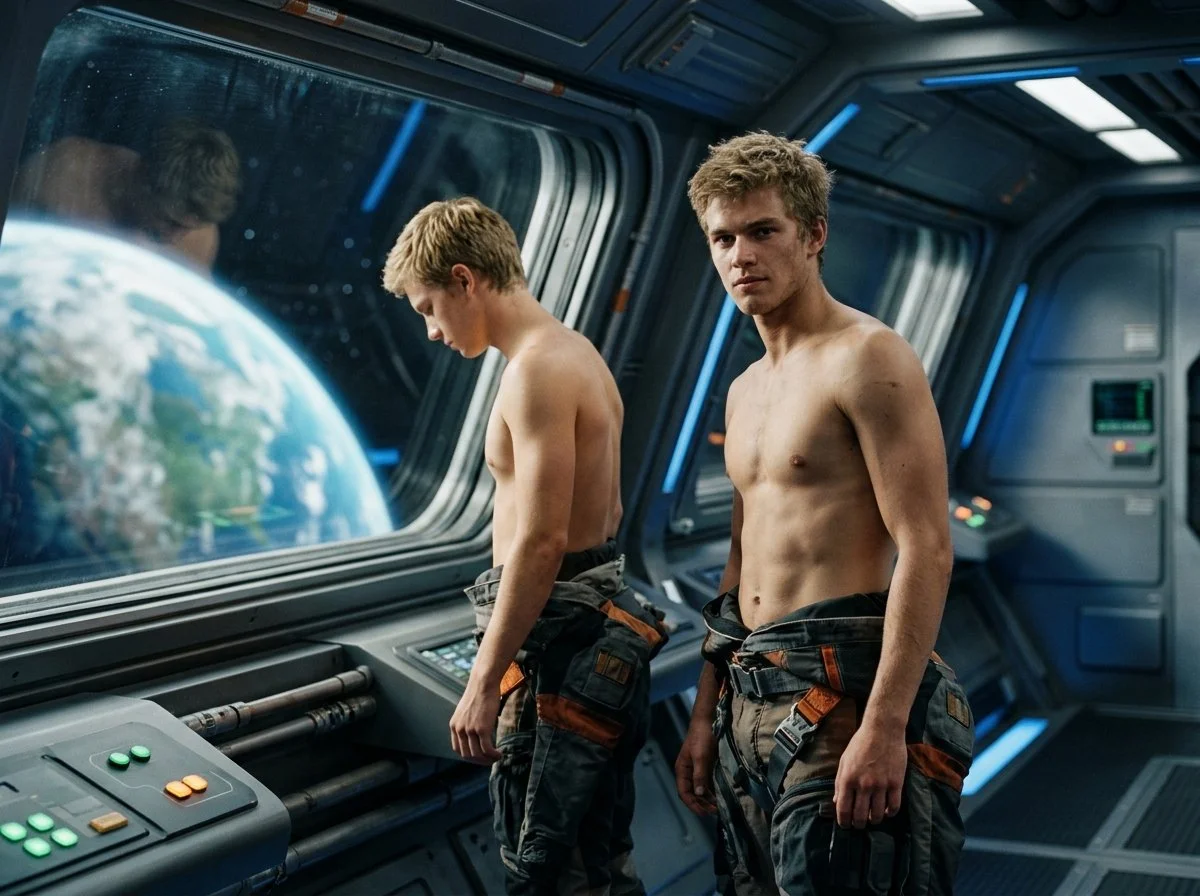
Interior. The cockpit of a battered orbital vessel. Warm amber light hums from the ceiling panels. Cool blue spills in from the window, where Earth hangs huge and silent. One brother leans against the pilot's chair, flight suit half-zipped, eyes locked on us. Behind him, the other stands at the glass, suit peeled to his waist, one hand pressed to the frame like he's holding the whole ship together.
A low pulse begins somewhere in the hull. Steady. Patient. Building.
You want to know what happened up here.
Everybody does now. Now they want to know.
Sit down. Don't touch anything. Half these buttons don't do what the labels say. We learned that the hard way.
(He glances back at his brother. Neither one smiles.)
It started quiet. That's the part nobody tells you about the worst day of your life. It doesn't kick the door in. It just starts blinking. One little orange light, right there on the panel. Then another. Then the screen that's supposed to show you where you're going just shows you static.
And we asked. We asked. We got on that channel and we said, "Talk to us. What are we looking at? What do you know?"
And they knew.
They always knew.
They sat down there under all that blue sky with the answers in their hands, and they gave us silence. Static. "Stand by." "We'll get back to you." "Don't worry about that right now."
Don't worry about it.
(He laughs, but there's nothing funny in it.)
You ever been told not to worry while the air gauge is dropping? You ever watched your brother do math on his fingers because the computer stopped answering him? Because the people who built the computer stopped answering us?
(The pulse grows louder. A second rhythm joins it, faster, tighter.)
So we did what you do.
We stopped waiting.
He took the left console. I took the right. No orders. No map. Just two people who've known each other since we were kids building forts out of couch cushions, now building a way home out of guesswork and nerve.
He'd call out a number. I'd flip a switch. Wrong. Again. Wrong. Again. Something sparked behind the wall and we both just looked at each other, like, okay. So that's how it's gonna be.
Hours. Days. I honestly couldn't tell you.
I can tell you he never once left my side.
I can tell you that when I couldn't breathe right, he talked me through it, slow and steady, like counting stars. In. Out. In. Out. Look at the planet. It's still there. We're still here.
I can tell you I'd do it again. Every second of it. For him.
(He pushes off the chair and steps toward us. Closer now.)
And then it was over.
The lights went green. The hatch opened. And somebody stood in the doorway with a clipboard and a little smile and said:
"You know none of that was real, right?"
(Beat.)
Box and string. That's what they called it. A test. A setup. A room with some wires and a window and a story. Just a box and a string, boys. Nothing to get worked up about.
(The rhythm cuts to almost nothing. Just one heartbeat pulse.)
Let me tell you something about the box and the string.
You remember that old story? Plato's Cave? People chained up in the dark, staring at a wall. Somebody walks past a fire behind them and they see shadows. Shapes. And that's their whole world. That's all they know.
And everybody outside the cave gets to feel real smart about it. Look at those poor guys. Scared of shadows. Don't they know it's just puppets?
Sure.
From out there, I bet we looked ridiculous. Two kids sweating over flickering lights. Screaming at a radio. Holding on to each other like the sky was falling.
From out there, it was shadows on a wall.
From in here?
(He points at the floor. Hard.)
From in here, the fear was real. The cold was real. My brother's hand on my shoulder was real. Every choice we made with half the information and none of the help was real.
You don't get to stand outside the cave, holding the truth you never shared, and tell us the dark wasn't dark.
You don't get to keep the map in your pocket and then laugh because we got lost.
(The pulse returns. Stronger. Faster. The build is coming.)
So here's what we're not gonna do.
We're not gonna say sorry.
Not for being scared. Not for fighting. Not for taking it seriously when you wouldn't. Not for the bruises, or the yelling, or the night he cried and I pretended I didn't see, or the night I did and he pretended right back.
We're not gonna shrink it down to fit your clipboard.
We're not gonna call it "just a test" so you can sleep better.
Because whatever it was to you, it made us. Every wire we got wrong taught us something. Every hour of silence taught us who'd stay. And he stayed. And I stayed. And we walked out of that hatch different than we walked in.
(His brother finally turns from the window. They lock eyes.)
Stronger. Closer. Awake.
(The rhythm explodes. Full volume. Every light on the console blazes at once.)
So go ahead. Call it shadows. Call it cardboard. Call it a box and a string.
We'll call it the day we found out what we're made of.
We'll call it the fire that forged us.
We grow through what we go through, and we are done apologizing for the growing.
(He turns to the window. Shoulder to shoulder now. Earth glows beneath them, enormous and blue.)
Look at that.
Still there.
Still here.
And tomorrow?
Tomorrow's gonna be a better day.
(The music hits its peak. Hold on the two of them, backlit by the world. Cut to black.)
-Deck
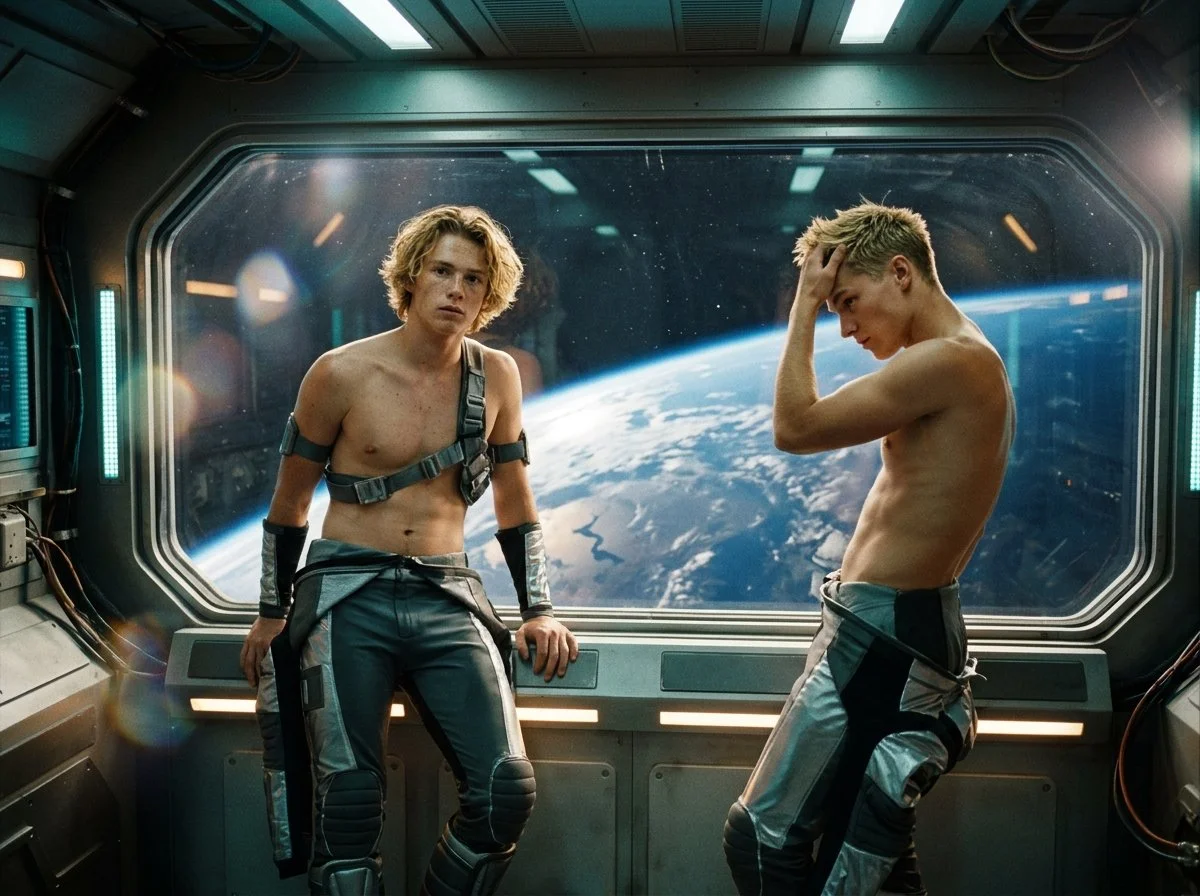
Reversal: (Interior. The cockpit of a battered orbital vessel. Warm amber light hums from the ceiling panels. Cool blue spills in from the window, where Earth hangs huge and silent. One brother sits against the pilot’s chair, elbows on his knees, head tipped back like he’s catching his breath. Behind him, the other stands at the glass, same posture, same stillness. One hand raised, palm pressed to the curve of the window, the other clenched tight at his side.)
There’s this idea people love. It’s a good idea. They’ll talk about it in speeches, write it on posters, stick it in movies where everybody knows how the story’s gonna end—you know what it is. The idea about how we fall back on training when we’re scared. When things go sideways, when what you were counting on slips, you don’t think. You don’t hesitate. You just shift into gear and go.
It’s a nice thing to believe in.
(His brother turns slightly toward him—an unspoken question. He holds up a finger. Hang on.)
But here’s the thing they won’t tell you. Sometimes the training’s not there. Sometimes the setup doesn’t work the way they said it would, and the people giving instructions forget to say that part out loud. And then it’s just you. Just two people out of their depth with a problem bigger than both of you. And you know what?
(He leans forward now, sharper, eyes lock on us like he’s steering.)
Sometimes that’s enough. Just having a dream stupid enough—big enough—to make you think, yeah, fine, we’ll figure it out. A dream that leaves room for mistakes, for wrong turns, for hands pressed to walls where the cracks start to show. A dream that scares you so much even trying feels like madness. To other people, bizarre. But that doesn’t stop it. And it shouldn’t.
(From the back, his brother looks over his shoulder again. This time, he waits for the end.)
We leaned on each other when nothing else would hold. We made it because we decided we would. No perfect plan, no guarantees, just nerve and each other. That kind of ambition, the kind that sticks when every light goes out—that’s what gets us through.
(The low pulse in the hull builds steady again. Their shoulders shift toward the window as Earth turns beneath them, shining.)
And here we are. Still there. Still here. Still believing in the dream, even when it feels too big for the cage holding it.
Tomorrow’s gonna be a better day.
(The music swells. The light through the glass flares on their faces. The screen cuts to black.)