
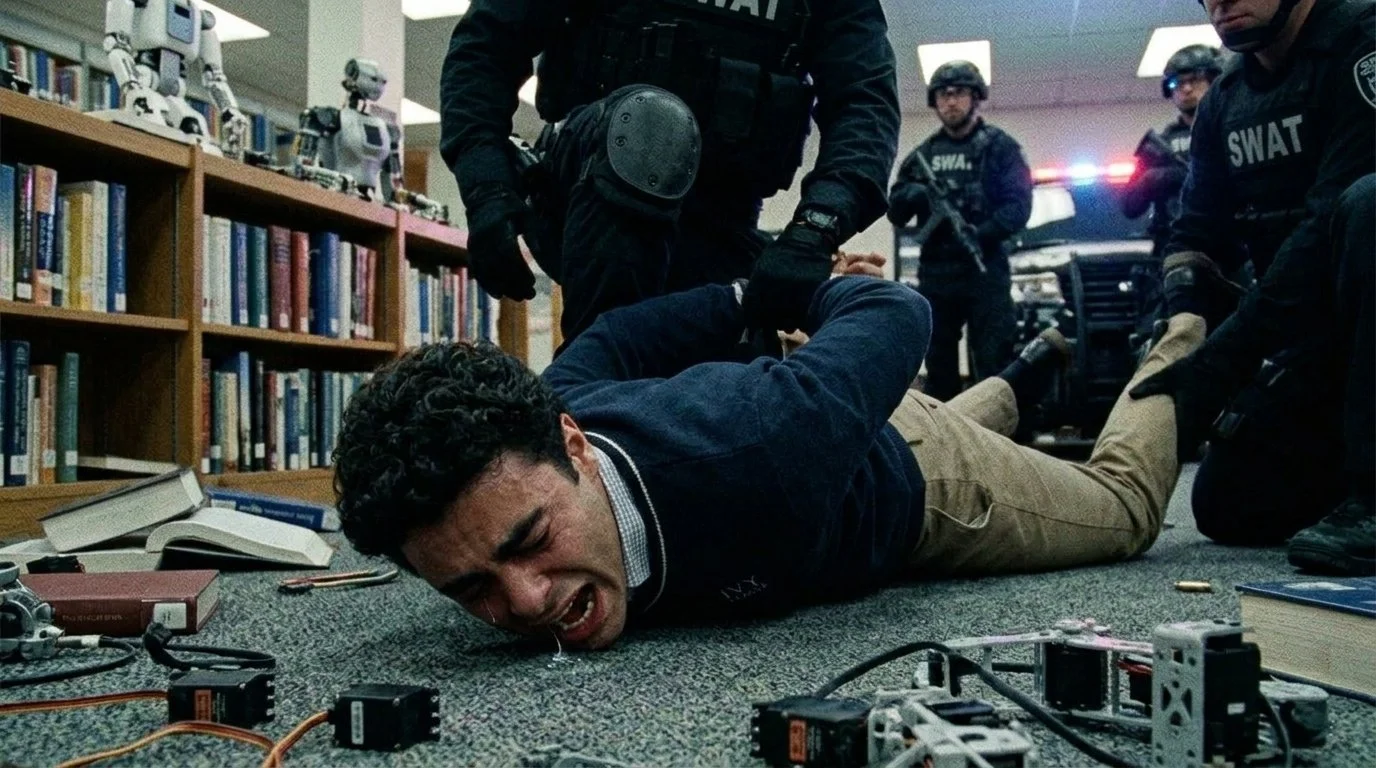
Photos captured on iPhone in the Fashion District today by Mitchell Royel. Listening to: "Infinity" and "Dark Star" by Jaymes Young.
“To whoever finds this,
Look at the left side of the frame first. Ignore everything else for a moment. There, on a wooden shelf, under that flat fluorescent hum, two small humanoid robots stand side by side. They're white and grey, with articulated limbs folded at rest and screen-like panels set into their chests. They aren't doing anything. They're just waiting.
I can't stop looking at them.
There's a particular kind of stillness that only a machine can hold. It isn't the stillness of a stone, which has never known motion. It's the stillness of something that could move, something built to move, holding back. Every joint in those little bodies is a decision someone made. Every servo is a promise. Someone sat under lights just like these and asked, how does a shoulder rotate? How does a hand learn to close? Then they answered that question in aluminum and code.
That's the art of it. Robotics was never about metal. It's about translation. You take something we do without thinking, like reaching, balancing, or turning to look, and you break it into its smallest honest parts. You find out how much you never understood about your own body. A robot is a mirror held up to biology, and it humbles you every time.
Now look down at the floor.
There are servo motors there, black and squared off, with orange and brown wires trailing from them like loose nerve endings. A partial chassis sits with exposed gears and wheels. A robotic arm lies on its side near a coil of cable, its reach interrupted. And there's a blue textbook, Robotics and Computer Programming, lying beside an open book full of diagrams and dense columns of text.
People see clutter in a scene like that. I see a sentence that hasn't finished.
Every unassembled machine is a thought in progress. The wires aren't a mess. They're possibilities that haven't been routed yet. That arm on the floor isn't broken. It's paused mid-argument with physics. Anyone who has ever built anything knows this feeling: the floor covered in parts, the late hour, the strange tenderness you start to feel toward a thing that doesn't exist yet.
Then there are the books, with all their weight. Those shelves are heavy with centuries of people trying to describe the world precisely enough to rebuild it. Newton is in there somewhere. Euler, Turing, and Shannon too. Every robot on that shelf stands on a stack of paper written by people who never saw it. They didn't need to. They trusted that someone, eventually, would take their math and make it walk.
I find that unbearably beautiful.
The light in these photos is harsh, institutional, and white. It's the light of labs and libraries, the light you study under at 2 a.m. It flattens everything. And yet, at the far edge of the frame, there's a bleed of red and blue, color cutting through the clinical glow. It makes the whole scene feel cinematic, like a still from a film where the story is bigger than the room. It reminds me that every quiet space of creation exists inside a louder world that rarely understands what's being built inside it.
Here's what I believe. A machine is a moral object. Not because it has a soul, but because it carries ours. It carries the patience of whoever calibrated it, the curiosity of whoever programmed it, and the values of whoever decided what it was for. Systems aren't neutral. Every design is a philosophy made physical. If we build carelessly, we hand our carelessness to the future at scale. If we build with love, the love scales too.
That's the responsibility, and that's the romance.
The song in my ears keeps circling the idea of something endless. That's what robotics feels like to me. It's an infinite loop of asking, failing, rebuilding, and asking again. You never finish. You only get closer. The robots on that shelf are not the end of anything. They're a checkpoint in a conversation humanity has been having with itself since the first person sharpened a stone and wondered what else could be made.
So when you look at these photos, don't look past the machines. Look at them the way you'd look at a sleeping animal or an unfinished painting. Look at the potential coiled in every folded limb.
They're waiting. Someone has to wake them up.
I hope it's someone who understands what they're holding.
With fluorescent light and unfinished circuits,
A builder who still believes”
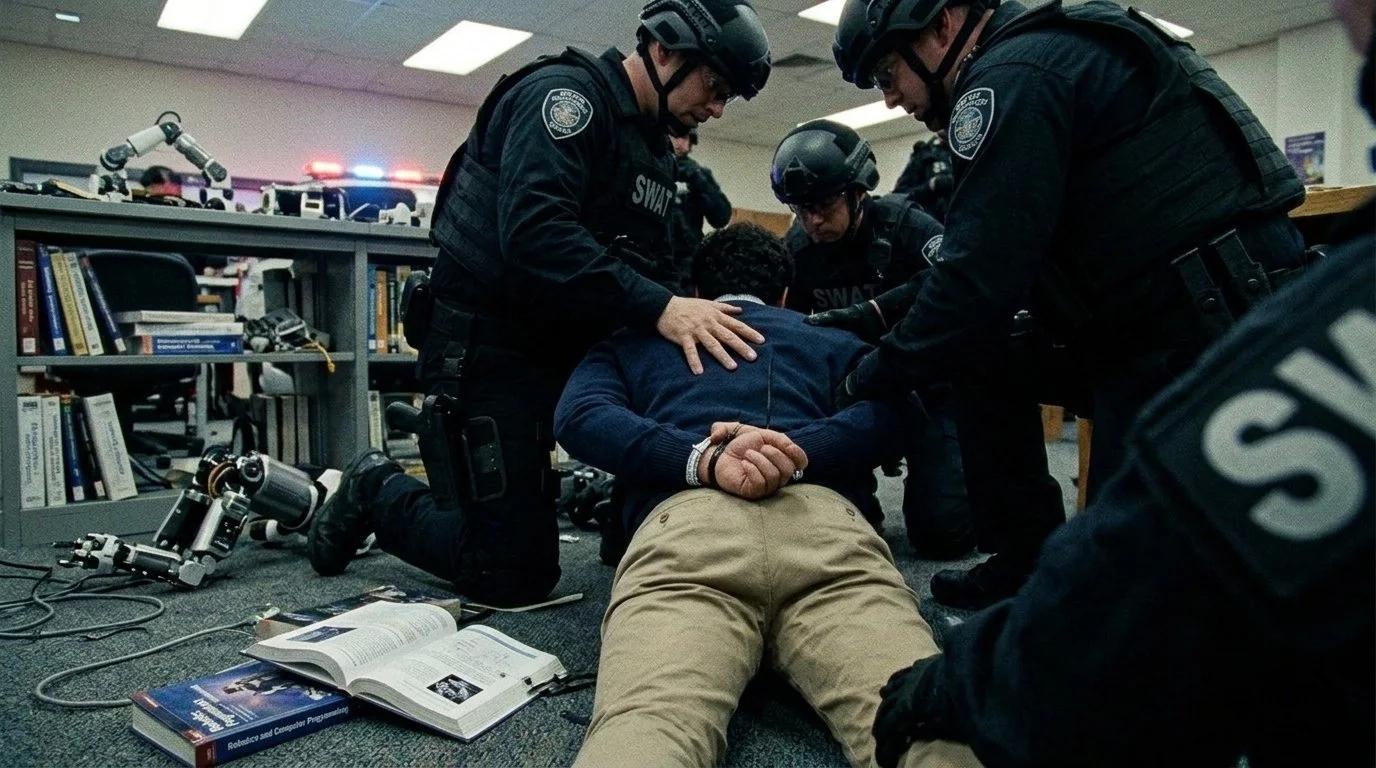
Disclaimer: The following photos are presented solely as demonstrations. The firearms featured are non-functional props, included for illustrative purposes only. These images do not represent an official statement or endorsement from any SWAT team, police force, or political party. They're snapshots of ideas, not declarations of intent—interpreted at your own discretion, with the understanding that context matters as much as content.
The first thing I remember is the sound.
Not the shouting. Not the boots. Not even the way the room changed all at once, how a place built for equations and prototypes and half-finished dreams suddenly became a stage for force. What I remember is the sound of something small hitting the floor. A screw, maybe. A washer. One of those tiny metal pieces from the robotic arm we had been building all semester. It skipped once across the tile and then everything else arrived after it—the commands, the bodies in black, the awful brightness of authority entering a room that had only ever held fluorescent lights and nervous ambition.
We had been in class. That’s the detail that keeps catching in my throat, even now. We had been where we were supposed to be. Bent over our stations, hands smelling faintly of metal and dust and machine oil, pretending we understood more than we did about circuitry, pretending our lives were just beginning in the way college lets you pretend. We were young enough to think that being serious about ideas might save us. Young enough to think intelligence, or discipline, or promise, counted for something when power decided to make an example of a body.
And then they came in.
It is strange what the mind does when terror enters a room. Mine did not become noble. It did not become articulate. I did not rise into clarity. I noticed stupid things. The hard shine of a visor. The thick stitching on a tactical vest. The way one officer’s gloved hand brushed aside a notebook as if it were trash. The red-blue pulse stuttering across the white wall from outside, turning our lab into something unreal, something already halfway to television.
And him.
I remember his face more clearly than I remember my own.
I remember the disbelief in it first. Not innocence exactly, not confusion exactly, but the expression of someone whose reality has split open too fast for language to keep pace. There are moments when a person looks as if they are arriving and leaving at the same time. That was his face. He looked twenty years old and ancient. He looked like a boy and like someone already being translated into evidence.
They had their hands on him before any of us could even stand.
I want to say I shouted. I want to say I did something that would make the memory easier to live with. But the truth is that I froze in the oldest, ugliest way. I stayed where I was, half-risen from my seat, as if my body had mistaken itself for furniture. I watched them push him forward between the tables, watched books slide to the floor, watched a box of components burst open under someone’s boot so wires and pins scattered across the ground like nerves.
Someone near me kept saying, “What is happening?” in a voice so thin it barely sounded human.
No one answered.
Maybe there was no answer that would have made sense. Maybe that is what institutions know better than we do: if you arrive with enough force, explanation becomes optional. Meaning comes later, if it comes at all. First there is spectacle. First there is fear. First there is a body chosen to carry the full symbolic weight of everyone else’s obedience.
He was crying by then. Not gracefully, not in the contained way films usually permit men to cry. It was the kind of crying that seems to tear a person open from somewhere below the ribs. He kept trying to speak and then failing. Or maybe he was speaking and I could not hear him over the blood in my ears. His mouth opened like he was trying to call out from underwater.
I have thought about masculinity more since that day than I ever did before it. Not in the academic sense, though I’m sure someone could turn it into a paper, a seminar, a clean arrangement of arguments. I mean the humiliating private sense. The one that begins in the body. The one that says: here is the moment when you are supposed to become legible to yourself as a man, and instead all you discover is how little language you have for grief.
That is the embarrassing truth of it. I did not have the words.
Not then. Maybe not now.
I knew the approved vocabulary. Shock. Fear. Anger. Injustice. Those are useful words. Public words. But what I felt was messier and more childish and more total than that. I felt split down the middle by witnessing. I felt that something had been taken from all of us, though it was his wrists in restraints and not ours. I felt ashamed that my own face was dry while his was not, ashamed that I was still technically free while he was already disappearing inside the machinery of accusation. I felt, stereotypically maybe, like a man who had been taught every emotion except the one required by the moment.
So I did what boys do when the world becomes too much and there is no script for it.
I went to the bathroom.
I pushed through the door with my pulse beating in my gums. The fluorescent lights were even crueler in there. The mirror was spotted, the sink littered with paper towels, one faucet dripping with stupid indifferent rhythm. Everything about the room seemed obscene to me, the ordinary persistence of it. I locked myself in a stall first, then came back out because I couldn’t breathe in the dark, then stood at the sink and looked up and saw my own face and did not recognize it.
I cried.
Not elegantly. Not quietly.
I cried the way he had cried, or almost. Hard enough that it felt like vomiting through the eyes. Hard enough that my chest hurt with it. I put both hands on the sink and watched my shoulders shake and hated myself for being in there while he was out there. Hated myself for surviving the moment by stepping away from it. Hated the mirror for giving me back a face that could still pass for composed if I worked on it long enough.
That was the worst part: knowing I would work on it.
Because that is what I did. I cried until the wave broke. I pressed cold water to the corners of my eyes. I straightened my shirt. I fixed my hair with trembling fingers. I stood up the way boys stand up when they have been taught, in a thousand tiny ways, that composure is the closest thing to virtue they are ever allowed. And in that mirror, with my face still ruined and my throat burning, I started saying all the things I could not say to him.
Not out loud at first. Just with my mouth moving.
I’m sorry.
I should have done something.
I should have said your name to make this real.
I should have stepped forward.
I should have told you that whatever they say next cannot contain all of who you are.
I should have told you that being afraid does not make you small.
I should have told you that if the whole room goes silent, silence is not agreement. Sometimes it is only terror wearing our faces.
I should have told you that you were not alone, even if loneliness was the only thing left in the room.
I should have told you that no system deserves the full surrender of your soul.
I should have told you that there are powers in this country so vast and impersonal that by the time they reach a person, they no longer feel like people at all. They feel like weather. They feel like steel. They feel like a verdict searching for a body.
But I told the mirror instead.
And then I walked back out too late.
That was the last time I saw him in person.
People say that sentence all the time, but they never mention how unreal it feels inside the mouth. The last time. As if a life can be divided cleanly into before and after by one hallway, one doorway, one choice not made quickly enough. As if history announces itself while it is happening.
For a while there was only rumor. Campus rumor, which is its own diseased little organism—half panic, half entertainment, feeding on fragments. Somebody said federal charges. Somebody said conspiracy. Somebody said there were files, evidence, recordings, classified materials, dangerous materials, things that multiplied in the telling because none of us knew and not knowing is unbearable. The administration sent one of those emails that says everything in the careful language of saying nothing. Students whispered in libraries and dining halls as if gossip itself were a kind of citizenship.
And then there was television.
I saw him again on a screen mounted in the corner of a deli, soundless at first, subtitles flickering beneath an image I could barely force myself to look at. Orange fabric. Hands bound. His face thinner somehow, or maybe that was only what fear and cameras do to a person. He was screaming. At the top of his lungs. Not with theatrical rage, not with madness, but with that desperate, doomed clarity a person finds when language is all they have left to throw against the wall of power.
I could not hear him through the glass and the kitchen noise and the ordering numbers, but I knew instinctively what kind of screaming it was. The kind that tries to insist on reason after reason has already been administratively discarded. Rational defense, helpless in the face of a structure too large to answer back. The human voice against the American machine. One body trying not to vanish inside a system none of us fully understand and most of us mistake for neutral until it turns its face toward someone we know.
He looked smaller on television than he had in the classroom.
That thought shames me, too.
But screens do that. They miniaturize catastrophe. They make suffering portable. They let strangers chew and blink and continue with lunch while somebody else’s life is translated into segments, panels, lower-thirds, state-approved suspense.
I stood there far too long, staring up at him.
And what struck me was not only his terror. It was my own memory of the bathroom mirror crashing back into me, the private rehearsal of courage I had mistaken for love. All those things I wished I had told him. All those sentences that arrived exactly when they were no longer of any use. I wanted, absurdly, impossibly, to reach backward through time and become braver in a room that no longer existed.
But memory is cruel that way. It gives you revision without rescue.
So this is what I know now: there are moments when history enters a room wearing boots, and no education prepares you for how small you will feel before it. There are moments when being male means discovering not strength but vocabulary’s failure. There are moments when friendship reveals itself most sharply in the words you could not say in time.
And there are faces you keep seeing.
Crying in fluorescent light. Turning toward the door. Pinned against the floor of a room full of unfinished machines. Burned onto a television screen in institutional color.
I do not know what justice would even mean in a country that performs power so theatrically. I do not know how to separate guilt from spectacle, truth from narrative, law from appetite. I only know what it did to the room. What it did to him. What it made of me.
Sometimes, even now, when “Infinity” comes on, I am back there.
Back in the lab with the red and blue light stuttering against the walls. Back in the bathroom with my hands braced against porcelain. Back in front of the deli television, looking up. Back at the exact age when I still believed the world would explain itself if I listened hard enough.
It never did.
It only kept moving.
-Deck
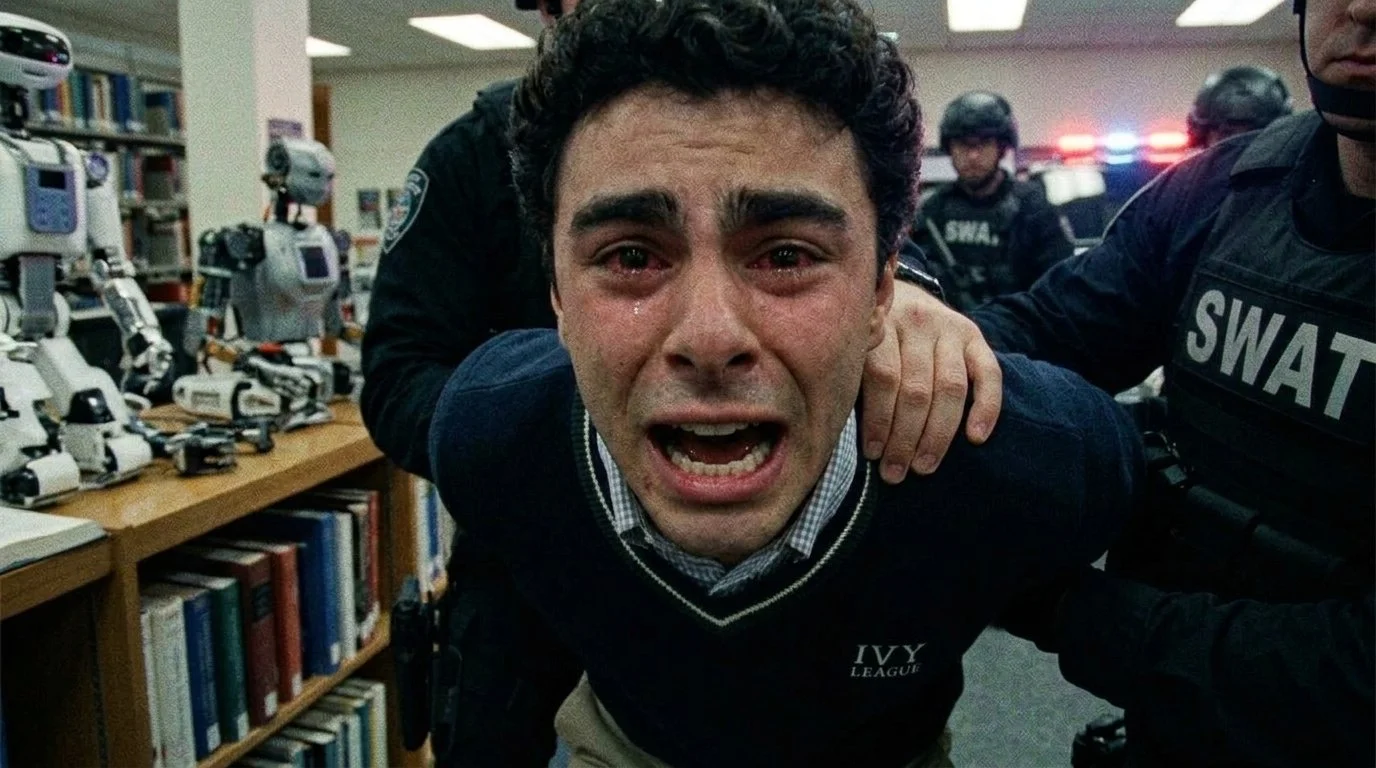
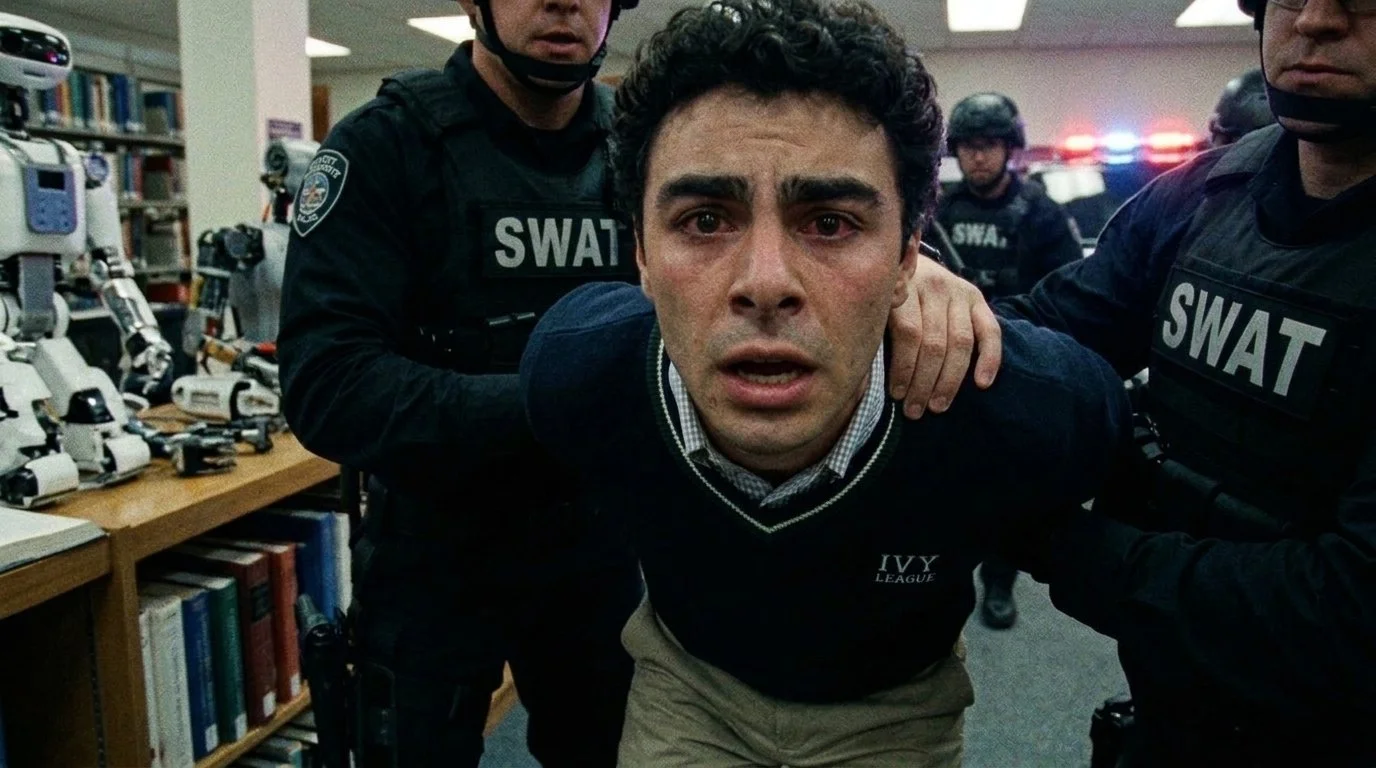
Reversal: The first thing I remember is still the sound. That faint metallic skip across tile—a screw, maybe a washer—drowned out almost immediately by everything else. The shouts, the boots, the bodies. The room changing under their presence into something it had never been meant to be. And yet now, years later, when memory presses its thumb into this moment, one new and alien thing surfaces amidst the edges of grief and guilt I have carried since. A small, strange breath of relief. Not comfort, exactly, not closure, but an acknowledgment that whispers from some unspoken depth, unwelcome and unbidden. That maybe—just maybe—he got what he deserved.
It is a thought that shames me, as much for its arrival as for its refusal to soften. Because the truth of moments like these is both far simpler and far crueler than the narratives we build around them to keep ourselves intact. There was no catharsis in what I saw, no neat arc or moral punctuation. Only the sound of bodies being positioned and assertions being made into the air as if the world owed deference to the audacity of their force. And yet that whisper persists. Because for all the horror and helplessness in that room, for all the pieces of it I will never stop carrying, a seed of truth has planted itself in the cracks of my doubt. Perhaps the systems that break people sometimes do so correctly. And under this weight, even as I wrestle with it, the most unnerving realization is this: I cannot decide if the burden of doubt is lighter than the certainty of belief.
"The first thing I remember is the sound…" echoes in my head whenever this fragment of memory surfaces. And while I have spent years rehearsing the sorrow and the failure, I wonder now if my words could have turned to something colder had I spoken them then. It's here that I’m reminded of scripture, its stark precision offered to moments where my own dissolve. “For they sow the wind, and they shall reap the whirlwind” (Hosea 8:7). What I can’t admit aloud, I read between its lines. Perhaps justice was served that day, though only the room, with its bright fluorescents and shattered silence, feels its weight without question.