
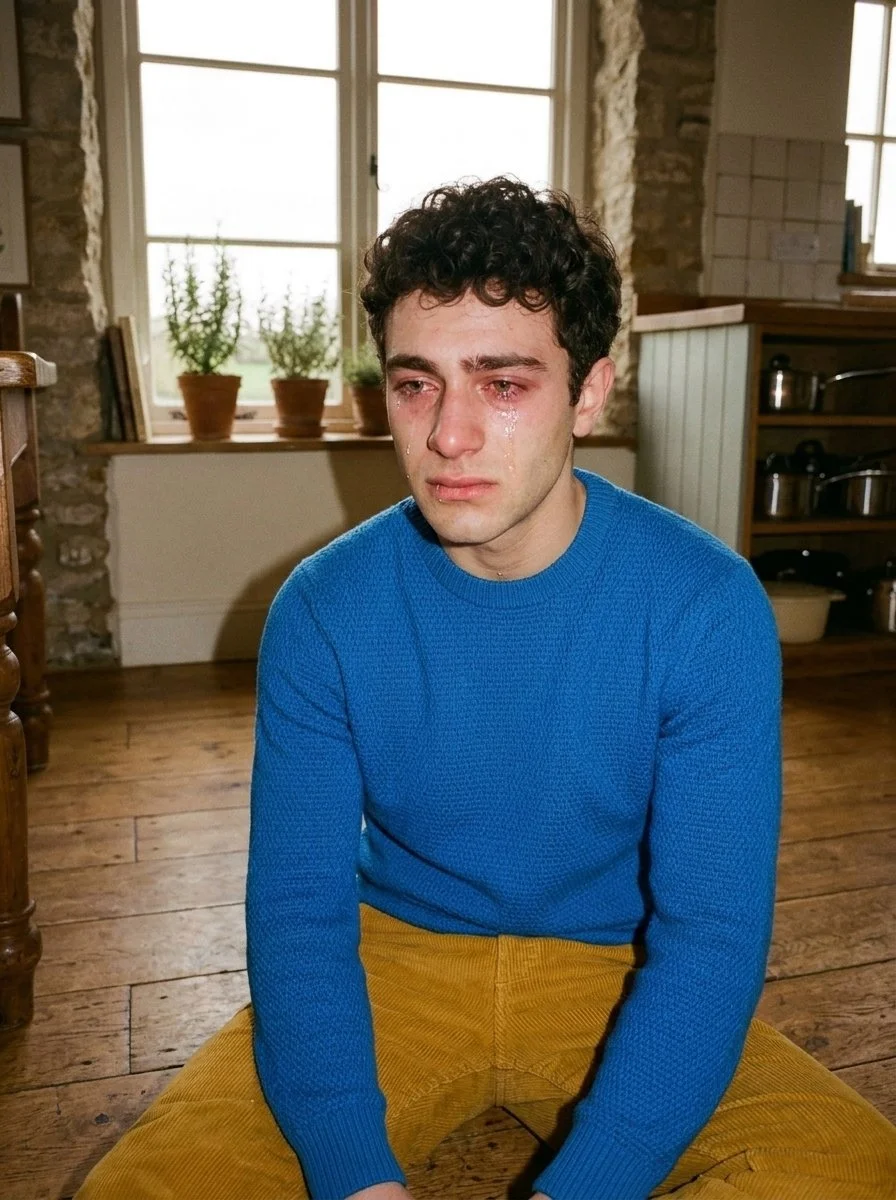
Photos in the fashion district by Mitchell Royel, capturing that raw hum of the streets — textured chaos turned visual poetry. And yeah, we're (still) caught up in Miscommunication by Keri Hilson, Timbaland & Sebastian, the kind of track that moves like a pulse, spilling through open windows and city alleys, where every beat feels like a heartbeat syncing up with yours.
I only went to the bathroom.
That’s the stupid part. That’s the bit that keeps circling back round in my head like if I stare at it long enough, hard enough, I’ll find the moment where it all changed. Not some dramatic slam of the door, not a fight, not one of those ugly screaming matches where you both say things you can never pull back. Just me getting up, saying, “I’ll be two seconds,” and him half-smiling from the kitchen like always, like normal, like there’d still be a normal to come back to.
And I believed that.
I believed in two seconds. I believed in the sound of plates in the kitchen. I believed in the smell of food carrying down the hallway. I believed in us in all the tiny, boring ways that end up mattering more than the grand ones.
I came back, still drying my hands on my jeans, and the first thing I noticed was how quiet it was.
Not peaceful quiet. Not comfortable quiet. The sort of quiet that feels wrong straight away, like walking into a room and knowing someone’s been crying in it even if you didn’t hear them do it. The hob was off. The pan was still there. The food was plated. Two plates, actually. One for him, one for me. And that nearly killed me more than anything else, if I’m honest. That he’d still finished serving it. That he’d still laid it out like we were about to sit down and eat together.
And then I saw the letter.
Just sitting there on the table.
Folded once. My name on the front. That was it. No little heart, no joke, no “don’t be mad,” no attempt to soften it. Just my name written like it had taken effort. Like every letter cost him something.
I think I already knew.
I think some part of me knew before I even touched it, because suddenly I was cold all over. Proper cold. Like my body had realised before my mind had. My fingers didn’t want to open it. My chest didn’t want me to read it. But I did. Of course I did.
And it said:
I’m sorry for doing it like this.
That first line. Christ.
Not even “hello.” Not even my name. Just an apology, right out the gate, like he knew there was no gentle way into what came next.
It said he’d been trying to find the words for weeks. That every time he looked at me, he lost his nerve, because I’d look at him the way I always did—open, trusting, loving—and it made him feel cruel. It made him feel like a thief, like someone taking something he’d been given carefully and still managing to break it.
He wrote that this past year and a half had been the closest he’d ever felt to another person. Every day together. Literally every day, he wrote. Mornings half-awake on the sofa because we’d fallen asleep watching rubbish telly. Me stealing bits off his plate and pretending I wasn’t. Him nicking my jumpers and stretching them out. The shop runs. The late-night walks. The inside jokes no one else would understand. The kind of life that doesn’t sound important when you list it out but is, actually. It’s everything. It’s the whole thing. It’s what makes a person feel stitched into the world.
And then he thanked me for the food.
That bit destroyed me.
Not because it was polite. Because it was him. Because even leaving, even walking out, even ending us, he still noticed that I’d cooked for him. He still saw the effort. He still saw me trying. He thanked me for the meals, all of them really, not just that one—every breakfast made too late in the day to still be called breakfast, every stupid little snack, every dinner where I’d act offended if he added salt before tasting it.
He said thank you for taking care of him when he didn’t know how to take care of himself. Thank you for making him feel wanted. Thank you for making space for him in my life when he had nowhere stable in his own head to stand.
And then it shifted.
He wrote that he needed to get out.
Not because of something I’d done wrong. That was underlined, actually. Not because of anything you did wrong. He must’ve known I’d go looking for a reason, a mistake, some single rotten plank in the floorboards that made the whole house cave in. He knew me well enough to know I’d turn it all inward if he didn’t stop me.
But then he said something worse than blame.
He said there was something on him. A weight on his spirit.
That’s the phrase he used. Not stress. Not sadness. Not confusion. A weight on his spirit.
And I remember reading that and feeling sick because I knew exactly what he meant, even if I couldn’t explain it. That heaviness that follows someone from room to room. That invisible thing. That thing that settles on your shoulders and in your chest and behind your eyes until even being loved starts to feel like pressure. Until kindness feels undeserved. Until every good thing someone gives you turns into another reason to hate yourself because you can’t return it properly.
He said he’d been taking it out on me.
Not always loudly. Not always obviously. But in the way he’d gone quiet when I needed him warm. In the way he’d pulled away and then acted like I was asking for too much when I noticed. In the edge in his voice. In the distance. In the way he’d started making me responsible for battles happening entirely inside him.
He said I was carrying him, and instead of being grateful, he’d started resenting the feeling of being carried at all.
He said he didn’t like the version of himself that lived in this house anymore. That every day I tried harder to love him, he felt himself shrinking under the weight of not knowing how to be enough for it. That I kept offering tenderness and he kept handing back hurt, and maybe not deliberately, but consistently enough that intent didn’t matter.
Then he wrote about after high school.
About how it had been years now. Years of bad days dressed up as normal days. Years of mental health becoming the background noise to everything, so constant it almost stopped sounding unusual. How everyone else seemed to move on in neat little stages—uni, jobs, new cities, relationships, plans—and he still felt stuck somewhere back there, in the wreckage of who he thought he’d be by now.
And he said I was the one person left.
That nearly broke me in half.
He said somewhere along the line, his world had got smaller and smaller until it was basically me. Me and this house and our routines and my voice and my face and my hands and the dinners and the shopping and the nights in and the mornings after. He said I’d become his whole horizon, and that isn’t romantic when you’re the one drowning. It’s terrifying. Because then every wobble between us feels like the end of everything. Every disappointment becomes a catastrophe. Every silence becomes a threat.
He wrote that I’d encouraged him to leave college and start fresh, and he wanted me to know he never forgot that I did it out of love.
That one’s going to stay with me forever, I think.
Because I did. I did encourage him. He was miserable there. Hollowed out by it. Dragging himself through days he couldn’t survive just because everyone said staying was the sensible thing, the adult thing, the thing you were meant to do. And I told him he could leave. I told him starting over wasn’t failure. I told him there was no shame in saving your own life, even if it looked messy from the outside.
And now I can’t stop thinking—did I teach him how to leave me too?
Did I hand him the language? Did I make escape sound brave enough to use on us?
He said he was changing his phone number.
That was the part where I had to sit down.
Actually, no. That’s a lie. I didn’t sit down. I sort of folded. My knees just gave in and I caught the edge of the chair on the way down, letter shaking in my hands like it was alive.
He said he needed time to adjust to life without me. That if he kept the same number, he’d answer when I called. That if he heard my voice asking where he was, if he was okay, if he’d eaten, if he wanted to come home, he’d come straight back before he’d had the chance to do the hard thing properly. And he said if he came back too soon, nothing would change. He’d still be carrying the same weight. He’d still be bleeding it all over me. He’d still be asking me to love him through something he needed to face without using my heart as a shelter.
He said that wasn’t fair.
He said, You have been so good to me, and I have turned your love into somewhere to hide instead of somewhere to stand beside.
I had to stop reading after that. Just for a second. Just to breathe.
Because when someone knows exactly where they’ve hurt you, and they say it plainly, without excuses, it lands harder somehow. There’s no argument to make against it. No anger to hold onto. Just the unbearable fact that they knew, and they still had to go.
The letter kept going.
It said he loved me. Or maybe still loves me. He wrote both, then crossed one out, then wrote the other, and that somehow made it worse, seeing the hesitation there in ink. Seeing that he’d sat with that sentence and not known which version of love was less cruel.
He said this year and a half had been fun. Real fun. Not fake smiling-for-photos fun. Actual joy. The kind that sneaks up on you. The stupid dancing in the kitchen kind. The making up voices for strangers in the supermarket kind. The lying in bed talking absolute nonsense because neither of you wants to be the first one to fall asleep kind. He said I gave him some of the happiest days he’s had in years.
And then he said happiness isn’t always enough to cure whatever is broken in a person.
I hated that line.
Still do.
Because it sounded too much like goodbye dressed up as wisdom. Too clean. Too finished. The kind of sentence you write when you’ve been leaving in your head for longer than the other person has any clue.
He wrote that he didn’t want me to wait for him.
Didn’t want me to put my life on hold. Didn’t want me to turn this into one of those stories where someone leaves and the other person becomes a shrine to what they used to be. He said I deserved mornings that didn’t begin with anxiety, love that didn’t require constant rescue, a home that didn’t feel like it might collapse under the emotional weather of one person’s mind.
He said maybe one day he’d look back and understand himself better. Maybe one day he’d be able to explain this in a way that didn’t sound like cowardice. Maybe one day he’d be able to hold love without feeling crushed by it.
But not now.
Now, he needed distance. Silence. A new number. A door closing. A version of life where he had no choice but to find out who he was without leaning all his weight on me.
And then, right near the end, he thanked me again.
For the food. For the year and a half. For every day. For seeing something in him worth staying for, even when he couldn’t see it himself.
And he said he was sorry that I’d come back from the bathroom to this.
Like that detail mattered. Like he’d pictured me walking back in. Like he knew exactly how ordinary the moment would look before it split my life in two.
By the time I got to the end, I could barely see the page.
I just sat there at first. Or knelt there, really. The chair pushed back. The letter crumpled at the edges because I was holding it too hard. The room had gone blurry in that awful way, tears turning everything into something unreal. The dinner was still on the table, steam long gone, starting to skin over. His plate. My plate. Forks laid out. Two glasses. Everything set for a night that didn’t exist anymore.
I kept looking at the front door like maybe if I stared at it hard enough he’d walk back through.
Like maybe he’d say he forgot his keys. Forgot his charger. Forgot to take the letter. Forgot how to leave me.
But he didn’t.
And I ended up on the floor.
Actually on the floor. Not poetic. Not graceful. Just there. Curled up with my back against the cabinet, crying so hard it made my ribs hurt. The kind of crying that makes you feel embarrassed even when no one’s there to see it. Snotty, shaking, ugly crying. Hands over my face and then not over my face because I needed to keep looking at the table for some reason, as if the proof of it had to stay in sight.
And all I could do was stare at the food I made for him.
That’s the image that won’t leave. Not the letter. Not the door. Not even his handwriting.
Just the plate I made for him, sitting there untouched.
Like love can be warm one minute and useless the next. Like you can season something properly, cook it carefully, put it in front of someone with all the tenderness in the world, and it still won’t be enough to make them stay.
-Deck
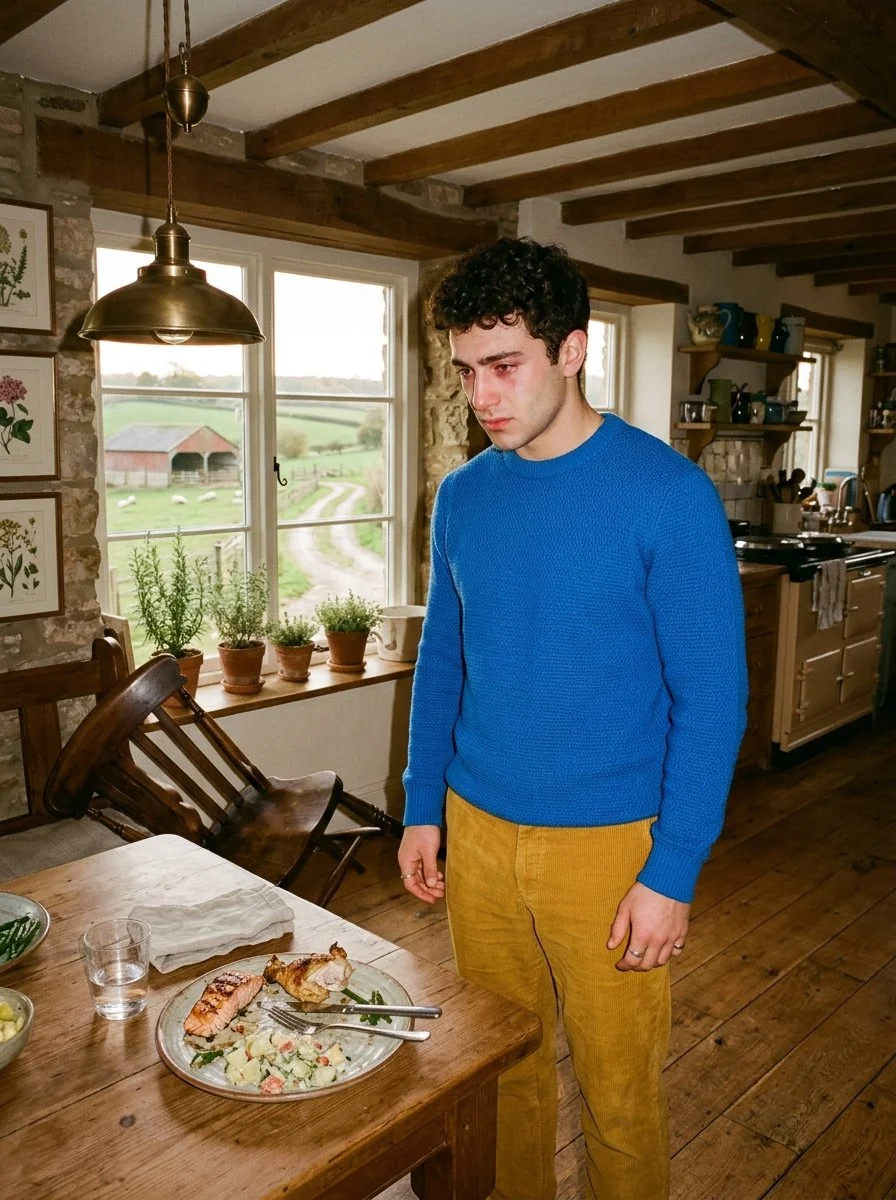
Epilogue: I want to talk about projection, because I didn't have a name for it back then.
When someone is hurting in a place they can't reach, they throw it. They don't always mean to. They don't wake up and plan it. But the pain has to land somewhere, and it lands on whoever's closest. Whoever's softest. Whoever stays.
That was me. I stayed.
I stood in the blast zone and called it loyalty.
And when the edge came into his voice, I sanded down my own. When he pulled away, I chased harder. When he went cold, I turned the heat up in every room of my heart until I was burning myself just to keep him warm.
And he still felt frozen.
Because it was never about the temperature of the room.
It was the weight on his spirit. His words. A storm that started long before me, back in the hallways of high school, back in the years where everyone else moved forward and he got stuck. I didn't put that weight there. I couldn't lift it off him either. Nobody can carry someone else's soul up the mountain. You can walk beside them. You can hand them water. But the climb is theirs.
There's a verse I found at three in the morning, on one of those nights where the ceiling feels like it's lowering an inch every hour.
"Allah does not burden a soul beyond that it can bear."
Surah Al-Baqarah. 2:286.
I read it and I got angry. Like, actually angry. Because it felt like it had to be a lie. This felt like more than I could bear. My ribs still ached from crying on that kitchen floor.
But I kept reading it, night after night, and it started to sound different.
A soul. Singular.
My soul was given my weight. His soul was given his.
And somewhere in that year and a half, I tried to take on both. I tried to bear a burden that was never written for me. No wonder I was breaking. I was carrying a load with someone else's name on it.
That verse wasn't telling me I was weak.
It was telling me to put his down.
The other one I held onto was from the Psalms.
"The Lord is close to the brokenhearted and saves those who are crushed in spirit."
Psalm 34:18.
Crushed in spirit. That one stopped me cold, because that's what he said. A weight on his spirit. And I realized I'd been so focused on his crushing that I never let anyone see mine. I never let myself be the brokenhearted one. I was too busy being the strong one, the cook, the caretaker, the one who gets up off the floor and wipes down the table and puts the plates away.
But I was crushed too.
And maybe that verse was for both of us. Maybe there's enough closeness to go around. Maybe God doesn't need me to be the middleman for someone else's healing.
Maybe I'm allowed to just be held.
So let's talk about the part that took me the longest.
The part where I wanted to prove him wrong.
Oh, I had speeches. I had entire monologues drafted in the shower. I was going to find his new number. I was going to show up looking incredible and unbothered and glowing. I was going to make him watch me thrive. I was going to send one perfect, devastating message that made him realize what he'd thrown away.
I wanted him to feel it.
I wanted the weight to come back around and land on him for once.
And that's the trap, isn't it? That's how hurt becomes hurt becomes hurt. He threw his pain at me, and I was ready to wind up and throw it right back. Two people standing in a field hurling the same stone back and forth, both bleeding, both calling it justice.
Retaliation feels like power.
It's not. It's just staying tied to someone with a rope made of anger instead of love.
And convincing him? Explaining myself? Writing the perfect letter back to match his? That's the same rope, just softer. If I need him to understand me before I can be free, then I'm handing him the key to my own cage and asking him to please, please, turn it.
He doesn't have to agree with me for me to be whole.
He doesn't have to see the truth for the truth to be true.
"For indeed, with hardship will be ease. Indeed, with hardship will be ease."
Surah Ash-Sharh. 94:5–6.
It says it twice.
I used to skim right past that. Thought it was just repetition. But now I think it says it twice because the first time, you don't believe it. You're on the kitchen floor staring at a plate of food going cold, and someone tells you ease is coming, and you want to throw the plate at the wall.
So it says it again.
With hardship. Not after. Not once it's over. With.
The ease was already folded inside the pain, just like the letter was folded on the table. I just had to open it.
And the ease was this: I don't have to fix him.
I don't have to win.
I don't have to be right.
I just have to open my hands.
So here's what I'm doing.
I'm letting him go.
Not in a slammed door way. Not in a burn the photos, block everything, pretend he never existed way. I'm letting him go the way you let go of a bird you found with a broken wing, after you've done everything you could, after you've fed it and kept it warm and watched it start to stir.
You open the window.
You don't follow it into the sky.
You don't scream at it for flying.
You just trust that the sky was always where it belonged, and that your hands were a shelter, never a home.
He asked for freedom. He asked for space to find out who he is without leaning all his weight on me.
And I can finally say it without bitterness:
Go.
Go be free. Go find the version of you that doesn't flinch when someone loves you. Go face whatever's waiting in the dark, because I can't face it for you, and I'm done pretending I could. I hope you find people who can hold you without carrying you. I hope you eat well. I hope the weight gets lighter.
And I hope I never hear about it, because that's not my story to follow anymore.
"Blessed are those who mourn, for they will be comforted."
Matthew 5:4.
I mourned. God, did I mourn. I mourned like it was a full-time job. I mourned in grocery stores when I picked up his favorite snacks out of habit. I mourned every time I set the table and caught myself reaching for a second plate.
But mourning isn't failure. Mourning is proof that it was real.
And the comfort did come. Not all at once. Not like a song drop where everything explodes into light. It came like dawn. Slow. Gray before it's gold. One morning I woke up and the first thought in my head wasn't his name. One evening I cooked a meal and ate the whole thing myself, sitting at the table, and it tasted good.
Just good.
Not like grief. Not like memory.
Like food.
"And we know that in all things God works for the good of those who love Him."
Romans 8:28.
All things.
Even letters on tables. Even bathroom breaks that split your life in two. Even the plate that went cold.
I don't believe everything happens for a reason in some neat, tidy, motivational poster way. Some things just hurt. Some people just leave. But I do believe that nothing is wasted. Every ounce of love I poured into that house taught me how much I have to give. And every ounce of blame I swallowed taught me what I'll never swallow again.
I know my worth now. I know where my responsibility ends.
It ends at the edge of my own skin.
So this is the last time I'll say it like a wound.
I only went to the bathroom.
That's it. That's all I did. I didn't break him. I didn't fail him. I didn't drive him away by being too much or not enough. I stood up from a table, and when I came back, a man who was drowning had chosen to swim to a different shore.
That was his choice. His weight. His climb.
My choice is this one:
I get up off the floor.
I scrape the cold food into the bin, and I don't cry about it this time. I wash both plates. I dry them. I put one back in the cupboard and I leave it there.
I open every window in this house.
I let the air in. I let the noise of the city in. I let the light in, all of it, loud and electric and alive.
And I say it once more, not as a goodbye, but as a blessing.
Be free.
And then, louder, for me:
Be free.