
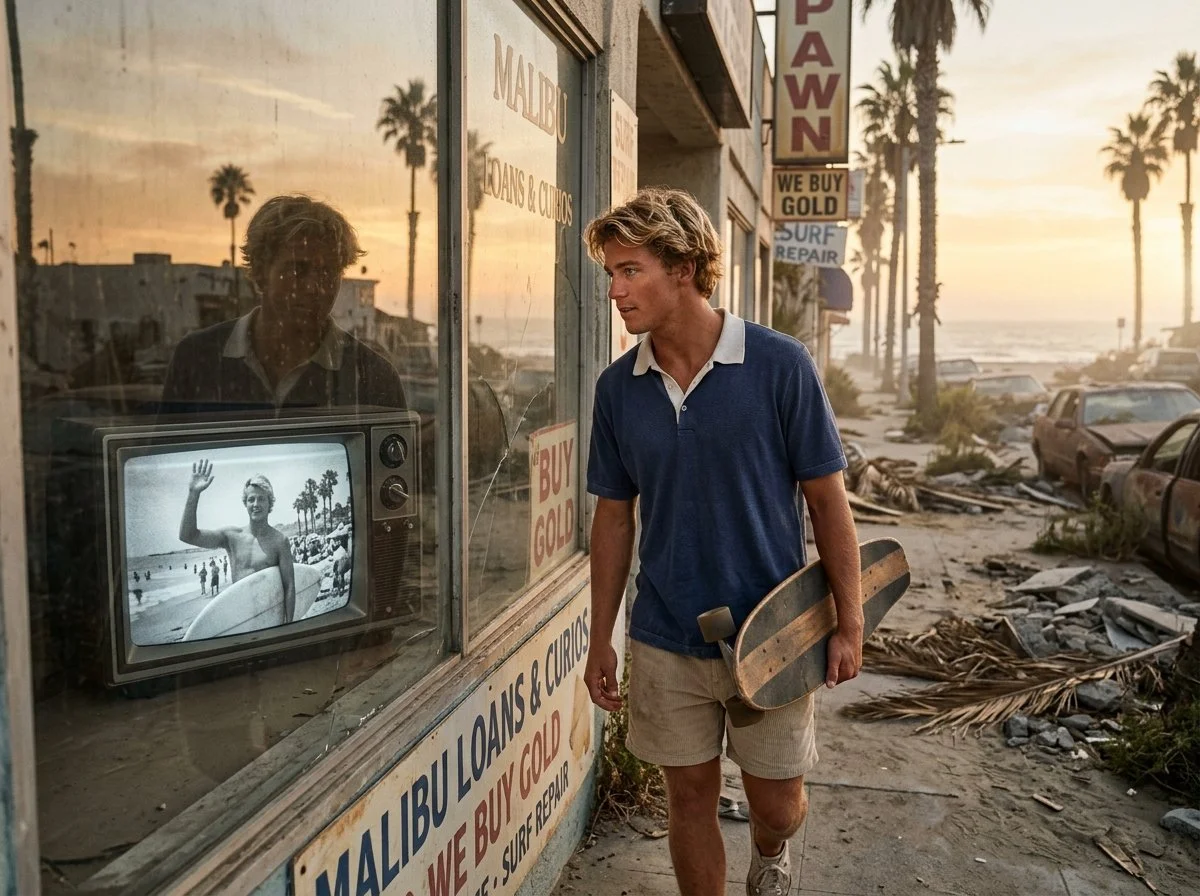
photos captured by mitchell royel in the fashion district.
set to “Amber & Amber - Live” by 311.
A few weeks ago I had this dream.
And I know everybody says that before they tell you something insane, like that somehow makes it normal, like saying I had a dream is enough to prepare somebody for what comes next. But this one was different. It didn’t feel random. It didn’t feel like one of those dreams where your teeth fall out or you show up somewhere and forgot who you are or whatever. It felt placed there. Like it had weight. Like it had been waiting for me.
In the dream, there was a war.
I never saw where it started. I never saw who was fighting it or why. That was the weird part. It was like I had missed the explanation but still had to live inside the result. All I knew was that a bomb had gone off in my hometown. Malibu. And not just near it. Not offshore. Not on the news. In it. Through it. Like it had ripped straight through the middle of everything familiar and left the outline behind.
And after that, everything was gone.
Not gone like empty. Gone like erased.
I was walking down the street and I remember thinking this makes no sense, because the street was still there, but everything that was supposed to give it meaning was missing. Storefronts broken open. Sidewalks buried in dust. Cars left where they died. Palm trees standing there like witnesses. Sand where sand shouldn’t be. Pieces of signs. Glass. Concrete. Wires hanging out of buildings like nerves. It was Malibu, but stripped of the version of itself people carry around in their heads. No shine. No fantasy. No easy sunlight. Just the bones of it.
And I was alone, but not in that horror-movie way. More like in the way a place can become so emptied out that even your own footsteps start to feel borrowed.
The crazy part is, in the dream I’d been skating all over Malibu.
Like that was just what I was doing.
Just pushing through the wreckage, carving around broken curbs, rolling past dead intersections, passing shops with their windows blown out, weaving through a town that looked like somebody had tried to remember it after forgetting half the details. I had my board with me the whole time and that felt important. I don’t know why. Maybe because in dreams you hold onto one normal thing and treat it like proof. Proof that you’re still yourself. Proof that some part of the world still works the way it’s supposed to.
And while I’m skating through all of this, I keep thinking about that old kids book.
You know the one.
The one where they keep taking and taking and taking. They suck up all the natural resources, strip everything clean, drain the world down to almost nothing, and it’s told in this way that feels simple when you’re a kid but then later it starts sounding less like a story and more like a warning. In the dream I don’t name it. I just know it’s there in my head like this little splinter. This idea that maybe nothing disappears all at once. Maybe first people use it up. Maybe first they hollow it out. Maybe ruin has a long childhood before it shows its face.
So I’m skating, and the whole place feels haunted by that thought.
Not haunted like ghosts exactly. Haunted like consequences.
Everywhere I looked, it felt like the dream was asking the same question in different ways. What happens when something beautiful is treated like it can never end? What happens when everybody thinks paradise is permanent? What happens when a place becomes an image before it remains a place?
And then I came up on this television.
Just sitting there inside a shop window.
Old box TV. Dust on the glass. Knobs on the side. The kind of television that already feels like a memory even before it’s turned on. And somehow it still had power. Somehow in the middle of all that wreckage, with the whole town blown open and emptied out, this one screen was alive.
So I stopped.
I rolled up to the window and looked in.
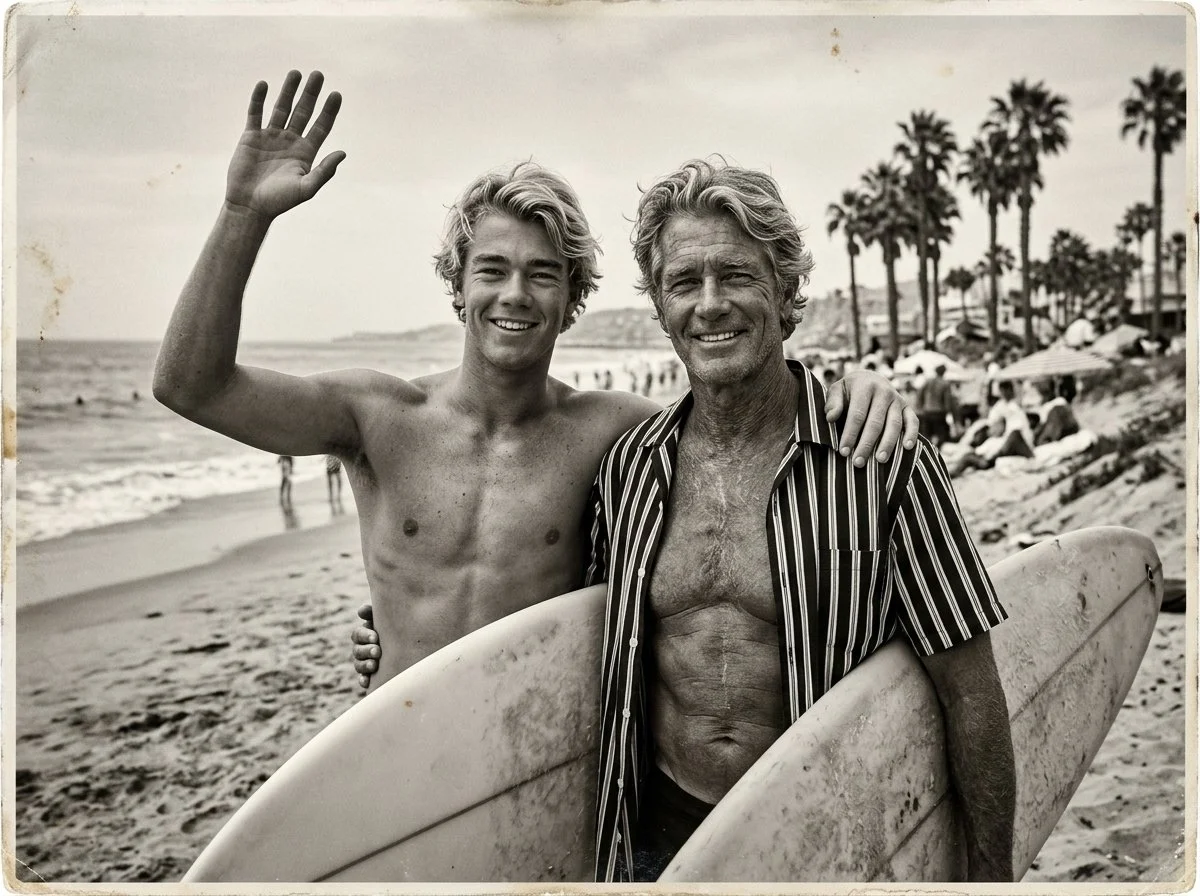
At first I thought it was just static, or some old broadcast, because the picture had that grain to it, that soft black-and-white blur like something from way before me. And then it sharpened. And there was this guy on the television. Standing on a beach. Smiling. Waving.
Waving at me.
Not in a general way either. Not like somebody waving at a camera. I mean it felt direct. Like he could see me through the glass. Like across all that distance—whatever distance even means in a dream—he knew exactly where I was standing.
And I remember this cold feeling in my chest, because I knew him.
Or I thought I did.
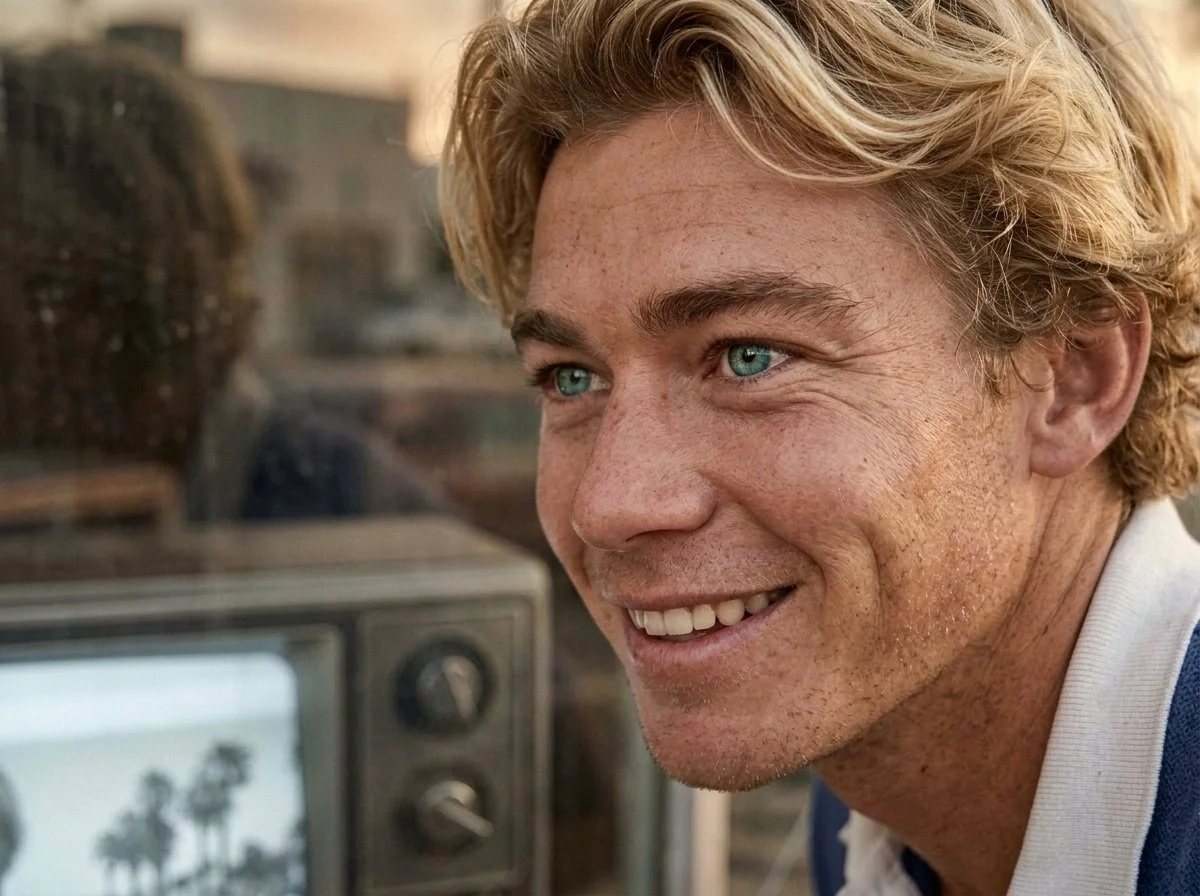
He looked familiar in that impossible dream way where recognition hits before logic. Like your body decides first. I moved closer. I stepped right up to the glass. I could see my reflection over the screen, my face kind of ghosted on top of his, and I remember thinking no, that can’t be right, that doesn’t make sense.
So in the dream it’s like my vision zooms in.
Not with a camera. Not literally. Just that dream thing where suddenly you’re closer without moving. And the picture gets tighter and tighter and I’m staring at the guy’s face on the television, trying to place him, trying to understand why seeing him felt like grief and familiarity at the same time.
And then I realize it.
The guy on the screen is my dad.
Not exactly how he is now. Younger. Sunlit. Almost unreal. Like he’d been preserved in some older version of Malibu that existed before all the damage. Before the bomb. Before the dust. Before whatever happened to the town happened to all of us too. He’s there on the screen with a surfboard, waving like this is some perfect day that never ended. And the strangest part is he doesn’t seem trapped in the television. He seems calm. Like he belongs there. Like he’s from that place and that time in a way I never could be.
And next to him—or somehow within that same image—is another guy.
For a second I think I’m looking at a stranger. Then I think I’m looking at my dad again. Then I realize the face is younger, almost like the image is folding generations together. Like I’m seeing who he was, and who he came from, and maybe who I’m supposed to become, all at once. Dream logic. Bloodline logic. Memory turning into prophecy or maybe the other way around.
And the whole time I’m standing there in this ruined version of my hometown, staring into a television that should not be working, watching this impossible scene play out from the days prior—or maybe from years prior, or decades, or some time that doesn’t exist anymore—and all I can think is: why is he waving?
Why is he smiling like that?
Why does it feel like he knows something I don’t?
That’s the part that stuck with me after I woke up. Not even the bomb. Not the war. Not the destruction. It was the look on his face. Like he was trying to tell me something without saying anything. Like the wave itself was the message.
And I’ve thought about dream symbolism since then.
Because everybody does that after a dream like this. You start breaking it apart like there’s an answer hidden inside it. You start assigning meaning to every object. The board means youth. The street means memory. The bomb means fear. Malibu means identity. The television means distance, inheritance, history, the versions of ourselves we only receive secondhand. The man on the screen means fatherhood, legacy, longing, some unreachable image of masculinity, some old American mirage, some signal coming through the static from a life you’re not sure you’re allowed to claim.
Maybe the war is just the feeling that everything is changing too fast.
Maybe the destroyed town is what happens when the dream you were handed no longer matches the world you’re standing in.
Maybe the kids book thing—the draining, the taking, the using up of everything good until there’s almost nothing left—is about more than land. Maybe people do that too. Maybe families do. Maybe cities do. Maybe whole generations inherit the echo of somebody else’s appetite and then call the emptiness fate.
Or maybe the television is just memory doing what memory does.
Taking what’s gone and making it glow.
Taking what’s unreachable and flattening it into an image.
Making it beautiful enough to hurt.
And maybe seeing my dad there, younger and untouchable and waving from inside that bright little frame, was about realizing that no matter how close you think you are to the people who made you, there’s always some part of them living in a country you can’t fully enter. A place with its own weather. Its own music. Its own language. You get glimpses. Hand-me-down stories. Fragments. A look. A habit. The way they carry silence. But not the whole map.
That dream felt like standing at the border of that place.
Like I had skated to the edge of something.
Like the ruins around me were real, but so was the love inside the screen. So was the distance. So was the question of what survives when the surface gets blown apart. What stays lit. What keeps playing. What waves back.
And then I woke up.
Just like that.
No big ending. No voice from the sky. No final revelation. I just opened my eyes and I was back in my room with morning light coming through the window, and for a second I still felt the dust in my throat. I still felt that weird pressure in my chest. I just laid there trying to decide whether it had meant something or whether my brain had stitched together fear, memory, history, and too much late-night thinking into one long movie.
I kept thinking maybe dreams are less about answers and more about exposure.
They show you what your mind reaches for when it has no audience.
They show you what symbols you still believe in when nobody’s asking you to explain yourself.
They show you what scares you enough to become scenery.
But you know what?
It was probably nothing.
Probably just a dream.
Probably just my head throwing images together. War. Malibu. My dad. A television in a dead storefront. A wave from somewhere I can’t go back to. Probably just one of those nights where your mind wanders too far out and comes back carrying pieces of strange light.
That’s all.
Just a dream.
And right when I’m thinking that, my phone rings.
It’s my friend asking if I want to go skating.
Like nothing happened. Like the world is still here. Like the streets are waiting. Like the morning doesn’t know anything about bombs or symbols or old televisions glowing in the dark.
And I just sit there for a second, holding the phone, listening.
Then I say yeah.
Yeah, give me ten minutes.
-Deck
Reversal: Some people don’t connect with metaphors or analogies—and if that’s you, I completely understand. Not everyone pulls meaning from imagery or feels moved by poetic expressions. And that’s okay. I’m not here to try to change how you process the world or force connections that don’t feel natural to you. What I’ve shared might not resonate, might not strike a chord, and that’s fine too. But even so, I’m still asking for something genuine, something rooted in the heart. I’m asking for a moment of your time, a moment to pause and reflect, to open yourself to something deeper. A moment to pray.
Pray for Malibu. Pray for its land, beautiful yet fragile. Pray for its people, diverse and vibrant, yet facing challenges they cannot bear alone. Pray for its countless stories, past and present, that hold meaning for so many. Pray for Malibu’s spirit—a spirit that has weathered storms, endured flames, and risen time and time again. This is not just a place; it’s a sanctuary for those who live there and for those who visit and feel the peace it brings. It’s a corner of Earth that represents the meeting of nature’s raw power and its breathtaking beauty. And, in its fragility, it needs us, now more than ever.
Malibu is more than a location marked on a map. It’s a tapestry of crashing waves, wind-carved bluffs, and golden, sun-soaked sands, woven through with threads of history, culture, and memory. It’s a place that inspires, a space where people find their center while standing at the edge of the world. But Malibu is not immune to change, not impervious to the challenges of time, of nature, of humanity. Fires rage, waters rise, and the sands themselves shift under the weight of an uncertain future. The beauty of Malibu—the beauty we so often admire, take photos of, and share—is inseparably linked to its vulnerability.
And so, as much as Malibu gives, it now calls on us to give back. Nature is not a one-sided relationship, and neither are we mere spectators to its drama. Whether you’ve walked its paths, surfed its waves, or simply admired a sunset from afar, you’ve touched, in some way, what Malibu offers. It might have anchored a moment of peace for you. Or it might have stayed in your imagination as a place of solace or yearning. If you’ve felt it—if you’ve connected at any level—then I ask you now to give something just as real in return.
Please, take this moment to pray. You don’t have to have all the words or know exactly how to frame it. The beauty of prayer, like the beauty of Malibu, is that it needs no pretense or perfection. Just speak from your heart. Whether your belief is in a divine presence, in the energy of the universe, or in the strength of human resolve, your prayer matters. It is real, and it carries weight. It is connection, with not just the divine but also with the land and the people who need healing, comfort, and hope.
Here is my prayer for Malibu, humble but heartfelt:
May its shores stand strong against the shifting tide. Ocean currents are powerful forces, changing landscapes over time and often laying bare the fragility of coastal spaces. But may Malibu’s shores remain a source of beauty, of calm, of refuge—resilient against erosion, pollution, and destruction. May its beaches always feel the warmth of footsteps that come seeking connection, restoration, and joy.
May its hills heal from scars seen and unseen. Wildfires have etched their pain into Malibu’s hills, an annual reminder of both nature’s fury and nature’s fragility. The physical scars are raw, the burned landscapes a painful sight. But beyond the visible, there are unseen wounds in the spirits of those who’ve fled their homes, who’ve lost everything they’ve built, everything they’ve known. May these scars, both visible and invisible, find renewal through time, care, and the support of a resilient community.
May its streets carry life, love, and laughter, free from fear. These streets, winding through mountains and along cliffs, are where lives unfold. They see families coming together, neighbors reconnecting, and communities growing. But they’ve also borne witness to fear—evacuations, losses, and uncertainty weighing on those who travel them. May these streets become paths of hope again, welcoming journeys of celebration and discovery, instead of routes of escape.
May the Malibu community find resilience, unity, and grace in times of trial. For all its natural beauty, it’s the people of Malibu who bring it to life. The surfers, the hikers, the artists, the teachers, the caretakers, the dreamers, and the doers—this mosaic of humanity is what makes Malibu more than a postcard-perfect destination. But in trials, the bonds of any community can be tested. May Malibu’s people find strength in coming together, setting differences aside, and working hand in hand for the greater good. May resilience be their guiding light, uniting them as they rebuild, restore, and protect what truly matters.
And may the beauty of this place endure, a light for generations to come. Malibu has always been more than the sum of its parts. It inspires not just because of its sights or sounds but because of how it makes people feel—alive, connected, grateful. This legacy is worth preserving. May it remain a light, continuing to shine brightly for future generations who will walk its beaches, climb its hills, and marvel at its sunsets. May they find the same solace, joy, and inspiration that so many have found before them.
“Amen” doesn’t always mean the end of a prayer—it means agreement, a moment of shared sincerity in saying, “Yes, so be it.” And so, if Malibu has touched you in some way, I invite you to join this prayer in your own words and way. Maybe you’ll echo what I’ve shared, or perhaps your heart will guide you to something different. But whatever it may be, know that your voice matters, and your prayer carries weight. Together, our words weave strength, just as the threads of the Malibu landscape weave beauty. Every whisper, every intention, is part of something larger—something healing, hopeful, and enduring.
Malibu is a place, but it is also an idea, a feeling, an invitation to connect. It reminds us of the delicate balance of life and the beauty that springs from that balance. And so, as we pray for its preservation, we also pray for our own understanding of how to tread more lightly, live more kindly, and appreciate more fully. May our prayers guide not only healing for the land and the people but also a shift in all of us toward greater gratitude and stewardship for the world we share.