
POETRY IN MELODY AND MELANCHOLY
We move on. Or we don’t. Stuck in the amber of the Fashion District, under neon signs that hum like they’re alive but burn out just the same. Mitchell Royel snaps a photo, catching me mid-shoulder shrug, cigarette dangling, pretending not to notice. “Back to You” by Billi Royce whispers from somewhere—I don’t know where it’s playing, maybe it’s all in my head—but the words slither into my ears, soft and venomous. The kind of song that lulls you into thinking you’re okay while it tears open every scar you thought had healed. It’s all the same, isn’t it? The music, the faces, the lights that blur into halos when you stare too long. None of it sticks. None of it matters. None of it fills the space where something used to be. Something wild. Something clawing and loud and messy. Now it’s just a whisper, a faint ripple, a feeling you can't quite name.
It started in the basement, like it always does—hot, sticky, desperate. The air was thick enough to choke on, laced with sweat, stale beer, and that unspoken hunger for something more. The plan? Burn it all down, metaphorically—or maybe not. Music so loud it throbbed in your ribs like a warning, bodies crammed tight enough to blur the edges of where you ended and someone else began. A tornado of alcohol, dollar bills dumped in heaps for a DJ who didn’t deserve it, snacks melting in untouched piles. Chaos wasn’t the goal—it was the vibe. And for a while, it hit just right. Invincible. Immortal. Like we had bottled perfection and could pour it shot by shot all night.
But perfection’s a liar. It never holds long, and we should’ve known. It started with the breaker. Someone—of course it was someone—decided the speakers weren’t loud enough and plugged some Frankenstein power strip into another. Flash! Darkness swallowed the room, cheers warped into confused howls. The music died a strangled death, leaving us standing in the void. Nothing but breathing, awkward laughs, and the scrape of sneakers on concrete. Then the lights sputtered back, too bright, too real. And for a surreal, fleeting second, it made sense. Like, was this what it’s all about? A stupid, weird, messy basement and some kind of stupid, weird, messy clarity?
Then came the road trip idea. How? Why? Who even started it? That piece of information’s gone now—vomited out amidst the mess. But it latched on fast, spinning in the air like wildfire and racing through the crowd. “Downstate,” someone said. “Now. Right now.” No one questioned it. Why would they? When stupid feels right, nothing else matters. Suddenly we were in a car—or four or five cars—speeding into the dark. Windows down, music blaring louder than sanity, bodies leaning out to howl at the stars. Kings. Like, actual kings of adrenaline, immortal gods with nothing ahead but possibility.
And that’s when the cracks started to show, though we didn’t see them for what they were. Not yet. But his grin—it wasn’t real. It was too wide, stretched to breaking, his eyes looking past us like he wanted out. None of us cared. We were flying too fast to stop, giddy and stupid and entirely detached from reality.
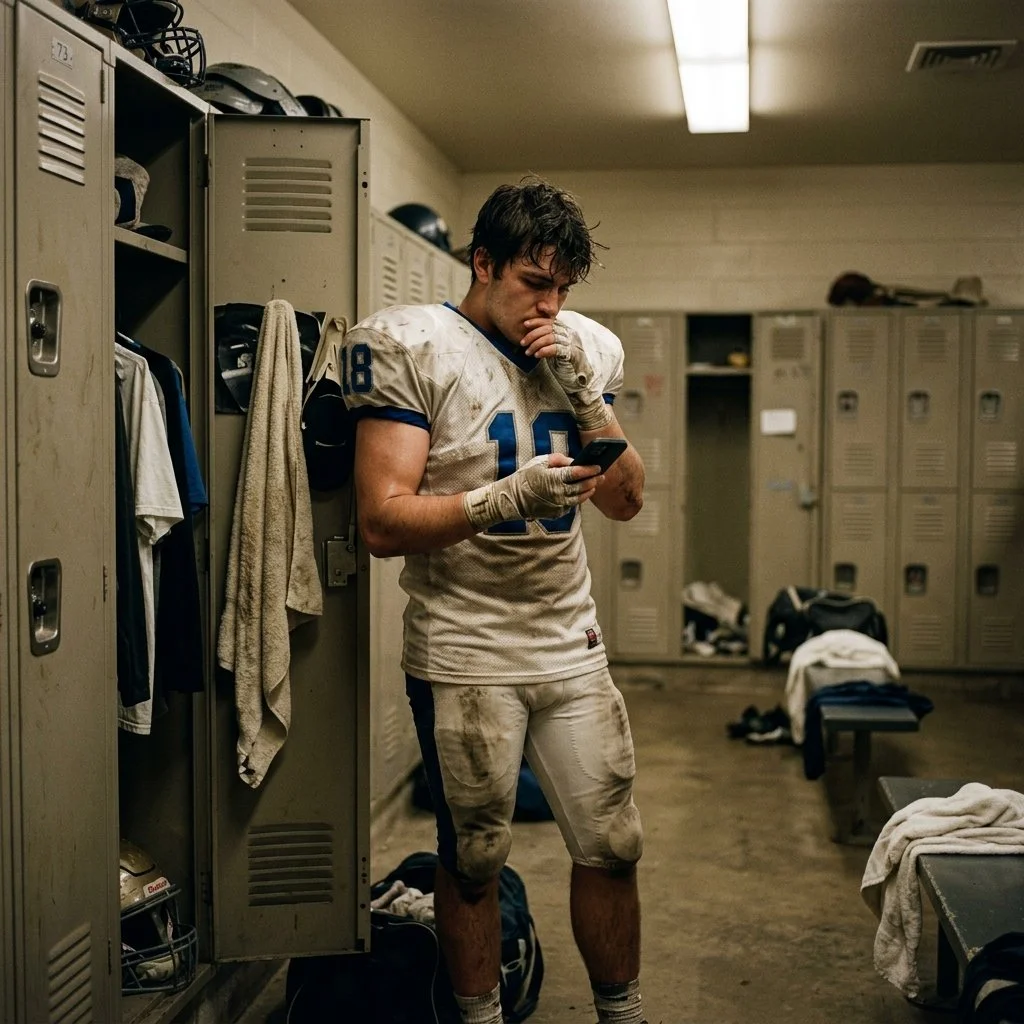
But I saw it later. Really saw it. Back at the locker rooms, harsh fluorescent lights buzzing louder than the silence between words. Everything slowing down, the world coming apart at the seams. I heard him before I saw him—just murmuring at first, a low hum of words. But then her name. Her. Like the only thing tethering him to something real. It was disgusting. Her name hung there like poison gas, and I followed the sound, doing what you always do when curiosity kills reason.
He was curled up—actual fetal position—muttering her name over and over like it could fix something. It couldn’t. My voice hit him harder than it should’ve, or maybe just hard enough. “Are you kidding me?” The words hit harder than a punch, and his head snapped up. Guilt. That’s all I saw. Guilt and nothing else. He didn’t even try to bluff or lie or flinch. Just sat there, paralyzed. If guilt could kill, he’d have been a chalk outline by then.
Word spread fast. There are no secrets in a group like ours, not when blood runs hot and loyalty is everything. We turned on him sharp, fast, final. All the trust, all the nights and laughter and spilled booze—it all evaporated on the spot. He didn’t fight it. Didn’t plead. Just packed his stuff like a robot, dead in the eyes, and went. No screams, no tears, no fight. Just... gone.
Now? The basement’s quieter. The beer’s cheaper. The chaos is muted, whispers of what it used to be. But none of it feels good anymore. The nights don’t soar; they just… happen. Go through the motions. Maybe that’s the point. Maybe this was never supposed to feel good in the first place.
We move on. Or we don’t. Whatever. It’s all the same.
He didn’t fight it. Didn’t beg. Just packed his sad, wilted dreams into boxes that smelled like whiskey and regret, his eyes vacant, hollow—like an old church with all the stained glass gone. He left without a soundtrack, without a single wisp of drama—no screaming, no tears, no pleas to stay. Just a door closing softer than it should have, as if the universe itself didn’t care enough to slam it. And now? The basement hums a different kind of silence. Cold. Sterile. The beer is cheaper, sure, but it tastes like nothing. Like drinking fog. The speakers still bleed music into the night, but the songs don’t reach your chest anymore. They hover in the air like ghosts that don’t know why they’re still here, haunting a place that forgot what it means to be alive.
There’s no chaos, no crashing waves, just a flat, endless ocean under a sky smeared with too much gray. The nights used to crackle with something electric, didn’t they? Or maybe that was just a trick of the light. Now? The nights just drip like melting wax. Slow. Too slow in the wrong places and then gone all at once. Maybe that’s the point. Maybe it was never supposed to feel good. Maybe we were always starving in a feast, clinking empty glasses and laughing like it didn’t hurt.
-DECK