
Exhibition at St. Mark's
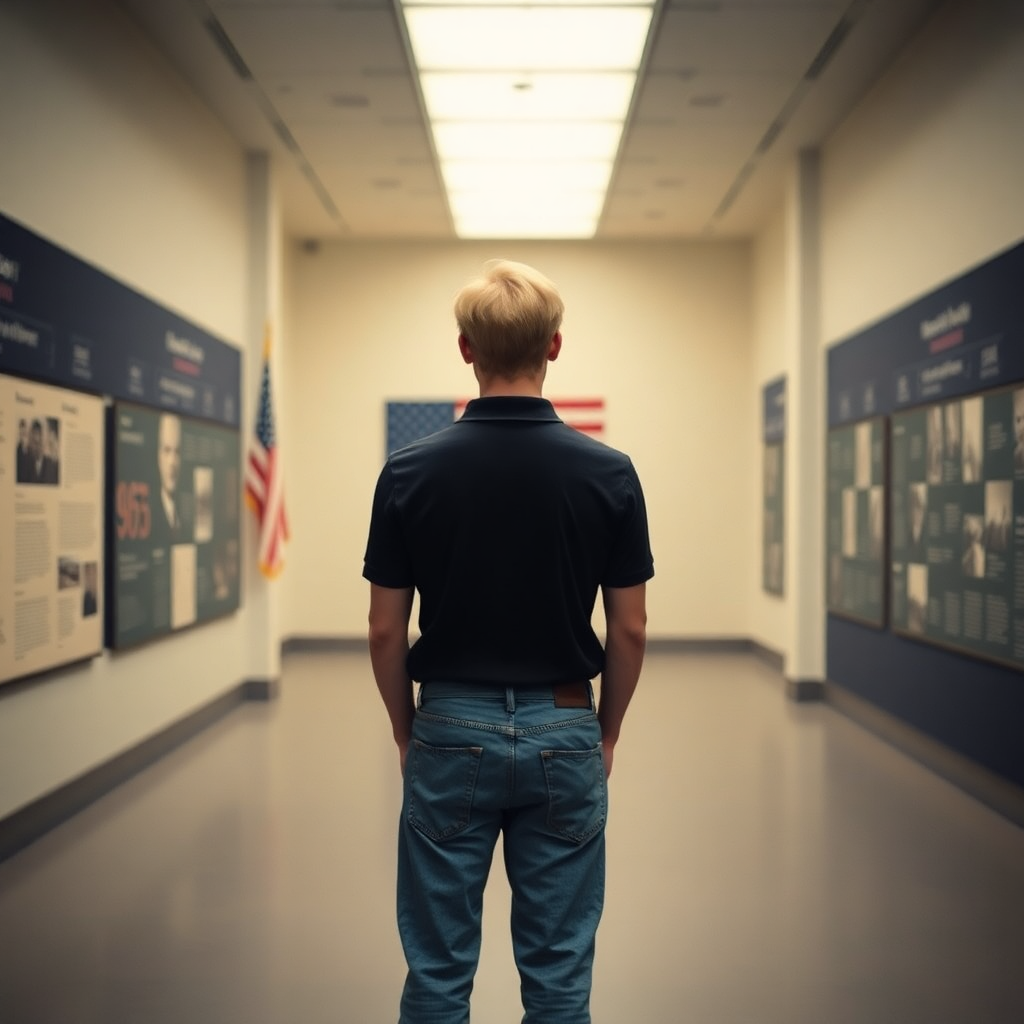
Captured by Mitchell Royel
Stunning 1080x1080
Now playing: "Dancing Alone" by ATALE, Pio
In the quiet spaces between what was and what could be, we find ourselves standing at the threshold of memory and prophecy. This frame—frozen at 1080x1080—holds more than pixels and light. It captures a moment of reckoning, a young man confronting the weight of tomorrow in the sanctuary of yesterday.
The composition speaks in whispers: the solitary figure, back turned to us, gazing into a future we cannot yet see but can already feel. The blurred exhibition before him represents all the warnings we've ignored, all the signs we've missed while dancing alone to our own rhythms, disconnected from the collective heartbeat that once kept us in time.
"Dancing Alone" plays as the soundtrack to this generation's isolation—not the loneliness of being without others, but the deeper solitude of being surrounded by people yet fundamentally disconnected. ATALE and Pio understand this paradox: we are more connected than ever and more alone than we've ever been. The music pulses with that tension, that ache, that recognition that we're all moving to different beats in the same crowded room.
Mitchell Royel's lens doesn't just document; it interrogates. The perfect square format—1080x1080—creates a democratic frame, neither landscape nor portrait, refusing to privilege width over height or breadth over depth. It's the format of social media, of Instagram, of the digital town square where we perform our lives for audiences we'll never meet. But here, that format is subverted, turned inward, made contemplative rather than performative.
The American flag in the periphery—present but blurred, visible but indistinct—serves as both anchor and question mark. What does it mean to stand before the symbols of our identity when those symbols have become contested territory? What does patriotism look like when the future of the nation itself hangs in the balance of choices we're making right now?
This is not escapism. This is confrontation dressed in the aesthetics of indie cinema, where every frame matters and silence speaks louder than dialogue. The depth comes not from what we see clearly, but from what remains just out of focus—the details we have to lean into, the truths we have to work to understand.
We are all dancing alone until we choose to dance together. We are all standing in front of exhibitions of possible futures until we decide which one we're going to build. Mitchell Royel's frame asks us to stop scrolling, stop performing, stop dancing alone long enough to really see what's in front of us.
The music plays on. The figure stands still. The future waits.
1080x1080. Perfect symmetry. Imperfect world. Infinite depth.
A Parable
I wasn't planning on going back. You know how it is—you leave your hometown for college, and suddenly the place that raised you feels like a costume you've outgrown. But my dad asked, and I had a free Saturday, so I drove the two hours back to that sleepy Virginia town where nothing ever changes except the gas station prices.
St. Mark's looked exactly the same. Same red brick. Same white steeple that needed repainting five years ago and still does. Same parking lot with the cracks forming a map to nowhere. I pulled in around 2 PM, expecting the usual—potluck in the fellowship hall, maybe some kids running around, Mrs. Patterson asking if I'm eating enough at school.
But there was a sign out front I'd never seen before: "Remembering Tomorrow: An Exhibition."
The sanctuary was darker than I remembered. They'd covered most of the windows with black fabric, and where the usual bulletins and children's drawings would be taped to the walls, there were photographs. Dozens of them. All in stark black and white, all depicting... I couldn't quite tell at first.
I moved closer to the first panel.
It was a street I recognized—Main Street, our Main Street—but wrong. The buildings were there, but hollowed out. Windows shattered like broken teeth. The old movie theater where I saw my first film, its marquee hanging by a single bolt, letters scattered on the sidewalk below spelling nothing. And in the foreground, a figure in what looked like a hazmat suit, walking alone.
The placard beneath read: "Main Street, 2047. After the Silence."
I felt my stomach drop.
The next photograph showed the church itself—St. Mark's—but transformed into something else entirely. The steeple had collapsed. The doors were barricaded with rusted metal sheets. Spray-painted across the brick in jagged letters: "NO SANCTUARY HERE." The parking lot I'd just walked across was filled with makeshift tents, and people—thin, desperate-looking people—huddled around burning trash cans.
"St. Mark's Community Church, 2051. Refuge Denied."
I moved through the exhibition like I was walking through a nightmare version of my own memories. There was the high school, converted into a detention center. The park where I learned to ride a bike, now a mass grave marked with numbered stakes. The library, burned to its foundation, books scattered and waterlogged in the ruins.
Each photograph was dated sometime in the next twenty to thirty years. Each one showed my hometown—*our* hometown—destroyed by something the placards only referred to as "the Silence." No explanation. No context. Just the aftermath.
I found myself standing in front of the final photograph, the largest one, mounted where the cross usually hung behind the pulpit. It showed a young man—maybe my age, maybe younger—standing in front of what used to be the town square. He was looking directly at the camera, and his eyes were hollow. Behind him, an American flag hung upside down from a broken pole, its colors faded to gray.
The placard read: "The Last Witness, 2053. He stayed."
"Powerful, isn't it?"
I turned. Pastor Lysander Corvinus stood beside me, hands in his pockets, looking up at the photograph with an expression I couldn't quite read. He'd been at St. Mark's for about three years now—a younger pastor with an unusual name that always made people do a double-take when they first heard it. Something about Romanian and Greek ancestry, if I remembered correctly.
"What... what is this?" I asked.
"An artist came through town about six months ago," he said quietly, his slight accent making the words sound more deliberate. "Young guy, maybe thirty. Said he'd been having these visions—dreams, he called them—of what could happen if we keep going the way we're going. Not just here, but everywhere. He spent three months creating this exhibition. Photoshopped every image himself, based on real places in town. Wanted to show it here, of all places."
"Why here?"
Pastor Lysander smiled sadly. "He said churches used to be where communities gathered to remember the past and imagine the future. He wanted to remind us that the future isn't set. That we're writing it right now, every day, with every choice we make or don't make."
I looked back at the young man in the photograph—the last witness. There was something familiar about his face, something in the set of his jaw that reminded me of my own reflection.
"Is this supposed to scare us?" I asked.
"I don't think so," Pastor Lysander said. "I think it's supposed to wake us up. See, the thing about dystopia is that it doesn't just happen overnight. It's a thousand small compromises. A thousand times we chose comfort over courage, silence over speaking up, apathy over action. This"—he gestured to the photographs—"this is what happens when we forget that the future is something we build, not something that just happens to us."
I stood there for a long time after Pastor Lysander walked away. The sanctuary was quiet except for the hum of the old AC unit and the distant sound of traffic on the highway. I thought about my life at college—the classes I was taking, the parties I was going to, the way I'd convinced myself that the big problems were someone else's responsibility. That I was just one person. That nothing I did really mattered in the grand scheme of things.
But standing there, looking at that photograph of my hometown destroyed, I realized something that felt both terrifying and liberating: the future isn't written yet. These photographs weren't prophecies. They were warnings. Possibilities. A question posed in the language of art: What are you going to do about it?
I pulled out my phone and took a picture of the exhibition poster. Not to post on social media—I wasn't ready for that kind of performance yet. Just to remember. To carry with me back to campus, back to my dorm room, back to the life I was building whether I realized it or not.
As I walked out of St. Mark's into the late afternoon sun, the town looked different. Not changed, exactly, but seen. Every building, every street, every person walking by—they were all part of a story that hadn't been finished yet. A story I was part of, whether I wanted to be or not.
The question wasn't whether the future would be dystopian or utopian. The question was simpler and harder: What was I going to do today?
I got in my car and sat there for a minute, engine running, looking at the church in my rearview mirror. Then I turned the car off, pulled out my laptop, and started writing. Not a song this time—though maybe that would come later. Just thoughts. Questions. Ideas about what it means to be awake in a world that's sleepwalking toward something we might not be able to come back from.
The exhibition would only be up for another week, Pastor Lysander had said. But I had a feeling its images would stay with me a lot longer than that.
Maybe that was the point.
My dad texted me as I was finishing: "Glad you came today. Dinner at 6?"
I looked at the message for a long moment, then typed back: "Yeah. And Dad? We should talk. Really talk."
Three dots appeared, then disappeared, then appeared again. Finally: "I'd like that, son."
I put the phone down and kept writing. The sun was starting to set, painting the sky in shades of orange and purple that looked nothing like the gray, ash-filled skies in those photographs. Not yet, anyway. Not if we didn't let it.
-Deck