
DUMB LOVE IN THE DINING HALL
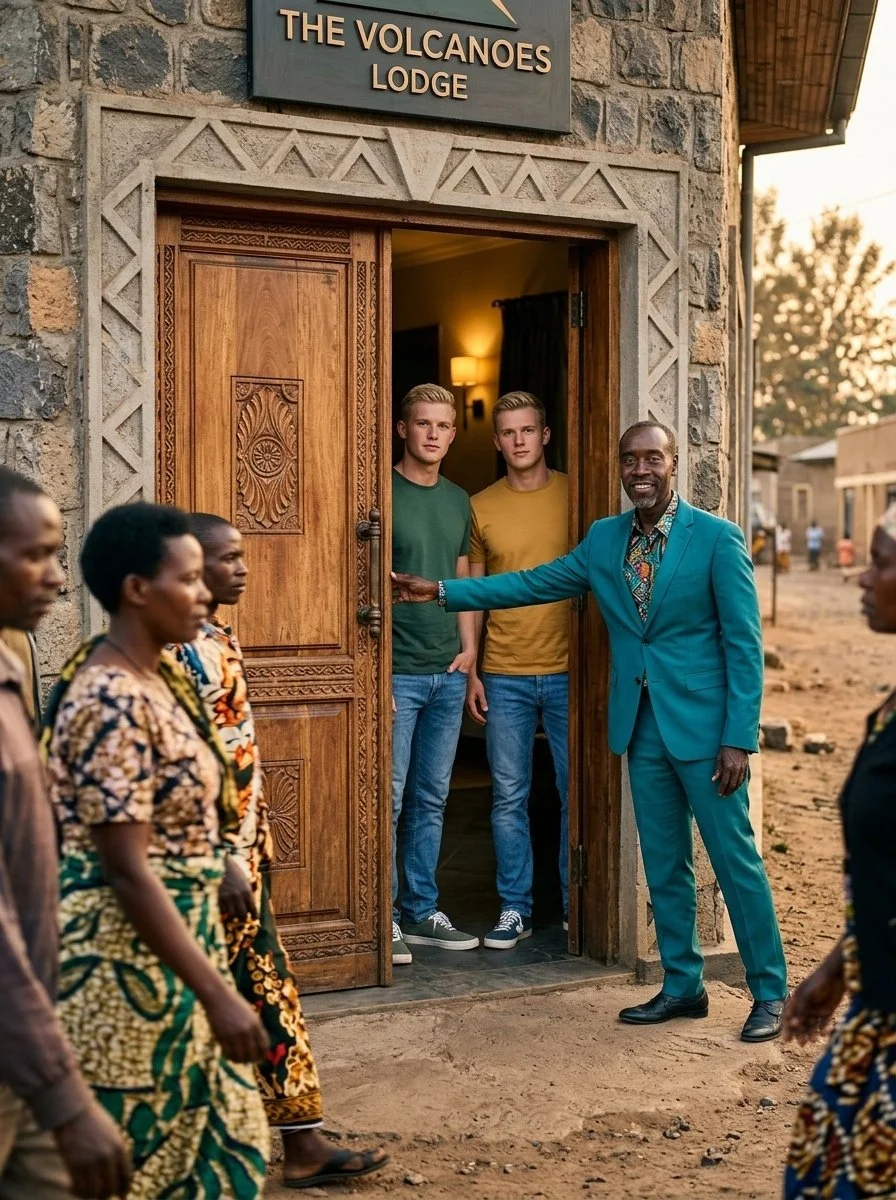
The following photograph of Don, captured by Mitchell Royel in the Fashion District on August 22, 2026, is provided for informational purposes only. This photograph is not affiliated with the film Hotel Rwanda in any manner and should not be construed as an official statement or commentary on the Rwandan Genocide or any related historical events.
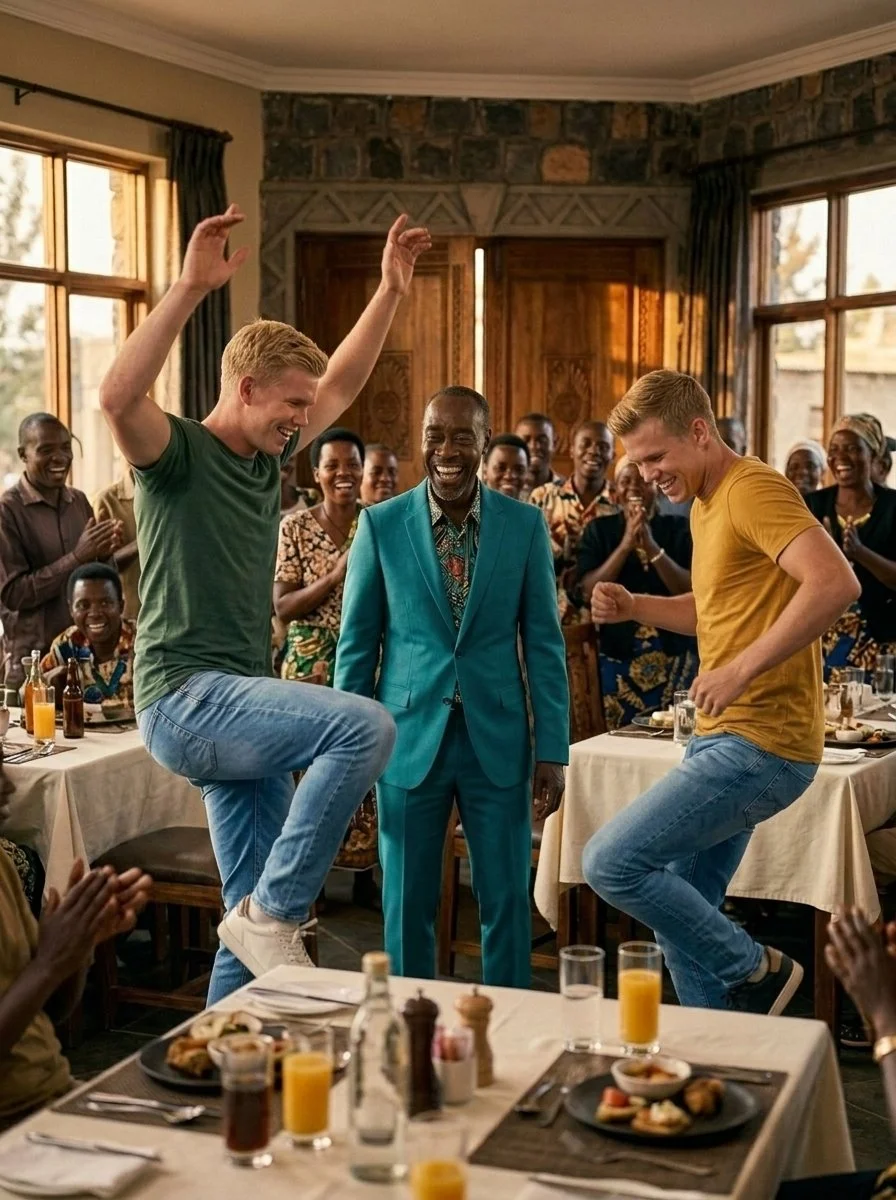
INT. HÔTEL DES MILLE COLLINES — DINING HALL — NIGHT
The room should be silent. It isn't. "DUMB LOVE" by Sean Kingston pumps from a cracked portable speaker balanced on a linen-draped table. Crystal glasses vibrate with the bass. White napkins — still folded into swans — tremble at the edges.
Two YOUNG MEN are dancing. Not elegantly. Not carefully. BRIGHAM (early 20s, broad shoulders, sun-bleached hair, the kind of guy who learned to talk to God on a surfboard) has both arms in the air, head thrown back, feet sliding across marble in his socks. Beside him, HYRUM — leaner, freckled, equally ridiculous — is doing something that might be the worm.
They are making the absolute most of nothing. And everyone in the room knows it.
AFRICAN STAFF and refugees line the edges of the room — blurred, half-lit, watching. A waiter still in his vest. A mother with a child on her hip. A teenage boy with hollow eyes that suddenly — for just a second — aren't hollow anymore. They laugh. All of them. Because Brigham just tried a spin and nearly took out a candelabra.
In the doorway — PAUL. The manager. Dark suit. Straight back. The weight of twelve hundred lives folded neatly behind his eyes. He watches. One beat. Two.
He laughs.
TIME CUT — LATER.
The music has stopped. The room is quieter now, the way rooms get when they remember where they are. BRIGHAM sits at a table, elbows on the white cloth, speaker in his hands. He speaks to us — or to no one — or to the version of himself that made it home.
BRIGHAM (easy grin, hiding everything)
You want to know what I remember most about that place?
(beat)
The napkins. Little white swans on every plate. Bombs in the hills, soldiers at the gate — and somebody had still folded the swans.
He sets the speaker down.
BRIGHAM (CONT'D)I came to Rwanda for a surf trip. (laughs at himself) Wrong coast, obviously. My buddy Tanner had a map — turns out he'd been reading it upside down since Nairobi. Classic Tanner. So we ended up in Kigali. We figured we'd just roll with it.
(the grin fades, just slightly)
Then everything went sideways. And the hotel became the whole world. And rolling with it wasn't a choice anymore — it was the only play we had.
He looks toward the windows. The dark outside isn't empty.
BRIGHAM (CONT'D)
They kept saying help was coming. The radio said it. The embassy said it. "The international community is deeply concerned." Man. I have never hated a sentence more in my life. Deeply concerned. Like the world was watching a wave and deciding whether to paddle in.
(leaning forward, urgent)
We called everyone. Parents. Friends. Tanner called a professor he'd failed twice who happened to know someone in State. We spelled our names out loud, slowly, like the letters were a lifeline. Like if someone wrote your name down far enough away, they'd have to come find you.
(quieter)
The white people got buses. I need you to sit with that. They came for us. The foreigners, the tourists — buses pulled up, hands reached out, and we climbed on. And the ones who couldn't be evacuated from their own skin — they stayed.
He presses both palms flat on the table.
BRIGHAM (CONT'D)I'm not telling you this so you feel sorry for me. I'm telling you because of what happened before the buses came. I'm telling you about the night Tanner and I decided to dance.
The lamp shifts warmer — memory bleeding back in. The music rises again: "DUMB LOVE." Full and bright and impossibly out of place.
BRIGHAM (V.O.)
It was Tanner's idea. Technically. He said — and I will never forget this — he said, "Brigham, if we're gonna be scared, we might as well be scared with the song on." So I hit play. And then I just... went for it.
We see it again — BRIGHAM and TANNER, dancing in the dining hall. Full send. No apologies. Arms wide, feet loose, grinning like idiots. The faces around them soften. The hollow-eyed teenager laughs for real this time.
BRIGHAM (V.O.) (CONT'D)
Because if we stopped — if either of us stopped — we'd have to hear the other sound. The one outside. And we weren't ready to hear it. Not yet.
In the doorway, PAUL watches. And laughs.
BRIGHAM (V.O.) (CONT'D)
Paul Rusesabagina. The man who ran that hotel. Bribed soldiers. Made calls at three in the morning. Put his family on a bus and sent them away so they wouldn't watch him fall. He carried all of it — every name, every list, every kid — and he never let any of us see the weight of it.
(a whisper)
But that night, he laughed. Head back, hand on the doorframe, full laugh — at two dumb surfer kids sliding around in their socks to a Sean Kingston song. And for the length of one chorus, we weren't the stranded and the endangered. We were just people in a room, saying not tonight.
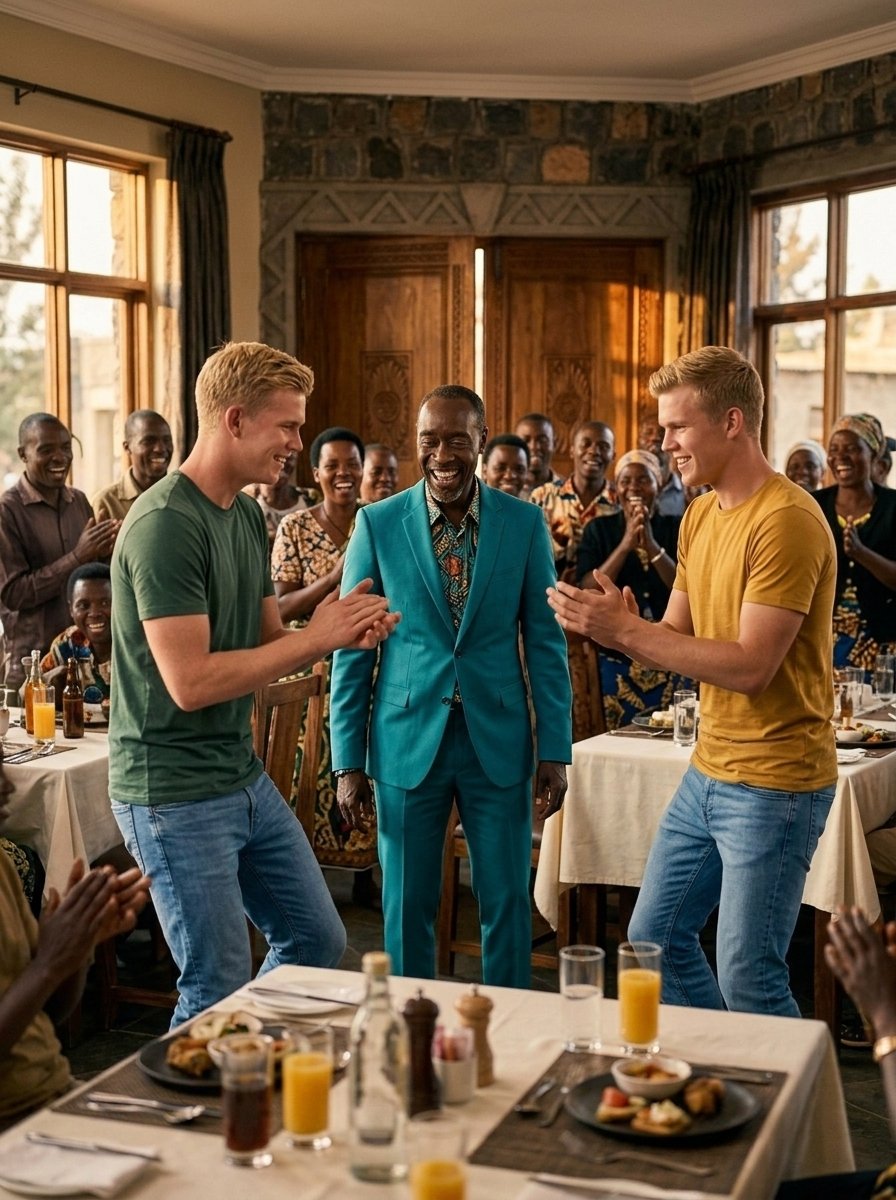
The music swells. BRIGHAM waves Paul in. Paul shakes his head — once, twice — then steps forward. He dances. Everyone dances. The blurred faces at the edges sharpen for one held breath —
alive, alive, alive —
Then the song ends. And the room remembers.
Back to BRIGHAM. Alone. The lamp is cold again.
BRIGHAM (barely audible)Tanner made it. We both did. I know that's not the whole story. It's not even close to the whole story.
(he straightens)
People ask me how we could dance. How we could laugh with all that death pressing on the glass. And I always want to say — that's why. That's exactly why. The guys outside wanted everyone in there reduced. Numbers. Bodies. Less than. And every time we hit the floor, every time Paul laughed in that doorway — we were saying no. We're still here. We still love something dumb. You don't get to take that.
He stands. Picks up the speaker.
BRIGHAM (CONT'D)
The world moved too slow. Write that down. The help came late, and it came for the wrong people first, and I've got to live with that every day of my life.
(beat — something rising now, something like a shore break)
But a man in a suit decided to open his doors when the whole world was dead-bolting theirs. Twelve hundred people walked out breathing because one person decided they were worth the risk.
(looks directly at us)
So if you ever wonder what one person can do against the dark —
He smiles. It's the realest thing he's got.
BRIGHAM (CONT'D)
He laughed at two idiots dancing. And then he saved them all.
He clicks the speaker off.
BLACK.
BRIGHAM (V.O.)
Fold the swans. Even now. Especially now.
FADE OUT.
END OF MONOLOGUE.
EPILOGUE
The room is silent now. A soft hum of wind threads through an open window, carrying the scent of earth and rain. The swans still sit folded on the plates, pristine, like hope set carefully in place. We hear the faint rustle of movement as BRIGHAM’s voice carries us forward, quieter now, but steady.
BRIGHAM (V.O.)
We don’t always get to choose the weight we carry. Sometimes, it finds us. But what we do with that weight — brothers, sisters — that is the real story. Rwanda was not about monsters, though the world likes to draw those lines. Monsters over there. Helpers over here. Nah, it’s not like that. It could be any place. Any people.
He pauses, the silence weighted, pressing softly like a hand placed on a shoulder.
BRIGHAM (V.O.) (CONT'D)
Rwanda was about what happens when we forget. When we forget Imago Dei — that every person carries God’s image. Genesis 1. That’s the whole beginning. He looked at us — all of us — and called us good. But when you stop seeing that image in someone else, you can start convincing yourself they’re worth less. Until maybe they’re worth nothing at all. And when enough hearts believe that, you get what Rwanda got. You get what anyone could get.
The soft hum of wind shifts. There’s a faint echo of music from earlier, distant but persistent — Sean Kingston, the two kids dancing.
BRIGHAM (V.O.)
But that’s not the end. It doesn’t have to be the end. Because one person can push back. Paul pushed back. And when we step into that kind of faith — faith in the face of the unthinkable — we’re not just holding the line for ourselves. We’re holding it for us. All of us.
The camera pans across the linen-draped tables, over the swans, then moves to the window. Darkness lingers outside, but it feels different now. Brighter somehow. The wind picks up again, carrying Brigham’s voice with it.
BRIGHAM (V.O.) (CONT'D)
Fold the swans. Open the doors. And laugh in the face of the storm — even if it’s as dumb as two kids in their socks on a marble floor. Because every small act of God’s love is a light against the dark. Philippians 2 says we shine like stars in the sky. And family, this sky’s not done needing stars.
FADE OUT.
END.