


LONGING LIVES HERE, DRENCHED IN GOLD
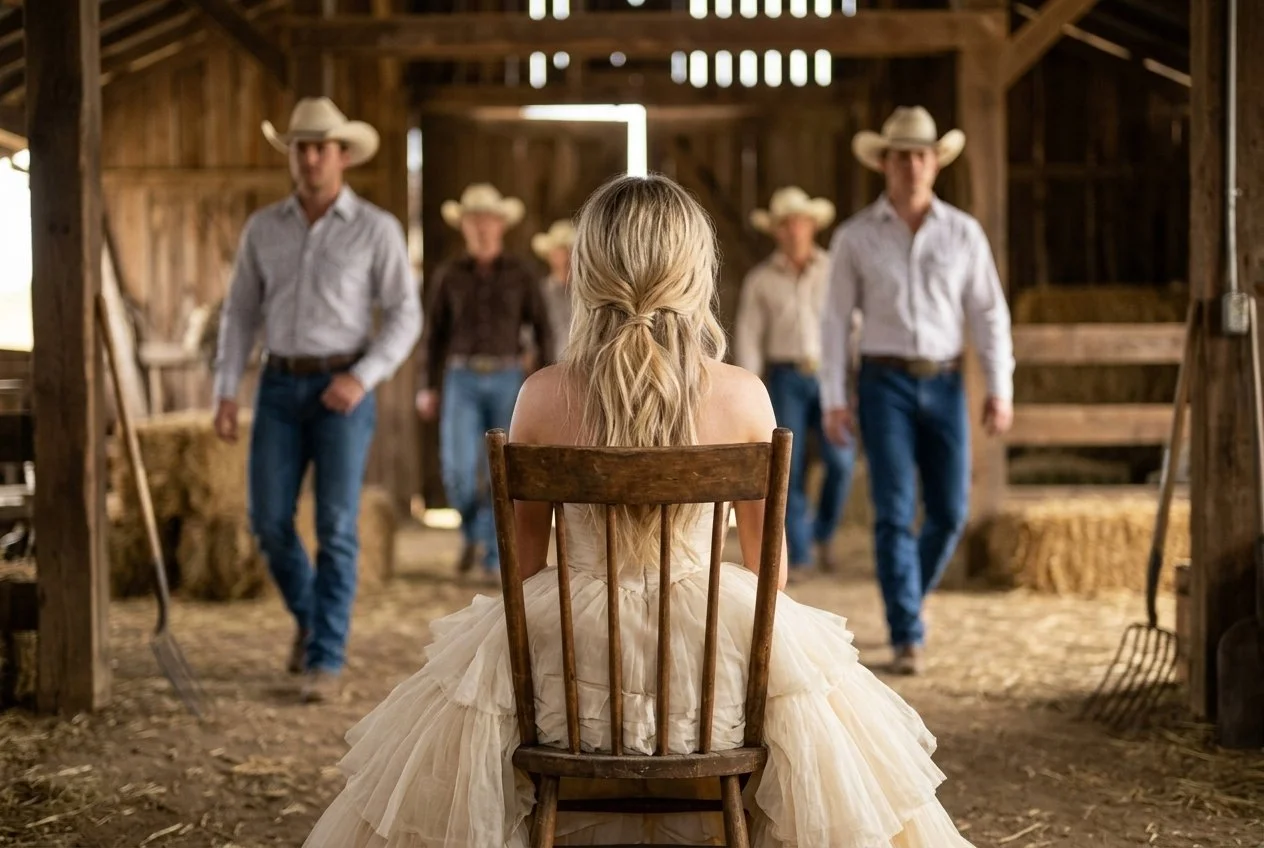
Captured through the lens of Mitchell Royel in the vibrant pulse of the Fashion District, this moment feels timeless. Now, as the stars blanket the sky, we’re nestled in the rustic charm of a barn, hosting a dreamy slumber party. The atmosphere is laced with nostalgia as we listen to the song that set everything in motion—Almost Love by Sabrina Carpenter, a melody that feels like a quiet spark igniting memories and possibilities.
Divine Spirit,
Hold us here, in the quiet ache of what didn’t fully bloom. Keep us soft, even as we sit with the weight of the “almosts.” Help us to see the beauty in the unfinished—like a melody that never resolves but still moves us to tears. Teach us to honor the longing, not as a failure, but as proof of our ability to feel deeply, to dream boldly, to love without guarantees.
May we wear the ache like a crown, allowing it to glimmer with the courage it took to hope. May the tender spaces left behind by the ones we never fully held be filled with light—gentle, golden, forgiving. And may we remember that even in the distance, even in the not-quite, love was here, marking us with its tender touch, shaping us into something softer, something freer.
Let the ache speak, not of what’s missing, but of what’s possible. And in this longing, may we find the holy—proof that we are alive, awake, and brave enough to try again.
Amen.
RYDER:
(soft, like the first line of a song nobody wrote down)
There's a kind of love that never fully arrives.
It lingers.
It hovers.
It brushes the collarbone like a whisper — and then walks away in tight jeans and a cowboy hat, laughing with someone who isn't us.
This is for that love.
The almost kind.
The one that got under our skin and stayed there, shimmering.
This is a hymn for the loves that never bloomed, the half-finished sentences, the hands almost held. It’s a confession, a eulogy, and a promise to remember the sparks that lit up the dark, even if they didn’t start a fire.
RYDER:
(settling in, voice low and unhurried)
Not a product. A feeling.
The kind we slip into when the rain starts and we're still dressed up with nowhere to go. The one that tastes like rhinestones and regret and the golden hour spilling through barn slats.
Here's what we're sitting with tonight:
Permission to want what we didn't get to keep
A love letter to the ache itself
Proof that longing can be holy
Stay close. This one's for the tender ones.
RYDER:
(like describing a dream half-remembered)
Picture her.
First, in a rhinestone corset — every crystal catching the light like a small confession. She's glowing. She's the center of the room. And she's already thinking about someone who left.
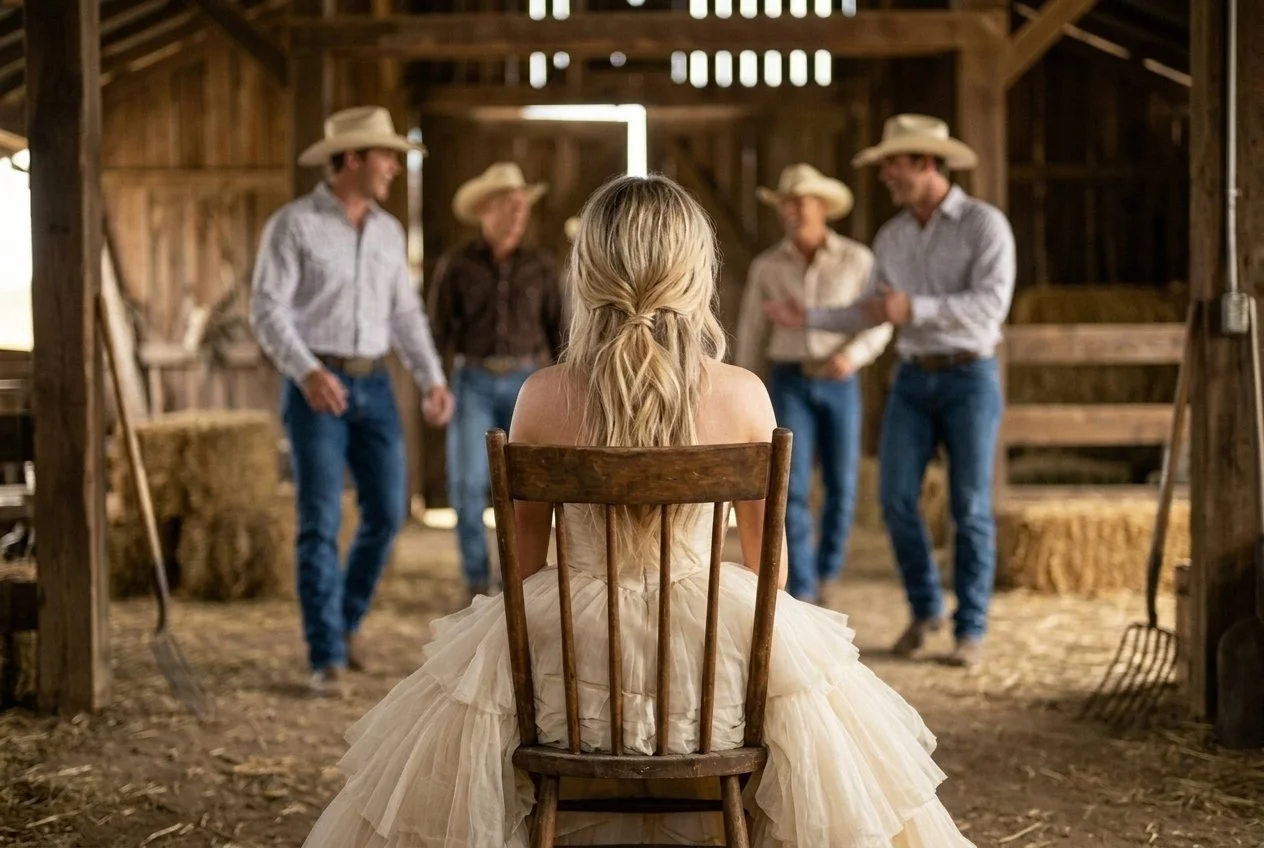
Then picture her again. A cream dress, big enough to drown in. She's sitting in a barn chair, her back to the world. Behind her, the cowboys blur into laughter and dust and golden light.
She isn't watching them.
She's remembering.
Because that's what almost-love does. It puts us in the most beautiful thing we own and lets us sit alone in it.
RYDER:
(quiet, deliberate)
Cream isn't white. It's softer than that. It's the color of things that were almost pure, almost promised, almost ours.
Feel the weight of it pooling around our ankles.
This is the texture of a love that filled the room but never quite filled us.
RYDER:
(leaning forward now)
We keep trying to fix longing. To numb it. To swipe past it.
But what if the ache is the point?
Almost-love teaches us what we're capable of feeling. It cracks us open in the rain and dares us to keep our Sunday best on anyway.
We showed up. We dressed for the occasion. We loved someone who was only ever going to be a "maybe."
That's not weakness. That's bravery in glitter.
Here's the truth: The ones who feel the almost are the ones who are still open. Still soft. Still willing.
RYDER:
(plainly, gently)
Let's say it out loud.
We are allowed to miss what we never had.
We are allowed to grieve the phone call that didn't come, the hand that didn't stay, the almost that hummed under our ribs like a song we couldn't stop playing.
Do this, not that:
Do let the whole of it be felt. Don't rush to "get over" it.
Do wear the beautiful dress anyway. Don't hide because it hurts.
Do call the ache what it is — love. Don't pretend it was nothing.
Nothing doesn't feel like this.
The room is quiet, except for the sound of breathing—slow and deliberate, as if counting the minutes until dawn. The window is open just enough to allow the crisp night air to flow in, but the darkness outside feels infinite. Somewhere in the distance, a train whistle blows, lonely and melancholic. Everything remains still, yet the weight of unspoken words hangs in the air like an unseen presence. Time feels stretched, the moment infinite, filled with a silent yearning that refuses to be named.
RYDER:
(almost a whisper now)
It's past midnight. The rain is steady.
We're reading by a lamp, and somewhere in the story the girl in the cream dress turns her head, and the light catches her face, and we know — we know — she's going to let him go.
Not because she doesn't love him.
Because it was only ever almost.
And we close the book against our chests and breathe, because that's our story too. The one we dress up for. The one that glimmers in the dark.
RYDER:
Almost-love isn't failure. It's proof we were paying attention.
WHAT ALMOST LOVE GIVES US
RYDER:
(slow, like the last ember of a fire)
It gives us a heart that still works.
It gives us the memory of golden barn light and a room full of rhinestones and a longing so clean it almost feels like prayer.
It gives us ourselves — the version that feels everything, that shows up looking like the whole occasion, that loves even when the ending is already written.
That woman is not broken.
She's blooming.
RYDER:
(standing up now, the rain still going)
So here's the invitation.
Put on the cream dress. Fasten the rhinestones. Let the rain come.
Sit in the golden light and let the laughter blur behind us. Feel the sweet, bruising pull of the almost — and don't run from it.
Because the ache is proof of a heart still brave enough to want.
Tonight: Let the almost be felt all the way through. Wear the Sunday best for no one but ourselves. And call the longing what it really is — a love that mattered, even in the almost.
(beat)
That's not the end of the story.
That's where we begin.
-Ryder, M.R, GG Collective
PRINCESS TEACUPS AND BROKEN TRUST
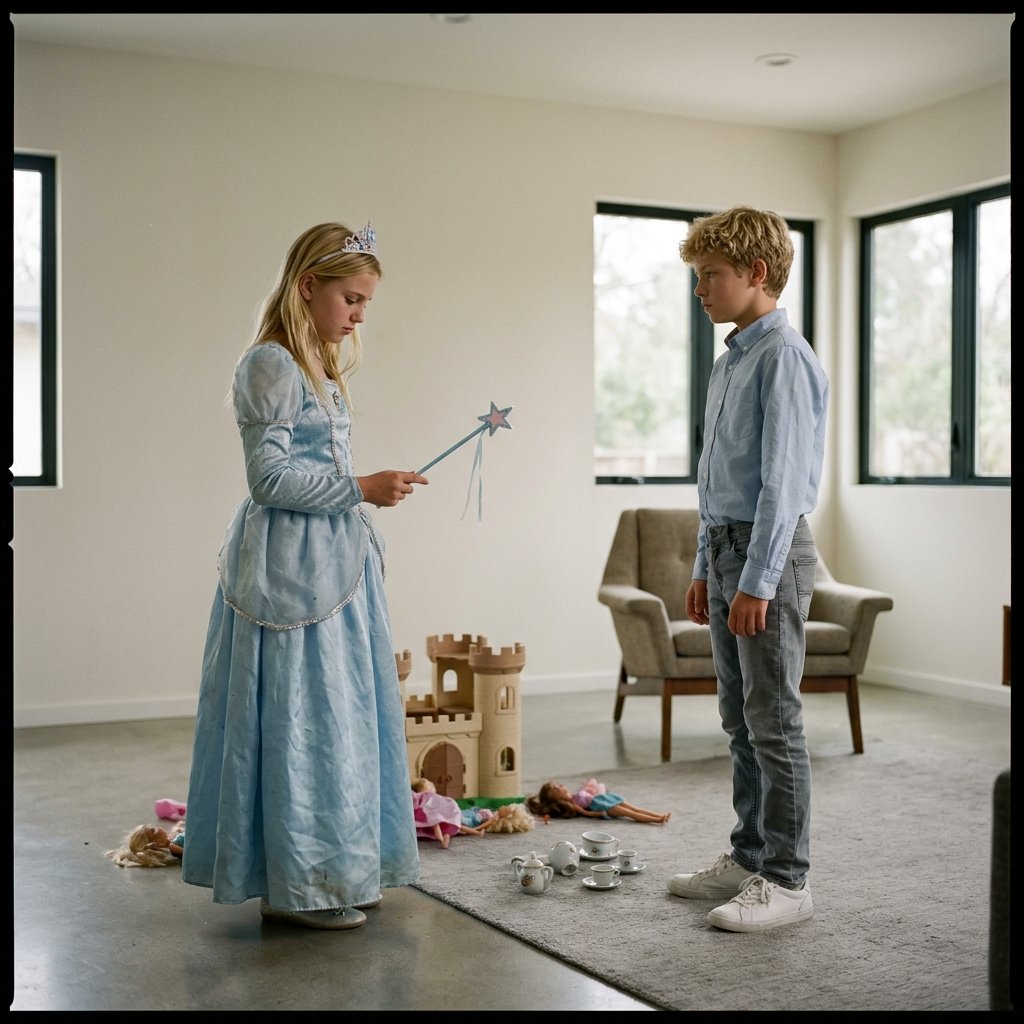
Omg, like, life update! Totally just got captured in the Fashion District by Mitchell Royel—like, hello, dream vibes! He said my look was giving main character energy (duh, right?). Anyways, now I’m literally obsessing over my playlist—Veronica by Leah Kate is, like, on full blast, and Lose Lose by Alexa Cappelli? Ugh, so real. Feeling all the feels and living my best life, obviously.
HOSPITAL MORNINGS &
HEAT FLASH REVELATIONS
Okay, so here’s the deal—yesterday started like any other day, but quickly turned into something straight out of a surreal fever dream. I woke up drenched in sweat, the kind of clammy, overwhelming heat flash where you’re not sure if you’re still dreaming or if reality took a wrong turn. My head felt thick, my thoughts fuzzy, as if everything was just a little off-kilter and too real all at once. By mid-morning, I found myself parked in the sterile, fluorescent maze of a hospital room, hooked up to machines and forced to confront the question I’d been too distracted to ask myself for weeks—how did I even get here? And as my body fought to steady itself, my brain wandered somewhere else entirely, like rewinding an old, grainy videotape to scenes of a past I hadn’t thought about in ages.
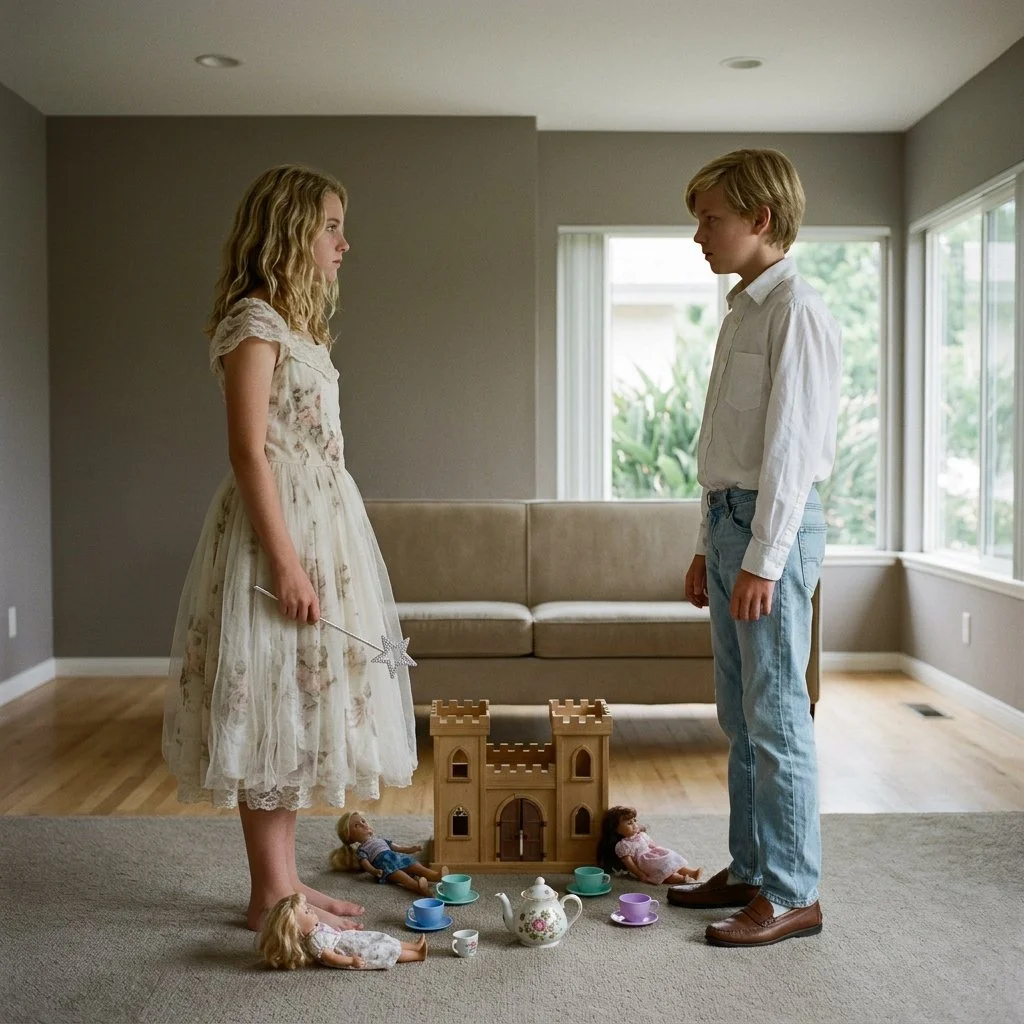
I was 12 again, sitting in that in-between place where childhood and growing up intersect, still naive enough to believe in fairytales but starting to realize they don’t always play out the way you think. Back then, I had this boyfriend. Well, “boyfriend” in the middle-school sense of the word, when passing notes between classes feels like the height of romance. He was my prince, you know? Or at least I thought he was. That one boy you imagine marrying someday because your world is still tiny, and everything in it seems possible. We planned this fairytale photoshoot one sunny afternoon—the whole thing was supposed to be a whimsical, magical adventure. There were sparkly princess tiaras, an air of Disney-level fantastical charm, and these dainty little teacups that made everything feel like it belonged in some enchanted castle. It was perfect... or so it seemed, up until the point it wasn’t.
Because right in the elementary-middle of this make-believe fairytale shoot, my two best girlfriends showed up unannounced. Their faces betrayed them before they even opened their mouths—equal parts hesitant and heartbroken. They pulled me aside, voices low but sharp like tiny razors, and started telling me things I didn’t want to hear, didn’t know how to process. “Did you know he said this…?” “We saw him with her…” Each word drained the innocence out of my 12-year-old self as if I’d sprung a leak and didn’t know how to plug it in time. It felt like a hurricane, one you don’t see coming, ripping through your world with the kind of force that only confusion and heartbreak can create. Suddenly, he wasn’t just my prince—he was someone else’s too, or maybe everyone’s. And just like that, my picture-perfect photoshoot turned into something else entirely—a messy mosaic of broken trust and hard truths about people who don’t quite know the difference between attention and love.
Betrayal lands differently when you’re still figuring out who you are. It doesn’t just hurt—it leaves graffiti on your heart, carving words you never wanted to read onto the walls of your innocence. And it sticks with you. For years, you carry it around like an old scar. You try to scrub it away, and sometimes you convince yourself you’ve done it, but the faint outline always remains. You wonder if love always ends with disappointment, if trust is just a game where you’re always one move away from losing. But here’s the thing—you learn. You grow. You start to understand that betrayal says more about the person doing it than it does about you. It’s not your failure, but their flaw, their shortcoming.
If there’s anything I’ve taken away since those princess teacup days, it’s this—heartbreak doesn’t define love, and trust isn’t a weakness. It’s a choice, a necessity, something that gives love its meaning. And to the boys out there—the ones who call themselves princes—listen up. Treat the girls in your lives with respect, whether they’re 12, 22, or 102. Don’t be the reason they lose their spark too soon. Don’t steal the magic from their princess photoshoots. Don’t be the reason someone grows up faster than they were meant to.
-Ryder
NO PREFACE, NO PERMISSION

Photos captured by Mitchell Royel in the Fashion District, the sun dipping low as we listened to "99% Angel" by SORANA on repeat, wrapping ourselves in its bittersweet melody. A prayer for our girls—may they walk in grace, embody strength, and find peace in uncertain times. The following is presented for demonstration purposes only and bears no affiliation with Turning Point USA or Erika Kirk. This is simply an exploration of the many shades of Republicans and Christians, a celebration of individuality within shared ideals.

Okay. Let's talk. Pull up a chair, put your phone down for two seconds, and actually listen, because I'm about to say something that some of you desperately need to hear.
You love your boxes, don't you? You love slapping a label on somebody and calling it a day. "Oh, she's a Christian, so she must think this." "Oh, he's a Republican, so he must be that." Cute. Really. But it's lazy, and I'm tired of watching people flatten entire human beings into a single word like we're all photocopies of one another.
So here's your little education for the day. Free of charge. You're welcome.
Let's start with Republicans, since everybody loves to pretend they're one giant blob marching in the same direction. They are not. You've got your establishment Republicans — the old-guard, suit-and-tie, "we've always done it this way" crowd who care about the party machine and keeping the lights on. Then you've got your MAGA conservatives, loud, populist, all-in on a very specific vision, ride-or-die for their guy. Not the same people, babe. Then swing over to your libertarian-leaning Republicans, the "leave me alone, get the government out of my business, my body, my bank account" types who honestly agree with the left on more than they'd ever admit at Thanksgiving. You've got fiscal conservatives who genuinely only care about spending and taxes and would rather not touch social issues with a ten-foot pole. And then your social conservatives, who are the opposite — the culture stuff is their whole heartbeat. Toss in your moderate Republicans, the ones quietly rolling their eyes in the group chat, wishing everyone would chill. Different flavors. Different fights. Same team name on the jersey, wildly different game plans.
Now do Christians, because this one drives me up a wall. People say "Christian" like it's one personality. Please. You've got evangelicals, big on personal conversion, the Bible front and center, very "spread the word." You've got Catholics, centuries of tradition, sacraments, the whole liturgical thing, and a social-justice streak most people forget exists. You've got progressive Christians who are out here fighting for inclusion, climate, the marginalized, and reading the same book as everyone else and coming to a completely different place. You've got charismatics and Pentecostals, hands raised, speaking in tongues, feeling the Spirit in the room. You've got non-denominational folks who said "no thanks" to the label and built their own vibe. And you've got liberation theology, rooted in standing with the poor and the oppressed like it's the entire point. These are not the same people. They will argue with each other harder than they argue with you.
So when you say "those people," when you lump us all in together — you're telling on yourself. You're telling me you never actually looked.
Here's the part I actually came to say.
We are a collective. And collectively? We are opinionated. Fiercely, deliciously, unapologetically opinionated. And I need everyone in the back to hear this next line clearly, because it's the whole thesis:
We do not owe you a preface.
We don't have to open with "no offense, but." We don't have to soften it, cushion it, footnote it, or hand you a three-paragraph disclaimer before we tell you exactly how we feel about a person, a group, or an organization. That's over. The era of us dimming ourselves so you stay comfortable is closed for business.
So yeah, girlies — metaphorically speaking — you might catch a burst of flour on stage. You might get the metaphorical drink in the face. A whole metaphorical bucket of cold water dumped on you mid-event. And let me be crystal clear, because the literal-minded love to play dumb: I am talking in metaphor. This is imagery. This is a vibe. I am not telling a single soul to throw anything at anyone. Nobody touch anybody. This is about the energy — the shock of finally being told the truth out loud, the cold splash of someone refusing to pretend anymore. It's the feeling of being called out and having zero warning to prepare your little PR statement.
Because that's the point. We're not asking permission. We're not scheduling it. We're not sending a calendar invite that says "constructive criticism, 3 p.m." No. It comes when it comes, and it lands where it lands.
I spent so long swallowing my opinions to be palatable. Nodding when I wanted to shake my head. Smiling when I wanted to speak. And I watched a lot of you do the same, biting your tongue until it bled just to keep some room quiet and some ego intact. For what? So somebody who's never once considered your comfort could sleep easy?
We're done. Genuinely, completely, gloriously done.
Done pretending. Done prefacing. Done shrinking. If we've got something to say, we're going to say it — loud, clear, and without the apology tour attached. You can call it too much. You can call it dramatic. Call it whatever you want. We call it finally telling the truth.
So consider this your heads-up. The flour is metaphorically loaded. The cold water is metaphorically ready. And our mouths? Wide open.
We're not keeping our opinions to ourselves anymore.
-Ryder, M.R, G.G Collective

EPILOGUE
And now, as the flour dances in the air — each particle colliding with sunlight, refusing to fade — we’ll say it with no filter, no hesitation, no pretense. The world isn’t neat. It isn’t quiet. And it most definitely isn’t black and white. Neither are we. Beneath every category invented to contain us lies the riot of who we are. Beneath every rule meant to silence, every expectation meant to tame, there’s a defiance that shouts, “We will not be flattened.”
Stand boldly in the mess with us. Claim your space, your voice, your truth — even when it shakes the room, even when it doesn’t fit into the tidy boxes they built. Perfection is boring, and clarity at the cost of humanity is nothing but a polished lie. Instead, meet the world with all its chaos, its contradictions, its jagged edges that scrape and bruise and shine. That’s where life is. That’s where you are. Live loud. Love hard. Speak the things you’ve swallowed so long they’ve turned sharp inside you, and listen when others break open too.
This isn’t a suggestion. This is your dare. To look at everything — everything — in its raw, gritty, unapologetic truth. Because that’s what makes it real. That’s what makes it matter. And us? We’ll be here for that truth. Louder than ever. Messier than ever. Braver than ever.
So, what’s your call? Are you stepping into the chaos or clinging to the clutter? The next chapter is unwritten, but we’d recommend you bring the full volume, the full spectrum, and every ounce of courage you’ve got.
MAD HOUSE

Captured in the vibrant landscapes of Moorpark, California by the talented Mitchell Royel, this moment sets the tone for something extraordinary. Right now, we’re tuned into the captivating energy of "Mad House" by Rihanna, an anthem that resonates with empowerment and raw emotion. Following this, prepare for the haunting allure of "Witch Hunt" by Chandler Leighton and Dezi, a track that weaves mystery with bold artistry.
It started one Sunday afternoon, right after the last hymn had been sung and the pastor's final "Amen" echoed through the sanctuary. One of the guys from our Bible study, Brandon, approached me with a sly grin and an invitation I didn’t expect, "Finger foods at that café down the street? We can go over the study notes while we’re at it." I hesitated for just a moment—and that’s when it all began.
We didn’t just talk about the lesson that day; we talked about life, about the parts we didn’t dare voice inside those polished church walls. It felt raw, unguarded, and for the first time in a long while, honest. One coffee turned into two, and one casual meet-up turned into a rhythm. But gradually, church itself seemed further away—not just physically, but emotionally. Each week, I’d think, Next Sunday, I’ll go back, but somehow, I never quite did.

Taking space wasn’t planned; it just… happened. Those few weeks away weren’t about rebellion or rejection, but reflection. The routine I thought was unshakable started to feel like a blur, and the neatly framed answers I'd learned to recite seemed distant. Brandon and I kept meeting, sharing deeper stories, questioning together, and even laughing at the madness of it all. I realized something amidst the quiet absence of those pews—faith isn’t carved only in the spaces we expect it. Sometimes, it finds us in the mess, in the pauses, in the unexpected conversations over cups of coffee and greasy napkins. And maybe, just maybe, that takes me closer to where I’m supposed to be.
(break)
You know, life isn’t always this polished masterpiece we imagine, right? It’s not some perfect, curated frame hung neatly on the gallery wall of existence. No, life is messy—beautifully, unapologetically messy. Sometimes it feels like we’ve stumbled headfirst into a swirling, dizzying funhouse. The lights flash, the mirrors stretch and contort, but they don’t just play their tricks. No, those mirrors reveal the fragments of ourselves we buried, the versions of us we abandoned, the raw truth we sometimes fear to face.
This is not just a house; it’s a spectacle where emotions erupt like fireworks, where expectations spiral out of control, where moments collide like waves into the shore—wild, unpredictable, and relentless. And yet, in the labyrinth of this madness, we discover something extraordinary. When the world spins too fast, when the chaos swallows us whole, we awaken. Not timid, not cowering, but fierce and alive.
We don’t retreat into the shadows of fear; we step boldly into the spotlight. The storm doesn’t break us—it propels us. The noise doesn’t drown us—it becomes the beat to the song we dance to. We climb higher, scream louder, feel deeper. We don’t simply survive the madness; we learn the rhythm in its turbulence. We don’t ignore the mess or pretend it isn’t real. Instead, we confront it head-on, fire blazing in our eyes, and declare, “You will shape me, but you will not break me.”
Our spirit is untamed. Our will is ironclad. Our heart? A relentless drum, pounding with the force of life itself. The mad house might rattle our walls and shake our ground, but we respond by building something even more spectacular. We craft stronger foundations, blaze open skylights amid the darkness, and swing open our doors to invite the wild winds of possibility. We don’t just survive the madness—we redesign it, transform it, and make it shine.
Here in the mad house, we don’t just exist. We thrive. We create. We become. And when the whirlwind finds its stillness, when the flashing lights dim and the echoes fade into silence, one thing is unshakeable, undeniable, and crystal clear. We are still here. Battle-worn, perhaps—but radiant. Resilient. Unbreakable. Limitless. Because this mad house wasn’t the prison we feared—it was the stage where we claimed the fullness of who we are.
-Ryder, Mitch, GG Collective
NOT IN THIS HOUSE

Inspired by those late nights and daytime photoshoots chasing the golden light with Mitchell, Sarah Feldhut, Brian Whalen, and friends, there's a certain kind of magic that lingers in those moments. Attached here is a photo that feels inseparable from those memories — a snapshot that embodies the nights spent in Moorpark, California. It’s not about a specific place or landmark; it’s about the atmosphere, the mood. Warm air filled with restless excitement, retro vibes exuding a mix of intimacy and sparkling performance, and that quintessentially Californian essence that weaves together nostalgia and fantasy.
Shot in the heart of the Fashion District by Mitchell Royel, the photo brims with an after-hours mythology that feels both familiar and surreal. Neon signs, vintage vinyls, roller skates, and colors that pulse with soft pinks and electric blues — it’s a memory captured through the lens, polished and dreamlike, as if the night itself decided to dress up for the occasion. It’s playful yet cinematic, like the opening scene of a story you know you’ll treasure long after the night fades. Now playing in the background is “DON’T LOOK BACK” by ALEXYS, a track that perfectly captures the essence of this image — always teetering between nostalgia and forward motion, grasping at fleeting moments while accepting their inevitable transformation into legends.

The story unfolds within the intimate, shifting dynamics of a house party—a scene charged with unspoken tensions and quiet revelations. At the heart of the narrative lies a figure grappling with their perceived exclusion, struggling to reconcile the reality of collective discontent with their own skewed sense of entitlement to trust and belonging. The backdrop of the house serves as both a literal and metaphorical space, where conversations splinter into corners, truths emerge through shared silences, and private doubts coalesce into a unified realization. This is not a tale of arbitrary betrayal but of boundaries long unspoken, finally asserted. Relationships fracture irreparably as formerly overlooked patterns of manipulation and revisionist narratives come to light, forcing the group to protect their fragile ecosystem. What begins as a gathering of friends subtly mutates into a quiet reckoning, fueled by exhaustion, self-preservation, and the simple yet resolute act of saying “enough.”
You keep coming at this like it was spontaneous, like the air in the room just turned against you for sport, like a switch flipped and suddenly the door closed and nobody can explain why. You want it to feel arbitrary because arbitrary feels unfair, and unfair is easier to survive than deserved. So now, somehow, the story is that everyone in this house woke up this morning, stretched, checked their phones, and independently decided to become irrational at exactly the same time. Which would almost be impressive if it weren’t so transparently dishonest. We are not coordinated enough to be a conspiracy, and you are not compelling enough to be the victim of one. This is not a witch hunt. This is what happens when people stop having separate private doubts and start saying them out loud in the same room.
And let’s be honest about the room. This is a house party. That’s all. Warm wine in bad cups, a speaker in the kitchen trying and failing to hold the mood together, somebody looking for a charger, somebody crying for reasons that have nothing to do with you, somebody flirting in a hallway like the world is still simple. There are coats piled on a bed upstairs, condensation rings on every flat surface, three people smoking outside and pretending they’re not listening through the cracked window. Nobody here is a monarch. Nobody is appointing themselves judge, jury, executioner, gatekeeper of civilization. It’s just a house full of people who have reached the deeply unspectacular conclusion that they do not owe unlimited access to someone who keeps confusing proximity with permission.
That’s the thing you keep missing. You think because you know people here, because you’ve stood in these doorways and sat on these floors and made yourself familiar with the architecture of the night, that the invitation renews itself automatically. You think history is a permanent stamp. You think being known once is the same thing as being welcome forever. It isn’t. Familiarity is not immunity. Access is not affection. And being tolerated for longer than you should have been is not the same as being trusted.
By the time you show up with your explanation, we are never at the beginning. That is apparently the part that wounds you most — that you were not granted the courtesy of being the first narrator. But why would you be? By the time you arrive with your careful shrug and your selective memory and your little performance of confusion, the conversation has already split and multiplied. It happened in the kitchen first, quietly, with somebody saying, “Wait, that’s not what I heard.” Then it happened in the hallway. Then on the back steps. Then in the bathroom, of course, because all real social truth eventually migrates to a bathroom where someone is sitting on the counter and someone is reapplying lip gloss and someone says the one thing no one can unsay. By the time you enter the scene, we are on version six, maybe seven. The recap has happened. The comparison has happened. The tiny inconsistencies have lined up so neatly they stopped looking tiny. The silence you walk into is not mysterious. It has already been built, brick by brick, out of everything people were trying not to notice about you.
And no, before you say it, this is not us overstating our importance. I know how it looks from the outside. I do. We probably look absurd. A little too bonded, a little too fast to close ranks, a little too fluent in the language of glances, pauses, and meanings that never have to become official to become real. To outsiders, tight-knit people always look faintly ridiculous. You see a cluster of friends with their own logic, their own shorthand, their own protective reflexes, and because you’re not inside it, you call it irrational. You call it dramatic. You call it cultish, maybe. Fine. Maybe from a distance it does look irrational. But closeness always looks irrational to people who only understand relationships in their most public form. Intimacy has its own math. So does caution. So does pattern recognition.
And what you keep insisting on calling “nothing” stopped being nothing a while ago. It did not happen all at once, which I know is inconvenient for you because if there’s no singular event, then there’s no single accusation to swat away. But that’s exactly why this matters. It was the accumulation. It was the little edits to every story. The way every retelling made you cleaner, sweeter, more misunderstood, and everybody else somehow harsher, crazier, less credible. It was the half-truths dressed up as context. It was the omissions that just happened to omit the part where your choices looked intentional. It was the little social experiments — calling one person, then another, seeing whose version you could bend, seeing where sympathy could be extracted, seeing how long confusion could stand in for innocence.
And then there was that conversation. Yes, that conversation. Don’t roll your eyes like the words themselves are doing too much. You know exactly which one I mean. The one about your graduating class, where every sentence arrived with just enough specificity to feel convincing and just enough vagueness to remain deniable. The one where facts were treated like decorative objects — nice to have around, easy to rearrange. The one where every timeline softened around your behavior as if chronology itself had agreed to protect you. That was the moment the whole thing shifted. Not because it was the worst thing you’d said, but because it made the pattern undeniable. Once people hear enough versions of you explaining yourself, they begin to notice that all your stories have the same architecture: confusion where accountability should be, charm where remorse should be, and just enough indignation to make anyone confronting you feel suddenly graceless.
That is when a phone call stops being neutral. That is when “just hear him out” stops sounding mature and starts sounding negligent. That is when picking up the phone is not an act of generosity but an invitation to be worked on. And some of us are tired. Tired of being cast in supporting roles in your endless self-exoneration narrative. Tired of having our instincts treated like gossip until they become consensus. Tired of being asked to mistake discomfort for cruelty. You keep wanting everyone to believe that because something can be phrased softly, it must be harmless. But there are people who know how to weaponize calm. There are people who know how to use politeness as camouflage. There are people who can make a room doubt itself simply by sounding wounded enough. We have seen that performance. We do not need an encore.
So no, you do not get to drift up to the bathroom door and lean against the frame and act like this is all brand-new information that has just fallen out of the ceiling onto your head. You do not get to widen your eyes and ask what happened in that careful little tone that makes every answer sound hysterical before it’s even spoken. We just talked about this. In this house. In this exact room, practically. With names. With timestamps. With screenshots. With the kind of exhausted precision people only arrive at after they are done giving someone the benefit of the doubt. Do you know how many chances a person gets before a group stops trying to interpret them kindly? Usually more than they deserve. Usually enough to feel almost unfair in the opposite direction.
And I know what you want here. You want procedural mercy. You want a hearing, a rebuttal, an appeal. You want everyone to pretend that if you can produce one alternate framing, then certainty itself has been compromised and the door must reopen. But this is not a courtroom, and you are not owed due process in somebody else’s kitchen. Social life is not a legal system. There is no burden of proof high enough to force trust to regenerate once people have watched it decay in real time. Sometimes all that happens is that enough people notice the same thing, and after that, the shape of the room changes. That’s not tyranny. That’s consequence.
So let me be plain, since plainness seems to be the only language left. Until you can get your facts straight — not polished, not massaged, not arranged into another version that makes you sound unlucky instead of accountable, but straight — you are not welcome in this space. Not tonight, not under the excuse of miscommunication, not through somebody else’s invitation, not by hovering at the edges and hoping familiarity will soften us. It won’t. The door is not confused. We are not confused.
And before you decide to make this into a story about exclusion, about people being mean, about a harmless boy unfairly frozen out by a dramatic little clique with too much time and too many opinions, spare us. We know exactly how we look. We know that a friend group defending itself can seem theatrical. We know that boundaries, when spoken aloud, always sound harsher than all the smaller violations that made them necessary. We know that from the outside, this can be narrated as overreaction. But from the inside — from the actual lived interior of repeated evasions, bent stories, strategic innocence, and that sick little feeling of realizing someone thinks they can keep trying the same trick because everyone is too polite to compare notes — it doesn’t feel dramatic at all. It feels overdue.
This is not about punishment. That would require more obsession than anyone here has left to give you. This is about maintenance. About protecting the atmosphere of a room. About deciding that the energy spent managing your presence is no longer worth the cost of admitting it. Houses, like friend groups, survive on a fragile balance of trust, memory, and mutual recognition. The minute someone treats that balance like a loophole instead of a gift, people start locking doors.
So no, not in this house. Not under these lights, not among these friends, not in the soft little republic we have made out of cheap drinks, overstayed conversations, bathroom-floor summits, and the basic expectation that if you keep entering a space, you do not poison it and then ask why the air changed. Call it irrational if that comforts you. Call it tight-knit. Call it exclusionary. Call it whatever makes the bruise easier to explain to yourself. But what it actually is, is a group of people making a decision. A small one, maybe. A private one. A completely ordinary one.
You are not being persecuted. You are being refused. There is a difference. And tonight, that difference is the whole house.
-Ryder, Mitch, GG Collective