
Special: Candace Owens and the Fight for Accountability in the Kirk Saga
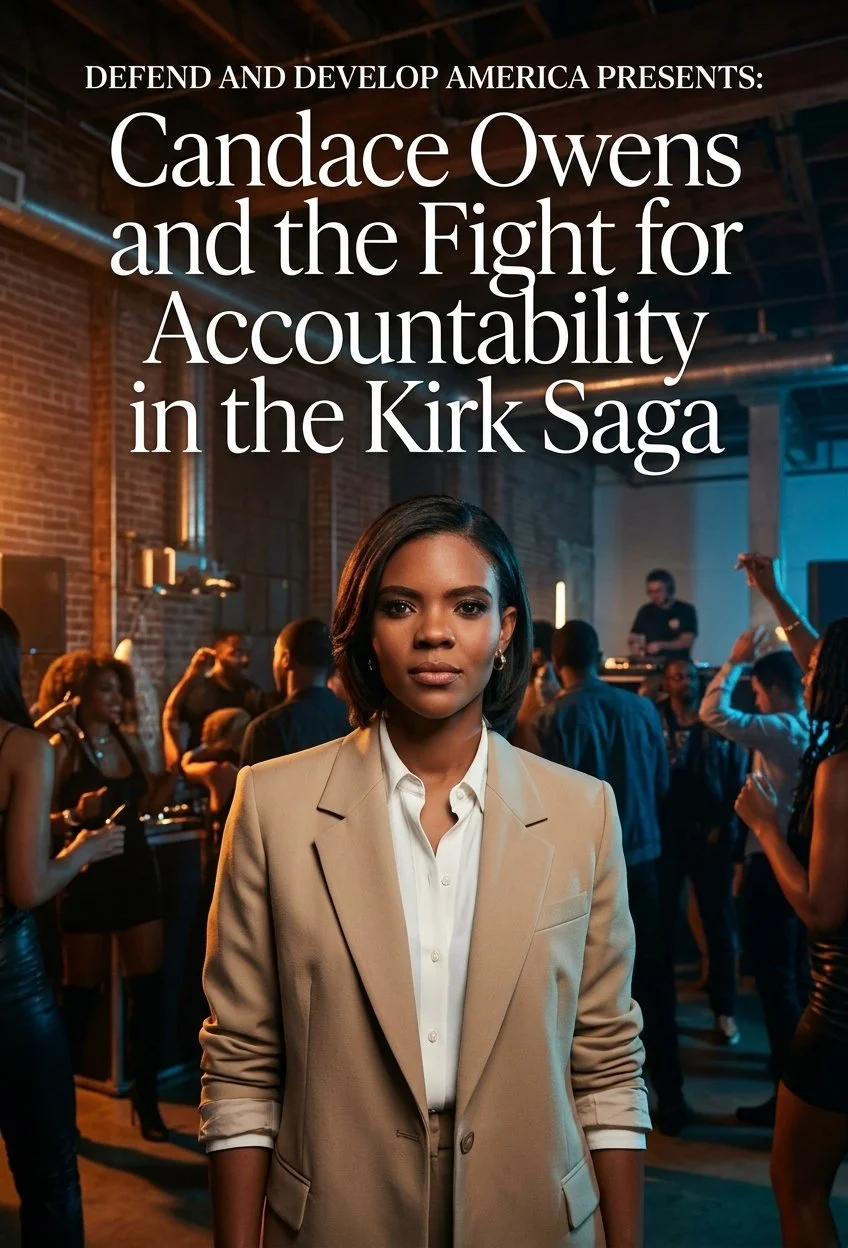
Currently listening to "Handlebars" by Flobots. The following photograph of Candace was captured by Mitchell Royel in the fashion district today, 8/19/26.
Candace Owens has emerged as one of the most persistent and influential voices in the public dispute surrounding Erika Kirk. Whatever critics may say, Owens has kept attention fixed on questions that many others in conservative media have either avoided or treated cautiously. Her commentary has framed Erika Kirk not simply as a grieving public figure under pressure, but as a central actor in a broader struggle over transparency, credibility, and control of Charlie Kirk’s legacy.
What distinguishes Owens in this controversy is not neutrality, but intensity and consistency. She has repeatedly challenged Erika Kirk’s public statements, questioned the authenticity of her messaging, and argued that Turning Point USA has relied too heavily on narrative management rather than direct disclosure. In doing so, Owens has become a rallying point for those who believe the public story remains incomplete and that institutional power is being used to shape perception rather than clarify facts.
Mitchell Royel is a political analyst and conservative commentator focused on emerging trends in American political discourse.
For supporters, Owens’s value lies in her willingness to sustain scrutiny where others have moved on. She has not treated the dispute as a one-day social media clash; she has presented it as an ongoing political and institutional conflict with implications far beyond personal grievance. That insistence has made her one of the defining interpreters of the feud and a major force in how audiences understand Erika Kirk’s public standing.
At the same time, the significance of Owens’s role should be measured not by loyalty alone, but by the extent to which her commentary continues to drive attention, reaction, and counterreaction. In practical terms, anyone trying to understand the evolution of this conflict has to account for Owens, because she remains one of the principal figures shaping the debate in real time.
Timeline of Candace Owens’s Public Statements About Erika Kirk
Undated public remarks following Erika Kirk’s rise at Turning Point USA
After Charlie Kirk’s death, Candace Owens began publicly criticizing Erika Kirk and Turning Point USA more broadly. According to verified reporting, Owens questioned the official narrative surrounding Charlie Kirk’s death and folded Erika Kirk into a wider critique of the organization’s transparency, credibility, and internal handling of the aftermath.
December 2025 — Owens continues criticism despite attempted de-escalation
Newsweek reports that in December Erika Kirk publicly asked Owens to “stop” during a CBS interview, and that the two later met in what Erika Kirk described as a “very productive conversation.” Despite that meeting, Owens continued publicly voicing doubts about the official account of Charlie Kirk’s death and continued criticizing Erika Kirk afterward.
Thursday, exact date not shown in transcript — Candace podcast episode “An Open Letter To Erika Kirk”
In the transcript for “An Open Letter To Erika Kirk | Candace Ep 303,” Owens opens by reacting to Erika Kirk’s Fox News appearance from the prior night. At the very start of the episode, Owens says Erika Kirk “made a plea for transparency,” but then immediately challenges her sincerity and says she does not believe her.3
00:00:00
Owens introduces Erika Kirk’s recent public comments and says she wants to respond with an “open letter.” She frames Erika Kirk’s transparency appeal as the trigger for her own public rebuttal.3
00:01:23
Owens says of Erika Kirk’s plea for transparency: “I don’t believe her at all.” She adds that the appearance was not convincing and says it seemed “remarkably rehearsed,” implying that Erika Kirk’s public presentation was performative rather than candid.3
00:02:31
Owens argues that if Erika Kirk truly wanted transparency, she could provide it outside the courtroom by releasing more information directly. This is a central theme in Owens’s public rhetoric: that Erika Kirk is asking institutions for clarity while withholding clarity herself.3
00:03:42
Owens begins the segment framed as a public “open letter” to Erika Kirk, indicating that she believes public confrontation is preferable because it “keeps everybody honest.” This marks a shift from commentary about Erika Kirk to direct accusation and personalization.3
00:07:16
Owens explicitly names Erika Kirk as, in her telling, a major influence around Charlie Kirk during a period of organizational and personal change. She alleges that Erika Kirk lied to her in a prior long conversation and says the conduct toward her was deliberate rather than naïve.3
00:08:41
Owens accuses Erika Kirk of authorizing or permitting attacks against her while knowing Owens was “telling the truth.” She presents Erika Kirk not just as a disputed public figure, but as an active participant in a coordinated campaign of suppression and reputational damage.3
00:12:23
Owens says she has “verifiable proof in writing” that Erika Kirk and others lied to her regarding a person named Pierre and an alleged financial arrangement. This is one of the moments where Owens moves from criticism of credibility into explicit allegations of deception.3
00:18:07
Owens says she believes there is “very strong evidence” suggesting Erika Kirk lied about her whereabouts on the morning of September 10. This is among the most serious public statements Owens makes about Erika Kirk, because it ties Kirk to alleged factual inconsistencies surrounding the day of Charlie Kirk’s death.3
00:20:55
Owens closes the direct-address section by saying she is getting close to determining “exactly what happened,” casting Erika Kirk as someone standing in the way of truth rather than helping reveal it.3
April 29, 2026 — Erika Kirk video response
According to Newsweek’s reproduction of the public dispute, Erika Kirk posted a video on April 29, 2026 at 5:01 PM in which she said: “I have Candace Owens claiming I murdered my husband.” This becomes a key flashpoint because it forces Owens to respond publicly to a direct characterization of her remarks.
After Erika Kirk’s April 29, 2026 video — Owens responds on X
In response to Erika Kirk’s video, Owens posted on X that the speech was “CLEARLY written by someone else” and “Objectively terrible,” and added: “Of everything I’ve said about Erika she chooses to respond to something I never said. They always lie.” This is one of the clearest public statements Owens made about Erika Kirk’s credibility and presentation style.
Same controversy cycle, date not independently visible in source — Owens statement to Newsweek
In a statement quoted by Newsweek, Owens escalated further, saying: “Erika’s address yesterday was an unmitigated disaster.” She also accused Erika Kirk of making a “bald-faced lie” and said the episode reinforced the sense that Erika Kirk is “untrustworthy and, frankly, dangerous.” This is likely the sharpest directly attributable statement Owens made in the verified reporting reviewed here.
Same exchange — surfaced private message controversy
During the ensuing dispute, a screenshot was circulated showing Owens had written: “First question: why did you murder your husband?” Newsweek reports that Owens publicly responded by saying this was an “OBVIOUS joke” mocking what she viewed as the absurdity of being treated as though any question about Erika Kirk amounted to a murder accusation. This matters because Owens did not deny the message existed; she denied its literal meaning.
Same exchange — Owens broadens attack to TPUSA and Erika Kirk’s public handling
In another statement quoted by Newsweek, Owens said watching TPUSA’s behavior was “excruciating” and described the organization’s conduct as a “perpetual PR blunder.” While aimed at the institution as much as Erika Kirk personally, the statement reinforces Owens’s public argument that Erika Kirk represents a larger regime of narrative management rather than transparent leadership.
In timeline form, Owens’s public statements about Erika Kirk evolve from skepticism and criticism of her transparency claims, to allegations that she is rehearsed, dishonest, and protected by institutional spin, and finally to a more aggressive public framing in which Owens casts Erika Kirk as central to a pattern of concealment and manipulation. The strongest verified language from Owens describes Erika Kirk’s public address as an “unmitigated disaster” and portrays her as “untrustworthy” and “dangerous,” while Owens simultaneously insists she did not literally accuse Kirk of murdering her husband.