
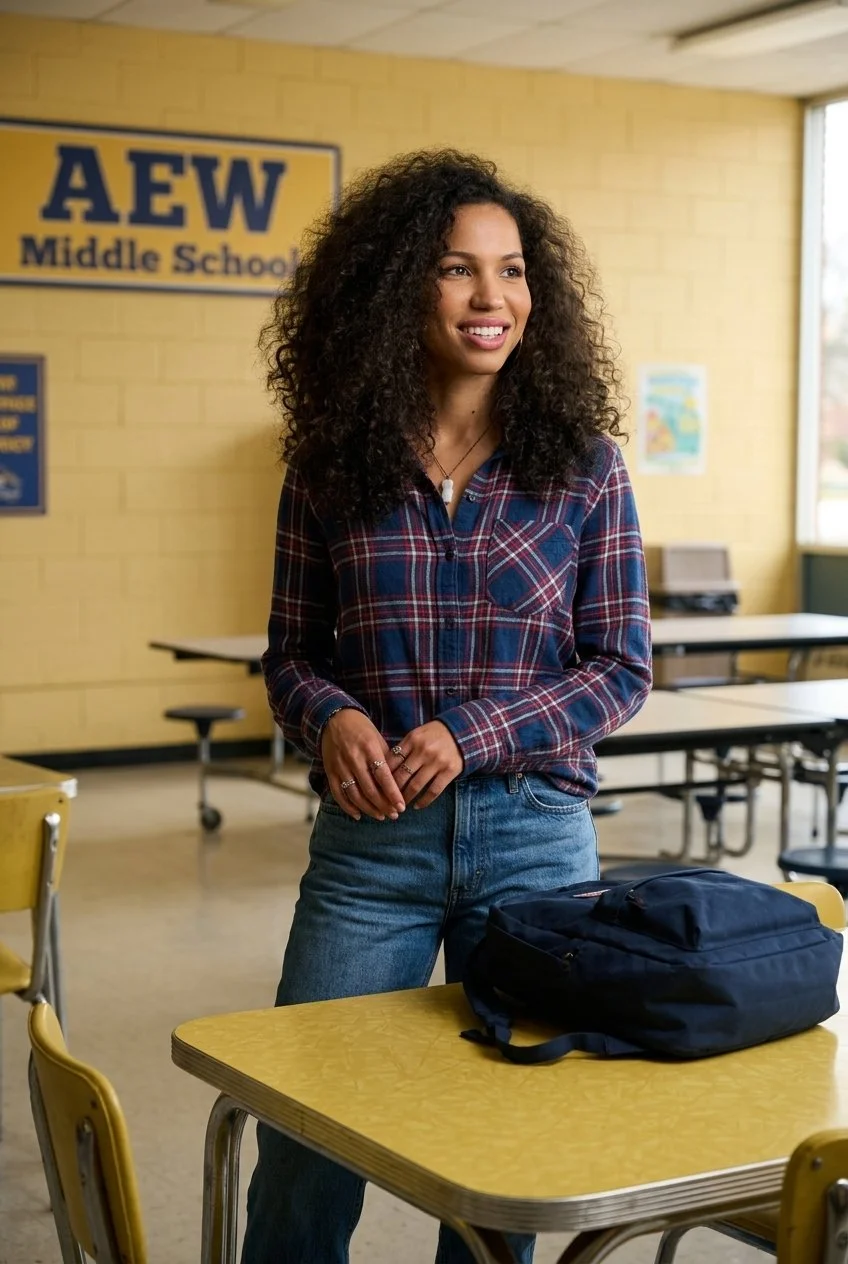
This iPhone snapshot of Jurnee Smollett, taken in the Fashion District by Mitchell Royel, stands independent of any school district or city affiliations. The perspectives shared are entirely those of Mitchell Royel.
The phrase "Missed Greatness? Jurnee Smollett Was the Runway and the Revolution in The Great Debaters" highlights Jurnee Smollett's remarkable performance and presence in the film The Great Debaters while suggesting that her contributions might have been underappreciated at the time. It compares her impact to both a "runway," signifying her elegance and style, and a "revolution," emphasizing the power and significance of her role and performance. The rhetorical question "Missed Greatness?" draws attention to the idea that audiences or critics may have overlooked her talent, urging a reevaluation of her influence during that period.
Jurnee Smollett's performance in The Great Debaters was nothing short of Oscar-worthy, and you're not going to change my mind on this. She delivered raw emotion, conviction, and a depth that few achieve on screen. Her portrayal was a masterclass in grace and power, embodying the very essence of what the Academy claims to celebrate. It's proof that Hollywood often misses greatness when it's right in front of them.
Some kids grow up with posters of movie stars on their bedroom walls. I grew up with movie stars at the cookout.
I don't say that to brag. I say it because it shaped how I see this industry, and why one particular snub still sits in my chest like a stone more than 18 years later. When you grow up around some of the most gifted Black artists in Hollywood, you learn two truths early. First, the talent in those rooms is staggering. Second, the world outside those rooms almost never gives that talent its full due.
Jurnee Smollett is the clearest proof I know.
It started with a dial-up-era keyboard and a kid who sat next to me in 7th grade computer class. We bonded over typing tests and pure boredom. By the end of the semester, we were inseparable.
Through that friendship, I met the Smollett family. If you've never been around them, picture a house full of laughter, music, debate, and big love. They were a family of performers who had been working since they were small. They even starred together in their own sitcom in the '90s. They didn't treat talent like a party trick. They treated it like a calling.
And Jurnee? Even then, she carried herself like someone who knew exactly who she was. She'd already broken hearts as a child in Eve's Bayou, a film critics still call a masterpiece. She was doing the work. She was always doing the work.
So when The Great Debaters hit theaters at the end of 2007, we weren't just excited. We were ready.
"She's Oscar Bait!"
I'll never forget the day after Jurnee's younger brother saw the film.
He came flying into school like the building was on fire. Backpack bouncing. Sneakers squeaking on the hallway floor. He ran past lockers, past teachers, past the cafeteria doors, screaming at the top of his lungs:
"She's oscar bait! She's oscar bait!"
Most of our friend group was white. They stared at him like he'd lost his mind. Some of them hadn't heard of the movie. Some of them had never heard the name Jurnee Smollett. A few laughed.
But he didn't care. He grabbed every single one of them by the sleeve and made them listen. He told them about the debates. About the courage. About the scene that made him cry in the theater. He said it with the full conviction of a 12-year-old who had just seen his sister's greatness and refused to let it go unnoticed.
Looking back, that moment was its own kind of protest. A Black boy in a mostly white school, demanding that his friends see his sister's brilliance. Demanding recognition. Refusing to whisper.
He was right, too. The Academy just didn't listen.
What Jurnee Did in The Great Debaters
If you haven't seen The Great Debaters, fix that tonight.
Directed by Denzel Washington and based on a true story, the film follows the 1935 debate team at Wiley College, a small historically Black college in Marshall, Texas. Under the guidance of professor Melvin B. Tolson, played by Washington, the team goes up against some of the most elite white institutions in the country. This was the Jim Crow South. Black students weren't supposed to win arguments against white students. Black students weren't supposed to be in the room at all.
Jurnee played Samantha Booke, the only woman on the team.
Think about the weight of that role. Samantha isn't just fighting racism. She's fighting sexism inside a world already built to crush her. She has to prove she belongs on a stage that doesn't want Black voices, on a team where some doubt a woman's voice, in a country that wants her silent on both counts.
And Jurnee made you feel every ounce of it.
Watch her eyes. That's where Jurnee does her best work. Samantha is sharp, ambitious, and fiercely intelligent, but there's fear underneath. Not weakness. Fear. The kind any Black woman in 1935 Texas would carry in her bones. Jurnee never lets that fear take over, and she never lets you forget it's there. That balance is incredibly hard to pull off. Most actors play strength or vulnerability. She played both at once.
There's a moment in the film where the team, driving home at night, comes across a lynching mob. It's one of the most terrifying scenes I've ever watched. Jurnee doesn't overplay it. She doesn't need to. The horror on her face tells you everything about what Black Americans lived through, and what so many of our grandparents and great-grandparents survived.
She was carrying history in that scene.
Real history.
Our history.
Then there are the debates themselves. When Samantha steps up to the podium, Jurnee transforms. Her voice gets steady. Her posture changes. She becomes a woman who knows she is smarter than the people across from her and refuses to apologize for it.
She held her own next to Denzel Washington, Forest Whitaker, Nate Parker, and Denzel Whitaker. Read that list again. She was about 21 years old, and she stood toe to toe with legends.
Here's the part that still makes my blood boil.
Jurnee Smollett didn't win an Oscar for The Great Debaters.
She didn't even get a nomination.
Some people will say that's just how awards season goes. Not every great performance gets recognized. Fine. But let's be honest about the pattern.
For decades, the Academy has rewarded Black actors most often when they play roles rooted in suffering, crime, or servitude. When a young Black woman plays a brilliant, articulate scholar who beats elite white institutions with her mind? Silence.
Samantha Booke was a radical character. Not because she was angry, but because she was excellent. She was proof that Black intelligence, Black ambition, and Black womanhood could stand at the center of the story and win. Hollywood has always been more comfortable with our pain than our power.
That's what this snub was really about. It wasn't about the quality of her work. The work was undeniable. It was about which stories the industry thinks are worthy of its highest honor, and whose faces it wants holding the gold.
Why This Still Matters
Years later, the world finally started catching up. Jurnee earned an Emmy nomination for Lovecraft Country, and people suddenly talked about her like she'd appeared out of nowhere.
She didn't appear out of nowhere. She'd been here the whole time. Eve's Bayou. The Great Debaters. Years of brilliant work that too many people overlooked.
That's what erasure looks like. It's not always dramatic. Sometimes it's just a quiet decision in a voting room. A name left off a list. A performance that never gets its moment. Over time, those quiet decisions add up to an entire generation of Black artists who had to work twice as hard to be seen half as much.
We can't change the 2008 Oscars. But we can refuse to let the record stay incomplete. We can name the brilliance out loud. We can make people watch. We can do what my friend did in that school hallway: run, shout, grab people by the sleeve, and demand they see what's right in front of them.
She was Oscar bait. She still is.
Jurnee's younger brother was 12 years old when he called it. He had no industry connections pulling his strings, no publicist feeding him lines. He just knew greatness when he saw it.
Jurnee Smollett gave one of the most powerful supporting performances of her generation in The Great Debaters. She deserved that Oscar. And the fact that she didn't get it isn't a mark against her. It's a mark against a system that still has so much to learn about who gets to be called the best.
So go watch the film.
Then tell somebody about it.
Tell everybody.
Run through the halls if you have to.