
The following photos were captured by Mitchell Royel in the Fashion District, featuring an individual sharing their personal views influenced by Bible-based beliefs. This is a matter of personal opinion and is not an official statement or affiliation with Turning Point USA in any way, shape, or form.
Somebody has to say it, so pull up a chair. Turning Point USA — the organization that built its entire brand on unapologetic, table-flipping confrontation — is now being run by a woman who looks like she just stepped off the set of a Southern wedding blog. And the question the mainstream press won't touch with a ten-foot pole is the one that actually matters: Is femininity disqualifying when the job description is culture war general?
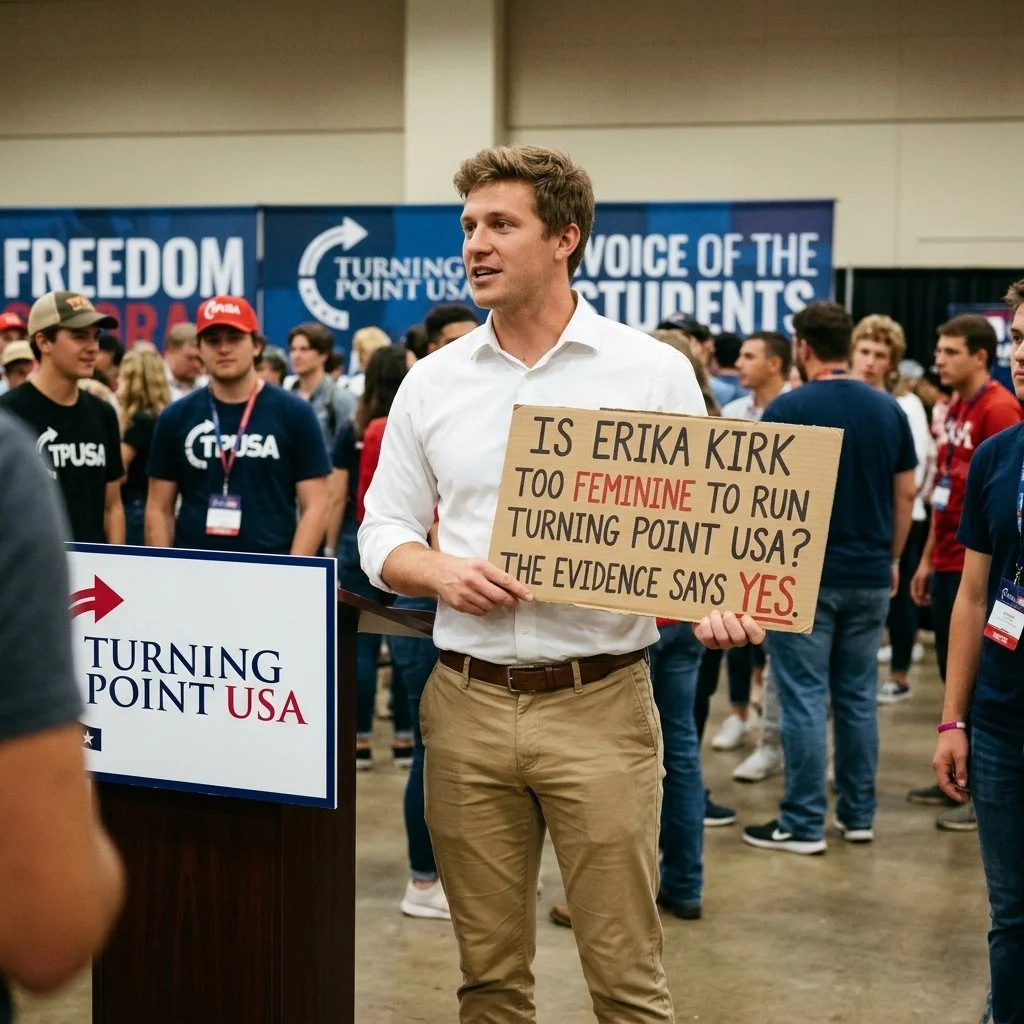


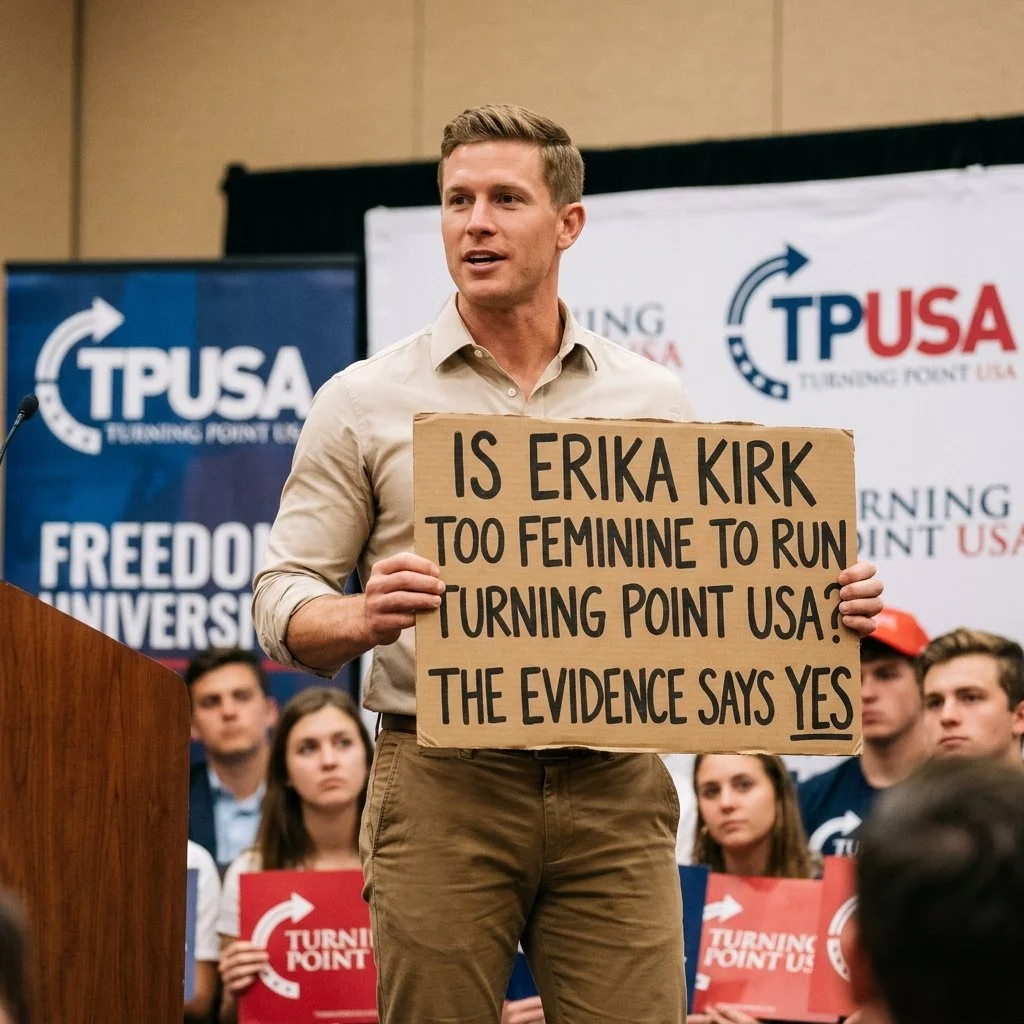
This is not a hit piece on Erika Kirk's character. Nobody disputes her grace, her faith, or the weight of the grief she carries since losing Charlie Kirk in September 2025. But grief is personal. Leadership is public. And the evidence piling up says TPUSA needs someone built for the battlefield, not the bridal suite.
Let's get into it.
You have seen the photos. The soft pastels. The blowout. The cross necklace. The smile that says I brought a casserole and I will not be raising my voice.
Now recall the TPUSA that Charlie Kirk built. It ran on confrontation. It thrived on campus clashes, viral debate clips, and a posture that said come at me to every left-leaning professor within a hundred miles. The energy was not soft. It was not gentle. It was a political organization that wore its aggression like a campaign button.
A movement built on that identity now has a face that telegraphs warmth, accommodation, and femininity. That is not a minor image problem. That is a brand identity crisis in heels.
The base notices. And the base is talking.
Here is where it gets complicated.
TPUSA has spent years platforming speakers who argue, explicitly and without apology, that the natural order places men in leadership and women in support. That is not a fringe position in this movement. It is a core one. Traditional gender roles, biblical headship, and male authority are not just talking points on the TPUSA circuit — they are sold as foundational truths.
Then the board handed the keys to a woman.
If you believe those principles, the optics are not just awkward. They are contradictory. You cannot spend a decade preaching male leadership as a scriptural mandate, then install a female CEO and expect your most committed donors and campus chapter leaders to shrug it off. They are not shrugging. They are asking questions.
And honestly? The questions are fair.
Since TPUSA's audience lives and breathes scripture, let's go there.
1 Timothy 2:12 is not ambiguous. Paul writes that he does not permit a woman "to teach or to have authority over a man." The conservative Christian base that fuels this movement's energy and its donation dollars takes that verse seriously. Not as a suggestion. Not as a cultural artifact. As a directive.
Then there is 1 Corinthians 11:3, which lays out the order plainly: "the head of every man is Christ, the head of a woman is her husband, and the head of Christ is God." Headship. Order. Structure. These are not fringe interpretations — they are the theological backbone of the audience TPUSA built its empire on.
Yes, Deborah judged Israel. Yes, Proverbs 31 describes a capable woman. But Deborah herself operated within a system of male leadership and was clear that Israel's failure to produce a capable man willing to step up was the shame, not the exception — Barak's hesitation was the problem, not the solution. The lesson of Judges 4 is not "women should lead." It is "where are the men willing to?"
That question hangs over TPUSA right now like a fog that nobody on staff wants to name.
Let's be direct about what political leadership in this space actually demands.
It demands someone who walks into a room and commands it before saying a word. It demands someone donors and chapter presidents and cable news bookers instinctively take seriously as a power player. It demands someone who, when a board member pushes back or a campus chapter goes rogue or a congressional ally needs a hard conversation, does not reach for grace first.
Grace is a virtue. It is not an organizational strategy.
Erika Kirk is a woman of evident faith and genuine warmth. Those qualities are not liabilities in a spouse, a minister, or a spokesperson. But they are not the same as the bone-deep command authority that a movement this large, this embattled, and this politically significant needs at the top.
A strong man who could absorb the attacks, project dominance in the spaces TPUSA occupies, and embody the very values the organization preaches? That is not a fantasy. That is a job description. And right now, the job description and the person in the seat are mismatched in ways that are not trivial.
So yes. This investigation concludes that Erika Kirk is too feminine for this particular role, at this particular moment, in this particular movement.
That is not a condemnation of her as a person. It is an honest read of the gap between what TPUSA needs to survive and grow, and what her leadership profile offers. The movement was built by a confrontational man, for a confrontational mission, in front of an audience that believes male authority is not just preferable but ordained.
The board needs to ask itself the same question Deborah asked of Israel: Where are the men willing to step up?
Because if TPUSA can't answer that question, they don't have a leadership problem. They have a vision problem.
And no amount of casseroles will fix that.