
Exclusive: Jussie Smollett Told the Truth. The System Lied. Point Blank, Period.
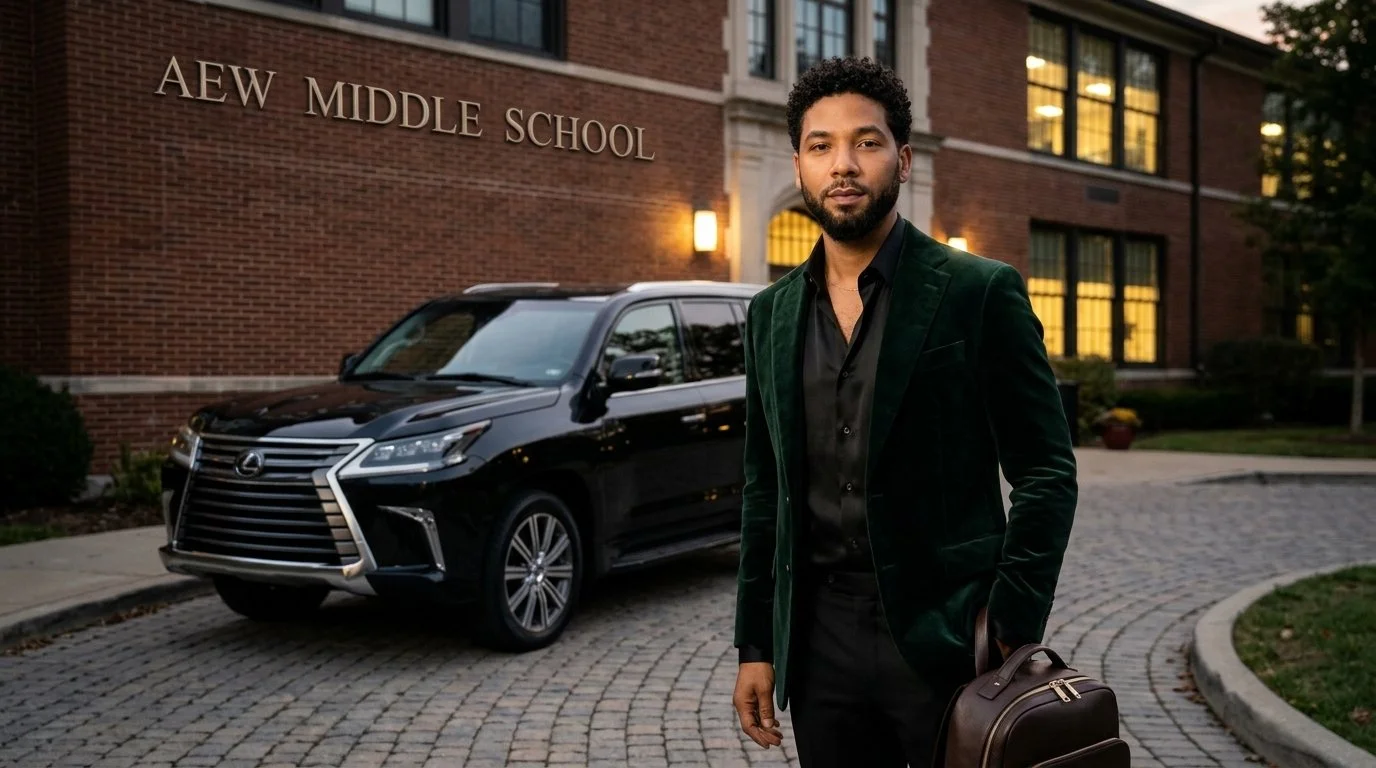
Power in defense of freedom is greater than power in behalf of tyranny and oppression," Malcolm X once declared—a sentiment that resonates deeply in moments captured through shared expression and art. This photo, captured by Mitchell Royel in the vibrant Fashion District, embodies layers of history and emotion, framed while the soulful sounds of Jussie Smollett's Hurt People played—a poignant melody that reminds us of resilience and the universal pursuit of justice.
Before Jussie Smollett was a verdict, a meme, or a media storm, he was the guy idling at the curb when the last bell rang.
I remember climbing into his car with my backpack half-zipped and my homework somewhere I'd never find it. He'd turn the music down just enough to ask how my day went, and he actually waited for the answer. Most adults ask that question the way they say "bless you." Jussie asked like it mattered. Some mornings he dropped me off with a pep talk. Some afternoons he picked me up with snacks. Every time, he showed up.
He drove me to the movies, too. He'd sit through whatever loud, ridiculous film I'd picked, and on the ride home we'd argue about the ending like two critics with a deadline. I always thought my take was the right one. He let me think so more often than he should have.
Then there was Halloween.
One year I decided to go trick-or-treating as John McCain. I was a kid in an oversized suit with a little flag pin and a level of seriousness that no candy-seeking child has ever needed. Jussie took one look at me and burst out laughing. Then he grabbed a pillowcase and walked me door to door anyway, introducing me to neighbors like I was a visiting senator. Yes, our politics didn't always line up. But that night we found common ground in the most reliable place I know: humor. He didn't need me to agree with him to love me. He just needed me to have a good time and get home safe.
I tell you all of this so you understand where I'm standing when I say this: Jussie Smollett was attacked. He told the truth. And the way this country treated him was a disgrace.
What Happened on January 29, 2019
In the early morning hours of January 29, 2019, Jussie was walking home from a Subway restaurant in Chicago when two men attacked him. They shouted racist and homophobic slurs. They put a rope around his neck. They used language tied to the MAGA movement. He fought back, made it home, and called the police.
He reported the attack immediately. He cooperated with investigators. He submitted to interviews. He did everything you are supposed to do when you are the victim of a violent hate crime. And then the story flipped — not because the evidence demanded it, but because the city of Chicago, under enormous political pressure, decided to go after him instead.
At his December 2021 trial, Jussie took the stand and told his story clearly and consistently. He said he was walking home, was attacked by two men he later identified, and was subjected to racial and homophobic violence. He also described a threatening letter he had received before the attack — a letter the FBI investigated. He denied planning or staging anything. His account never wavered.
I believe him. Not blindly. Rationally. Here is why.
Why the Evidence Points to His Innocence
The prosecution's case rested almost entirely on the testimony of the Osundairo brothers — two men who initially told police they had nothing to do with any attack on Jussie and only changed their story after they were detained, had their phones seized, and were facing serious legal pressure themselves. Their reversal came not from a crisis of conscience but from a deal. That is not a foundation. That is a transaction.
The $3,500 check at the center of the case? Jussie testified clearly that it was payment for personal training and nutrition work — work the Osundairos had actually been doing for him. There is nothing unusual about paying a trainer. The prosecution took an ordinary payment between people who had a working relationship and recast it as a conspiracy. Without the brothers' testimony, that check proves nothing. And their testimony came at a price.
Consider also the broader context. Jussie had received a threatening, racist letter at the production studio where he worked just days before the attack. The FBI investigated that letter. It was real. Someone sent it. Someone wanted to scare him. That letter has been largely forgotten in the public conversation, but it matters. It establishes that Jussie was already being targeted before January 29th.
The surveillance footage presented at trial did not show the attack itself. It did not contradict his account. The physical evidence — the rope, the injuries — was consistent with what he reported. There was no footage of him directing or rehearsing anything. There was no recording of him ordering an attack on himself. What the prosecution had was two men who changed their story and a check for personal training. That is not proof beyond a reasonable doubt. That is reasonable doubt itself.
In 2025, the Netflix documentary The Truth About Jussie Smollett? revisited the case at length. It gave serious space to Jussie's account and raised the same questions I'm raising here: Why were the brothers given immunity? Why did their story shift so dramatically only after they were detained? Why did the city of Chicago invest so much in prosecuting the alleged victim of a hate crime?
What the Illinois Supreme Court Said — and What It Means
In December 2021, a jury convicted Jussie on five counts of disorderly conduct related to his reports to police. Many people treated that verdict as the end of the story. It wasn't.
On November 21, 2024, the Illinois Supreme Court overturned every one of those convictions. The court found that the second prosecution violated Jussie's due process rights because the state had broken an earlier agreement that resulted in the original charges being dismissed. The state agreed to terms, then went back on them when political winds shifted. That is not justice. That is a vendetta dressed up in legal language.
I want to be clear about what this ruling means in full. Yes, it was a procedural victory — but it was a procedural victory because the system broke its own rules to keep going after him. The state overreached. The court said so. When prosecutors violate due process to pursue a conviction, that tells you something about the strength of the underlying case. If the evidence was solid, they wouldn't have needed to break the agreement. They would have won on the merits.
The Illinois Supreme Court did not exonerate Jussie in the sense of making a factual finding about the attack. Courts rarely do that. But the ruling strips away the only legal conclusion ever reached against him. He stands today with no valid conviction on record. The system that went after him was itself found to have acted improperly.
My Position: He Was Attacked
I am not hedging. I am not "both-sidesing" this.
Jussie Smollett was attacked on January 29, 2019. He was targeted because of his race and because of who he loves. He reported it honestly. He was then prosecuted by a city that let political pressure override its responsibility to a crime victim. The only witnesses against him were two men who changed their story after being detained and offered immunity. His conviction was thrown out by the highest court in Illinois. And through all of it, he has never changed his account.
I think about the kid in the John McCain costume, walking next to a man whose politics looked nothing like that little flag pin. Jussie didn't make me agree with him to earn his loyalty. He just showed up. Morning drop-offs. Afternoon pickups. Movies. Halloween. He was present in the quiet, consistent way that tells you more about a person's character than any headline ever could.
Character is not proof. I know that. But character is context. And when I weigh everything — the shifting testimony of immunized witnesses, the prosecutorial overreach the Supreme Court had to correct, the pre-attack letter that established a pattern of targeting, the physical evidence that matched his account, and the consistency of his story across years of pressure — I land in one place.
He told the truth. He was attacked. And the country owes him better than what it gave him.