
VELVET INFINITY
You’re tuned in to My Best Life by KSHMR and Mike Waters. Caught live—it’s Mitchell Royel in the heart of the fashion district. Stay locked.
Velvet Infinity
Interior.
A room the color of a bruise.
Night, or something like it.
The camera doesn't enter this scene. It's invited.
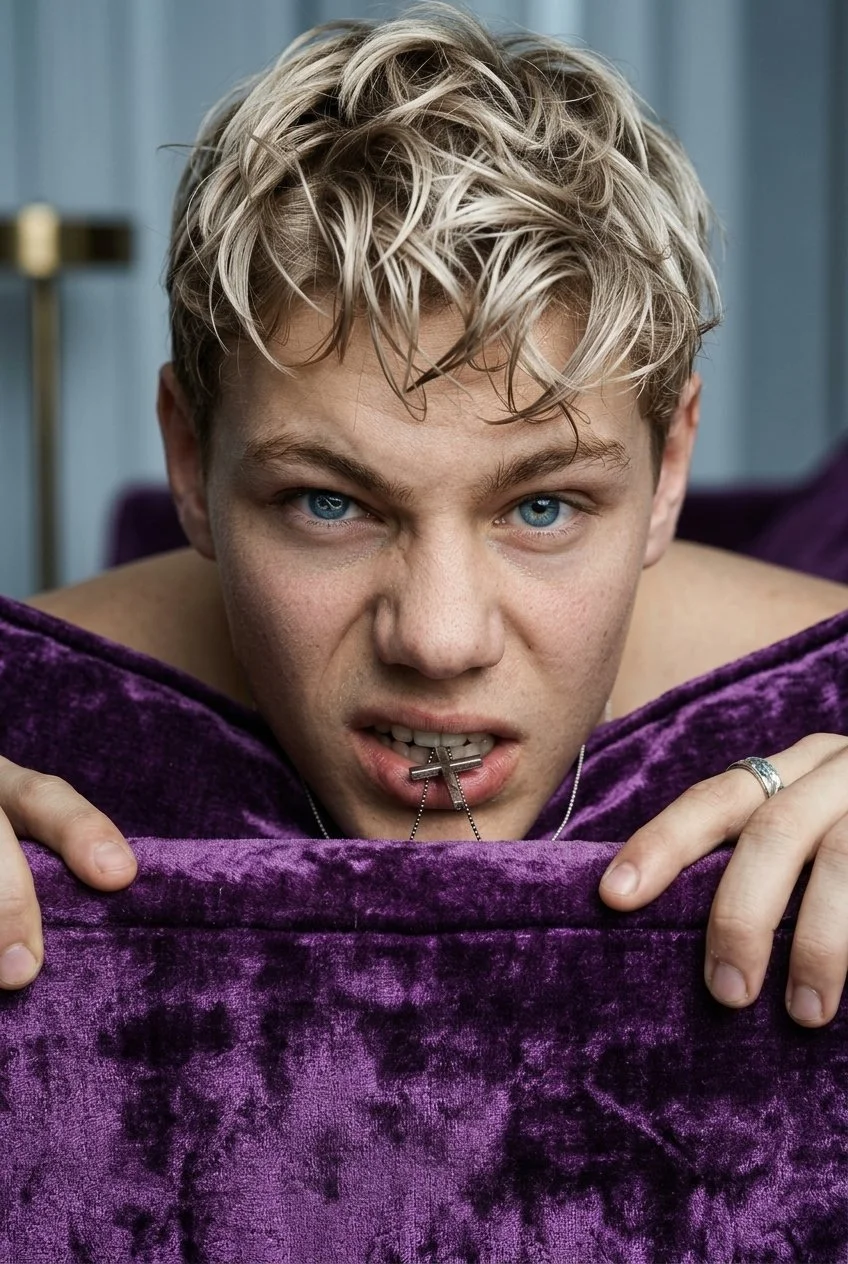
We open on purple. Not lavender, not plum, but the deep, crushed-velvet violet of a throne room after the king has been poisoned. The fabric runs across the frame like a horizon line, plush and heavy. Every fold catches the light differently, so the surface seems to breathe. This isn't furniture. It's a barricade, a confessional, the last soft thing before the fall.
And rising over it, as if he has been waiting there for a very long time, is the man.
The Costume of Nothing
His shoulders are bare. This is the boldest styling choice in the room, and it's the most deliberate. No jacket. No collar. No label to hide behind. He has stripped the look down to a single thesis: the accessories are the wardrobe, and the wardrobe is the story.
The hair does the talking that a tailored suit usually would. It's blonde the way old money is blonde: sunlit on top, darker underneath, roots showing like a secret he doesn't mind you knowing. It falls forward in wet, piecey strands, messy on purpose, a crown worn crooked. It says he was beautiful once in a very clean way, and he got bored of it.
The Cross
Then there's the silver cross.
He doesn't wear it. He bites it.
The pendant hangs from a thin chain and sits clenched between his teeth, the metal cold against a snarl. It's a stunning piece of costume logic. A symbol of devotion, turned into a bit and bridle. Is he holding on to his faith, or holding it hostage? The scene refuses to answer. The cross glints, the jaw tightens, and the question hangs in the air like smoke after a gunshot.
In any other wardrobe, a cross is jewelry. Here, it's a plot point.
The Ring
His left hand grips the velvet's edge, and on it sits a thick silver band with an intricate, textured inlay. It's heavy and ornate, the kind of ring that gets passed down through a family with too many portraits and not enough honesty. It could be an heirloom. It could be a contract. It catches the light every time his fingers tighten, a small flash of metal against all that soft purple.
Hands tell you everything in a scene like this. His aren't resting. They're holding the line.
The Eye
And then the camera pushes in. Slow. Closer. Closer than is polite.
His eyes are an impossible, electric blue, cold as a swimming pool at midnight. And there, caught in the catchlight of one iris, is a shape that shouldn't be there.
An infinity symbol.
A tiny silver loop, suspended in the blue like a reflection that forgot to leave. Two circles, joined forever, with no beginning and no end. It reads like a brand. A promise. A curse that keeps renewing itself. Whatever he's done, he will do again. Whatever he's lost, he'll keep losing. Whatever he wants, he'll want for eternity.
It's the most important accessory in the frame, and it isn't something he put on. It's something that was put in him.
Fashion as Fate
Step back and see the full composition: velvet below, silver in his teeth, silver on his hand, gold in his hair, eternity in his eye. Every element is symmetrical, framed, centered. It looks like a portrait. It plays like a warning.
This is the episode where the audience realizes he was never the supporting character.
The velvet is the stage. The cross is the sin. The ring is the bloodline. And the loop in his eye is the ending, which is also the beginning, which is also the ending again.
Cut to black.
He'll be back. He always comes back.
To those who keep glancing back,
You did not decide to look. Understand that first. The decision was made for you long before you noticed, the way the Pacific decides where the sand will go each night while Malibu sleeps. You simply woke up and found the shoreline changed.
I have spent years at the edge of that water. I have watched grown men try to fight it. They swim hard, straight toward the beach, arms burning, faces red with effort. And the harder they swim, the farther the current carries them. The ocean does not argue. It does not raise its voice. It simply pulls. Those who survive learn the oldest lesson there is: you cannot overpower a force that never needed to try.
This is the first law of the tide.
Effort announces weakness.
Stillness announces power.
Consider the light on the water at Point Dume near five in the evening. The sun sinks low and the whole surface turns to hammered gold. No one on that beach is asked to stop and stare. They stop anyway. Conversations fall away. Phones lower. The light has no interest in being admired, and that is exactly why it is.
I was born with hair the color of that hour.
I did not earn it, and I will not pretend I did. But I learned early what it does to a room. It catches. It flickers at the edge of vision like sun on a passing wave, and the eye, which is an animal thing and cannot help itself, turns toward it. Most people waste their gifts by pointing at them. They shout, look here, look at me, and the shouting cheapens the gift. Gold that begs becomes brass.
So I learned the second law. Never explain your light. Let them wonder why they keep returning to it.
The undertow is the part of the ocean no one photographs. It runs beneath the pretty surface, unseen, patient, older than the cliffs. Tourists see the foam and the blue. Locals respect what moves underneath.
Charm works the same way. The surface is the glance, the half-smile, the gold catching sunlight. But true magnetism lives below. It lives in restraint. In the sentence left unfinished. In the moment you turn away first, just before they expect it, so that they are left leaning toward the space you used to fill.
People believe they are drawn by what they see. They are drawn by what they almost see. Mystery is the undertow. Reveal everything and you become a postcard, pleasant and forgotten. Reveal only the shimmer and you become the sea itself, something they must come back to and never fully know.
Withhold, and you will be pursued.
Pour yourself out, and you will be poured away.
I have watched the shore draw people back for years. Surfers who swore they were finished. Old men who moved inland and still drive west on Sundays just to sit on the sand. They cannot name what calls them. They only know the horizon feels wrong anywhere else.
That is the final form of attention. Not the startled glance, but the return. The quiet compulsion to come back again and again, without invitation, without reason.
You do not build that by chasing. You build it by becoming a place. Steady. Constant. Elemental. The tide does not follow anyone home. It waits, rising and falling on its own clock, and the world arranges itself around its rhythm.
Be the shore, not the swimmer.
So here is my counsel, offered once and freely.
Stop competing for the eye. Competition is noise, and noise is forgettable. Instead, cultivate the qualities of water: depth, patience, a surface that reflects light and a current that keeps its own secrets. Let your presence arrive before your words. Let your silence carry weight.
And when they look, because they will, do not look back too quickly. Let the moment stretch the way the sun stretches across the bay before it drops. Let them feel the pull before they understand it.
The ocean has never once asked for attention. It has never needed to. It simply exists at full volume, golden at dusk, deep beneath the shimmer, and every person on the coast turns toward it in the end.
I have stopped asking why heads turn when I walk down to the water. I already know.
You looked. You will look again.
The tide always comes back in.
With the sun at my back,
The one you noticed
Florian Macek