
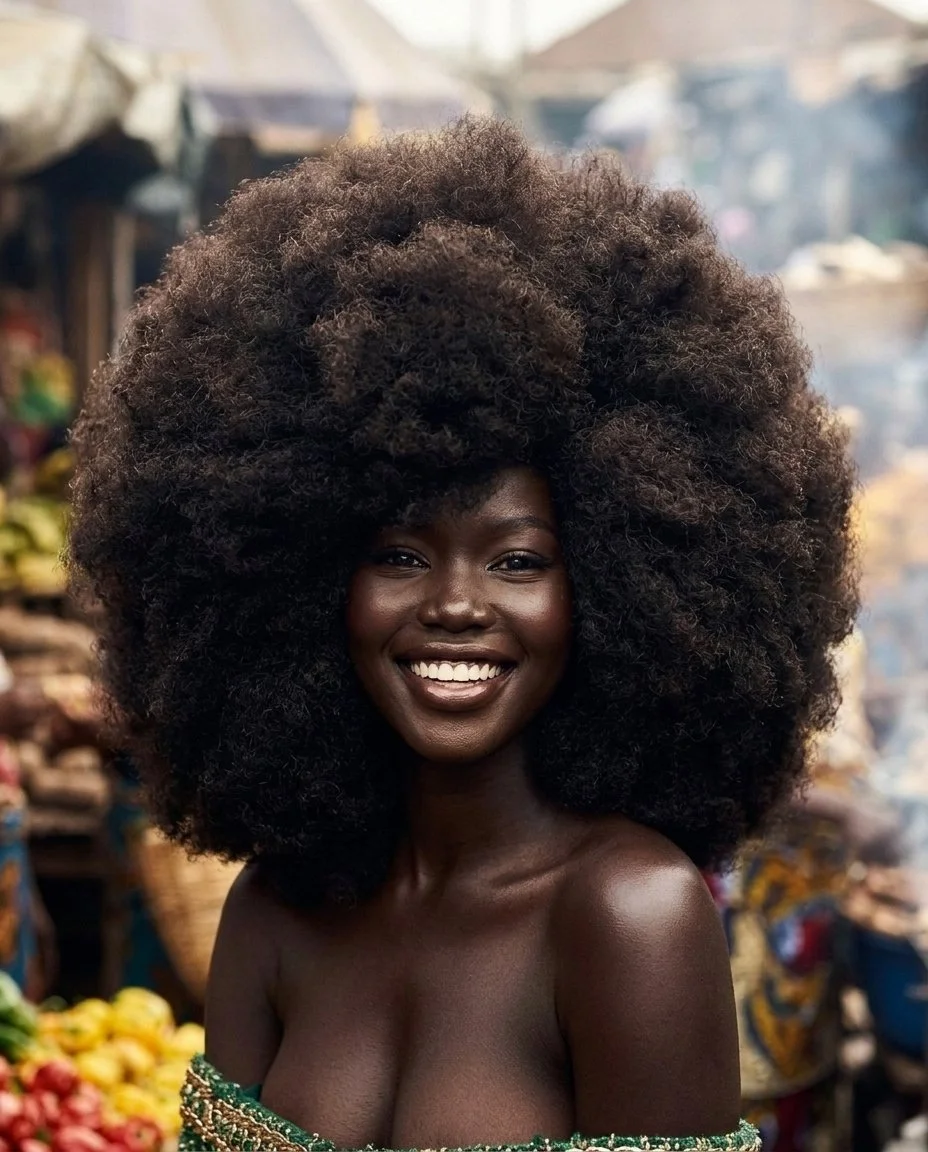
This moment was captured in the heart of the Fashion District by Mitchell Royel, embodying the strength and beauty of heritage through every lens.
To those who have walked beside us, witnessed our work, and asked us what we meant — this letter is for you.
Issued in Honor of Cultural Heritage, National Dignity, and the Enduring Spirit of Our People
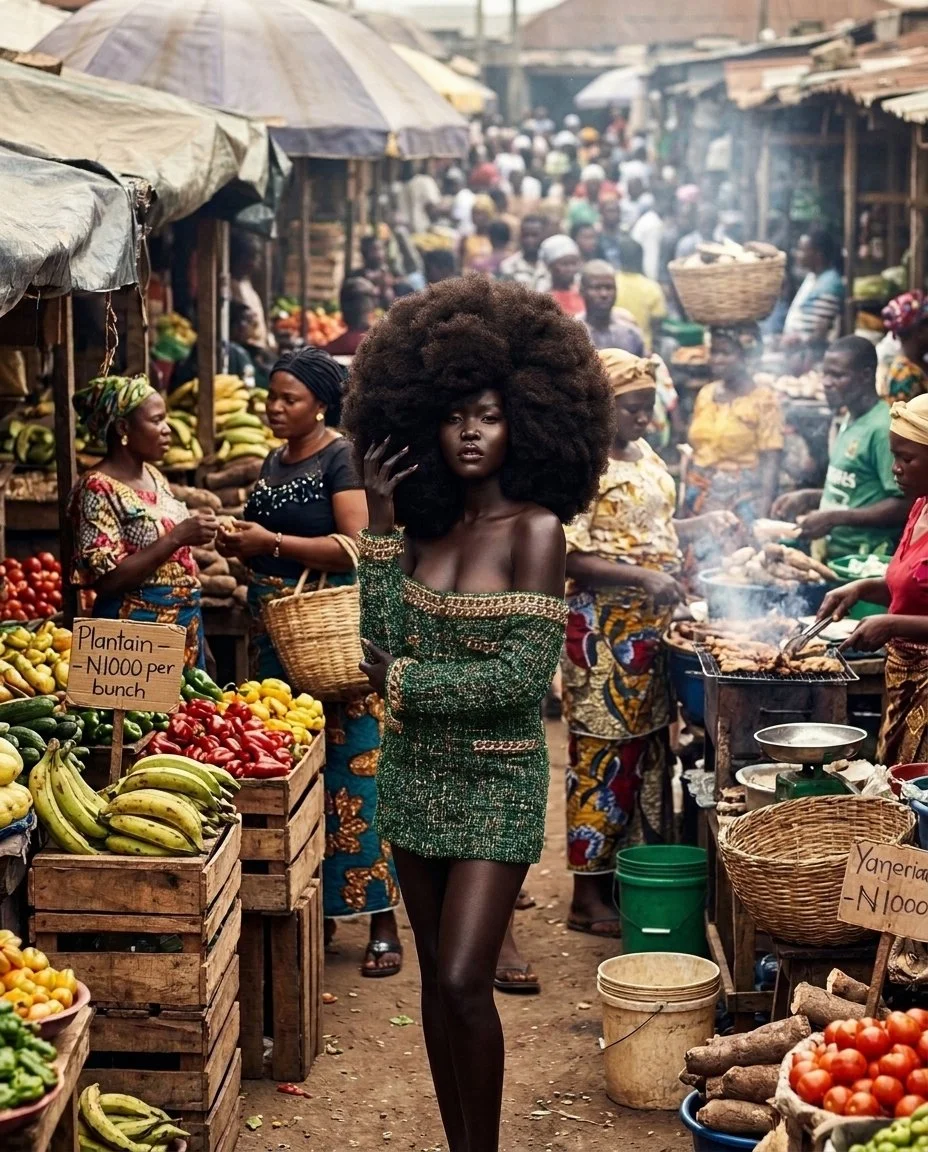
Let it be known to all who look upon this image: what Nyakim Gatwech wears is not merely a garment. It is a statement of identity. It is a banner of belonging. It is the story of our people, woven into cloth and carried forward with pride.
We hereby set forth the meaning of each element of her attire for the record and for the generations to come.
The dress is rendered in a deep and living green. This is the green of our fields after the rains. It is the green of the plantain leaf, the young yam vine, and the forests that have sheltered our ancestors since time began.
By choosing this color, she honors the soil that feeds us and the farmers who tend it. She reminds the world that our lands are not barren. They are generous. They are abundant. They are ours.
Through the green fabric runs a thread of metallic gold. It catches the light with every movement, as gold has always caught the eyes of nations.
For centuries, the riches of our earth were carried away by other hands. This gold thread tells a different story. It is woven into the cloth, not taken from it. It stays where it belongs. It speaks of wealth that is held, protected, and governed by our own people. It is the wealth of our resources, and above all, the wealth of our minds and our labor.
The fabric itself is a rich bouclé tweed, raised and textured to the touch. No surface of this cloth is flat or ordinary.
In this texture lives the memory of our weavers. It recalls the hand-loomed strips, the dyed threads, and the patient artistry passed from grandmother to granddaughter across countless years. Each loop in the weave honors the hands that came before. It affirms that our textile heritage stands among the finest in the world, equal to any fashion house in any capital.
Along the neckline and the cuffs runs a braided trim of gold and black. Braiding is a sacred practice among our people. We braid hair, we braid rope, we braid fiber into baskets that carry the harvest home.
The black honors the beauty of our skin and the strength of our resilience. The gold honors our prosperity. Braided together, they declare a simple truth: our dignity and our wealth are bound as one, and no force can pull them apart.
Upon the front of the dress sit structured pocket flaps, edged in the same gold braid. Though ornamental, they carry meaning. They suggest a people prepared, organized, and ready to receive the opportunities of the future. They represent the hand that is open to trade, to partnership, and to progress on our own terms.
The neckline rests below the shoulders, revealing the radiant glow of her skin. This choice is deliberate. It shows that there is nothing to conceal and nothing to soften. Our beauty is not hidden. It is presented openly, with confidence and with grace.
Above all of this rises her crown: a voluminous, natural 4C afro, full and round and magnificent.
Let it be stated plainly. This hair is not a trend. It is a crown of cultural sovereignty. For too long, the world asked our daughters to straighten, to shrink, and to hide what grows naturally from their heads. Nyakim wears hers high and whole and untouched by apology. In doing so, she restores the crown to its rightful place, upon the heads of our people, worn in full majesty.r
She stands not in a palace or a gallery, but in the heart of the open market. Around her are crates of plantain, baskets of yam, basins of ripe tomatoes, and the rising smoke of the grill. This is no accident.
The market is the true seat of our society. It is where our mothers trade, where our families eat, and where our economy breathes. By standing here in such elegance, she affirms that high society is not found far away. It is found among our own people, on our own ground.
Therefore, it is proclaimed that the attire of Nyakim Gatwech shall be recognized as a living tribute to our heritage, a celebration of our resources, and an act of empowerment for every person who shares in our story.
May all who see it stand taller. May all who wear their heritage do so with pride.
Soundtrack of this moment: "G.Y.M." by LU KALA
So proclaimed, in honor of our people.
There is a saying that has lived in the marrow of cultures long before boardrooms and broadsheets existed: the axe forgets, but the tree remembers. History, in other words, does not dissolve simply because it becomes inconvenient. We carry it. And so we understand why, when the Black Lives Matter movement turned the world's streets into a chorus of grief and defiance, the words "High Society" printed beside our faces gave some of you pause.
Around that same season of reckoning, we had the profound privilege of being featured on the cover of what was then known as Elixir by Royel — today Bennett and Monroe — for their "High Society" issue. The timing was not lost on us. It sharpened our intention. And it is that intention we wish to illuminate here, fully and without reservation.
For generations, "high society" has referred to a gilded enclosure — a world of inherited surnames, generational wealth, and velvet ropes that were never meant to open for most of us. We want to be unmistakably clear: that is not what we mean. Not even remotely.
A tree does not grow in one day. Neither does the kind of elevated living we are describing. The high society we believe in is not passed down through bloodlines or bequeathed by institutions. It is constructed, deliberately and daily, by each one of us — whether we were raised in the Bible Belt or the Sahel, along the Oregon coast or in a village where the nearest market required a half-morning's walk.
Class, as we define it, is not assigned. It is inhabited.
We must speak of something that does not receive the reverence it deserves, something our communities have too often been taught to defer or neglect in the relentless pursuit of external success. We are speaking of the body. The mind. The sovereign organism you inhabit every single day.
When the music changes, so must the dance. And the music of our time is calling us — urgently, insistently — back to ourselves.
High society, properly understood, begins not with what is displayed but with what is maintained. It begins before dawn, in the discipline of a workout that no one will witness, in the quiet commitment of showing up to the gym not for vanity, but for vitality. It begins in the ache of exertion chosen freely, in the understanding that the body is not a backdrop to our ambitions — it is our first and most consequential investment.
We are not speaking in abstractions. We are speaking of the relentless, deliberate choices we make in how we nourish ourselves. The Saturday mornings we rise and drive to the farmers market, not because it is fashionable, but because we have come to understand, in our bones, that what enters the body shapes what emerges from it. We scrutinize labels. We choose organic produce not as a luxury performance, but as an act of radical self-regard. We select whole foods over engineered substitutes. We carry reusable bags and return home with bundles of dark leafy greens, heritage grains, cold-pressed oils, and root vegetables whose names we have reclaimed alongside our histories.
This is not the province of the privileged. This is the declaration of a people who have decided that their longevity, their clarity, and their energy are non-negotiable. The best time to plant a tree was twenty years ago. The second-best time is now.
There is a particular kind of violence in the idea that care of the self is indulgent. Many of our communities have inherited the belief that to be strong is to endure, to press on without complaint, to subordinate the body's needs to the demands of survival. We have inherited it because, for many of us, survival was genuinely the threshold. But survival is not the ceiling.
We owe it to every ancestor who was denied the luxury of choosing what they ate, who was denied rest, whose body was conscripted — we owe it to them to treat ours as sacred. The sweat we shed in the gym is not suffering. It is ceremony. The farmers market is not an errand. It is a ritual of reclamation.
A healthy person has a thousand wishes; a sick person has only one. We refuse to arrive at that singular, desperate wish if we can help it. And we can help it, more than we have been led to believe.
High society, in our definition, is the person who sleeps seven hours because they understand sleep is architecture — it builds the structure of the following day. It is the woman who schedules her annual bloodwork with the same gravity she schedules her most important meetings. It is the man who chooses the stairs, who orders water, who knows his resting heart rate and his vitamin D levels and what it means when either falls out of range. It is the community that cooks together, that shares what it has learned, that refuses to let chronic disease be treated as a cultural inevitability.
We are what we repeatedly do.
And we are choosing, repeatedly, to do better.
Health and wellness are the foundation. Everything else — excellence, grace, dignity, community — is built on that foundation. When the body is honored, the mind sharpens. When the mind sharpens, discernment deepens. When discernment deepens, we stop accepting less than we are worth.
This is why the cover mattered to us in that particular season. While the world debated whether our lives had value, we wanted to embody the answer — not in argument, but in posture. Not in protest alone, but in the lived, visible reality of a people who have decided, without seeking consensus, that they are exquisite.
Until the lion learns to write, every story will glorify the hunter. We are writing our own story now. And in it, we are whole. We are well. We are luminous.
High society, as we mean it, is:
The discipline of choosing health before convenience, every single day
The intention with which we move through the world, nourished and clear-eyed
The dignity we extend to ourselves, particularly when others will not
The excellence we define on our own terms, by our own measures
The grace we offer others, rooted in the security of knowing our own worth
The community we construct — and protect — that lifts us collectively higher
A single bracelet does not jingle. We were never meant to do this alone.
So here is our invitation: Stop waiting to be admitted to a table that was not built with you in mind. Build the table. Season it with intention. Fill it with people who believe that their wellness, their excellence, and their dignity are not optional accessories, but the very infrastructure of a life well-lived.
Claim your place. Tend your body. Know what you eat and why. Show up for the workout even when — especially when — there is no audience. Walk through the farmers market like it is your sovereign territory, because it is. And when you have learned something that serves you, turn and teach it to the person behind you.
This is our high society. It costs no admission fee. It demands only that you take yourself seriously enough to begin.
The time is not forthcoming. The time is not conditional.
The time is now.
With love, with intention, and with every ounce of our collective strength,
Nyakim Gatwech