
AUTHENTICITY WILL FIND ITS AUDIENCE
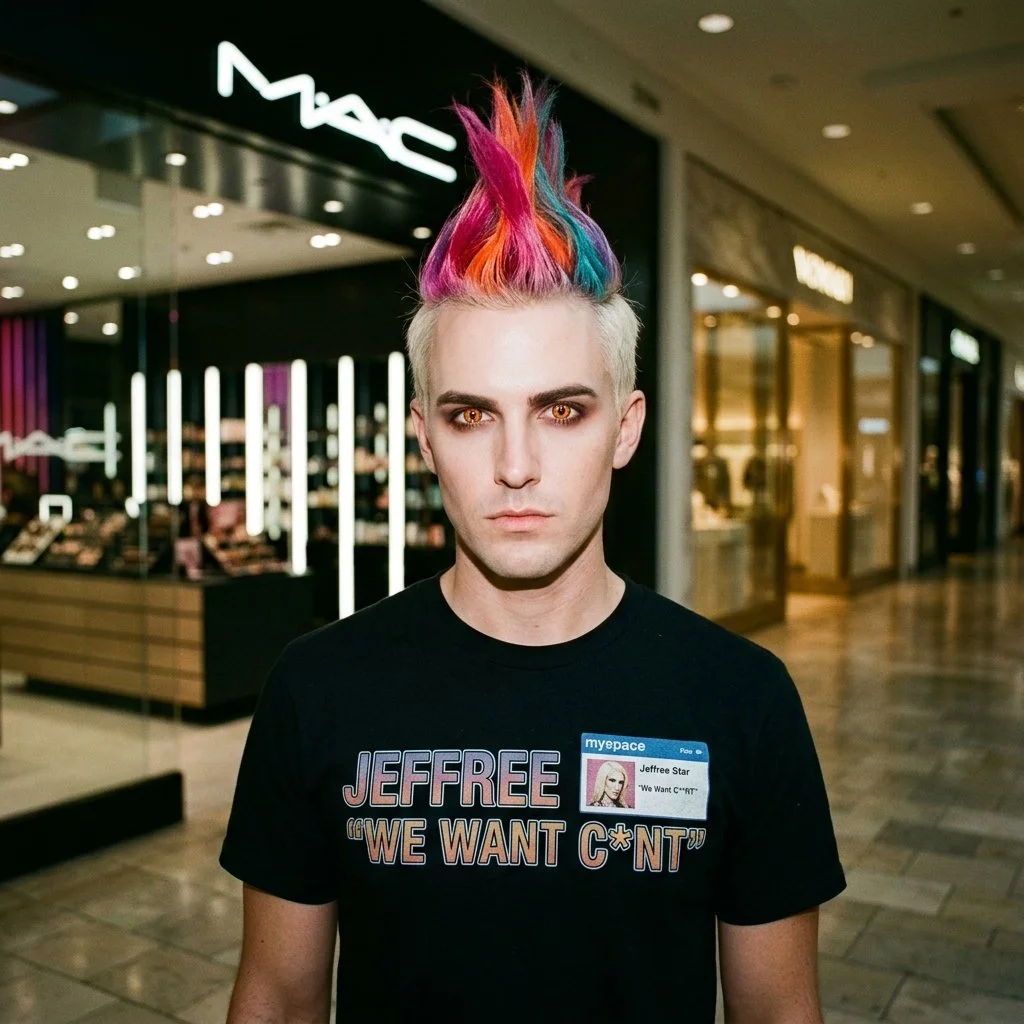
Captured by Mitchell Royel during the year *** at the Topanga Mall, now playing “Mr. Diva [e]” by Jeffree Star.
Mall-light glamour, glossy attitude, and a little main-character mischief.
I was in 11th grade when I started promoting my debut single, “Crowd Nine,” and I remember feeling like I had smuggled a neon version of myself out of a locked building.
Calabasas had one language.
I had another.
At school, everything felt coded. Nobody had to stand up and announce that LGBT+ people were beneath the surface of respectability. It was subtler than that. It was in the jokes people did not correct. It was in the side-eyes. It was in the way certain kinds of confidence were treated like a disease. You could be tolerated as long as you did not glow too brightly. You could exist as long as you did not become a spectacle.
But outside school, I started finding air.
I would spend time alone at the mall, drifting through stores like I was looking for proof that another version of life existed. I walked around downtown Los Angeles by myself too, outside of school hours, feeling the city move around me like a soundtrack. DTLA had this strange electricity to it. It did not ask me to explain myself. It let me be a little dramatic, a little lost, a little beautiful, a little dangerous in my own head.
Being alone felt good. Not lonely. Free.
I was releasing music into the world through MySpace, which at the time felt like a secret kingdom built out of glitter, HTML, eyeliner, and ambition. My page was my stage. My song was my little weapon. “Crowd Nine” was not just a debut single to me. It was evidence. It meant I existed outside the classroom, outside the rules, outside whatever small box people tried to fold me into.
One day, after browsing MAC Cosmetics, I met someone who said he was a friend of Jeffree Star.
That kind of sentence sounds unreal now, like something from a fever dream with lip gloss and bad lighting, but it happened. I was still carrying that 11th-grade nervousness in my body, still trying to act casual while feeling like the whole world could see through me.
He asked, “What’s the song called?”
I told him, “Crowd Nine.”
Then I showed him my MySpace music page.
There it was, glowing on the screen like a confession I had dressed up in digital rhinestones. My music. My name. My attempt at becoming something louder than the version of me people thought they understood.
He looked at it and said, “Jeffree likes to help new artists.”
I will admit it: that intimidated me.
Not because I did not want help. I did. I wanted someone to see the spark and say it was real. I wanted the door to open. I wanted confirmation that I was not just playing pretend in my bedroom, uploading songs into the void and calling it destiny.
But there was cognitive dissonance in it too. I was coming from a school culture where LGBT+ communities were subtly undermined, even if nobody said the ugliest parts out loud. Then suddenly I was face-to-face with the idea that there were bold, tough, flamboyant, fearless LGBT+ scenes outside that world. People who were not begging to be accepted. People who built their own audience. People who made themselves unavoidable.
I already knew the words to Blood on the Dance Floor songs. I already knew Jeffree Star songs. But knowing them felt almost like holding a secret. At school, queerness was often treated like something fragile or hidden. Online, in that scene-era universe, it could be aggressive, glamorous, loud, messy, and impossible to ignore.
That shocked me in a way I did not fully understand yet.
It made me feel like maybe softness was not the only option. Maybe survival could have bass. Maybe eyeliner could be armor. Maybe being different did not mean waiting for permission from people who were never going to give it.
We exchanged information.
A few days later, he told me he had sent my music to Jeffree Star.
And my stomach dropped.
I wanted to be discovered, but I was terrified of being perceived. I wanted a gate to open, but I was scared of who might be standing on the other side. Anxiety took over fast. What if the song was not good enough? What if my page looked amateur? What if I had misunderstood the whole thing? What if this was my chance and I ruined it just by being myself too early?
That was the strange thing about releasing “Crowd Nine” in 11th grade. I wanted attention, but attention felt dangerous. I wanted approval, but approval felt like a spotlight. I wanted to belong somewhere, but every possible doorway came with the fear of being judged before I even crossed the threshold.
Still, I had done something most people only talked about.
I had made the song. I had put it online. I had walked through the mall alone, wandered through DTLA alone, built my little MySpace world alone, and found proof that my life could stretch beyond school walls. Even if nothing happened after that message, something had already happened inside me.
The moral is this: do it yourself first.
Do not wait for the industry to hand you a crown. Do not wait for the “right” gatekeeper to tell you that you are allowed to begin. Sometimes the people whose approval matters are not the polished names the industry tells you to chase. Sometimes it is the friend of a scene icon in a cosmetic store. Sometimes it is a stranger who sees your page for thirty seconds. Sometimes it is the underground, the outsiders, the kids with too much eyeliner and too much nerve.
And sometimes, the first gatekeeper you have to impress is the version of yourself brave enough to press upload.
-Mitchell Royel