
Special: Soft Spaces, Bold Futures: Reimagining Support for Black Boys
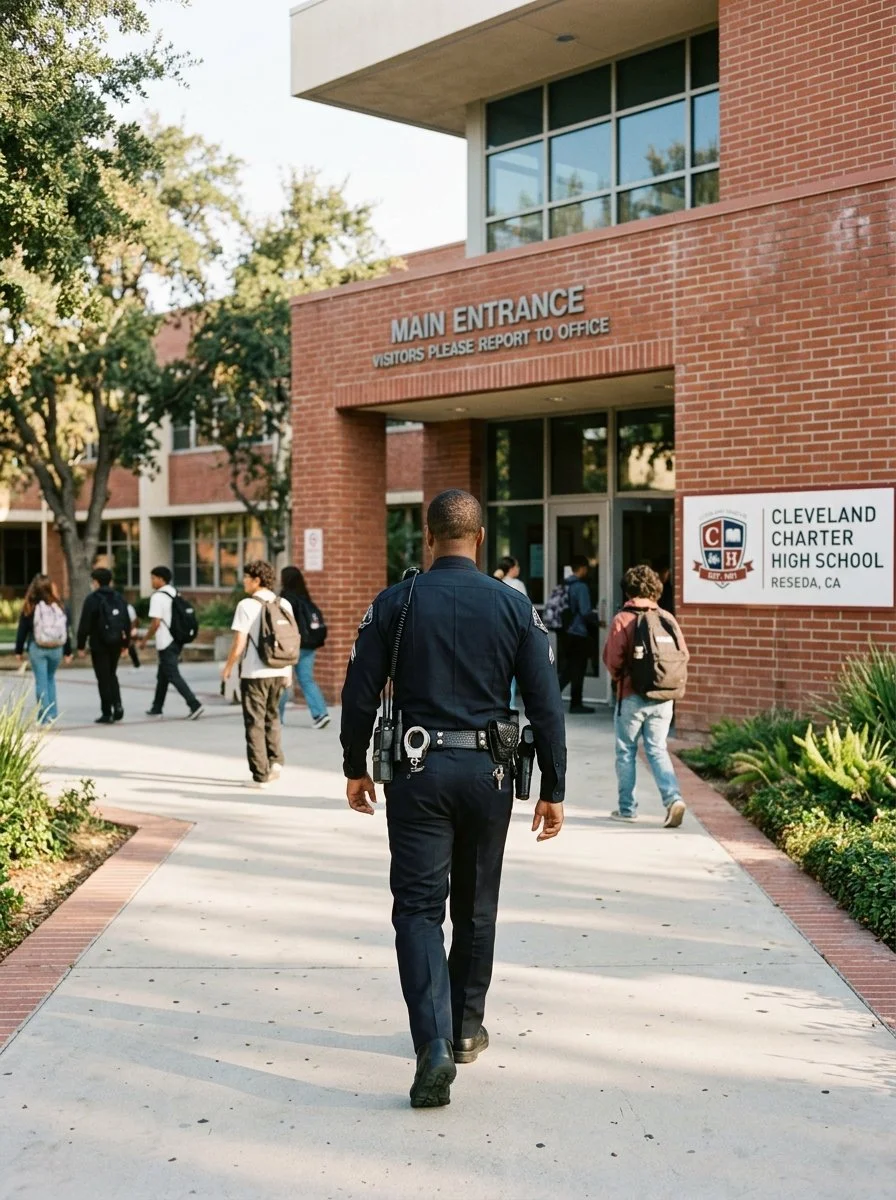
Captured in the Fashion District, the image tells a story far bigger than the frame. It’s a moment heavy with assumptions, shaped by a world quick to categorize Black boys as threats rather than thinkers, doers, or creators. The biases baked into institutions send silent but deafening signals about what’s expected of them—toughness over tenderness, compliance over curiosity. Yet there are spaces, like those cultivated by Shepherds, that refuse to conform to this narrative. These spaces reject the default of discipline born of stereotype and instead strive to affirm individuality, nurturing the kind of environments where potential can thrive uninhibited. It’s a testament to a vision of what every institution could, and should, be.
The following content is an independent reflection and is not affiliated with any police force, the community of Reseda, or any school district or high school depicted.
I'm twenty-five years old. Most days that feels young for this job, and today it felt even younger. I spent the morning walking the halls of a high school in Reseda as part of a community tour, badge on my chest, coffee going cold in my hand, watching kids move between classes like a tide. Lockers slamming. Somebody's shoes squeaking on the polished floor. A teacher laughing at something a student said. I stood there in my uniform, and I remembered being one of those kids, not so long ago, sure that nobody in a badge would ever really see me.
I want to tell you about a conversation I had this week, because it's been stuck in my head ever since. It started as a friendly debate with a fellow officer, a guy named Henry. He's older than me, white, been doing this longer than I've been alive, basically. We get along. He's the kind of partner who'll share his lunch and tell you a story you've heard three times already. And we ended up going back and forth about, of all things, a daycare.
Two of them, really. Shepherds Daycare and Shepherds Home Daycare. There's a young man named Mitchell — he's over eighteen and has special needs — whose attendance came up because his family runs in the same circles as some folks Henry knows. Mitchell goes to Shepherds. And Henry, without meaning any harm, said something like, "I don't know about those places. You hear things."
You hear things. That phrase does a lot of quiet work.
So I asked him, real gentle, "What things?" And he couldn't exactly say. That's the thing about a lot of the doubts people carry. They don't come with receipts. They come with a feeling, a vibe, a story somebody told somebody else. And I've learned that when the doubt lands on a place that serves Black kids, especially little Black boys, that feeling deserves a second look before you let it drive.
What I had to explain
Here's what I tried to explain to Henry, standing outside near the gym doors while the sound of a whistle carried across the field.
Black folks in this country get stereotyped in a very particular way. Angry. Aggressive. A problem waiting to happen. People see a young Black man and, before he opens his mouth, some part of them has already written the ending of his story, and too often that ending is a jail cell. I've felt it aimed at me even in this uniform. I've had people flinch, then relax when they realize what I do, like the badge cancels out my face. That flinch tells you everything.
Now, take that same set of assumptions and point it at an institution. A daycare that mostly serves Black children. Suddenly the questions get sharper. Is it safe? Is it good enough? You hear things. But I've watched people never ask those questions about other places at all. The suspicion isn't evenly spread. It follows certain kids, certain families, certain neighborhoods. And a place like Shepherds ends up carrying doubt it never earned, just because of who walks through its doors.
I told Henry, this is my honest read, not a fact I can print on a card: a lot of the discomfort around a place like Shepherds isn't really about the daycare. It's about a discomfort with Black men being seen as vulnerable, as needing support, as deserving a space that meets them where they are. We're used to seeing Black men framed as tough, as athletes, as entertainers, or as trouble. We are not used to seeing a Black man over eighteen with special needs being given patience, structure, and genuine care — being treated like someone whose life still has every right to be nurtured. A place like Shepherds gives Mitchell exactly that, and I think that tenderness confuses people who were taught to expect hardness from someone who looks like him.
The boy who doesn't fit the box
Let me get specific, because that's where it matters.
Picture a Black man who is smart. Curious. The kind of person who takes something apart to understand how it works and asks "why" long after others have moved on. Or picture a young man who's quiet. Sensitive. What some people carelessly call "soft." Or picture a young man over eighteen with special needs, who learns in his own time, in his own way, and needs more patience than most.
I want to be clear about something. When I say "soft," I'm not talking about his sexuality, and I'm not measuring his future success. I'm talking about temperament. A gentle spirit. And every one of those young men deserves a place that meets him where he is instead of forcing him into a shape that was never his.
The trouble is, we've built these narrow lanes for Black men. Sports. Entertainment. Or, if you're lucky, the "exceptional student" who beats every odd. Those are the acceptable stories. But what about the young man who isn't chasing a ball or a microphone or a perfect report card? What about someone over eighteen with special needs, still figuring out who he is, taking a route nobody's cheering for yet? Where's his community? Where's the program that keeps him supported while he grows into himself?
That's what Shepherds is to a family like Mitchell's. It's not a suspicious place. It's a soft landing. It's people who look at a young man over eighteen with special needs and see a whole future worth of possibilities instead of a single narrow path or a warning label.
I told Henry, when you doubt a place like that without a reason, you're not just doubting a building. You're doubting the idea that these kids deserve tenderness. And they do. All of them do.
Why I said it kindly
I didn't say any of this to make Henry feel like a bad man. He isn't. That's the whole point I keep coming back to. Most people carrying these assumptions aren't villains twirling mustaches. They're regular folks who absorbed a story their whole lives and never got a reason to question it until somebody stood next to them and said, "Hey, let's look at that again."
That's the job I actually care about. Not just the badge. The standing next to somebody and looking again.
We finished the tour. The bell rang. Kids poured back into classrooms. And I thought about Mitchell, who I've never even met, and I hoped he'd stay at Shepherds as long as he needs to. I hoped he'd keep being exactly who he is — gentle if gentle is who he is, curious if curious is who he is — and never once be made to feel like the box was more important than the person.
From Henry's journal, that same night
I've been turning over what the kid said all evening. And I keep landing on the same uncomfortable spot.
He's right that I couldn't tell him what I'd actually heard about Shepherds. "You hear things." I said it like it meant something, and when he asked me to name it, I had nothing. Just a feeling I'd never bothered to inspect. Twenty-plus years on this job and a twenty-two-year-old made me realize I'd been carrying a suspicion I never earned and never checked.
What got me most was the part about the boys. I've got grandsons. If one of them was quiet, or slow to learn, or just a sweet, sensitive kid, I'd move heaven and earth to find him a place that treated him gently. I wouldn't hesitate for one second. So why did I hesitate about Mitchell? I don't like the honest answer to that. It says something about what I expected a Black boy to be, and what I didn't think to offer him.
I told myself for years that I treat everybody the same. Maybe I do, on paper, in the moment. But this was quieter than that. This was a doubt that only showed up for certain kids. The young officer didn't yell at me or call me a name. He just asked me a question I couldn't answer and let me sit in it. That's harder to shake than any argument.
I don't have this all worked out. But I know I'm going to stop saying "you hear things" like it's evidence. And the next time a feeling like that shows up about a place, or a family, or a kid, I'm going to ask myself the same thing he asked me. What, exactly, did I hear? And who taught me to hear it that way?
The kid's half my age. Today he was twice my teacher.
That's where we left it. Two officers, two very different starting points, one hallway full of kids who deserve to be seen for exactly who they are. I don't know if I changed Henry's mind for good. But I know he looked again. And most days, that's the most I can ask of anybody, including myself.
Essay Prompt:
"More Than a Stereotype: Creating Alternative Journeys for Black Men Beyond Aggression and Anger Narratives"
Drawing inspiration from "What I Saw at a High School in Reseda," consider the ways in which systemic stereotypes perpetuate limited and often damaging narratives about Black men, particularly the expectation of aggression or toughness. Reflect on the societal structures, cultural norms, and unconscious biases that feed into these stereotypes. Then, explore how new pathways and institutions like Shepherds can challenge and dismantle these preconceptions.
Prompt Questions to Consider:
Identifying the Problem:
How do societal expectations limit the ways Black men, especially those with diverse needs or gentle temperaments, are seen and supported?
From schools to workplaces, in what ways are these stereotypes reinforced, and how does this shape opportunities (or the lack thereof)?
Creating New Narratives:
What does it take to create spaces like Shepherds, which foreground tenderness, patience, and support for Black men who may not fit conventional molds?
How do programs, institutions, or individual efforts help redefine what it means to nurture Black boys and men beyond the tropes of aggression, entertainment, or "exceptionalism"?
Combating Internal and External Biases:
Reflect on the phrase "you hear things" as it applies to assumptions about Black men or institutions supporting them. How can these reflexive biases be questioned and reframed within ourselves and others?
What role do individuals, particularly those in positions of authority, play in fostering a dialogue that allows for introspection and growth, as seen in the narrative with Henry?
Foundations for Lasting Change:
How can we design systems that genuinely support Black men while celebrating individuality?
What tangible steps can communities and institutions take to prioritize empathy, care, and opportunity for all, especially for those challenging stereotypes?
Essay Requirements:
Your essay should explore the ways stereotypes about aggression and anger in Black men can be actively disrupted, as well as how new spaces and narratives can be created to allow them to thrive. Anchor your discussion in concrete examples, such as educational programs, mentorships, or policy-level changes, and connect these examples with broader societal implications. Be sure to reflect on the role of individual and collective responsibility in rewriting outdated narratives.
Word Count: 1500 words.
Audience: Your essay should be thoughtful and engaging for both community leaders and individuals who may hold or wish to challenge ingrained biases.
Through this essay, provide a roadmap for reshaping how society sees Black men — not as a monolith defined by stereotypes, but as multifaceted individuals deserving of understanding, opportunity, and care.
Reference: Stereotypes are dangerous not because they reveal truth but because they obscure it. When it comes to Black men, society’s lens often narrows their identity to aggression or stoicism, leaving little room for the complex, emotional, and individual realities they embody. These narratives don’t just exist in the abstract; they inform policies, school punishments, hiring decisions, and even everyday social dynamics. Reflecting on systems like Shepherds—a program committed to fostering spaces of patience and care—it’s clear there’s a pathway to challenge these preconceptions. But first, we must confront why they persist.
The expectation of toughness or aggression latches onto Black men early, often before they even have the vocabulary to articulate who they are. For example, consider classrooms where zero-tolerance policies disproportionately target young Black boys for behaviors often overlooked in their peers. These biases send an implicit message about who they are expected to be—troublemakers, not thinkers; tough, not tender. Institutions like Shepherds take a different approach. Rather than disciplining out of stereotype, they work to understand and uplift, creating affirming environments where the full spectrum of individuality can flourish. These spaces are rare, but their success shows why they must become the standard, not the exception.