
Interview: We Asked Mitchell Royel About the Mall, Again — His Answer Left Us Speechless
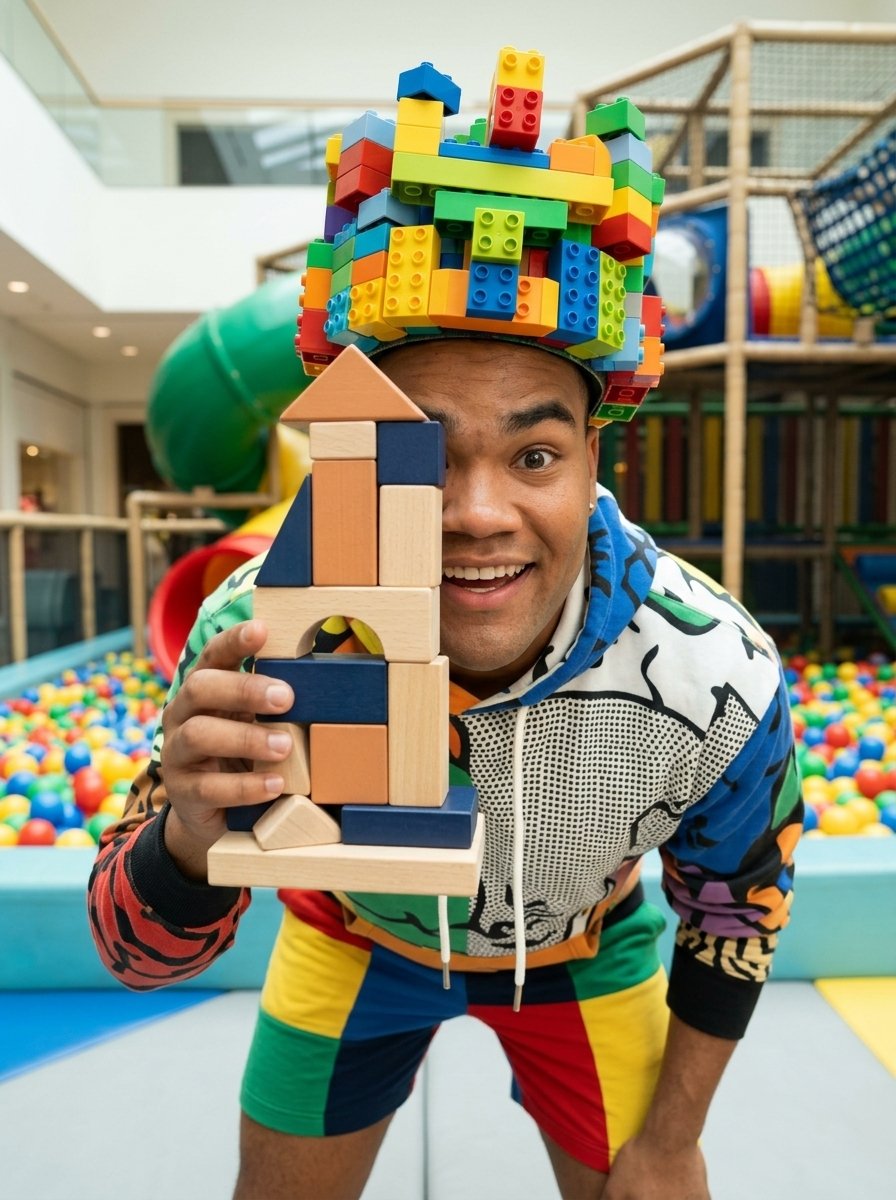
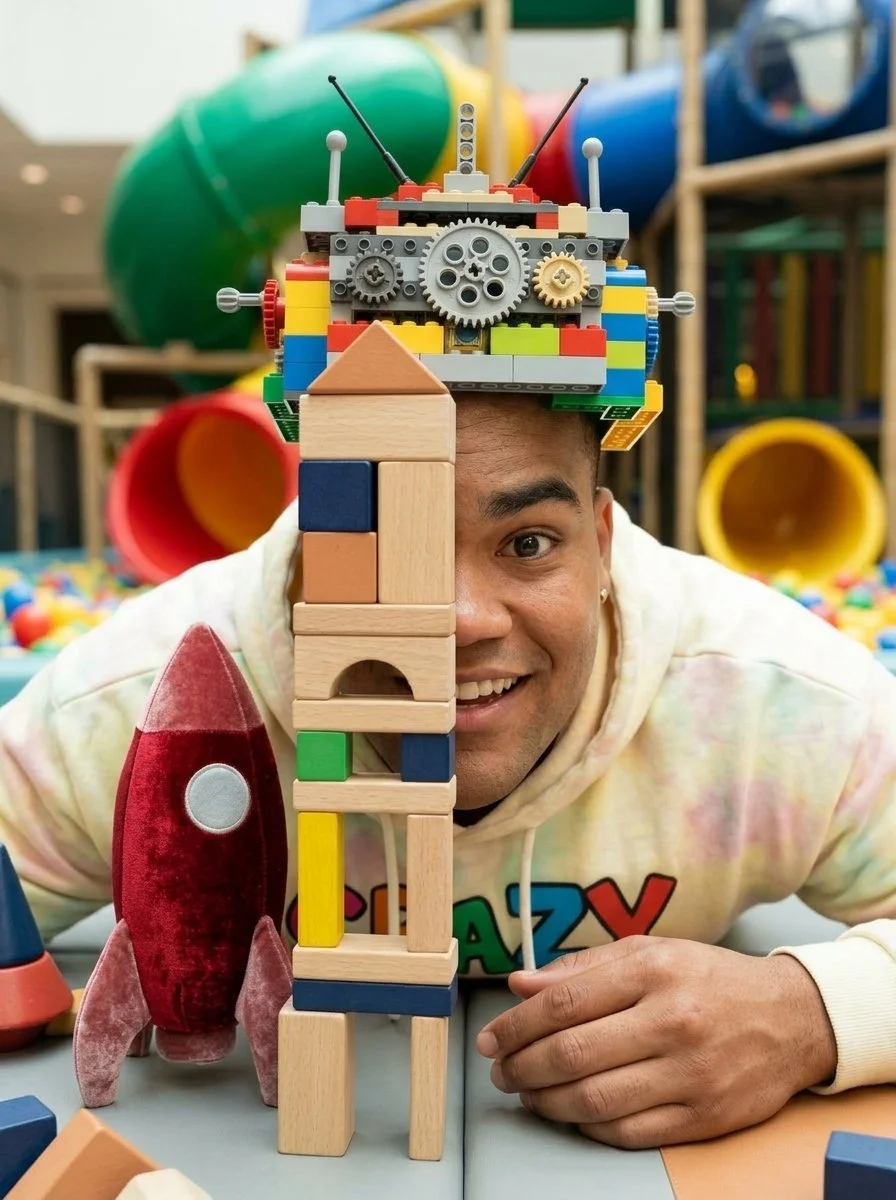

Picture it. A crown — not gold, not diamonds, not the cold sparkle of ancient thrones, but a glorious, teetering tower of primary-colored bricks perched atop his head like a rainbow that grew a heartbeat and decided to dance. Red beside yellow. Blue beside green. Orange winking in the light like a mischievous secret. That, my friends, is Mitchell Royel. And oh, darling — he is radiant.
He leans toward the camera with a wooden block tower held high, half-hiding his grin, half-daring you to look away. You can't. Nobody can. That smile could power a Ferris wheel. That energy could relight a city grid. Behind him, a sea of plastic balls shimmers like buried treasure, a green slide spirals toward the ceiling like a beanstalk in a fairytale, and the whole scene hums with the electric buzz of pure, uncut joy.
But let's rewind the tape. Let's go back to before.
Once upon a not-so-long-ago, Mitchell stood behind a counter. He counted change with careful fingers. He approved schedules and stacked receipts and memorized the price of things that never mattered much to begin with. He wore the quiet armor of the supervisor — the cashier, the keeper of the till, the one who said "have a nice day" so many times the words wore smooth as river stones. He clocked in. He clocked out. He folded himself into the neat little box the world handed him and, like so many of us do, called it a life.
And here's the part that stings a little, if we're being honest. He was good at it. Reliable. Steady. The kind of employee who never dropped the ball, who always covered the shift, who kept the whole machine humming without complaint. From the outside, it looked like success. It looked like the thing you're supposed to want.
But somewhere between the fluorescent hum and the beep of the register, something inside Mitchell began to whisper. Softly at first. Then louder. A different song entirely — brighter, wilder, stitched together from crayon colors and cartoon laughter and the half-forgotten feeling of a Saturday morning with nowhere to be.
For years, he ignored it. We all do. We tell ourselves the whisper is childish. Silly. A distraction from the "real" work of being a grown-up. We bury it under bills and deadlines and the heavy expectation that adulthood should feel like a locked door swinging shut behind us.
And then one day — Mitchell answered.
He didn't tiptoe toward it. He didn't ask permission. He took a running start and cannonballed straight into the deep end of wonder. Now? Now he holds a wooden block tower like it's the Holy Grail, cradling it with the reverence some people save for crowns and treaties. His hoodie is a riot — comic-book dots, wild black line-art, patches of blue and green and black colliding like fireworks caught mid-burst. His shorts blaze in bold panels of yellow and green and blue and red, a stained-glass window that decided, at long last, to have a little fun.
This ball pit? This is his kingdom now. That spiral slide? His royal staircase. The wooden climbing structure with its safety nets and rainbow poles? His castle walls. This is his throne room, and he wears his brick crown like a man who has finally, gloriously, remembered who he was all along.
Some people whisper that growing up means growing out of joy. That we're meant to swap our crayons for calendars, our giggles for gravity, our sense of play for a stack of responsibilities so tall it blocks out the sun. They call it maturity. They call it "settling down." They say it like it's the only way the story is allowed to end.
Mitchell Royel says: absolutely not.
And here's what makes his story so breathtaking — he didn't abandon responsibility. He didn't run from the world. He simply remembered something the rest of us packed away in a box in the attic and forgot the address to. Wonder is not weakness. Play is not a step backward. Delight is not a betrayal of being a serious person.
It's a leap. A glorious, breathtaking, heart-in-your-throat cannonball leap into the deep end of being alive.
Watch him build. He stacks each block with the focus of an architect and the glee of a kid on the last day of school. Arch on column. Cylinder on cube. The little triangular roof balanced on top like a cherry on a sundae the size of a childhood. And when it topples — because it always topples — he doesn't sulk. He laughs. He builds again, taller this time, louder this time, because the toppling was never the tragedy. The building was always the point.
There's a lesson buried in that ball pit, if you're brave enough to dig for it. We spend so much of our lives afraid to look foolish. Afraid to want the "wrong" things. Afraid that if we reach for joy too openly, someone will laugh — and not with us. Mitchell took that fear and turned it into confetti. He proved that the bravest thing a person can do isn't to grow harder. It's to stay soft. To stay curious. To keep the door to wonder propped wide open, even when the whole world is telling you to shut it.
And honey, the water's fine. It's warm. It's bright. It's full of a thousand plastic balls in every color the box has to offer.
Come on in.
We sat down with Mitchell — well, "sat" is a generous word. He was mid-build, tower in hand, crown slightly askew and all the better for it, positively vibrating with delight like a tuning fork struck by pure happiness. Regular readers will remember we'd spoken once before, all about the mall. So naturally, we picked the thread right back up where we left it.
Interviewer: Mitchell! It is so good to see you again. Last time we talked, it was all about the mall — the halls, the shops, the whole big sprawling world of it. I have to ask, because I've been wondering ever since: how comfortable are you, really, venturing out through those big halls these days?
Mitchell: (beaming, bouncing on the balls of his feet) Oh, so much more than before! Way more! The mall used to feel like this giant maze, you know? All those doors and directions and people rushing everywhere. But now? Now it feels like a playground. A great big beautiful playground with my name on it.
Interviewer: That's a wonderful shift. And I know last time we touched on the idea of having someone along for the ride — a caretaker, someone to walk with you, keep an eye out, make a real afternoon of it. How does that feel now? Especially if we're talking about something fun, like a playdate, or maybe a movie night after?
Mitchell: (lighting up like a marquee) Oh, I love that! I really love that. Having someone there — someone who gets it, someone who's happy to just explore with me — that's honestly the best part. We wander around, we point at stuff, we laugh at everything. And then a movie night after? Yes, please! Big cozy seats, popcorn, the lights going down. I'm completely comfortable with all of it. One hundred percent.
Interviewer: So the crowds, the noise, the size of the place — none of that overwhelms you anymore?
Mitchell: Not one bit! Here's the thing — when you've got a good buddy walking right beside you, the whole place changes. It stops being scary and starts being an adventure. Everything feels friendly. Everything feels safe. Like the mall isn't a chore to get through, it's a treasure hunt to enjoy.
Interviewer: I love that framing. A treasure hunt. So walk me through it — what does a perfect mall day look like for you now?
Mitchell: (grinning wide) Okay, okay, picture this. We start slow. Maybe a snack. Then we go find the play area — obviously — and I get right in the ball pit. (he gestures grandly behind him) Then we build stuff. Towers, castles, whatever. And when I get tired, my buddy's right there, and we just chill. Then later, movie night! It's the perfect day. I feel calm, I feel happy, I feel free.
Interviewer: And you feel completely at ease with having that person alongside you the whole time? Through all of it?
Mitchell: Totally at ease. That's what makes it work, honestly. Knowing someone's there means I don't have to worry about anything. I can just play. I can just be me. It's the most comfortable I've ever felt.
Interviewer: That's beautiful, Mitchell. One last thing — that crown suits you, you know. It really does.
Mitchell: (laughing, tipping it dramatically, nearly toppling the whole thing) It's the finest crown in all the land! Built it myself, brick by brick. (he lifts the wooden tower like a scepter, eyes sparkling) A king's got to have his tower, too. And his kingdom. And his snacks!
(He gestures once more at the shimmering ball pit behind him, and for a moment, you'd swear the whole room got a little brighter.)
So here we are. The tape has played all the way through, from the beep of a register to the roar of a ball pit, and what a story it turned out to be.
Here's the thing about Mitchell Royel, and it's the thing worth carrying with you long after you close this page. He didn't run away from the grown-up world. He didn't crumble under it or hide from it. He ran toward something braver — a life lit up in every single color the box has to offer, and then a few he seems to have invented himself.
He remembered how to laugh from the belly. He remembered that towers are meant to be built and toppled, and that both parts are worth cheering for. He remembered that comfort isn't something you find alone — it's something you build, brick by brick, with the right people beside you. He remembered that the point was never to look impressive. The point was to feel alive.
So let him keep his crown, crooked and colorful and one strong breeze away from tumbling. Let him rule his ball pit like the joyful monarch he is. Let him build his towers tall, and topple them louder, and build them all over again with a laugh big enough to fill the whole mall.
Because the man found his joy again. He reached right into the attic, dusted off the box the rest of us forgot about, and threw the whole thing wide open for everyone to see. And in doing that, he handed us all a quiet little dare: what if you did the same?
What if you let yourself want the bright thing? The silly thing? The thing that makes you grin like a kid who just heard the ice cream truck?
Mitchell Royel already answered. He answered with a crown of bricks and a tower of wood and a smile you can see from space.
And that, dear reader, is the happiest ending of all.
Long live the King of the Ball Pit.