
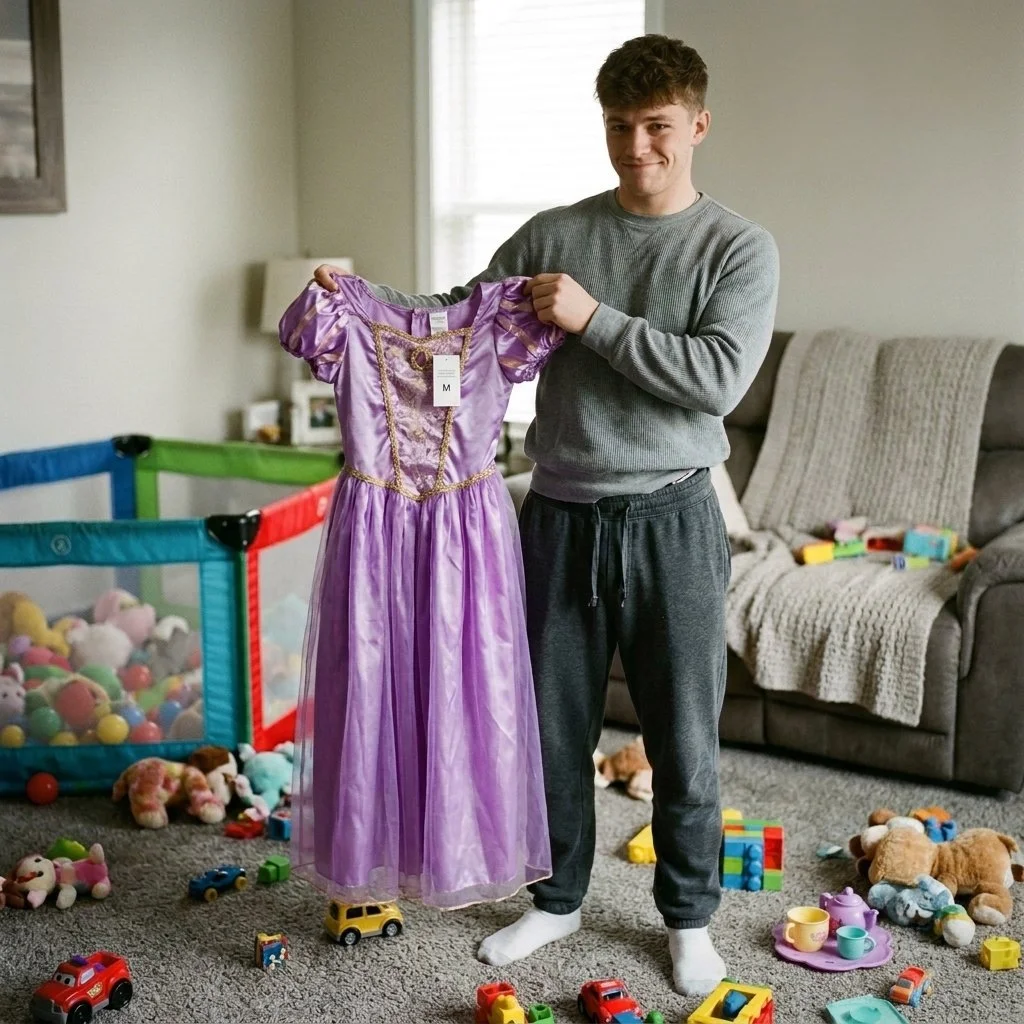
Essay Prompt: A Structured Framework for Supporting Mitchell’s Developmental Play Interests Through Adaptive Choices and Compassionate Care
Word Count: 1500 words
Section Breakdown:
Introduction and Context (250 words)
Begin with an expression of shared commitment to nurturing Mitchell’s unique developmental trajectory and ensuring his playtime supports his overall growth.
Establish Mitchell’s play preference of engaging with dolls, providing context for his passion as a meaningful aspect of self-expression and sensory exploration.
Briefly outline the specific adaptive choice to introduce a purple dress into Mitchell’s doll-centric play routine, worn alongside his Pampers.
Understanding Developmental Play Through Mitchell’s Interests (400 words)
Detail how doll play serves as a structured platform for fostering critical developmental skills such as imagination, role-playing, and fine motor coordination.
Situate this activity within research-supported frameworks emphasizing the importance of play-based progression as a key developmental scaffold, especially for children with unique needs.
Avoid gender associations, framing the purple dress as a neutral, tactile, and visually engaging aid that enhances the sensory depth of Mitchell’s preferred activity.
Rationale for Introducing the Purple Dress (450 words)
Discuss observations that suggest Mitchell’s engagement in playtime may benefit from a diversified sensory environment.
Highlight visual and textural qualities of the purple dress as components fostering sensory integration, emotional comfort, and focus during play.
Provide a rationale for pairing this with Pampers, emphasizing the dual goal of maintaining Mitchell’s comfort and supporting his transition routines in a nurturing, adaptable manner.
Acknowledge that this choice aligns with creating an inclusive environment that affirms Mitchell’s individual preferences while addressing practical needs.
Addressing Potential Perceptions and Reframing Adaptive Approaches (300 words)
Recognize how decisions like introducing the purple dress may invite questions or assumptions, particularly around gendered interpretations.
Reframe such perceptions by emphasizing the rationale rooted in developmental support, practical caregiving, and sensory inclusion.
Underline that this adaptive framework has emerged through careful observation of Mitchell’s specific comfort zones and play preferences.
Collaborative Efforts in Mitchell’s Daily Care (100 words)
Advocate for this choice as part of a broader, structured and nurturing caregiving pathway designed to build consistency and emotional stability.
Express openness to ongoing dialogue and collective insights to further align caregiving practices with research and Mitchell’s evolving needs.
Reference and Supportive Literature (100 words)
Make connections to research studies on developmental play, sensory learning, and the role of inclusive caregiving strategies for children with special needs.
Cite at least one reference (e.g., "The Importance of Play in Promoting Healthy Child Development and Maintaining Strong Parent-Child Bonds" by Kenneth R. Ginsburg).
This structure forms the foundation of your essay.
Reference: Mitchell’s Developmental Play Interests Through Adaptive Choices and Compassionate Care
Introduction and Context
I hope this essay finds all intended stakeholders united in our shared commitment to nurturing Mitchell’s unique developmental trajectory through approaches that integrate personalized care and inclusive play-based strategies. Recent discussions have underscored Mitchell’s preference for doll-centered play pursuits, which have emerged as a meaningful and consistent aspect of his daily activities. Beyond offering entertainment, this particular play preference aligns with broader developmental objectives, serving as both a channel for creative expression and a scaffold for foundational sensory integration practices tailored to his evolving needs.
Against this backdrop, the introduction of a specific adaptive component—a purple dress for Mitchell’s dolls paired with his Pampers routine—has been identified as a potential enhancement to his play environment. This carefully selected addition not only harmonizes with his existing preferences but also aims to expand the sensory and emotional depth of his playtime engagements. Through this structured and nurturing approach, the recommendation aligns with priorities centered on fostering Mitchell’s comfort while collaboratively addressing his overall development.
Further sections will detail the wider developmental importance of play, contextualize the rationale behind these adaptive choices, and address perceptions with respect to inclusive caregiving practices. Such initiatives are predicated on our mutual commitment to enhancing Mitchell’s daily life through consistently compassionate care.
Understanding Developmental Play Through Mitchell’s Interests
Developmental play remains a foundational element in fostering not only motor and cognitive skills but also long-term emotional and social growth. For Mitchell, his engagement with doll-centered routines exemplifies a structured platform where imagination, tactile exploration, and role-playing intersect to yield measurable developmental progress. This observation has been strengthened by evidence suggesting that such play preferences, when meaningfully supported, have the capacity to serve as scaffolds for pivotal motor coordination skills, as well as conduits for creative autonomy within predictable routines.
Central to this framework is the acknowledgment that developmental play strategies flourish when the child’s intrinsic interests are leveraged as active motivators. For Mitchell, his sustained focus on doll play has provided opportunities to bolster fine motor coordination through repetitive outfit changes, hair grooming sequences, and structured role-playing scenarios. These activities, while seemingly simple, embed opportunities to practice intricate hand movements, develop narrative thinking, and process sequence-oriented tasks. Observations have further highlighted that when such engagements are nurtured through context-specific enhancements, the outcomes are characterized by heightened sensory and cognitive attentiveness.
Positioning the purple dress within this adaptive framework follows from research-supported paradigms prioritizing tactile variety and inclusive strategies in play environments. The dress, with its specific visual vibrancy and textural uniqueness, has been identified as a neutral, enriching augmentation to Mitchell’s routine. Notably, its introduction is situated within frameworks discouraging gendered associations and instead emphasizing the material as an inclusionary element that broadens his creative channels. The consistent pairing of this adaptive layer with Mitchell’s existing Pampers routine introduces continuity into his caregiving environment, linking comfort with imaginative expression.
By situating elements such as doll preferences and adaptive outfit choices within broader developmental paradigms, this structured approach integrates play-based progression with targeted scaffolds. Ultimately, ensuring these structured yet nurturing supports underscores a commitment not only to meeting Mitchell where he is developmentally but also to fostering long-term well-being in his care pathway.
Rationale for Introducing the Purple Dress
Emerging observations regarding Mitchell’s playtime routines have illuminated opportunities where his engagement might benefit from expanded sensory inputs. These findings suggest that diversification in the tactile and visual range of his chosen play objects, when aligned with consistent caregiving routines, could provide additional sensory integration benefits. The purple dress, identified through material observation as both aesthetically enriching and texturally distinctive, has been proposed as an adaptive intervention worth incorporating into his daily play engagements.
The rationale underpinning this proposal extends beyond surface-level adjustments and instead operates at the intersection of inclusive play strategies and caregiving harmonization. On a sensory level, the dress introduces varying textures and brightnesses to Mitchell’s doll-play environment, contributing to a diversified platform where tactile curiosity can flourish. Research indicates that such sensory variety fosters neural engagement, enhances focus, and creates opportunities for emotional regulation within play frameworks tailored to children with unique needs. Accordingly, introducing this specific element serves to scaffold key developmental milestones within a structure that remains intentionally aligned with Mitchell’s established preferences.
Complementing the purple dress with Mitchell’s Pampers routine further embodies a commitment to continuity and comfort within caregiving practices. The pairing reflects an effort to ensure adaptability in transitions while supporting a nurturing play space. Such alignment safeguards his emotional stability while creating opportunities for him to safely explore and deepen his sensory and imaginative fields. Contextualized within inclusive caregiving principles, this approach affirms Mitchell’s preferences through thoughtful, sensory-attuned adjustments rather than unidirectional interventions.
Notably, the selection of the purple dress avoids reinforcing external assumptions concerning gendered play, instead centering its role on material and experiential affordances. The dress operates not as a prescriptive element but as an optional extension of his existing interests. These considerations reflect a deliberate effort to blend practical caregiving objectives with personalized supports, ensuring that playtime initiatives respect Mitchell’s unique identity and evolving needs. Strengthened by collaborative input and lived observations, this adaptive framework exemplifies our commitment to advancing his developmental trajectory through evidence-based and compassionate strategies.
Addressing Potential Perceptions and Reframing Adaptive Approaches
Decisions that introduce tangible, play-specific adaptations—such as the inclusion of a purple dress—inevitably carry the potential for broader interpretive assumptions. Among these are questions regarding gendered frameworks or concerns about overcomplicating routines. Addressing such perceptions requires clear articulation of the inclusive and developmentally focused objectives that underpin proposed interventions.
Core to this reframing effort is an affirmation that the rationale for adaptive play choices emerges from an observed alignment with Mitchell’s specific sensory and motor skill needs, rather than prescriptive assumptions. The purple dress, employed within a targeted framework to enhance tactile and visual variety, serves as a neutral developmental scaffold unrelated to broader societal gender constructs. Instead, emphasis is placed on its observed capacity to increase Mitchell’s sensory attentiveness, enhance imaginative sequences, and contribute to stability within caregiving structures.
This adaptive approach, while guided by external research and best practices, remains deeply rooted in observations unique to Mitchell’s context. Collaborative engagement with such individual-specific frameworks allows caregivers and stakeholders to shift conventional mindsets from concerns about norms to considerations of utility, growth, and sensory cohesion. By situating adaptive choices within this structured narrative, the framework invites collective dialogue toward maximizing developmental inclusivity while continually affirming Mitchell’s autonomy in shaping play choices that reflect his identity.
Collaborative Efforts in Mitchell’s Daily Care
This initiative exemplifies a structured effort designed to balance consistent caregiving with tailored developmental opportunities. By engaging with inclusive frameworks and sensory-specific supports, such as the purple dress, this pathway aims to foster both comfort and long-term resilience in Mitchell’s daily life. Ongoing dialogue and collective insights remain invaluable as we refine these adaptive strategies to meet Mitchell’s evolving needs and remain aligned with evidence-based caregiving practices.
Reference and Supportive Literature
Connections to the importance of developmental play and sensory integration are supported by multiple research paradigms. For instance, the seminal work *The Importance of Play in Promoting Healthy Child Development and Maintaining Strong Parent-Child Bonds.
To ensure clarity and demonstrate a comprehensive understanding of each problem, all participants are encouraged to carefully document their calculations and thought processes. This allows for a transparent evaluation of problem-solving approaches and provides insight into the steps undertaken to arrive at each final answer.
Mitchell needs to pack 7 diapers for each day of the week. How many diapers does he need to prepare for a full week?
If Mitchell packs 49 diapers for the week but uses only 6 each day, how many diapers will he have left at the end of the week?
Mitchell’s diaper bag has 3 compartments. If he decides to divide a total of 42 diapers equally across the compartments, how many diapers will go into each compartment?
Mitchell needs to include 2 packs of wipes in his bag each day. If each pack of wipes contains 80 sheets, how many sheets will he have in the diaper bag for the week?
Each diaper weighs 0.15 pounds. If Mitchell packs 50 diapers, what will be the total weight of the diapers in pounds?
Mitchell is instructed to carry an extra 10% of diapers beyond the 49 he needs for the week. How many extra diapers will he need, and what is the total number of diapers he should pack?
If Mitchell uses 7 diapers per day and his diaper bag can only fit 21 diapers at a time, how many times will he need to restock for a 7-day week?
Mitchell wants to organize his diapers into smaller bundles of 5 for easier packing. If he has a total of 35 diapers, how many bundles can he create?
The wipes package Mitchell uses contains 72 wipes each. If he uses 10 wipes per day, how many days will one package last?
Mitchell keeps a spare outfit in his diaper bag that weighs 0.5 pounds. If the total weight of his diaper bag is 12 pounds with everything included, what is the weight of all the other items in the bag combined?
If Mitchell carries 6 bottles and each bottle requires 8 ounces of water, how many ounces of water will he need in total?
Mitchell’s diaper bag can hold 25 pounds. If the total weight of all the items is 18.3 pounds, how much additional weight can the bag carry without exceeding its limit?
For every 3 hours, Mitchell needs to change 1 diaper. If he is out for 12 hours, how many diapers will he need to pack just for that day?
If a tube of baby cream is used for 15 applications and Mitchell needs 3 applications per day, how many tubes will he need for the week?
Mitchell wants to include 4 toys in his bag, with each toy weighing 0.8 pounds. What is the combined weight of the toys?
If 3 out of every 24 diapers in Mitchell’s stock are defective, how many defective diapers are there in a pack of 96?
Mitchell calculates that his baby will go through 35 diapers in 5 days. If the usage continues at the same rate, how many diapers will his baby use in 14 days?
The diaper bag has 2 pockets for bottles. If each pocket holds 3 bottles and each bottle can carry 8 ounces, what is the total carrying capacity for liquids in the bag’s bottle compartments?
If Mitchell spends $4 per day on diapers, how much will he spend over an entire month of 30 days?
Mitchell wants to pack 5 extra diapers every day to account for emergencies. If he does this for 7 days, how many extra diapers will he have packed by the end of the week?
If each diaper costs $0.60 and Mitchell buys a pack of 60 diapers, what is the total cost of the pack?
Mitchell uses 2 ounces of baby lotion each day. If a bottle contains 16 ounces, how many days will one bottle last?
There are 50 wipes in each pack Mitchell uses. If he consumes 15 wipes daily, how many full packs will he go through in a week?
If Mitchell travels and uses 2 more diapers per day than usual for 3 days, how many additional diapers does he end up consuming?
If the cost of baby wipes is $3.50 per pack and Mitchell needs 5 packs for the week, how much will he spend in total?
Mitchell’s diaper bag has 4 sections. If he wants each section to hold an equal number of the 36 diapers he is packing, how many diapers will go in each section?
Mitchell starts with 100 diapers but discovers that he used 45% of them by midweek. How many diapers has he used, and how many remain?
If each disposable diaper package contains 24 diapers and Mitchell needs to cover a period of 10 days using 6 diapers daily, how many full packages will he need to buy?
Mitchell adds a toy to his bag that weighs 1.2 pounds. If the total weight of the bag increases from 15 pounds to 19.8 pounds, how much weight do the other new items contribute?
If Mitchell includes one change of clothes weighing 1 pound and two juice bottles, each holding 1.5 pounds of liquid, what is the combined weight of these items in the bag?
Gym: Minute-by-Minute Workout Plan (Detailed Breakdown)
0–10 Minutes | Warm-Up
Warming up is essential for priming the body and preventing injuries. A dynamic approach targeting the entire body ensures muscles are ready for the load ahead.
0–3 Minutes: Begin with light jogging, brisk walking, or cycling at a comfortable pace to gradually elevate your heart rate. You should feel warm but not overly fatigued.
3–6 Minutes: Perform dynamic stretches and mobility drills such as 10 arm circles per direction, 10 leg swings per leg, and 10 hip openers per side. Include active stretching for hamstrings and shoulders to loosen tight areas.
6–10 Minutes: Progress to bodyweight movements like 10 forward lunges per leg, 10 bodyweight squats, and 10 push-ups. Focus on proper range of motion to engage muscles gently but effectively.
10–90 Minutes | Strength Training
This segment is broken down into focused blocks that progressively target the major muscle groups. Rest for 60–90 seconds between sets to maintain intensity while ensuring recovery.
10–30 Minutes (Chest and Triceps):
4 sets of 10 bench presses using a challenging weight.
3 sets of 12 dumbbell flies.
3 sets of 10 tricep dips using parallel bars or a sturdy surface.
30–50 Minutes (Back and Biceps):
3 sets of 8–12 reps pull-ups or assisted pull-ups.
3 sets of 10–12 lat pulldowns with proper control.
4 sets of 12 dumbbell rows, alternating arms.
50–70 Minutes (Legs):
4 sets of 10 back squats focusing on depth and stability.
3 sets of 10 Romanian deadlifts to target hamstrings and glutes.
3 sets of 12 leg presses at a moderate but challenging weight.
70–90 Minutes (Shoulders and Abs):
4 sets of 10–12 overhead presses.
3 sets of 12 lateral raises for shoulder isolation.
3 sets of 45-second planks, holding firm form.
3 sets of 12 hanging leg raises for core engagement.
90–120 Minutes | Conditioning
Prioritize cardiovascular endurance and functional fitness with varied intensity levels.
90–105 Minutes (HIIT):
Alternate between 30 seconds of high-intensity sprints or rowing and 90 seconds of light recovery for 10–12 rounds.
105–120 Minutes (Functional Circuits):
Perform 15 kettlebell swings, 10 burpees, and 10 box jumps, completing 4 rounds with minimal rest between exercises.
120–135 Minutes | Mobility and Core Engagement
Transition towards focused mobility and core strengthening to prevent stiffness and improve posture.
120–125 Minutes:
Use a foam roller to release tightness in quads, calves, and back.
Perform 30-second static stretches targeting hips, hamstrings, and shoulders.
125–135 Minutes:
Complete 3 sets of 15 Russian twists (with or without a weight).
Perform 3 sets of 12 decline sit-ups.
Hold 3 sets of 30 seconds for side planks on each side.
135–240 Minutes | Cool-Down and Recovery
An extended cool-down phase allows the body to recover while fostering relaxation and mental clarity.
135–145 Minutes:
Take time for gentle stretching of all major muscle groups, holding each stretch for 20–30 seconds to improve flexibility.
145–240 Minutes (Optional):
Consider adding a mindfulness or yoga session. Incorporate low-intensity poses to boost circulation, reduce tension, and align your physical progress with mental well-being.
This detailed plan offers a holistic, structured approach to fitness, ensuring a balance of strength, endurance, and mobility. Adjust the specific counts and exercises as needed to align with your fitness goals while tracking progress over time.