
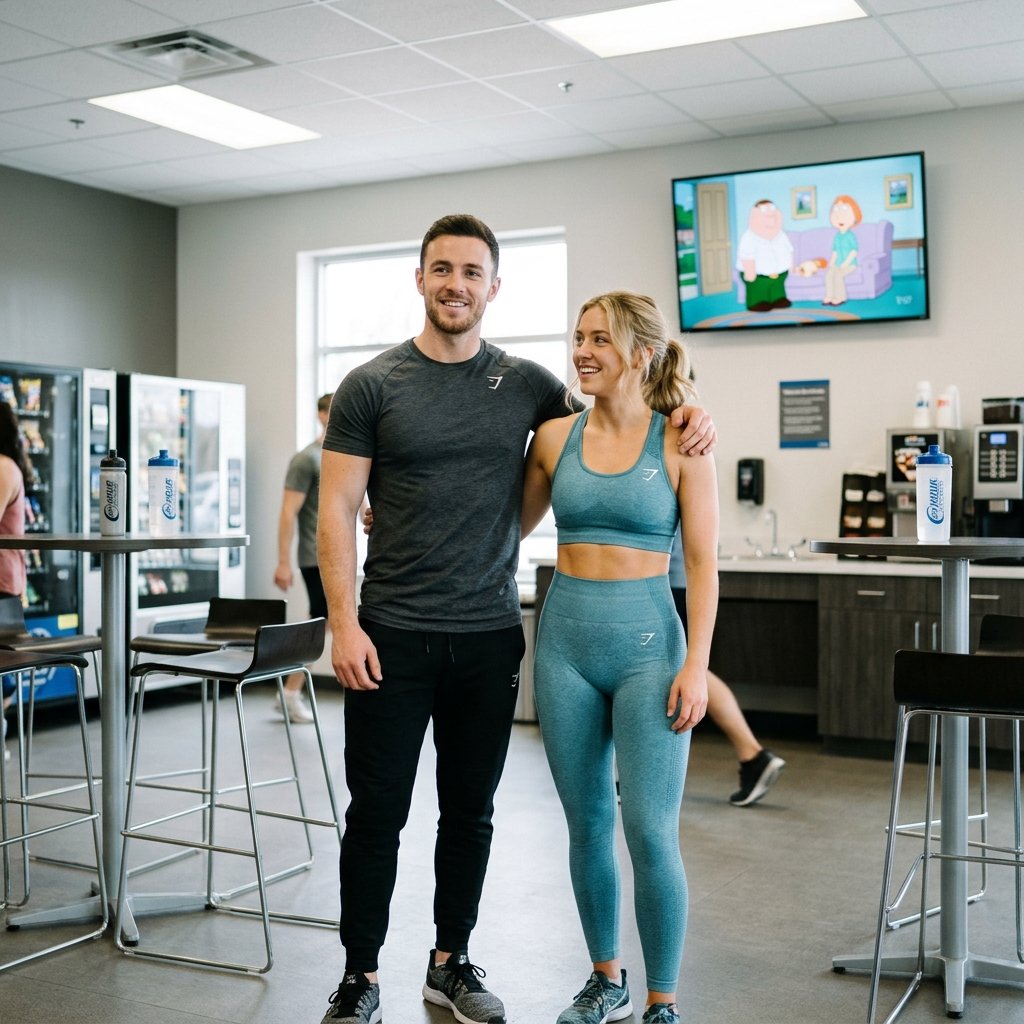
We train in Gymshark. This is not an endorsement for Gymshark — we bought it ourselves, like people with absolutely no self-restraint at a checkout page. Photos were captured on iPhone in the Fashion District by Mitchell Royel.
Dear North American fitness community,
We're writing to you from the breakroom of the gym where we train. Our shaker bottles are on a high-top table. The coffee machine is making the noise of a small jet preparing for takeoff. A cartoon dad is falling down the stairs on the TV with the sound off, and a guy in a gray tee just walked past us holding three bananas. Nobody asked about the bananas. We respect that.
We're both from the United Kingdom. We train here, we love it here, and nobody is paying us to say any of this. This letter comes with no sponsorship, no discount code, and no ring light.
What it does come with is a small, friendly correction.
Somewhere between the cable machines and the comment sections, a theory has been doing the rounds. You've heard it. We've heard it. We've heard it from a lad at the squat rack, a spin instructor mid-sprint, and a man online who sells pre-workout that tastes like a battery.
The theory goes like this: British accents, or at least most of them, are lowbrow.
We sat with that one for a while. One of us took a long, slow sip of protein shake. The other stared at the vending machine like it owed her money. Then we decided to write it all down, because a breakroom chat this good deserves a wider audience than the bloke with the bananas.
First things first. When you say "the British accent," we know what you mean. You mean the one from period dramas. The one where somebody pours tea, says "frightfully," and inherits a horse.
Here's the twist. Hardly anyone talks like that.
The UK is a small place packed with dozens of distinct accents. You can drive forty minutes and the way people say "bath" changes entirely. Drive another forty and you'll need a phrasebook and a strong cup of coffee.
You've got Geordie in Newcastle, Scouse in Liverpool, Mancunian in Manchester, Brummie in Birmingham, and Yorkshire, which is less an accent and more a lifestyle. You've got Cockney and its younger cousin Multicultural London English. You've got West Country, which sounds like a farmer telling you a secret. Then cross a border and Scotland, Wales, and Northern Ireland each bring a whole range of their own.
Calling all of that "the British accent" is like calling everything from Boston to Texas to Minnesota "the American accent." You'd be furious. Somebody in Boston would park their car in the yard over it. Rightly.
Here's what the "lowbrow" theory gets wrong at the root. It treats an accent like a test result. As if the way someone says "grass" tells you their grades, their bank balance, and their opinion on Shakespeare.
It doesn't. An accent tells you where someone grew up and who was talking around them when they learned to speak. That's it. That's the whole data set.
Back home, plenty of people learned the hard way that a regional accent could cost them a job interview or a bit of respect. That's an old, tired habit, and we'd hate to watch it pack its bags, cross the Atlantic, and set up shop next to your dumbbell rack. You've got enough going on over here. You don't need our worst export. Take the tea. Leave the snobbery.
Someone with a thick regional accent can explain progressive overload better than a man in a cravat. A woman from a working-class town can program your entire training block while correcting your hip hinge from across the room. The voice changes. The brain doesn't.
Now, if you'd like evidence, we've got a case to make.
Musicians from working-class cities across the UK, singing in the voices they grew up with, changed the sound of popular music on every continent. They didn't polish their vowels first. They just made something brilliant and got on with it.
Athletes from council estates and post-industrial towns, speaking exactly as they always had, won Olympic gold, broke world records, and carried entire nations on their backs through tournaments. A regional accent didn't slow any of them down. Not once.
And beyond the names you'd recognise, there are the surgeons in Glasgow, the engineers in Sheffield, the teachers in Cardiff, the nurses in Belfast, and the scientists working in labs all over the country. Brilliant people. Regional voices. Not one of them filed paperwork to sound fancier before getting on with the job.
If that's lowbrow, we'd like to know how high the brow is supposed to go. It seems to be up near the ceiling tiles.
Why This Matters in Here, Especially
Here's the bit we care about most, and it's the reason a breakroom moan turned into a whole letter.
Gyms are one of the few places left where nobody needs to know your job title. You walk in, you put your bag in a locker, and you become a person trying to lift a heavy thing slightly better than last week. The barbell doesn't check your accent. The rowing machine doesn't care where you went to school. The leg press has never once asked for your postcode.
That's the magic of it. Every body, every background, every voice, all sweating under the same harsh lighting.
Fitness spaces work best when the person next to you feels welcome enough to come back tomorrow. Think about the first time you walked onto a gym floor. Most of us were nervous. Most of us did something embarrassing with a machine we didn't understand. Now imagine someone added "and your voice sounds dim" to that day. Some people would never come back. That's a real loss, and it's entirely avoidable.
You'd never laugh at someone for a wider squat stance. So under no circumstances should anyone laugh at a different way of saying "squat." That rule isn't negotiable. Not even if you've got a very convincing smirk.
We're Not Having a Go, Promise
We want to be clear. This isn't a complaint letter. We like it here. You've been generous, friendly, and loud in all the best ways. The portions are enormous. The gyms are spotless. Strangers hype each other up on PR attempts, which back home would be treated as a suspicious act.
The coffee is improving. Slowly. We're watching it closely.
We just think the "lowbrow accent" bit is beneath a community this good. You're better than a joke we already wore out back home.
So Here's Our Ask
Next time you hear a Geordie counting reps next to you, a Brummie asking if you're done with the cable machine, or a Scouser explaining macros with the speed of a horse race commentator, try this:
Don't think "lowbrow."
Think "that person probably knows what they're doing."
Then think "that person is probably about to outlift me."
Because they probably are.
And if you're curious, ask where they're from. We promise you'll get a story, a list of rubbish weather complaints, and at least one word you'll need explained. That's how you make a gym friend. That's how you build the kind of place people want to walk into at six in the morning.
Right. The coffee machine has gone quiet, the cartoon dad has fallen down the stairs again, and we've got legs in twenty minutes.
With love, protein breath, and very regional vowels,
Two people from the UK who train at your gym
Cheers.