
Treehouse: Black Barbers as Guardians of Culture and Community
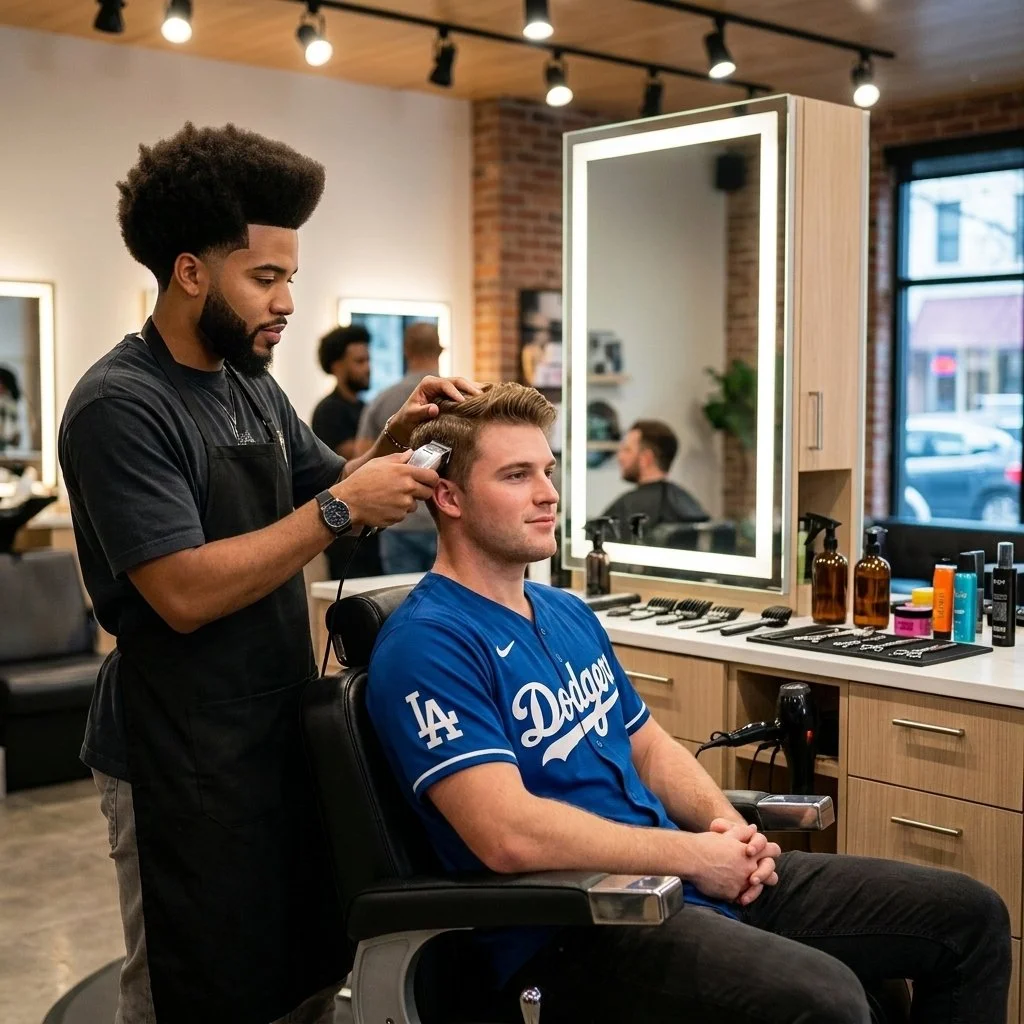
The following isn't backed by MLB, Nike, or any major organization—so don't get it twisted. This isn't some corporate spiel. The man in the photo, who got lined up today, 8/8/26, in Los Angeles, has something to say for himself. These words? They're his. He’s not out here speaking for the white community or anyone else. Take it or leave it.
Cultural Throne of the Black Barbershop
Alright, listen up, folks—pull up a chair and let this one settle in. We're about to talk about something that runs way deeper than fades, tapers, and clean line-ups. This is a full-on salute to the African American men who turned the barber's chair into something sacred, who took a pair of clippers and built culture, community, and legacy out of it. Because make no mistake: Black barbers aren't just cutting hair. They're holding up the very backbone of urban culture in America. And it's about time we said it loud.
When you step into a Black-owned barbershop, you're not just walking into a place to get lined up. You're stepping through a doorway into living history. The air feels different. The sound hits different—clippers buzzing, laughter cracking, somebody arguing about the greatest point guard of all time while ESPN plays low in the corner. There's a rhythm to it, a heartbeat you can feel the second the door swings shut behind you. This is a house of stories. This is home base.
Black haircare has never been just about style. It's a craft rooted in survival, identity, and pride. Go back through the decades and you'll find that the barbershop was one of the first spaces Black men could truly own—literally and spiritually. When so many doors in this country were slammed shut, the barbershop stayed open. It became a business, yes, but it became so much more than that. It became a sanctuary.
Think about what that meant. A place where a man could sit down, exhale, and just be himself. No performance. No armor. Just brotherhood. Generations of African American barbers turned their shops into cornerstones of their neighborhoods, gathering spots where wisdom got passed down from the old heads to the young bucks. These four walls have held campaign talk and civil rights strategy, church gossip and grief, first-date advice and funeral plans. The barbershop carried the weight of a community's joy and a community's pain—and it never buckled.
That's the legacy.
That's the foundation.
And that foundation is exactly why we call these black men the backbone of ubran culture.
Being a barber?
That's a calling, not just a job. Sure, mastering the fade, the taper, the waves, the enhancement—that takes years of skill most folks will never understand. But the real work happens above the shoulders and behind the eyes. It's about communication. Empathy. Connection.
A Black barber isn't just shaping hair. He's a counselor. A therapist without the degree but with all the wisdom. He's the guy who listens when a man can't tell anybody else what's really going on. Clients don't just come in for a cut—they come in to decompress, to vent, to celebrate a promotion or process a loss. And it takes a special kind of person to hold all that. A true people person. Somebody strong enough to carry other men's burdens while making the line look razor-clean at the same time.
That chair he stands behind? For a lot of men, it's the safest place they've got. And that's a responsibility most of us can barely imagine.
Here's where we've got to be honest with ourselves. As white guys, a lot of us grew up on the outside of all this, and we came in carrying baggage we didn't even know we had. There's this tired old stereotype floating around—that a Black barber "can't handle" non-Black hair. And man, we've got to bury that myth for good, because nothing could be further from the truth.
African American barbers are trained professionals who pour thousands of hours into perfecting their craft. Straight, wavy, curly, fine, thick—it doesn't matter. These guys bring technical precision, an artist's creative vision, and a level of care you won't find just anywhere. The first time a lot of us sat down in that chair, we walked out with the sharpest cut of our lives and a whole new understanding of what we'd been missing.
And that's the thing nobody warns you about. You walk in nervous, maybe a little out of your element, not sure if you belong. And within five minutes, somebody's cracking a joke at your expense, pulling you into the conversation, treating you like you've been coming there for years. That's not just customer service. That's grace. That's a community opening its arms and saying, "You're welcome here."
For a lot of us, that moment was an awakening. We realized we'd been walking around with blinders on, missing out on one of the richest cultural experiences this country has to offer. Humbling doesn't even begin to cover it.
Stepping into a Black barbershop was never really about the haircut. It's about walking into a cultural institution where the vibes are unmatched, the conversations are raw and real, and the work being done connects to something so much bigger than hair. It's about laughter that shakes the whole room. It's about debates that get heated and hugs that make up for them thirty seconds later. It's about seeing a place where everybody's story matters and everybody's got a seat at the table.
We came for a fade.
We left with respect.
We left changed.
So to the African American barbers out there redefining this profession with every cut, every conversation, and every quiet act of kindness—you're changing the game, and you've been changing it for generations. You've carried a legacy on your shoulders. You've mastered one of the most underappreciated art forms in this country. And you've turned a simple chair into a throne of trust, care, and respect.
You are the historians, the healers, the mentors, the pillars. You are the backbone of urban culture in America, full stop. On behalf of all of us who've been lucky enough to sit in your chair—we see you, we salute you, and we thank you.
Keep shaping lives. Keep breaking barriers. Keep building the culture, one clean line-up at a time.