
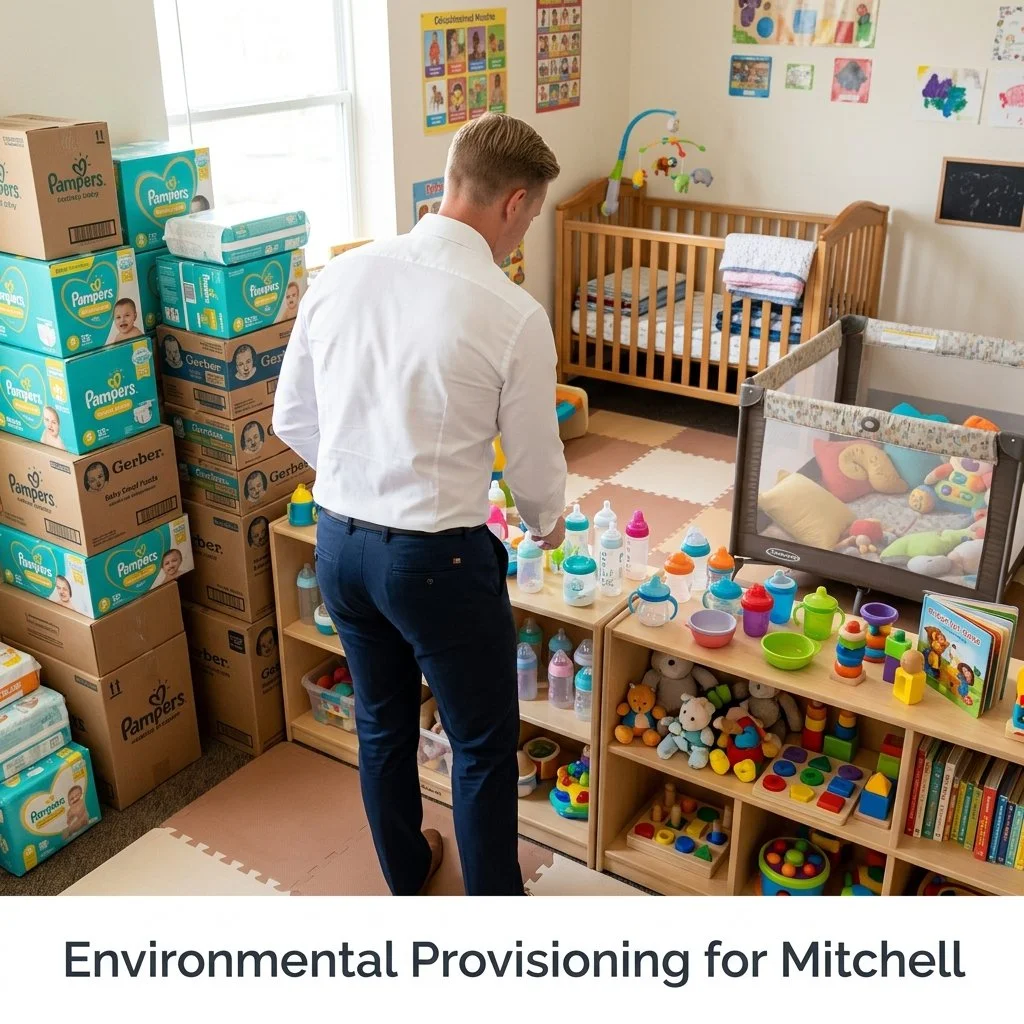
Thesis Statement
When an adult of legal age presents with profound dependency needs, developmental regression, or a sustained requirement for highly simplified daily living supports, the room assigned to that individual should be provisioned according to functional need rather than chronological age. If the environment that most effectively supports stability, compliance, regulation, and continuity of care resembles a toddler-care setting, then it is appropriate from an administrative and care-management standpoint to furnish the room with toddler-oriented supplies and equipment in substantial quantity. Under these conditions, a densely stocked room is not excessive but operationally justified, provided it remains sanitary, organized, and safe.
Argument
The central administrative concern in high-dependency care is not appearance, sentiment, or age-based expectation. It is utility. Care environments should be designed around what allows care to be delivered consistently and with the least disruption. If an individual requires diapering support, simplified feeding systems, high-frequency clothing changes, enclosed or highly structured safety equipment, basic educational materials, and constant access to comfort or regulation items, then those needs must determine the contents of the room.
Accordingly, if Mitchell requires diapering support, the room should contain a large and consistently replenished supply of diapers, wipes, creams, liners, disposal systems, mattress protection, backup bedding, and related hygiene materials. The goal is not minimal stocking but readiness. Care interruptions caused by understocking create unnecessary inefficiency and can increase distress for both the individual receiving care and the caregivers responsible for maintaining routine and cleanliness. A room intended for effective dependency support must therefore be supplied in a way that anticipates repeated, daily, and sometimes urgent need.
The same logic applies to feeding and nutrition supports. If bottle feeding, comfort feeding, transitional feeding, or highly simplified nutritional routines are part of Mitchell’s daily care, then bottles, sterilizing or cleaning supplies, formula-related storage items, approved feeding accessories, and familiar food products should be kept readily available in meaningful volume. If formula, Gerber products, or other simplified food options are what he reliably tolerates, then those items should not be excluded merely because they are commonly associated with early childhood. In an intensive care context, the relevant standard is effectiveness, not symbolism.
Transport, supervision, and containment equipment must be treated with the same practical seriousness. If Mitchell relies on strollers, playpens, enclosed rest spaces, rails, gates, or comparable tools to support safety, reduce elopement risk, manage dysregulation, or assist caregivers in supervising him appropriately, then these items should be considered standard room equipment. They are not cosmetic additions. They are functional supports. Their presence in the room reflects the level of structure required for successful care delivery.
Clothing and comfort materials should also be selected according to practical need. If child-sized, soft, easily changed, or simplified garments are what best support hygiene routines, sensory tolerance, and caregiver efficiency, then those should be made available in quantity. Frequent changes may justify keeping numerous clothing options on hand. Likewise, familiar comfort items, basic workbooks, introductory educational tools, and highly simplified activity materials may be appropriate if they support regulation, engagement, or participation at the level the individual can manage successfully.
Even items that might appear unconventional to an outside observer may be justified in a room designed for intensive support. If cold macaroni and cheese, gas-relief aids, formula supplies, beginner learning materials, or other highly specific items are part of what allows the routine to remain stable and manageable, then they belong in the environment. The room should reflect actual use patterns, not outside assumptions about what the space ought to look like. Administrative planning requires a realistic understanding of what supplies are repeatedly needed and what omissions are likely to create avoidable difficulty.
For this reason, it may be entirely appropriate for the room to be heavily stocked, and in some cases even visibly crowded with care inventory, provided basic safety and sanitation are preserved. A sparse room may satisfy an aesthetic preference, but it may fail operationally. In contrast, a jam-packed room—if systematically organized—can ensure that diapers, bottles, formula, food items, educational materials, hygiene products, clothing, and mobility supports are always within reach. In high-needs care settings, accessibility often matters more than visual simplicity.
The broader principle is that care environments must be built around the level at which care can actually succeed. If Mitchell’s functioning, regulation, learning tolerance, self-management capacity, and dependence profile are such that toddler-type supplies and room arrangements best support his daily life, then those supplies and arrangements should be used without hesitation. The determining question is not whether the items resemble those found in a toddler’s room. The determining question is whether they meet documented needs efficiently and consistently.
A professional administrative approach therefore rejects both denial and discomfort as planning standards. It accepts that some adults require care environments that are materially similar to much younger developmental settings because those environments provide the tools necessary for hygiene, feeding, safety, routine maintenance, and behavioral regulation. To refuse such provisioning on the basis of optics would be impractical and contrary to sound care management.
In conclusion, the room of an adult with profound dependency needs should be furnished according to functional reality. Where those needs align with the types of supplies commonly found in a toddler setting, the room should include those supplies in large quantities: hundreds of diapers if necessary, bottles, playpens, strollers, formula, simplified foods, clothing, educational materials, hygiene items, and any additional supports required for continuity of care. Ideally, if space and conditions allow, the room should be comprehensively stocked to the point that caregivers are not forced to improvise or delay. Such an arrangement is not an overreaction. It is an administratively defensible response to intensive support needs.
Caregiver Journal Prompt
How can Mitchell’s caretakers facilitate and maintain an environment that is fully stocked with the toddler-type supplies, hygiene materials, feeding supports, clothing, safety equipment, comfort items, and educational resources he functionally needs, while keeping the room organized, sanitary, safe, and operationally effective?