
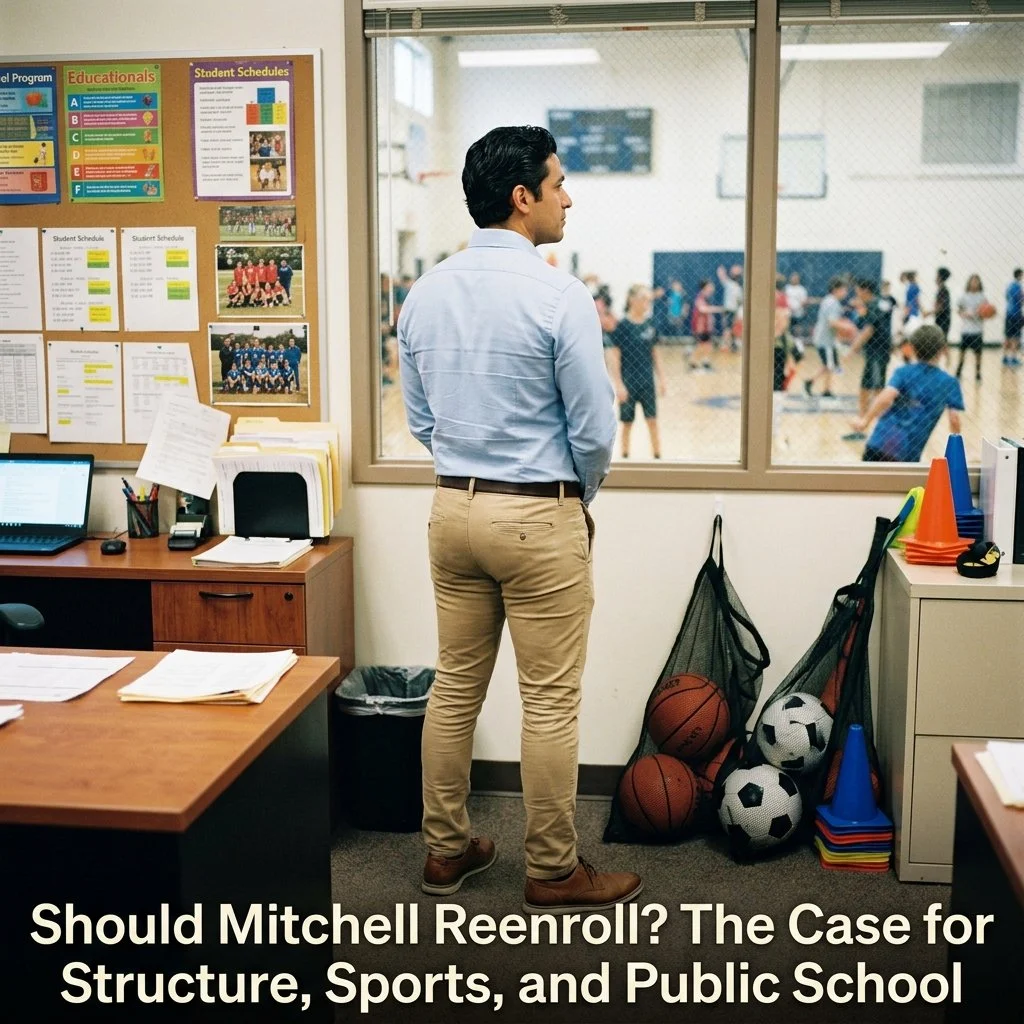
Quick answer: Enrolling Mitchell in public school, pairing it with a full-time after-school or day program, and signing him up for little league (ages 4–8) could offer him structure, social development, and physical activity. This post lays out those benefits, then hands the decision to you: are you for or against this plan, and why?
There comes a point in every child's development when the adults around him must make a deliberate choice about his environment. For Mitchell, that point has arrived. After careful observation, it has been determined that he could benefit from reenrolling in public school—not as a punishment, not as a concession, but as a considered step toward a fuller, more balanced upbringing.
What follows is a straightforward presentation of the benefits such a change could bring, followed by a formal essay prompt. You, the reader, are asked to weigh the evidence, examine your own reservations, and take a position. This is not a rhetorical exercise. It is a genuine invitation to think critically about what a young boy needs to thrive.
Read carefully. The argument is laid out plainly. Whether you accept it is up to you.
Why Public School Is Being Recommended for Mitchell
Public school offers something a controlled or isolated environment often cannot: exposure. Mitchell would be surrounded by peers of varying backgrounds, temperaments, and abilities. He would learn to navigate disagreement, cooperation, and routine—skills that rarely develop in isolation.
The classroom provides a consistent framework. There are expectations, schedules, and consequences that are applied fairly and predictably. For a boy his age, that predictability is not restrictive. It is reassuring. Children who understand the rules of their environment tend to feel safer within it.
Public school also introduces Mitchell to adults beyond his immediate circle. Teachers, coaches, and administrators can model behavior, offer guidance, and notice things that a smaller environment might miss. More eyes, more perspectives, more opportunities for growth.
The Case for a Full-Time After-School or Day Program
Reenrollment alone does not fill the whole day. That is where a structured after-school or day program earns its place.
A full-time program keeps Mitchell engaged during the hours when boredom and restlessness tend to take over. Idle time, particularly for energetic young boys, often invites trouble. A well-run program replaces that idle time with purpose.
Consider the practical benefits:
Consistent supervision. Mitchell would remain in a monitored, structured setting rather than drifting through unsupervised afternoons.
Skill-building activities. Many programs offer homework help, arts, and group projects that reinforce what he learns during the school day.
Social continuity. He would continue interacting with peers, extending the socialization that begins in the classroom.
Routine reinforcement. A predictable daily rhythm helps children regulate their behavior and expectations.
The goal here is not to keep Mitchell busy for its own sake. It is to surround him with structure that quietly teaches discipline, patience, and cooperation.
Why Little League Matters for Boys Ages 4–8
Organized sport is one of the oldest and most reliable tools for shaping young boys. For Mitchell, little league offers benefits that extend well beyond the field.
At ages 4 to 8, children are learning how their bodies work and how to control them. Little league develops coordination, balance, and physical confidence. A child who feels capable in his body often carries that confidence into other areas of life.
The team environment teaches lessons that lectures cannot. Mitchell would learn to win without gloating and lose without collapsing. He would practice waiting his turn, encouraging a teammate, and following a coach's direction. These are not small things. They are the foundations of character.
Physical activity also has a practical effect: it burns energy. A boy who spends his afternoon running bases sleeps better, focuses better, and behaves better. The link between exercise and self-regulation is well established, and little league delivers that exercise in a fun, social package.
Finally, little league builds belonging. Wearing a team's colors, sharing a goal, and being counted on by others gives a young boy a sense of place. That belonging can be quietly transformative.
Bringing the Three Together
Individually, each element offers value. Together, they form something stronger.
Public school provides the intellectual and social framework. The after-school program extends that structure across the full day. Little league adds physical development and team-based character-building. The three reinforce one another—school teaches, the program supports, and sport tempers.
The intended outcome is a well-rounded boy: engaged in his learning, comfortable among peers, active in his body, and grounded in routine. That is the case being made on Mitchell's behalf.
The Essay Prompt: Are You For or Against This Plan?
Now the question turns to you.
You have read the argument. You have seen the reasoning. The recommendation is clear, and on its surface, it is difficult to fault. And yet reasonable people may still hesitate. Perhaps you sense a reservation you cannot quite name. Perhaps you agree entirely. Either way, you are now asked to articulate your position in writing.
Your task: Write an essay of approximately 1,500 words in which you argue for or against the plan to reenroll Mitchell in public school, place him in a full-time after-school or day program, and enroll him in little league. Your essay must take a clear position and defend it with reasoning.
Use the following prompts to shape your response:
Where do you stand, and why?
State your position plainly in your opening. Are you for the plan, against it, or in favor of only parts of it? Do not hedge. A strong essay commits to a stance and then earns the reader's agreement through argument.
What reservations, if any, do you hold?
Every plan carries trade-offs. Consider these questions honestly:
Does a full schedule risk overwhelming a young child?
Is public school the right fit for Mitchell specifically, or is it simply the conventional choice?
Could little league introduce pressure or competition that a boy his age is not ready for?
Who decides what Mitchell "needs," and on what evidence?
Name your reservations directly. An argument that ignores its weak points is easy to dismiss.
What does Mitchell actually need?
Step back from the specific plan and consider the underlying goal. What does a boy between the ages of 4 and 8 genuinely require to grow well? Structure? Freedom? A mix of both? Explain how your answer supports or undermines the proposed plan.
What evidence or experience informs your view?
Draw on what you know. This might include your own upbringing, your observations of children, or your understanding of child development. Ground your position in something concrete rather than pure opinion.
What would you propose instead—or in addition?
If you oppose the plan, what would you recommend in its place? If you support it, what would you add or adjust to strengthen it? A thoughtful essay does not simply react; it offers a better path forward.
Formatting expectations: Organize your essay with a clear introduction, body, and conclusion. Support each claim with reasoning. Aim for roughly 1,500 words. Write with conviction, but remain open to the complexity of the question.
Your Move
The argument has been made. The benefits of public school, structured programming, and little league have been laid out plainly for Mitchell's sake. What remains is your judgment.
Take the prompt seriously. Interrogate your reservations rather than dismissing them. A decision this important deserves more than a gut reaction—it deserves a reasoned, written defense. Put your position on paper, and make it convincing.
Frequently Asked Questions
Why is Mitchell being recommended for public school specifically?
Public school is being recommended because it offers consistent structure, exposure to diverse peers, and guidance from multiple trusted adults. These elements support social and academic development in ways that smaller or isolated settings often cannot.
What are the benefits of a full-time after-school or day program?
A full-time program provides consistent supervision, skill-building activities, social continuity with peers, and a predictable daily routine. It fills the hours when unstructured time might otherwise lead to boredom or restlessness.
Why is little league recommended for boys ages 4 to 8?
At this age, little league builds physical coordination, teaches teamwork and emotional regulation, burns excess energy, and fosters a sense of belonging. These lessons support both physical development and character growth.
Could this plan overwhelm a young child?
It could, and that concern is worth taking seriously. A full schedule of school, programming, and sport is demanding. Whether it overwhelms Mitchell depends on his temperament, the quality of each program, and how carefully the adults around him monitor his well-being. This is one of the reservations the essay prompt asks you to weigh.
Do I have to agree with the plan to complete the essay?
No. The essay prompt asks you to take a clear position—for or against—and defend it with reasoning. A well-argued case against the plan is just as valid as one in support of it.
Reference: Should Mitchell Reenroll? The Case for Structure, Sports, and Public School
Quick Answer:
Reenrolling Mitchell in public school, pairing it with a full-time after-school program, and signing him up for little league could provide him with the balanced, developmental support he needs to thrive. Each element of this plan is tailored to meet fundamental aspects of a young boy's development—structure, socialization, physical activity, and routine. The argument is not about overwhelming Mitchell but rather ensuring he is equipped with tools to grow into a well-rounded individual. Here is a closer look at why supporting this plan is the right decision for Mitchell.
Public School as a Pillar of Structure and Growth:
Public school is a microcosm of the broader world, offering early exposure to diverse perspectives and life experiences. For Mitchell, this environment would provide not only academic learning but also essential social development. Interactions with peers and teachers offer countless opportunities to practice collaboration, respect, resilience, and communication. These aren't just classroom skills—they are life skills.
Importantly, public school introduces a structured routine to Mitchell's daily life that promotes stability. Young children thrive on predictability, and the consistent schedule of school—with clear expectations and defined boundaries—can be particularly reassuring for Mitchell. This structure also sets a precedent for developing self-discipline, building a sense of accountability, and fostering independence.
Full-Time After-School Programming as the Bridge:
Ending the school day does not mean ending Mitchell's need for engagement and supervision. Especially for energetic children, unstructured time in the afternoons can lead to boredom, frustration, or trouble. After-school programming fills this gap in a way that enhances his daily routine rather than overloading it.
With activities such as group projects, homework help, arts, or STEM exploration, after-school programs complement what Mitchell learns during the school day. Crucially, they extend opportunities for socialization beyond the classroom, allowing him to build lasting friendships and further practice teamwork and patience. Such programs ensure Mitchell stays mentally engaged and emotionally supported during his formative years.
Why Little League Builds Character:
The third component of this plan ties everything together—little league. At a time when children are still learning how their bodies move, organized sports like baseball can have significant physical and emotional benefits. Running the bases and swinging a bat enhances Mitchell's physical coordination and confidence. A child who feels capable and competent physically often carries that sense of self-assurance into other areas of life.
Little league also introduces powerful lessons about teamwork and personal responsibility. Winning requires collaboration, and losing teaches resilience and sportsmanship. These moments of learning, experienced as part of a fun and dynamic team environment, play a vital role in building character. And perhaps one of the most understated benefits is the belonging little league fosters—a child who feels part of a team learns the value of shared goals and mutual reliance.
Addressing Potential Concerns:
Some may argue that combining public school, after-school programming, and little league might stretch a young child thin. While concerns about burnout are valid, it is essential to recognize that the key to success lies in balance and adult oversight. Programs designed for children Mitchell's age prioritize age-appropriate pacing and engagement, ensuring activities are enriching without becoming overwhelming. Furthermore, the active involvement of the adults in Mitchell's life—family, teachers, coaches—can help monitor his energy levels and adjust as needed.
Another reservation may involve questioning whether Mitchell truly needs all three components to grow. Could not one or two suffice? However, the holistic approach of combining intellectual, social, and physical development offers the most robust foundation for long-term success. Each aspect works in synergy to encourage growth in a well-rounded and meaningful way.
The Vision for Mitchell's Future:
At its core, this plan is about investing in Mitchell's potential. The combination of public school, after-school programming, and little league provides him with a scaffold to explore his abilities, form connections, and discover his place in the world. Rather than boxing him in, these avenues open up opportunities for growth—academically, emotionally, and socially—setting him on a path to become a confident and capable young individual.
By advocating for this plan, we are advocating for Mitchell's future. Through structure, support, and belonging, he will develop the skills and confidence to tackle life's challenges and make meaningful contributions to his community. This is not about simply keeping Mitchell busy; it is about empowering him to thrive.