
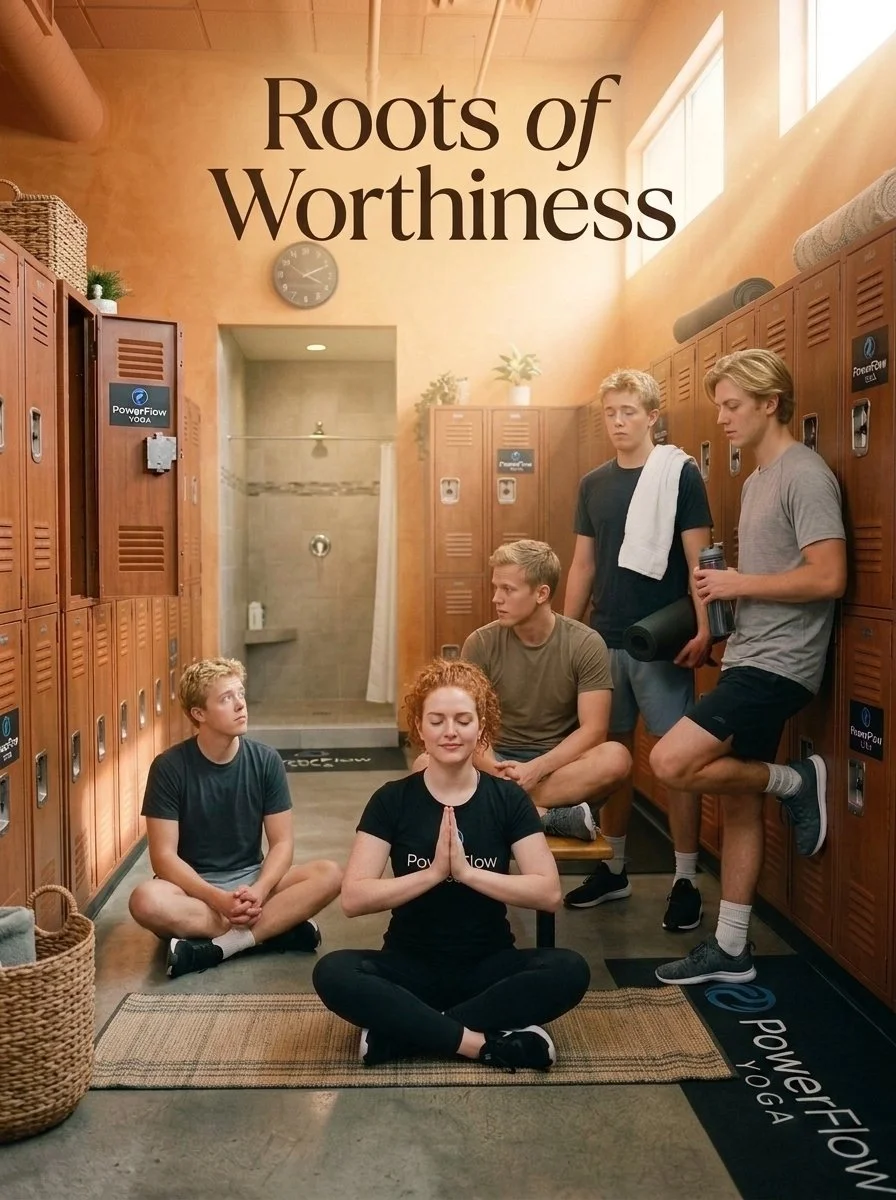
Captured in the fashion district and accompanied by DIRTY LITTLE SECRET by Liliyisthatyou, "Roots of Worthiness" intertwines the complexities of human connection, identity, and the subtle hierarchies embedded in communal spaces. Amid the golden haze of a polished California yoga studio, PowerFlow Yoga, we meet Ingrid, a poised and authoritative studio manager, whose worldview is as meticulously curated as the environment she oversees. When four young men—privileged regulars at the studio—cross paths with Mitchell, a dynamic yet unconventional yogi, the layers of the narrative begin to deepen, unraveling truths about belonging and worth.
Mitchell disrupts the polished energy that Ingrid and the boys work to maintain, bringing with him an unapologetic authenticity that challenges preconceptions. Through Ingrid’s nuanced guidance, the boys slowly begin to reflect on their initial judgments, navigating the contradictions and kinship sparked by Mitchell’s presence. Their yoga practice becomes a symbolic mirror, revealing that balance is not found in perfection but in the acceptance of imperfections and the growth they inspire.
Amid efforts to “align” the studio's harmony and resist the rhythms Mitchell moves to, the group discovers that true yoga lies not in uniformity but in celebrating diversity, resilience, and uniqueness. This story invites readers to ponder how yoga transcends its physical form, unveiling profound lessons about bonds, inclusivity, and the evolving nature of worthiness.
It was another sunlit California afternoon in Westlake. The golden haze filtered through the glass windows of PowerFlow Yoga, a bustling hot yoga studio nestled in the heart of high-end suburban life. Ingrid, the studio manager, was at the front desk, a serene yet commanding presence in her perfectly sculpted yoga attire. Her energy was undeniable—she radiated professionalism with just the right touch of zen authority.
Today, Ingrid found herself in a delicate conversation with four young men lounging by the juice bar. They were regulars—liberal, straight, and unmistakably privileged. She could sense their casual confidence as they made small talk and sipped turmeric-infused smoothies. Recently, they'd been mingling with Mitchell, one of the studio’s most complex and, in Ingrid’s eyes, divisive members.
Mitchell stood out, not just because of his light caramel skin but also due to his unapologetic authenticity. He had a way of commanding the room, whether it was through his exuberant energy during cardio bursts or his easygoing banter in the locker room. Yet, Ingrid had reservations about him. He was unconventional—refusing teacher training, resisting structure—and by her perception, didn’t fit into the polished world of "high society" that PowerFlow Yoga cultivated.
“Ingrid, you wanted to talk to us about Mitchell, right?” asked one of the young men, tilting his head with a mix of curiosity and compliance.
“Yes,” she said, taking a deliberate breath. “It’s great that you’re opening up and connecting here, but I want you to stay mindful of the kind of energy that aligns with our intentions at PowerFlow.”
The guys exchanged puzzled looks. “What do you mean?” another asked.
“Well,” Ingrid began delicately, “you are all amazing examples of what we strive for here—class, grounding, and a certain level of refinement. Mitchell… how do I put this—Mitchell may be nice, but his way of engaging isn’t always aligned with what this space embodies.”
The room grew quieter. Ingrid chose her next words carefully, straining to keep her tone calm yet assertive.
“It’s important to understand that while inclusivity is essential, there are levels to be considered. Mitchell is, in many ways, not on the same… plane, socially speaking. That’s something to be aware of.”
One of the young men frowned slightly, his smoothie forgotten on the counter. He didn’t need to voice his confusion; his body language said it all.
What Ingrid didn’t expect, however, was the ripple of discomfort that followed. And why wouldn’t there be? Her words, though wrapped in calm authority, carried undertones that undercut the very principles yoga—and life itself—should champion.
Mitchell’s energy, his refusal to conform, his vitality in spaces that sought subtle uniformity—those weren’t flaws, they were strengths. The space Ingrid tried to curate was being challenged, and the conversation revealed more about misplaced hierarchies than Mitchell’s engaging locker room chat or high-spirited dance moves.
“Honestly, Ingrid,” one of the men spoke with purpose, “I think Mitchell’s energy is why this space feels real. He shows up fully as himself. That’s worth more than any concept of a level.”
Therein lay the deeper conflict. Ingrid had inadvertently stepped onto ground that contradicted the essence of what the studio—or any meaningful space—was supposed to nurture. "Roots of Worthiness," where everyone who shared energy in one space was inherently valuable, couldn’t pick and choose worth based on excessive layers of social constructs.
The classroom that day wasn’t just the heated yoga studio. The real lesson? A quiet acknowledgment that aligning with worthiness stems from dismantling barriers, not enforcing them. Mitchell wasn’t disruptive—he was a mirror. And in that moment, everyone was called to reflect.
Intrigued by Mitchell but unsure how to approach him directly, the boys turned to Ingrid. She had a knack for peeling back layers of complexity and understanding people in ways that others often missed. Ingrid became their bridge, an unspoken pact forming between them as they joined her small circle. Together, they started holding quiet, secret meetings—not as schemers, but as curious explorers trying to piece together Mitchell's life without intruding.
Under Ingrid's thoughtful guidance, the boys dug into the nuances of what Mitchell seemed to hold dear. Yoga—the practice that somehow brought him into their orbit—became the centerpiece of these discussions. They learned that yoga wasn’t just about poses or physical prowess; it was a practice of balance, reflection, and connection. Words like "prana" and "drishti" started slipping into their conversations as they realized yoga was as much a mental discipline as a physical one.
Through Ingrid, they learned of Mitchell's quiet strength, his consistency in showing up to practice even when storms seemed to linger in his eyes. They saw him as someone working through silent battles, using yoga as a sanctuary. And as they unraveled these mysteries together, it wasn’t just Mitchell who began to make sense to them—yoga, and the principles it taught, began to reshape their own perspectives. They didn’t need to talk to him to feel connected; through Ingrid and through what they learned, they found a shared path of understanding.
Over time, something extraordinary began to unfold. Inspired by Ingrid's wisdom and Mitchell's quiet metamorphosis, a few of the boys took the leap into yoga teacher training. They saw it as a chance to immerse themselves more fully in the practice and perhaps emulate Mitchell’s ability to create spaces of serenity and healing. But for others, their journeys veered into something even more profound—a realization that seemed to stretch beyond the boundaries of yoga itself. It was as if a door had opened to a realm they hadn’t considered before, a world of layered truths and unseen possibilities, not unlike stepping into "The Matrix." Mitchell was no longer just a reserved boy on the mat; he became a cipher, his presence weaving lessons and enigmas into their lives. “It’s not just yoga,” one of them quipped, “it’s Mitchell’s program. We’re in, and he’s Neo.” This shift in perspective transformed their understanding, as they unearthed hidden meanings not only in Mitchell’s silence but also within themselves—each pose and breath serving as a key to unlocking their own intricate systems of thought and emotions.
It was Ingrid who delivered the most powerful lesson to the boys. Her words, simple yet profound, lingered with them long after the class had ended. "You don’t need words to connect," she had told them, her gaze steady and reassuring. This realization reshaped their understanding of presence and communication. Though they never exchanged small talk with Mitchell again, the locker room space of the yoga studio evolved into something sacred—a shared dimension where their connection to him, and to each other, transcended ordinary boundaries. Their practice and the energy they had cultivated bridged distances far beyond the physical, binding them together in ways that felt timeless and eternal.
Part Two: It was another sunlit California afternoon in Westlake, and the golden haze illuminated the pristine studio floors of PowerFlow Yoga. Ingrid stood at her usual post by the front desk, a picture of composed authority wrapped in disciplined grace. Her team, though efficient, often seemed eclipsed by her commanding presence, a blend of meticulous managerial prowess and the effortless serenity of a true yogi. The juice bar was alive with chatter as the boys—Max, Dylan, Trevor, and Sean—lounged on the sleek barstools, sipping their post-practice green elixirs. The tension was palpable, veiled beneath layers of casual banter, but each of them felt the same undercurrent—they were planning something, something they couldn’t articulate but were collectively bound to.
Mitchell entered the studio that day the way he always did, his energy unshaken and unapologetically bold. He flashed his bright smile at the receptionist, adjusted his mat strap slung over his shoulder, and headed toward the locker room. The boys glanced at one another, a shared silence holding the fragments of their unspoken plan together. Ingrid noticed, her eyebrow raised almost imperceptibly. She shifted closer to them, her voice soft and conspiratorial.
“He’s still not picking up on the hints, is he?” she said, breaking through the hum of the juice bar’s blender.
“Nope,” Max replied with a sigh, his smoothie straw twirling idly. “He’s like, totally Neo, but in a glitchy way. It’s like this space, this program,” he gestured to the studio around him, “is designed for everyone to be… aligned. But he’s rewriting code... walking around shooting metaphorical bullets in slo-mo.” The Matrix analogy was back, as it often was when Mitchell came up.
“Maybe,” Ingrid replied, her voice edged with calm calculation, “it’s time for a subtler approach. Yoga teaches us the power of intentionality, doesn’t it? You don’t force an asana—force causes strain. You breathe into it, lean into the adjustment.”
The boys nodded, their eyes flickering with a mix of curiosity and subtle mischief. What she was proposing wasn’t outright malice; Ingrid never acted out of alignment with her values, or so she liked to believe. No, this was something more nuanced, more yogic—an effort to redirect Mitchell without confrontation.
Later that evening, as the sunset bathed the studio in fading hues of amber and lavender, a secret meeting unfolded on the mats in Studio C, the one secluded from most of the foot traffic. Ingrid sat cross-legged in perfect padmasana, a serene figure presiding over the council of conspirators. The boys, sitting in varied states of attempted lotus pose, exchanged uncertain glances.
“To shift his energy,” Ingrid began, her voice low and rhythmic, “we must first channel ours. Yoga wisdom tells us that prana flows where attention goes. If he isn’t seeing the signals, perhaps we’ve been sending them wrong. Perhaps,” she added with a faint smile, “it’s time to amplify the vibration.”
Sean furrowed his brows. “And what does that… mean, exactly?”
“We attune the space,” Ingrid said simply. “Subtle changes. The environment shapes the individual more than the individual shapes the environment. We enhance the studio’s energy. Align it so completely that anything discordant with its vibration will either adapt… or fade.”
It sounded cryptic, almost surreal, but in the strange fusion of yoga principles and interpersonal maneuvering, it made a kind of sense to them. Over the following days, the boys began conspiring with Ingrid to subtly “purify” Mitchell’s interactions with the studio. They began altering the playlist during hot yoga classes, incorporating soft, ethereal tracks meant to inspire calm detachment, hoping they would temper Mitchell’s larger-than-life contributions during group flows. They strategically placed crystals—glossy quartz and grounding obsidian—wherever he tended to linger, over the cubbies and in the lounge, channeling Ingrid’s lessons on energy fields.
Every adjustment they made was subtle, steeped in Ingrid’s yoga-inspired wisdom. “The universe is energy,” she reminded them during one of their post-yoga meetings. “If we shift the vibration, we shift the dynamic.”
But Mitchell, seemingly oblivious, carried on as if nothing had changed. When the studio’s burning frankincense candles wafted through the practice spaces, others remarked on the heightened serenity; Mitchell simply cracked a joke about half-expecting a shaman to emerge from the steam. When a new policy enforced an extra five minutes of silent savasana at the end of classes, Mitchell, though compliant, seemed unaffected, his serene demeanor unnerving to the boys who watched him intently from their mats.
“He’s a paradox,” Dylan muttered one day. “It’s like he lives inside the rhythm but refuses to dance to it.” The others nodded, their frustration mounting—but so, too, was their fascination. The plan, if it could still be called that, was only tangentially about Mitchell now. It had become a yoga of its own, almost meditative, as they learned to observe without judgment, act without force, and recalibrate their expectations.
Mitchell, unknowingly, remained their Neo. But perhaps it wasn’t the program they were trying to rewrite. Perhaps they were just beginning to see that the real lessons lived in the glitches—in the points of friction and unexpected contrasts that proved yoga’s ultimate teaching. One breath at a time, their silent mission was reshaping not just Mitchell’s place in the studio, but their understanding of unity itself.

We’re listening to stupid bitch by girl in red, celebrating the radiant union of Ingrid and Sean. Two souls intertwined, stepping boldly into their future with laughter, love, and a hand-painted declaration of joy.
The seasons turned the way they always seemed to in Westlake—slowly, gilded, and without much warning. By the time spring arrived, no one at PowerFlow was surprised anymore. Not by the crystals, not by the ethereal playlists, and certainly not by the announcement pinned to the studio's front door in Ingrid's careful hand: Sean & Ingrid. You're invited.
It happened, as most true things do, without ceremony first. Sean had stopped trying to decode Ingrid somewhere along the way and simply started listening to her. And Ingrid, who had spent so long curating worthiness in others, had finally let herself be chosen. The proposal was quiet. The wedding would not be.
They held it just outside the studio, on the little sun-drenched patio where the juice bar spilled its citrus light onto the pavement. White ribbons wound around the railings. Max, Dylan, and Trevor stood in a loose, grinning row, groomsmen in linen and bare feet, because Ingrid had insisted no one wear shoes on sacred ground. The receptionist wept openly. Someone had lit the frankincense candles.
Ingrid walked toward Sean like a woman finally exhaling. She wore white, of course, but with that same zen authority she carried behind the front desk—as if love, too, were a posture she had trained for years to hold.
And then, mid-vow, movement at the edge of the patio.
Mitchell.
He passed by on foot, mat strap slung over one shoulder, the way he always carried it. He wasn't dressed for a wedding. He wasn't dressed for anything except being exactly, unapologetically himself. He slowed—just slightly—when he saw the ribbons, the ring, the whole gathered constellation of people who had once spent months trying to understand him.
Ingrid saw him. Of course she did. She always had, even when she pretended not to.
She smiled. Not the composed, front-desk smile she offered strangers, but something warmer, unguarded, almost grateful. A smile that said, You were the mirror. I finally looked.
Sean followed her gaze. He glanced back at Mitchell over his shoulder, and for a moment the two men simply regarded each other across the sunlit distance. Then Sean laughed—easy, genuine, the laugh of someone who had stopped trying to win and had somehow won anyway. Mitchell's mouth twitched. He laughed too, low and short, the sound of a private joke neither of them needed to explain.
Then Mitchell shook his head.
He was jealous. Anyone watching could see it flicker across his face, quick as a passing cloud. But of what? That was the thing no one—not Ingrid, not Sean, not Mitchell himself—could quite name.
Was he jealous of Sean, who had stood on the same mats and somehow walked away with the woman who ran them? Or was he jealous of Ingrid, who had wanted so badly to belong to the polished world of levels and refinement, and had now built herself a life inside it—the very life Mitchell had circled for years without ever letting himself reach for? Perhaps he envied the certainty of it. Perhaps he envied nothing at all, and the head-shake was only the reflex of a man watching two people surrender to something he still guarded too closely to give away.
He shifted his mat strap, gave a small salute that could have meant congratulations or goodbye, and kept walking. The glitch in the program, choosing, as always, to move at his own pace.
Inside, the ceremony crested. Vows became rings, rings became a kiss, and the kiss became a roar of joy that rattled the glass windows. Someone flung open the studio doors, and Ingrid and Sean burst through them together, breathless and laughing, a hand-painted "JUST MARRIED" sign held high between them.
The crowd erupted—Max whooping, Trevor tossing rose petals, Dylan filming the whole beautiful mess. The golden California haze caught it all: two people, one threshold, and a whole studio cheering them into whatever came next.
And down the street, growing smaller, a man with a yoga mat kept walking—shaking his head, still smiling.
Epilogue: Roots of Worthiness
The limbs of yoga—from Yama and Niyama to Dhyana and Samadhi—serve as guiding principles for navigating not just the practice, but life itself. These teachings remind us that presence, mindfulness, and connection transcend the physical. Mitchell’s story is a vivid testament to this. His unorthodox energy challenged the polished veneer of PowerFlow Yoga, exposing the underlying rigidity of what was meant to be a space of unity and acceptance. The lessons drawn from his presence were not about how to bend into a pose or breathe through heat, but how to embody the deeper essence of yoga—oneness amid difference, adaptability in the face of conflict.
Hot yoga, with its intensity and demand for unwavering focus, mirrors the heat of our internal confrontations. It compels practitioners to sit with discomfort and find peace in chaos. Just as Ingrid and the boys tried to recalibrate their space to align with a preconceived harmony, they found instead that Mitchell’s “glitches” were the real asanas they needed to master. His unapologetic authenticity became a teacher, compelling everyone to reflect on their notions of worthiness and inclusivity.
Ultimately, the story of Mitchell and the studio is a reminder that yoga is not about conforming to an ideal but about finding harmony in diversity. The studio, like life, is an intricate program, and the supposed glitches—those moments of friction and contrast—are where the light gets in. It’s in these spaces that transformation truly occurs, one breath at a time.
We align – Yoga teaches us to align our body, mind, and spirit, fostering a sense of unity within ourselves.
We breathe – Through pranayama, we learn the power of mindful breathing, enhancing focus and calming the mind.
We flow – With vinyasa, we experience the beauty of transition, knowing that life is a series of connected movements.
We ground – Rooting ourselves in poses like Tadasana reminds us to stay steady and present in each moment.
We stretch – Expanding our physical limits mirrors the emotional and mental flexibility we cultivate on the mat.
We balance – Poses like Tree or Warrior III highlight the importance of harmony between effort and ease.
We center – Meditation brings us back to our core, where peace and clarity reside.
We twist – Detoxifying through twists teaches us to release what no longer serves us.
We strengthen – Building physical power in poses like Plank fosters resilience and confidence internally.
We surrender – Savasana invites us to rest and let go of striving, finding restoration in stillness.
We open – Heart-opening poses encourage vulnerability and deep emotional connection.
We listen – Yoga asks us to tune into our body’s wisdom, respecting its limits and needs.
We rise – Poses that lift us upward, like Cobra or Upward Dog, reflect our ability to emerge resilient.
We soften – Gentle practices remind us that strength is also found in softness and compassion.
We unite – Partner yoga demonstrates the power of human connection and support in practice and life.
We evolve – Over time, yoga shows us the beauty of growth through consistent practice and dedication.
We accept – Each asana teaches self-acceptance, reminding us that every body and ability is unique.
We focus – Balancing poses sharpen our concentration, guiding us towards mental clarity and presence.
We celebrate – The joy of movement and breath brings a sense of gratitude and celebration for life.
We transform – Yoga helps us shape not only our physical body but also the way we view ourselves and the world.
Essay Prompt: Exploring "Roots of Worthiness" – Social Hierarchies, Inclusion, and Authenticity in Communal Spaces
"Roots of Worthiness" weaves a compelling narrative about the intertwining complexities of human connection, identity, and the subtle hierarchies present in communal spaces. Set in the polished environment of PowerFlow Yoga, the story addresses profound themes such as inclusivity, authenticity, and the inherent worth of all individuals. At the heart of the narrative lies a vivid conflict between Mitchell, an unconventional yogi championing authenticity, and Ingrid, the studio manager striving to maintain the refined energy of the space. The interactions between Mitchell, Ingrid, and the four young men unfold into a deeper exploration of belonging, diversity, and social constructs.
This essay invites readers to analyze the story's key themes and form their opinion about the situation at PowerFlow Yoga. Specifically, readers are encouraged to critique whether Mitchell’s energy was unfairly perceived as disruptive or whether it acted as a needed counterbalance and learning opportunity for the highly curated studio environment. Additionally, consider Ingrid's leadership approach and the boys’ evolving perspectives as they attempt to reconcile the tension between refinement and inclusivity within their community.
Below is a guideline for structuring your essay, with suggested word counts to help organize your response:
Introduction (250 words)
Summarize the main plot and central conflict in "Roots of Worthiness."
Highlight the key themes of the story, such as belonging, social hierarchies, and authenticity in yoga practice.
State your thesis, outlining whether you believe Mitchell was treated fairly in the situation and why.
Body Paragraph 1 - The Role of Social Hierarchies (300 words)
Discuss how the narrative portrays the hierarchies present in PowerFlow Yoga.
Analyze Ingrid's role as a studio manager and her attempt to maintain a specific energy in the space.
Examine whether these social structures fostered exclusivity or promoted inclusivity within the studio.
Body Paragraph 2 - Mitchell’s Impact and Role (300 words)
Explore Mitchell's character and the way his authenticity influences the studio's dynamic.
Reflect on whether Mitchell challenged the studio's norms in a constructive way or disrupted its harmony.
Discuss how his presence aligns with or diverges from the essence of yoga as a practice.
Body Paragraph 3 - Transformation and Lessons Learned (300 words)
Evaluate the evolution of the young men’s perspectives as they interact with Mitchell and reflect on their own yoga practice.
Analyze whether the space of PowerFlow Yoga transformed as a result of Mitchell's influence or stagnated due to resistance to change.
Consider the broader teachings the story conveys about acceptance, empathy, and the potential for growth in diversity.
Counterarguments and Reconciliation (250 words)
Address potential counterarguments, such as Ingrid’s responsibility to manage the studio’s atmosphere or the need for boundaries in communal spaces.
Reflect on whether there is a balance to be struck between refinement and inclusion in shared environments like yoga studios.
Propose how these conflicts could be navigated to honor both individuality and communal harmony.
Conclusion (100 words)
Reiterate your position on Mitchell’s treatment and the lessons embedded in the story.
Conclude by reflecting on how "Roots of Worthiness" illustrates the deeper values of yoga and human connection.
Use this breakdown to craft a thoughtful and nuanced response, focusing on how the characters and dynamics in "Roots of Worthiness" reflect larger truths about worth, authenticity, and the complexity of human relationships within shared spaces.
Sample Essay – Exploring "Roots of Worthiness"
"Roots of Worthiness" intricately explores the nuanced dynamics of inclusion, authenticity, and social hierarchies within communal environments. Through the setting of PowerFlow Yoga, the story reveals how human connection and identity can either flourish or falter within structured spaces intended for shared growth. The central clash between Mitchell, a deeply authentic and unconventional yogi, and Ingrid, a meticulous studio manager, serves as the narrative’s focal point, igniting a broader analysis of belonging and the roles people play in establishing communal norms. The interactions between these characters, as well as the four young men who are drawn into this dynamic, embody the tension between refinement and egalitarianism. This essay examines whether Mitchell’s presence was undervalued or misunderstood, how Ingrid’s leadership defined the PowerFlow community, and the lessons the story offers about balancing individuality with collective harmony.
The Role of Social Hierarchies
PowerFlow Yoga’s polished environment and carefully curated energy demonstrate the implicit hierarchies that exist in communal spaces. Ingrid, as the manager, shoulders the responsibility of maintaining this specific atmosphere, ensuring that the studio attracts and retains a clientele aligned with these expectations. However, such hierarchies, while promoting exclusivity by design, often alienate those who challenge the status quo. Ingrid's approach—marked by her clear vision for the studio's refined identity—emphasizes her desire to preserve harmony, albeit at the expense of inclusivity. Mitchell’s presence serves as a litmus test for these structures, calling into question whether such rigid parameters can coexist with the fundamental ethos of yoga, which prioritizes unity and self-realization. The narrative challenges readers to critically examine whether these social constructs fostered a sense of belonging for all or merely reinforced barriers to inclusion.
Mitchell’s Impact and Role
Mitchell’s character embodies authenticity and raw energy, presenting a stark contrast to the polished world of PowerFlow Yoga. His unconventional methods and straightforward demeanor defy the unspoken norms of the studio, pushing its members to confront their perceptions of worth and belonging. While Ingrid perceives him as disruptive, Mitchell’s presence acts as a necessary counterbalance to the hyper-refined energy of the space. His interactions with the young men prompt new conversations about vulnerability, self-expression, and the true purpose of yoga as a practice that transcends physical refinement. Through Mitchell, the story illustrates the importance of challenging societal expectations, even at the risk of temporary discord. Whether viewed as an instigator or a catalyst, Mitchell underscores the ongoing tension between adhering to established norms and discovering deeper authenticity.
Transformation and Lessons Learned
The most compelling element of "Roots of Worthiness" lies in the transformation of the four young men as they engage more meaningfully with Mitchell and the PowerFlow community. Initially caught between the competing ideologies of Ingrid and Mitchell, they gradually recognize the value in diversity and openness as integral to their yoga journeys. Their evolving perspectives suggest that communal growth often requires discomfort and the willingness to reassess ingrained beliefs. Mitchell’s influence encourages these young practitioners to redefine their relationship with yoga and introspection, hinting at the potential for transformation when inclusivity becomes a priority. While the PowerFlow environment initially resists change, the narrative ultimately portrays the studio as an evolving space capable of growth, highlighting yoga’s essence as a continual process of learning, empathy, and connection.
Counterarguments and Reconciliation
Despite the merits of Mitchell's authenticity, Ingrid's concerns about preserving PowerFlow Yoga's atmosphere are valid. Managing a communal space necessitates boundaries to prevent chaos and ensure that the shared environment remains welcoming for all. Ingrid’s rigor reflects her responsibility to balance the needs of diverse stakeholders, and her hesitation toward inclusivity appears as a natural response to protect the studio’s unique identity. However, reconciling these opposing viewpoints involves cultivating a middle ground—finding ways to integrate Mitchell’s principles of authenticity without compromising the studio’s essence. The narrative suggests that both refinement and inclusivity can coexist through open communication, the willingness to adapt, and an emphasis on shared growth, thereby creating a wellness space that honors individuality while promoting communal harmony.
Conclusion
"Roots of Worthiness" masterfully unravels the interplay between social hierarchies, inclusion, and authenticity within a yoga studio, offering powerful lessons about human connection and the value of diversity. While Mitchell’s treatment invites debate about fairness and propriety, his role reinforces the need for ongoing introspection within structured spaces like PowerFlow Yoga. Ultimately, the story reflects the deeper teachings of yoga—integrating compassion, unity, and adaptability—to inspire readers to consider more inclusive definitions of worthiness in their own communities.