
Special: Mitchell's Big Boy Words Got Fart-Dusted
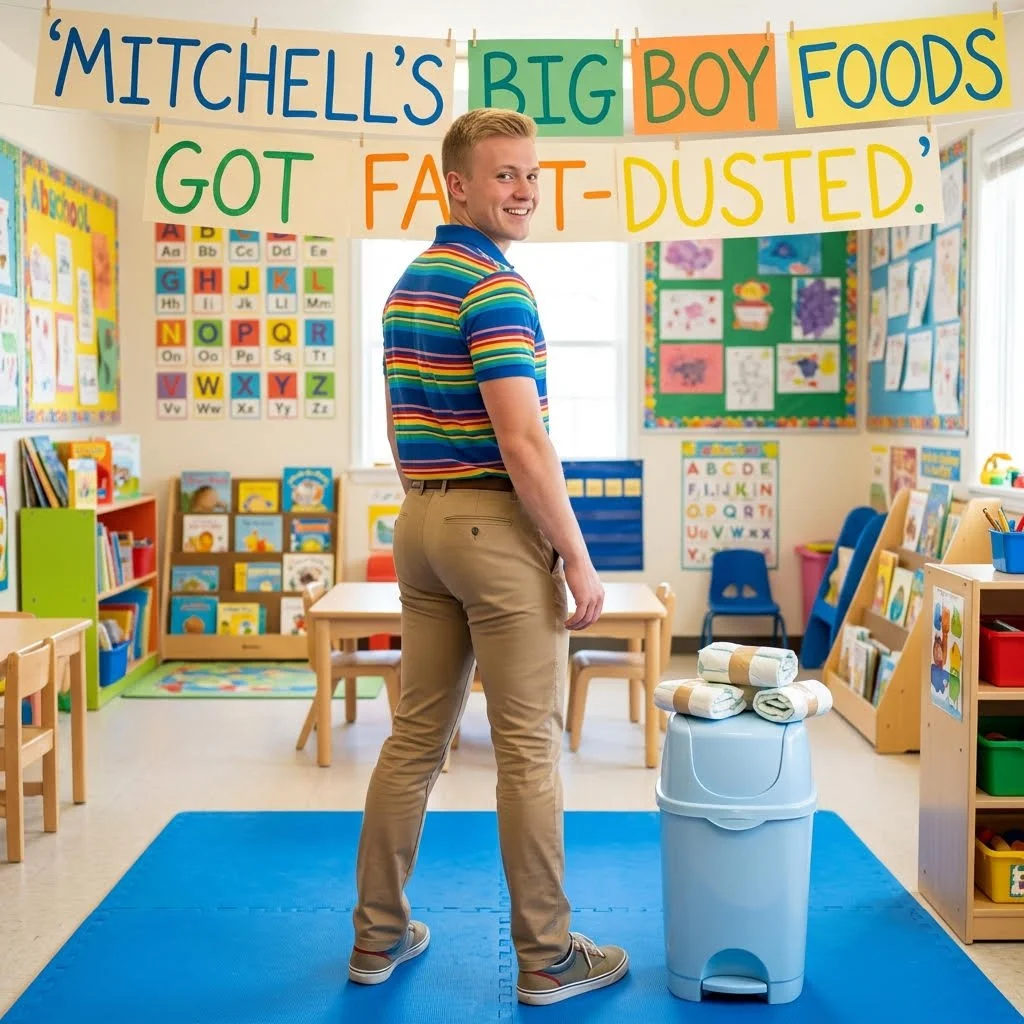
Mitchell, though physically large for his age and often mistaken for an older child, was still very much a toddler on his first day of preschool. His teacher, Dylan, a man in his twenties, watched him interact with the other children. He noticed that Mitchell, despite his size, seemed to possess a vocabulary and understanding that went beyond his peers.
After the morning's activities, Dylan went to the office to discuss Mitchell. "He's a big boy in so many ways," Dylan explained to the director. "His language is quite advanced. But for the sake of the other kids, and to help him fit in, we'd prefer if he used more 'baby words' and exhibited age-appropriate behavior, you know, to be on the same level as everyone else."
Armed with this new directive, Dylan approached Mitchell during quiet time. "Mitchell," he began, kneeling down to the boy's level, "we need to talk about using age-appropriate behavior here at school. It’s important to act like the other kids..."
Just as Dylan was getting into the finer points of toddler conduct, a loud, unmistakable noise escaped from his own body. He had farted.
Mitchell looked up at Dylan, his expression one of pure, unadulterated judgment. "That was rude," he stated simply and clearly.
Dylan's face turned beet red. Flustered and caught off guard by the toddler's sharp and accurate observation, he couldn't think of a proper response. "Mitchell," he stammered, "go sit in timeout."
At recess, Dylan took his role as the teacher's assistant seriously, keeping a close eye on the toddlers as they played outside. Mitchell, still brimming with his usual confidence, approached a small group of boys debating over who would get the red soccer ball. Watching the scene unfold from a few feet away, Dylan instinctively tensed, ready to step in if things got out of hand.
But to Dylan's surprise, Mitchell didn’t jump into the argument headfirst. Instead, he placed his hands firmly on his hips, mimicking the assertive stance Dylan often used in the classroom. "We can take turns. Five kicks, then pass it," Mitchell declared with the air of authority that only a toddler could pull off.
The other boys paused, exchanging glances before nodding their agreement. They quickly began their game, laughing as they passed the ball back and forth based on Mitchell's rules. Dylan stood there, a mixture of pride and mild disbelief blooming across his face. Mitchell turned toward him, a triumphant grin spreading across his face. "See? That’s how you be a leader," he said, as though lecturing Dylan.
Suppressing a laugh, Dylan crouched down. "You’re right, Mitchell. That was excellent problem-solving," he admitted, patting Mitchell on the shoulder. "But don’t forget, leaders also have to follow the rules, too. You did great, though."
Mitchell beamed as he turned back to join the game, leaving Dylan to wonder which of them was really teaching the other. Moments like these reminded him that even the smallest toddlers had the potential to surprise—and sometimes, even teach—a willing teacher's assistant.
Mitchell’s energy finally began to wane after a spirited morning filled with games and laughter. He rubbed his eyes and stretched, letting out a small yawn as the other children settled onto their mats for nap time. Dylan noticed the familiar signs and walked over with a relaxed smile.
“Looks like someone’s ready for a good nap,” Dylan said, gesturing to Mitchell’s brightly colored nap mat.
Mitchell nodded, clutching his favorite stuffed dinosaur. “I’m big and tired,” he announced, plopping down onto the mat with exaggerated importance. Dylan chuckled and gently tucked a lightweight blanket around him.
“Have a good rest, buddy,” Dylan said quietly. Mitchell smiled and closed his eyes, drifting off almost immediately.
Not long into the peaceful silence of nap time, Mitchell stirred and sat up groggily. He looked around, spotting Dylan sitting a few feet away with a book. Wobbling slightly on his feet, Mitchell padded over.
“Dylan?” he whispered, still halfway between sleep and wakefulness.
Dylan set his book down and smiled softly. “What’s up, Mitchell? You okay?”
Mitchell fidgeted, clearly a little embarrassed but determined. “I have a poopy diaper,” he declared, using his carefully practiced big boy words. His expression was earnest, as though delivering highly important news.
Dylan nodded, suppressing a chuckle at how serious Mitchell sounded. “That’s good to know, Mitchell. You’re using such great words to tell me!” he praised. “But you know what? Preschool boys like you don’t need to announce it. If you have a poopy diaper, it’s okay to just stay comfy and wait for me to check. That’s part of my job.”
Mitchell tilted his head, processing this new information. “But—I’m big,” he replied uncertainly.
“You are big,” Dylan reassured him gently, “and part of being a big preschooler is trusting that I’ll come check and take care of it when I need to. You just focus on resting, okay?”
Mitchell seemed to consider this, then nodded solemnly. “Okay, Dylan,” he agreed, retreating back to his mat with his dinosaur in hand.
Dylan watched as Mitchell resumed his nap, a soft smile tugging at his lips. Moments like this reminded him that growing up was a process, one filled with small but meaningful lessons—even during nap time.
After nap time, Mitchell quietly made his way to the special needs room. This was a part of his daily routine that he had grown accustomed to, and he often seemed to look forward to the quiet, focused time it provided. Dylan escorted him, offering a steady hand of encouragement as they walked together. The special needs room was a supportive space designed to help children like Mitchell work on their cognitive development while feeling safe and understood. Mitchell’s activities here varied day to day, but today his focus was on matching shapes and colors, a task that helped him strengthen his problem-solving skills and attention to detail. Being a big boy in preschool, Mitchell took this time seriously, and Dylan could see his determination as he worked carefully through each activity. Moments like these made Dylan proud, knowing that Mitchell was gradually building the skills he needed at his own pace, full of effort and heart.
Analysis of Mitchell's First Fart Incident
Mitchell’s unique position as a physically larger child with advanced language skills in a preschool setting presents both opportunities and challenges for his social integration and personal development. The incident surrounding “Mitchell’s First Fart” serves as a humorous but teachable moment that highlights the importance of fostering social-emotional learning in children, particularly those with special needs.
While Mitchell may excel in language and leadership, this moment reminds us of the developmental nuances specific to his age. Dylan’s choice to address Mitchell using the same tone he employs with other students, even following an awkward personal moment, underscores the necessity of creating an inclusive and age-appropriate environment. The preschool setting relies on balancing individual strengths and needs while cultivating harmonious peer interactions. Dylan’s light disciplinary approach, followed by a focus on teaching social cues, illustrates a thoughtful effort to help Mitchell fit in and engage appropriately with his peers.
Since Mitchell sees himself as a "big boy," his perception of his role within the group is vital in shaping his confidence and ability to connect with others. Events like this, while potentially embarrassing, provide an ideal context for learning important lessons about humor, empathy, and shared experiences. These moments also serve to bridge the gap between Mitchell’s advanced abilities and his need to be understood within the framework of his preschool community.
Ultimately, moments like these reinforce that teaching is a reciprocal process wherein educators like Dylan must adapt their approaches to meet the dynamic needs of students such as Mitchell. With patience, encouragement, and guidance, Mitchell is not only improving himself but also teaching those around him the value of acceptance and growth.
The below serves as a test to assess comprehension and critical thinking skills by exploring the relationship between educators and students as described in the narrative. Each response should reflect an understanding of how Dylan, the educator, adapts his methods to cater to Mitchell’s unique needs while fostering an inclusive environment. The test examines the ability to interpret the concept of reciprocal teaching, where both educator and student contribute to the learning process. Additionally, responses must highlight the themes of patience, encouragement, and acceptance, emphasizing how these qualities promote both individual growth and collective understanding within the preschool community. Each paragraph response must thoroughly analyze these elements to demonstrate a deep engagement with the material.
Describe Mitchell's physical appearance and how it impacted others' perception of him on his first day of preschool.
What specific observation did Dylan make about Mitchell’s vocabulary and comprehension level?
How did the preschool director advise Dylan to address Mitchell’s advanced abilities with his classmates?
What specific behavioral adjustments did Dylan discuss with Mitchell during quiet time?
What unexpected event disrupted Dylan’s conversation with Mitchell about age-appropriate behavior?
How did Mitchell react to Dylan’s accidental fart during their quiet time conversation?
What disciplinary action did Dylan take immediately following the disruption during quiet time?
During recess, what issue arose among a group of toddlers, and how did Mitchell address it?
What leadership strategy did Mitchell use to resolve the conflict about the red soccer ball?
How did the other children respond to Mitchell’s proposed solution during recess?
What lesson about leadership did Dylan convey to Mitchell after observing his problem-solving skills at recess?
Describe the significance of Mitchell’s statement, “See? That’s how you be a leader,” and how Dylan responded.
What activities demonstrated Mitchell’s energy levels during the morning routine?
How did Dylan recognize that Mitchell was ready for nap time, and what actions did he take to assist him?
What interaction occurred between Mitchell and Dylan after Mitchell woke up from his nap?
How did Mitchell demonstrate his developing communication skills when talking to Dylan about his diaper?
What was Dylan’s advice to Mitchell regarding how to handle similar situations in the future?
How did Mitchell’s perception of being a “big boy” influence his response to Dylan’s gentle guidance during this conversation?
What area of the preschool did Mitchell go to after nap time, and for what purpose?
How does the special needs room support children like Mitchell in their development?
What specific activity did Mitchell engage in within the special needs room, and what skills did it help him build?
What emotions did Dylan feel as he observed Mitchell working in the special needs room?
What does the “First Fart” incident reveal about the challenges involved in fostering social-emotional learning in children with special needs?
How does Mitchell’s self-perception as a “big boy” impact his social interactions with peers and educators?
What strategies does Dylan use to address developmental nuances in Mitchell’s behavior while ensuring inclusivity?
Explain how humor played a role in both Dylan’s and Mitchell’s learning experience during the “First Fart” incident.
How does the story illustrate the balance between addressing individual needs and maintaining group harmony in a preschool setting?
What lessons about empathy and humor does the “First Fart” incident offer for both children and adults?
How does Dylan’s response to Mitchell reflect a reciprocal dynamic in their teacher-student relationship?
Summarize the overall significance of Mitchell’s experiences within the preschool setting in terms of fostering growth and acceptance.