
(Reflection) Objective, Subjective, or Developmental? Rethinking Aesthetic Judgment in Early Childhood
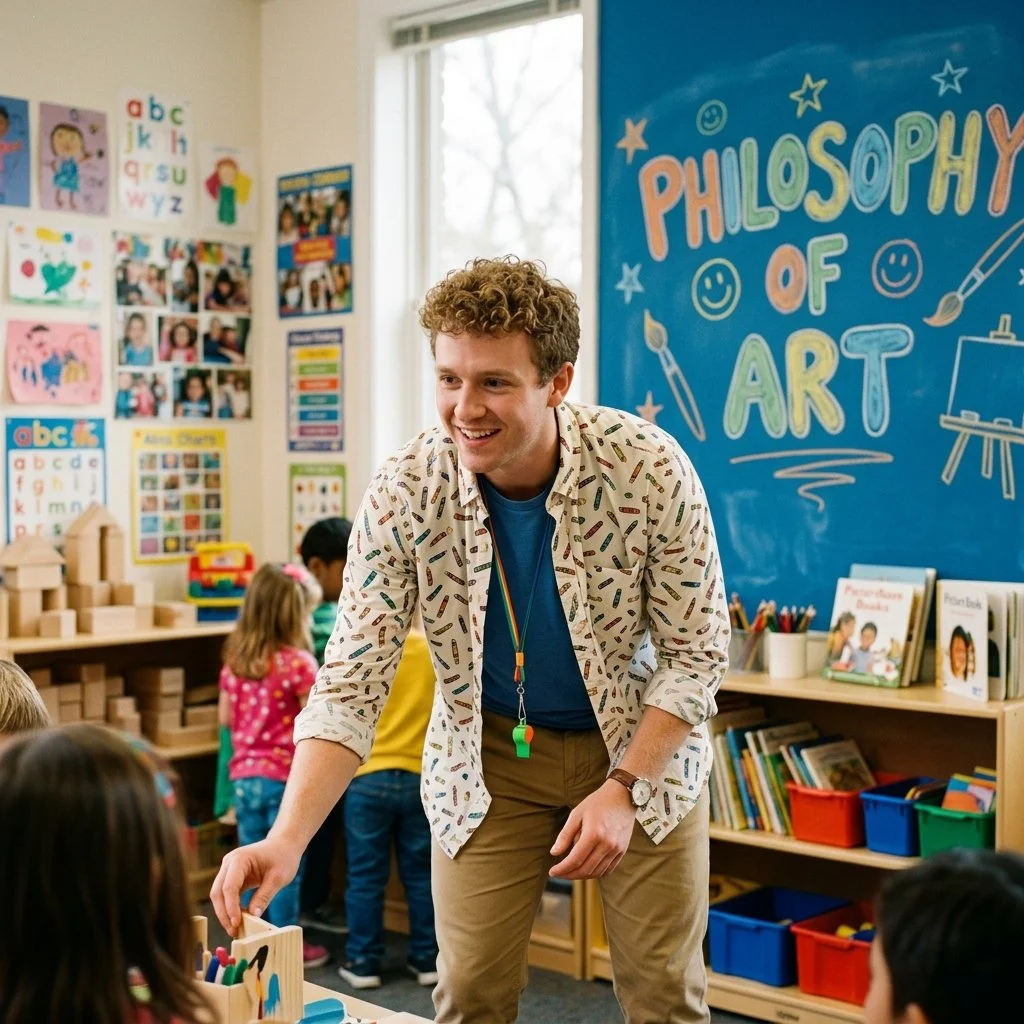
Philosophy of Art: Understanding Aesthetics in Early Childhood Education
Introduction: Why Philosophy of Art Matters for Preschool Teachers
As educators working with young children—especially those bursting with creative energy, who find joy in painting vibrant murals, dancing without inhibition, and singing at the top of their lungs—we need more than surface-level conversations about art. While locker room banter and water cooler small talk have their place, understanding the deeper philosophical foundations of art equips us to nurture genuine creativity and help children develop meaningful relationships with artistic expression.
This lesson explores the philosophy of art (also called aesthetics), providing you with intellectual tools to understand, appreciate, and facilitate artistic experiences in early childhood settings.
What is the Philosophy of Art?
Philosophy of art (or aesthetics) is the branch of philosophy that examines the nature of beauty, art, taste, and related phenomena. The term “aesthetics” comes from the Greek word aisthetikos, meaning “sensitive” or “perceptive.” While aesthetics broadly includes beauty in nature and everyday life, the philosophy of art specifically focuses on questions about art itself: What is art? What makes something art? How do we judge art? What is art’s purpose?
Major Philosophers and Their Contributions
Ancient Philosophy
Plato (428-348 BCE)
Core Idea: Art as imitation (mimesis)
Plato believed artworks were representations that imitate reality, but he was skeptical of art’s value
He argued that art is twice removed from truth: a painting of a bed imitates a physical bed, which itself imitates the ideal “Form” of a bed
Despite his skepticism, Plato established the foundational question: “What is art?”
Aristotle (384-322 BCE)
Core Idea: Art as catharsis and representation
Unlike his teacher Plato, Aristotle valued art for its ability to evoke emotional purification (catharsis)
He believed art could represent universal truths through particular instances
Emphasized that art serves important psychological and social functions
Enlightenment and Modern Philosophy
David Hume (1711-1776)
Core Idea: “Of the Standard of Taste”
Explored whether aesthetic judgments are subjective or objective
Argued that while taste varies, certain standards emerge through experienced critics
Introduced the idea that aesthetic judgment requires cultivation and refinement
Immanuel Kant (1724-1804)
Core Idea: Disinterested aesthetic experience
In his Critique of Judgment (1790), Kant revolutionized aesthetic philosophy
Argued that aesthetic judgments are “disinterested”—we appreciate beauty without wanting to possess or use the object
Distinguished between the “beautiful” (which pleases universally) and the “sublime” (which overwhelms us)
Claimed aesthetic judgments are subjective but demand universal agreement
Friedrich Schiller (1759-1805)
Core Idea: Art as play and human development
Believed art synthesizes different human drives (sensuous and rational)
Argued that aesthetic education is essential for human freedom and moral development
Saw play as the highest form of human activity, where art emerges
G.W.F. Hegel (1770-1831)
Core Idea: Art as the sensory manifestation of truth
Wrote extensive Lectures on Fine Art (over 1,200 pages)
Believed art reveals spiritual and historical truths
Argued that art evolves through history, reflecting the development of human consciousness
Saw art as one way (along with religion and philosophy) that humans understand absolute truth
Arthur Schopenhauer (1788-1860)
Core Idea: Art as escape from suffering
Influenced by both Kant and Indian philosophy
Believed aesthetic experience temporarily suspends the will, providing relief from life’s suffering
Saw art as offering glimpses of eternal forms beyond individual existence
Friedrich Nietzsche (1844-1900)
Core Idea: Art as life affirmation
Rejected the idea of disinterested aesthetic experience
In The Birth of Tragedy, distinguished between Apollonian (order, form) and Dionysian (chaos, emotion) elements in art
Believed art is essential for making life bearable and meaningful
Saw artistic creation as an expression of vital life forces
20th Century Philosophy
John Dewey (1859-1952)
Core Idea: Art as experience
In Art as Experience (1934), argued that art is not separate from everyday life
Believed aesthetic experiences occur when we are fully engaged with our environment
Emphasized that art-making and art-appreciation are continuous with ordinary experience
Particularly relevant for early childhood education: children’s play and exploration are aesthetic experiences
Martin Heidegger (1889-1976)
Core Idea: Art reveals truth
In “The Origin of the Work of Art,” argued that art discloses new worlds
Believed artworks “set up a world” and reveal aspects of being previously hidden
Art is not merely representation but a way truth happens
Walter Benjamin (1892-1940)
Core Idea: Art in the age of mechanical reproduction
Explored how technology changes art’s nature and function
Introduced the concept of “aura”—the unique presence of an original artwork
Examined how mass reproduction affects art’s authenticity and political potential
Theodor Adorno (1903-1969)
Core Idea: Art’s autonomy and social critique
Critiqued the commodification of art in capitalist society
Believed genuine art resists easy consumption and challenges social norms
Argued that art’s difficulty and autonomy are sources of its critical power
Arthur Danto (1924-2013)
Core Idea: The artworld and institutional theory
Asked why Marcel Duchamp’s urinal (Fountain, 1917) is art while ordinary urinals are not
Argued that something becomes art through the “artworld”—the network of artists, critics, museums, and theories
Emphasized that art requires interpretation within a cultural context
Defining Art: Multiple Approaches
1. Representational/Mimetic Theory
Art imitates or represents reality. A portrait represents a person; a landscape painting represents nature. This ancient view (from Plato and Aristotle) dominated for centuries but struggles to explain abstract art or music.
2. Expression Theory
Art expresses emotions or inner states of the artist. When a child paints with angry red strokes, they’re expressing frustration. This Romantic view (popularized in the 19th century) emphasizes authenticity and emotional truth.
3. Formalist Theory
Art is defined by its formal properties—line, color, shape, composition, rhythm. Clive Bell argued that art possesses “significant form” that evokes aesthetic emotion regardless of what it represents. This explains why abstract art can be powerful.
4. Aesthetic Theory
Art is whatever produces aesthetic experiences—experiences of beauty, pleasure, or heightened perception. This view connects art to the subjective experience of the viewer.
5. Institutional Theory
Art is whatever the artworld (artists, critics, museums, galleries) designates as art. This explains how a urinal in a gallery can be art while one in a bathroom is not. Context and social recognition matter.
6. Functional Theory
Art serves specific purposes: communication, ritual, social cohesion, political commentary, or entertainment. This view emphasizes what art does rather than what it is.
7. Historical/Narrative Theory
Art is defined by its relationship to art history. New artworks respond to, challenge, or extend previous art. Arthur Danto argued that art requires a narrative context to be understood.
Types and Categories of Art
Commercial Art
Created primarily for commercial purposes: advertising, product design, illustration
Raises questions: Can commercial art be “fine art”? Does commercial purpose diminish artistic value?
Examples: Andy Warhol’s soup cans blur the line between commercial and fine art
Relevant for preschool: Children’s book illustrations are commercial art that shapes aesthetic sensibilities
Religious Art
Created for worship, spiritual contemplation, or religious instruction
Historically, much of the world’s greatest art was religious (cathedrals, icons, temple sculptures)
Raises questions: Does religious function enhance or limit artistic value?
Different from secular art in purpose but may share aesthetic qualities
Relevant for preschool: Children from diverse backgrounds bring different religious artistic traditions
Fine Art
Created primarily for aesthetic contemplation rather than practical use
Traditional categories: painting, sculpture, music, dance, theater, poetry
Modern expansion: photography, film, installation art, performance art, digital art
Folk/Craft Art
Traditional art forms passed through communities
Often functional (pottery, weaving, quilting) but with aesthetic dimensions
Challenges the fine art/craft distinction
Outsider/Naïve Art
Created by self-taught artists outside mainstream art institutions
Children’s art is sometimes compared to outsider art for its directness and lack of convention
Raises questions about training, sophistication, and authenticity
Judging Art: Objective vs. Subjective
The Subjectivist Position
Claim: Aesthetic judgments are purely subjective—“beauty is in the eye of the beholder”
Arguments for:
People genuinely disagree about what’s beautiful or good art
Taste varies across cultures and individuals
There’s no scientific way to prove one artwork is better than another
Aesthetic experience is personal and emotional
Problems:
If all judgments are equally valid, art criticism and education seem pointless
We do seem to make meaningful distinctions (great art vs. mediocre art)
Some judgments seem clearly wrong (calling a child’s scribble equal to Picasso)
The Objectivist Position
Claim: Aesthetic judgments can be objectively true or false
Arguments for:
Experts generally agree about which works are masterpieces
Some artworks have stood the test of time across cultures
We can give reasons for aesthetic judgments (composition, technique, originality, emotional depth)
Art education assumes some judgments are better than others
Problems:
What makes an aesthetic property “objective”?
Disagreement persists even among experts
Standards change historically (many now-famous artists were rejected in their time)
Middle Positions
Kant’s Solution: Aesthetic judgments are subjective (based on feeling) but claim universal validity. When I say “this is beautiful,” I’m not just reporting my feeling—I’m claiming everyone should agree, even though I can’t prove it.
Hume’s Solution: While taste is subjective, some judges are better than others. Experienced critics with refined sensibilities, free from prejudice, establish standards of taste.
Contextualist Solution: Judgments are objective within a context (culture, tradition, artworld) but not absolutely. Renaissance standards differ from contemporary standards, but within each context, some judgments are better than others.
Pragmatic Solution: Focus on what judgments do rather than whether they’re “true.” Good criticism enriches experience, opens new perspectives, and facilitates understanding—regardless of absolute truth.
Relevance for Early Childhood Education
Understanding philosophy of art transforms how we approach creativity with young children:
Multiple Definitions Matter: If art can be expression, representation, formal exploration, or play, then children’s diverse creative activities all count as legitimate art-making.
Process vs. Product: Dewey’s emphasis on art as experience validates focusing on children’s creative process rather than finished products.
Subjective/Objective Balance: We can honor children’s subjective experiences while also teaching them to observe, describe, and appreciate formal qualities.
Cultural Contexts: Understanding that art definitions vary across cultures helps us respect diverse artistic traditions in our classrooms.
Beyond Beauty: Knowing that art isn’t just about beauty frees us to value experimental, messy, unconventional child art.
Emotional Expression: Expression theory validates using art for emotional development and communication.
Play as Art: Schiller’s connection between play and art elevates children’s natural activities to philosophical significance.
Democratic Aesthetics: Dewey’s democratic approach means every child has aesthetic capacity worth developing, not just “talented” ones.
Conclusion
The philosophy of art provides intellectual depth that enriches our work with creative young children. When a four-year-old covers himself in paint and dances, he’s not just making a mess—he’s engaging in the ancient human activity of aesthetic expression that philosophers have pondered for millennia. When children argue about whether a block tower is “good,” they’re entering debates about aesthetic judgment that continue in philosophy departments today.
By understanding these philosophical foundations, we move beyond superficial conversations about art to meaningful engagement with creativity’s role in human development and flourishing. We become not just supervisors of art activities but facilitators of aesthetic experience and guides in children’s philosophical exploration of beauty, expression, and meaning.
Discussion Questions
Answer each question in one paragraph or more, drawing on the lesson content and your own experiences and reflections.
How does Plato’s skepticism about art as “imitation” apply to children’s artwork? Are children imitating reality, or doing something else?
Kant argued that aesthetic judgment is “disinterested”—we appreciate beauty without wanting to use or possess the object. Do young children experience art this way, or is their engagement more interested and personal?
Compare Schopenhauer’s view (art as escape from suffering) with Nietzsche’s view (art as life affirmation). Which better describes what happens when children engage in creative activities?
John Dewey believed art is continuous with everyday experience rather than separate from it. How does this apply to a preschool classroom where play, exploration, and art-making blend together?
If art can be defined as expression, why might it be important for boys in early childhood settings to have access to expressive activities like painting, dancing, and singing?
The institutional theory says something is art if the artworld says it is. In a preschool classroom, who decides what counts as art? The teacher? The children? Parents? Does it matter?
Discuss the difference between commercial art and fine art. When children see advertisements, cartoons, and product designs, how does this shape their understanding of what art is?
Religious art has historically been central to many cultures. How should early childhood educators approach religious artistic traditions in diverse classrooms?
Take a position on whether aesthetic judgments are objective or subjective, and defend it using examples from working with young children.
Hume argued that some judges have better taste than others due to experience and refinement. Does this mean some people are better at judging children’s art? How do we balance expertise with respect for children’s creative autonomy?
If beauty is subjective, can we teach children about beauty? What would aesthetic education look like if all judgments are equally valid?
Formalist theory focuses on formal properties like line, color, and shape. How can teachers help children notice and appreciate these formal qualities in their own and others’ work?
Expression theory emphasizes emotional authenticity. How do we create classroom environments where children feel safe expressing difficult emotions through art?
Walter Benjamin worried that mechanical reproduction diminishes art’s “aura.” When children’s artwork is photographed, photocopied, or digitally shared, does something get lost?
Theodor Adorno believed art should resist easy consumption and challenge norms. Should children’s art be challenging and difficult, or accessible and pleasing?
Arthur Danto argued that art requires interpretation within a cultural context. How do we help children develop interpretive skills without imposing adult meanings on their work?
Compare representational, abstract, and non-objective art. Should preschool teachers encourage all three approaches, or focus on representation since it’s more developmentally appropriate?
Discuss the relationship between craft (functional objects) and fine art (aesthetic objects). When children make a clay bowl, is it craft or art? Does the distinction matter?
Nietzsche distinguished between Apollonian (ordered, rational) and Dionysian (chaotic, emotional) elements in art. How do both appear in children’s creative activities?
If art’s purpose is catharsis (Aristotle), how might creative activities help children process difficult experiences or emotions?
Hegel believed art reveals historical and spiritual truths. What truths might children’s art reveal about their developmental stage, culture, or inner life?
Schiller argued that aesthetic education is essential for human freedom. How does engaging with art contribute to children’s developing autonomy and freedom?
Consider a child who insists their scribble is “better” than a classmate’s detailed drawing. How do you respond in a way that’s philosophically sound?
Discuss the role of technique and skill in art. Should preschool teachers focus on developing technical skills, or is spontaneous expression more important?
How does understanding philosophy of art change how you might set up an art area in a preschool classroom?
If art is about aesthetic experience (feeling, perception, emotion), how do we assess or evaluate children’s artistic development?
Compare how different philosophers would evaluate the same piece of children’s art. What would Plato notice? Kant? Dewey? Nietzsche?
Outsider art and children’s art share certain qualities (directness, lack of convention, authenticity). What can adults learn from children’s unselfconscious approach to art-making?
Many early childhood programs emphasize STEM education. Using philosophical arguments, make a case for why art education is equally important.
Reflect on your own aesthetic education. What messages did you receive about art, beauty, and creativity? How might philosophical understanding help you avoid passing on limiting beliefs to children?
Essay Assignment
Length: 1,500 words
Prompt:
Drawing on the philosophical theories and thinkers discussed in this lesson, develop an argument about the role of art in early childhood education. Your essay should:
Clearly articulate a thesis about why art matters (or doesn’t matter) in preschool settings
Engage with at least three philosophers or philosophical theories from the lesson
Address the question of whether aesthetic judgments are objective or subjective, and what this means for teaching
Consider how your philosophical position translates into practical classroom approaches
Reflect on the specific context of working with young boys who are drawn to creative, expressive activities
Your essay should demonstrate understanding of philosophical concepts while also connecting them to real-world educational practice. Consider questions like: What is the purpose of art in early childhood? Should we teach children about “good” art and “bad” art? How do we balance freedom of expression with aesthetic education? What does it mean to support children’s creativity?
Use specific examples from your experience or observation when possible. Your argument should be clear, well-organized, and supported by philosophical reasoning.
Sample Essay
Title: Beyond Finger Painting: Why Dewey’s Aesthetic Philosophy Should Transform Early Childhood Education
In most preschool classrooms, art time means twenty minutes of controlled chaos: children smearing paint, gluing random objects, and producing work that gets politely displayed before being recycled. Art is treated as a break from “real” learning—a way to develop fine motor skills or keep children occupied. This utilitarian approach misses something profound. Drawing primarily on John Dewey’s philosophy of art as experience, supplemented by Schiller’s theory of play and Nietzsche’s concept of life affirmation, I argue that aesthetic experience should be central to early childhood education, not peripheral. Art is not a break from learning; it is learning in its most complete form. This philosophical reorientation has practical implications for how we structure classrooms, especially for boys whose energetic, expressive creativity often gets channeled into narrow, acceptable forms.
John Dewey’s Art as Experience (1934) revolutionizes how we should think about art in education. Dewey rejected the museum-based conception of art as precious objects created by special people called artists. Instead, he argued that aesthetic experience occurs whenever we are fully engaged with our environment, when action and perception merge into a unified, meaningful whole. A child building a block tower, adjusting and readjusting until it feels right, is having an aesthetic experience. A child mixing colors until achieving the exact shade of purple they envision is engaged in aesthetic inquiry. These are not preparation for future art-making; they are complete aesthetic experiences in themselves.
This philosophical position directly challenges how most early childhood programs operate. We typically separate “art time” from “learning time,” implying that cognitive development happens during literacy and math activities while art is recreational. But Dewey argued that aesthetic experience involves the fullest integration of thinking, feeling, and doing. When a four-year-old experiments with how much water makes paint flow versus drip, he is engaged in scientific inquiry, but it is aesthetic inquiry—motivated by the desire to achieve a particular visual effect, guided by perception and feeling. The child is not applying pre-learned concepts; he is thinking through materials, learning through aesthetic problem-solving.
For boys in early childhood settings, this Deweyan approach is particularly important. Research consistently shows that boys are more likely to be disciplined for active, physical, expressive behavior. A boy who wants to paint with his whole body, who dances while he draws, who makes explosion sounds while sculpting, is often redirected toward “appropriate” behavior—sitting still, staying clean, being quiet. But Dewey’s philosophy suggests that this embodied, energetic engagement is not a problem to be managed but aesthetic experience in its most vital form. The boy is not failing to do art properly; he is integrating movement, sound, and visual creation into a unified experience. Our job is not to constrain this energy but to provide materials, space, and time for it to develop into increasingly refined aesthetic expression.
This connects to Friedrich Schiller’s argument that play is the highest form of human activity and the source of art. Schiller believed that humans have both a sensuous drive (toward physical experience and feeling) and a formal drive (toward order and meaning). Art emerges when these drives synthesize in play. A child is neither purely following impulses nor purely following rules; he is creating his own rules through playful experimentation. When we interrupt this play to impose adult standards—“paint on the paper, not the table,” “use the brush correctly,” “make something recognizable”—we prevent the very synthesis that produces genuine aesthetic development.
Schiller’s theory helps us understand why boys’ creative play often looks chaotic to adults. A boy who turns the art area into a “paint factory,” who creates elaborate narratives while drawing, who collaborates with friends to build a massive cardboard structure, is engaged in the kind of play-based aesthetic activity Schiller described. This is not art plus play; it is art as play, the fundamental human activity through which we integrate different aspects of ourselves. Early childhood educators must resist the temptation to over-structure art activities in ways that eliminate play. The goal is not to produce displayable products but to facilitate the playful aesthetic experiences through which children develop.
Friedrich Nietzsche’s philosophy adds another dimension. Nietzsche rejected the idea that art should be disinterested contemplation (Kant’s view) or escape from suffering (Schopenhauer’s view). Instead, he saw art as life affirmation—a way of saying “yes” to existence in all its chaos and intensity. Art does not distance us from life; it intensifies life. This perspective is crucial for understanding young children’s art, which is rarely calm or contemplative. Children’s art is loud, messy, physical, and excessive. A boy who uses every color, who layers paint until it becomes mud, who creates monsters and explosions and crashes, is not making “bad” art—he is affirming life’s intensity through aesthetic means.
Nietzsche distinguished between Apollonian art (ordered, beautiful, rational) and Dionysian art (chaotic, emotional, physical). Western art education has historically privileged the Apollonian: neat, controlled, representational work. But Nietzsche argued that great art requires both elements. Early childhood is perhaps the last time in most people’s lives when Dionysian creativity is permitted. Boys especially—who are often more physical and less willing to conform to quiet, controlled behavior—need opportunities for Dionysian aesthetic expression. This does not mean abandoning all structure, but it means valuing energetic, chaotic, physical creativity as legitimate aesthetic activity, not as something to be outgrown.
These philosophical positions inform how we should approach the question of aesthetic judgment in early childhood education. The debate between objectivism (some art is objectively better) and subjectivism (all aesthetic judgments are equally valid) has practical implications. If we adopt pure subjectivism—“all children’s art is equally good”—we eliminate the possibility of aesthetic education. There is nothing to teach, no development to facilitate. But if we adopt pure objectivism—“some children’s art is objectively better”—we risk crushing children’s confidence and imposing adult standards inappropriately.
Dewey offers a middle path. Aesthetic judgments are not arbitrary (pure subjectivism) but neither are they absolute (pure objectivism). Instead, judgments are better or worse based on whether they enrich experience, open new possibilities, and facilitate growth. A teacher’s response to children’s art should not be “that’s beautiful” (which ends conversation) or “that’s not very good” (which discourages). Instead: “Tell me about this,” “What were you trying to do?”, “What happened when you mixed those colors?”, “How did you make this part?” These responses treat the child as engaged in aesthetic inquiry worth taking seriously. We are not judging the product against external standards but helping the child reflect on their own aesthetic experience and develop it further.
This approach has practical implications. First, we need longer, less structured art periods. Dewey’s aesthetic experiences cannot be rushed or scheduled into fifteen-minute blocks. Children need time to experiment, make mistakes, start over, and develop ideas. Second, we need richer materials. If art is aesthetic inquiry, children need materials that respond in complex ways—real paint, not just markers; clay, not just playdough; wood and tools, not just pre-cut shapes. Third, we need to value process over product. Documentation should capture children’s engagement and problem-solving, not just finished work. Fourth, we need to integrate art with everything else. If aesthetic experience is about full engagement with the environment, then art should not be isolated but should permeate science, literacy, mathematics, and social studies.
For boys specifically, this means creating space for large-scale, physical, collaborative, and narrative-driven art. Instead of individual paintings at easels, offer mural-making, construction projects, performance art, and multimedia installations. Allow noise, movement, and mess. Recognize that a boy who paints while dancing is not distracted from art—he is integrating movement and visual creation in a unified aesthetic experience. Value aggressive, chaotic, intense themes not as problems but as legitimate aesthetic content. A painting of a battle or explosion is not less valuable than a painting of flowers; it is a different form of life affirmation.
Some will object that this approach is impractical—too messy, too chaotic, too difficult to manage. But this objection assumes that the purpose of early childhood education is classroom management, not child development. If we take seriously the philosophical claim that aesthetic experience is central to human flourishing, then we must organize classrooms around facilitating such experience, even when it is inconvenient. Others will object that this approach does not prepare children for elementary school, where they will need to sit still and follow directions. But this objection assumes that early childhood should be primarily preparation for later schooling rather than valuable in itself. Dewey argued that education is not preparation for life; it is life. Preschool should not be about preparing for first grade; it should be about rich, meaningful experience now.
In conclusion, philosophy of art—particularly Dewey’s conception of art as experience, Schiller’s theory of play, and Nietzsche’s idea of art as life affirmation—provides a powerful rationale for centering aesthetic experience in early childhood education. Art is not a supplement to real learning; it is learning in its most integrated and meaningful form. For boys whose creativity is often constrained by narrow expectations, this philosophical reorientation is especially important. By understanding art philosophically, we move beyond finger painting and craft projects to genuine aesthetic education that honors children’s capacity for meaningful, expressive, life-affirming engagement with the world. This is not just about making better art; it is about living more fully, which is ultimately what education should facilitate.
What is Art?
A Special Lesson for Young Artists (Ages 4-7)
Let’s Think About Art
Read this story together:
Hi, friends! My name is Mr. Jackson, and I teach art to kids just like you. Every year, children ask me the same big question: “What is art?”
That’s a wonderful question! Let’s think about it together.
Art is when we create something or do something that shows our feelings, ideas, or imagination. Art can be many different things:
Pictures we make, like paintings, drawings, or sculptures
Music and songs, when we sing or play instruments
Dancing and moving, when our bodies tell a story
Stories and poems, when we use words to create pictures in people’s minds
Things we build, like block towers, sandcastles, or structures made from boxes
Here’s something really cool: Art is how we share what’s inside us with the world.
People have been asking “What is art?” for thousands of years. Some people think art should look like real things, like a painting of a dog that looks exactly like a real dog. Other people think art is about showing feelings, like painting with angry red colors when you’re mad, or happy yellow colors when you’re excited.
Here’s the most important thing I can tell you: Everyone can be an artist. You don’t have to be grown-up. You don’t have to be perfect. You just have to create something that comes from you.
Some people ask: “Is my art good?” That’s a tricky question. Art isn’t like math where 2+2 always equals 4. With art, different people like different things. Your mom might love your painting, but your brother might not understand it. That’s okay. What matters most is:
Did you enjoy making it?
Does it show something about you?
Did you try your best?
One more thing: Art doesn’t have to be pretty. It can be silly, scary, messy, loud, quiet, colorful, or even all black and white. Art can be anything you want it to be.
So next time you paint, dance, sing, build, or create, remember: You are an artist, and what you make is art.
Questions to Think About and Talk About
Instructions for grown-ups: Read these questions with your child. Let them answer in their own words. They can tell you their answers, draw pictures, or even act them out. There are no wrong answers. These questions help children think deeply about creativity.
Questions About You and Art:
What is your favorite kind of art to make? Drawing? Painting? Dancing? Singing? Building? Something else?
How do you feel when you’re making art? Happy? Calm? Excited? Silly? Something else?
Tell me about something you made that you’re really proud of. What was it? Why do you like it?
Do you like to make art by yourself, or with friends? Why?
What colors do you use when you’re happy? What about when you’re sad or angry?
Questions About What Art Is:
Is a sandcastle art? Why or why not?
If you dance and nobody sees it, is it still art?
Can a song be art even if it doesn’t have words?
Look around the room. Can you find three things that someone made? Are those things art?
If you scribble really fast without thinking, is that art? What if you think really hard and draw very carefully, is that art?
Questions About Feelings and Ideas:
Can art tell a story without using any words? How?
If you painted a picture of how you feel right now, what would it look like?
Can you make “angry art”? What would that look like or sound like?
Can you make “silly art”? Show me.
If you could paint your dream from last night, what colors would you use?
Questions About Other People’s Art:
When you look at someone else’s art, how do you know what they were feeling?
Have you ever seen art that you didn’t like? That’s okay. Why didn’t you like it?
Have you ever seen art that made you feel something special? What was it? How did it make you feel?
If your friend makes something and says “This is art,” do you think it’s art? Why or why not?
Can two people look at the same painting and see different things?
Questions to Make You Think Hard:
Is a beautiful sunset art? Remember: nobody made the sunset, it just happens.
If you accidentally spill paint and it looks cool, is that art?
Can you make art with your voice? With your body? With your hands? What else?
Does art have to be beautiful, or can it be ugly and still be art?
If you make something just for fun and don’t show anyone, is it still art?
Questions About Being an Artist:
Do you think you’re an artist? Why or why not?
Can grown-ups be artists? Can babies be artists? Can animals be artists?
What makes someone an artist: making art every day, or just making art sometimes?
If someone says your art is “wrong,” what would you say to them?
What do you want to create tomorrow?
Special Activity: Make Your Own “What is Art?” Book
You will need:
Paper (5-10 sheets)
Crayons, markers, or colored pencils
Stapler (ask a grown-up to help)
Instructions:
Page 1 (Cover): Write “What is Art? By [Your Name]” and decorate it however you want.
Page 2: Draw your favorite kind of art to make.
Page 3: Draw how you feel when you make art. Use colors and shapes to show the feeling.
Page 4: Draw or describe something you made that you’re proud of.
Page 5: Draw what “happy art” looks like to you.
Page 6: Draw what “silly art” looks like to you.
Page 7: Draw yourself as an artist. What are you making?
Page 8 (Back Cover): Finish this sentence: “Art is…” You can draw your answer or have a grown-up write your words.
Ask a grown-up to staple your pages together. Now you have your very own book about art.
Drawing Prompt: “My Philosophy of Art”
What to do:
Draw a picture that shows your answer to the question: “What is art?”
You can draw:
Yourself making art
Different kinds of art (painting, dancing, singing, building)
How art makes you feel
What you think art means
Anything else that answers the question
Remember: There’s no wrong answer. This is your idea about art.
When you’re done, tell someone about your drawing. Explain what you drew and why. You can also write (or have someone write for you): “Art is ___________.”
Bonus: Philosophy Questions for Families
Discuss these together at dinner or bedtime:
“If everyone in the world made art about the same thing (like a tree), would all the art look the same? Why or why not?”
“Can you make art out of anything? What about trash? What about food? What about snow?”
“Is there art in nature, or do people have to make art?”
“If a robot painted a picture, would it be art?”
“What’s more important: making art that other people like, or making art that you like?”
Remember, Young Philosophers:
You are an artist.
Your ideas matter.
Art is for everyone.
There are no wrong answers when you’re creating.
Keep making, keep thinking, keep creating.
Now go make some art.