
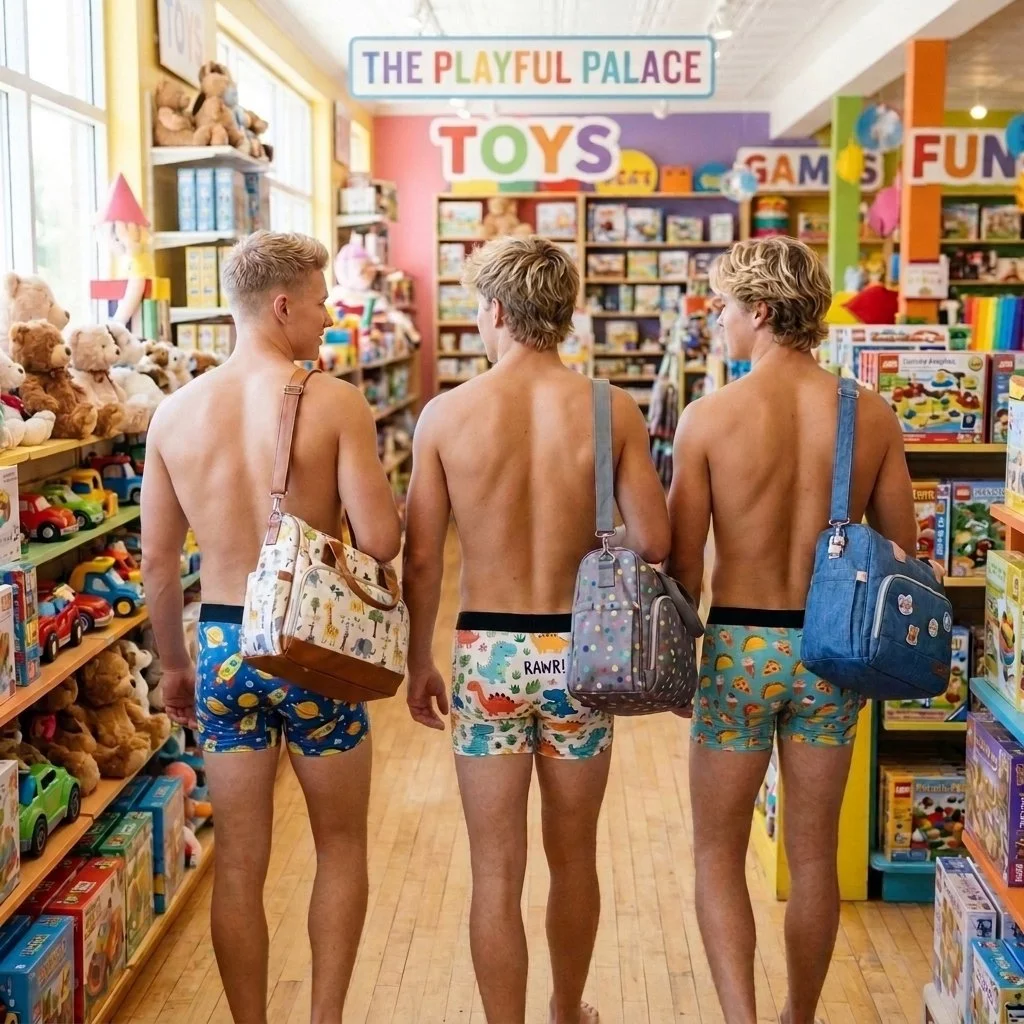
Mitchell isn’t just a toddler—he’s a visionary in the field of toy logistics, a rising mogul in the world of plastic empires. His approach to play isn’t for leisure or simple joy. No, this is business. Rubber duck negotiations. Block tower engineering. And under no circumstances can he afford to treat his inventory with anything less than the obsessive, all-encompassing seriousness it deserves. Your role, as Mitchell’s handler, is to craft a 1500-word tactical plan ensuring that by the end of this initiative, he isn’t just playing—he’s mastering.
This essay must outline the following:
Section I (300 words) — The Case for Toy Immersion: Why absolute dedication to his toys isn’t just a phase, but a non-negotiable first step in his career dominance. Explore the psychological, developmental, and (if you’re feeling bold) economic implications of grooming Mitchell for Toy Expert status. Bonus points for hyperbolic stats about how 110% of toddlers in the Toy Hall of Fame played like their lives depended on it by age three.
Section II (500 words) — The Tactical Playbook: Lay out your precise strategy for Mitchell’s professional growth. This should include:
Morning rubber duck audits (Are they squeaking tightly on-brand?)
High-stakes block-testing events (Can we maximize tower efficiency while minimizing meltdowns?)
Toy rotation schedules strict enough to rival Olympic training regimens.
Bonus creativity points for any mention of performance metrics like "Blocks Per Minute" or "Stuffed Animal Stock Diversification Index."
Section III (400 words) — Risk Mitigation and Resilience: Toddlers are notoriously tough recruiters. Discuss potential risks—burnout, misplaced loyalty to one specific unicorn figurine, or the horror of a toy-surplus meltdown—and propose solutions. Explain how you intend to prevent Mitchell from going rogue and retiring prematurely into snack-based distractions.
Section IV (300 words) — Outcome and Forecasts: What does success look like? Paint the picture of a toddler who’s obsessed with his craft to the point where you’re considering drafting a resume for Kid CEO of the Decade. If he doesn’t knock his plush animal negotiations out of the park, have contingencies ready—because failure is not in the cards... unless they’re flashcards about toy trivia.
Sample Reference Essay:
Title: Mitchell’s Toy Domination Plan (How One Toddler Built an Empire, One Block at a Time)
Listen, it's not every day you meet a toddler cut out for greatness, so when Mitchell smeared banana on his plastic laptop and declared his aspirations through something that sounded like "gah baa baah!" (we’re pretty sure he meant "corporate expansion"), I knew it was my time to shine as his handler. The mission is clear: transform Mitchell from a playroom dabbler to a bona fide Toy Expert. It’s not about whether he’ll dominate block architecture—it’s about how efficiently he’ll crush the competition.
Step one? Immersion. Under the new schedule, Mitchell will begin each day with a Duck Squeak Compliance Drill. “But why ducks?” you ask. Oh, no big deal—just the historic linchpin of every successful toddler empire since, well, the dawn of rubber. When he’s not testing ducks for squeak physics, his afternoons are locked in for Block Olympics, a rigorous event inspiring both critical thinking and emotional resilience (mostly on my end). Execution is key—we’re talking color-coded storage, optimized shelf cycles, and hourly rotations so he never suffers the creative death that is Toy Ennui™.
Of course, no great success comes without risk. Toddler burnout is real, and I’ll be there to catch him should he suddenly abandon stuffed giraffe logistics to chase rogue crackers under the couch. This is where contingency planning earns its stripes. “No snack reigns over toys,” is our official motto, and snack rationing will ensure it stays that way.
By the end of this, Mitchell won’t just play—he’ll revolutionize the industry. My job isn’t just to manage his plastic stock portfolio. It’s to make sure one day, that plastic crown fits perfectly.
Good luck, handler. This mission could change lives... or at least, ensure ducks everywhere squeak under optimal conditions.
Instructions
Solve each problem below, showing all your work for full understanding and clarity. These questions are designed to combine mindfulness, yoga, and baseball themes into 10th-grade level math practice. Take your time, stay focused, and enjoy the process!
Mindfulness and Math
During a meditation session, a gong is struck every 3 minutes. If the session lasts 45 minutes, how many times is the gong struck?
A yoga retreat charges $120 per person for a day-long session. If 15 people sign up, what is the total revenue?
A rectangular yoga mat measures 6 feet in length and 2.5 feet in width. What is the area of the mat?
During a yoga class, the instructor holds a pose for 5 seconds longer with each new repetition. If they start at 20 seconds and repeat the pose 10 times, how long do they hold the final repetition?
On a calming walk, a person counts their steps at a consistent pace of 2 steps per second. If they walk for 12 minutes, how many steps do they take?
An individual practices yoga in the morning 4 times a week and meditates 3 times a week. Over 12 weeks, how many total mindfulness sessions do they complete?
A yoga studio places a discount of 25% on its $200 membership price during a promotional week. What is the discounted price?
During a breathing exercise, a participant inhales for 3 seconds and exhales for 6 seconds. If the pattern is repeated 20 times, how much total time is spent on the exercise?
A meditation app features a 30-day program. Each session increases in length by 2 minutes starting at 10 minutes on day 1. How long is the final session on day 30?
Someone tracks their heart rate during mindfulness practice. Their heart rate decreases by 2 beats per minute for 8 consecutive minutes, starting at 80 beats per minute. What is their heart rate at the end?
Yoga and Geometry
A circular yoga mat has a radius of 4 feet. What is the area of the mat? Use π ≈ 3.14.
A yoga studio plans to tile its square floor with dimensions of 20 ft by 20 ft. If each tile measures 2 ft by 2 ft, how many tiles are needed?
The angle of a triangle in a yoga logo measures 40°, and the second measures 50°. What is the measure of the third angle?
A yoga instructor arranges 12 mats in rows. If each row holds 4 mats, how many rows are there?
A triangular yoga pose logo has side lengths of 6 inches, 8 inches, and 10 inches. Prove it is a right triangle using the Pythagorean theorem.
Baseball and Math
A baseball player hits a ball that travels at a speed of 90 mph for 300 feet. How long does it take the ball to reach 300 feet?
A pitcher throws 25 pitches per inning. If they pitch for 7 innings, how many pitches do they throw in total?
The baseball field runs in a diamond shape where each side measures 90 feet and the bases form a square. What is the diagonal distance from home plate to second base?
A baseball bat is discounted by 15% from its original price of $150. What is the final price of the bat?
A foul ball is caught at a height of 3 meters and it falls to the ground. If the ball falls freely with acceleration g = 9.8 m/s², how long does it take to hit the ground?
Real-Life Applications in Baseball, Yoga, and Mindfulness
A yoga instructor spends 60% of a two-hour class focusing on poses and the rest on meditation. How many minutes are spent on poses?
A baseball game lasts for 3 hours and 30 minutes. If each inning takes about 18 minutes, how many innings typically occur in total?
A yoga festival hosts 120 people and provides lunch in food trays that each serve 8 people. How many food trays do they need?
The shadow of a baseball bat is 6 feet long, while the bat itself is 4 feet tall. If a player 5.5 feet tall stands nearby, how long is their shadow?
A yoga pose lasts 15 seconds longer for every level of difficulty it increases. If the easiest pose lasts 90 seconds and the hardest lasts 195 seconds, how many levels of difficulty are there?
A baseball player’s batting average is calculated as hits divided by total at-bats. If the player has 140 hits in 350 at-bats, what is their batting average? Express the result as a decimal rounded to three places.
A yoga mat has an original price of $75 but is on sale for 20% off. What is the sale price of the mat?
A baseball stadium sells drinks and each drink costs $3.50. If 3,200 drinks are sold in a game, what is the total revenue?
A yoga studio earns a revenue of $10,500 from 70 students. How much does each student pay, on average?
A baseball is thrown upward with an initial velocity of 15 m/s. How high does it go after 2 seconds? Use the formula s = ut + 0.5at², with a = -9.8 m/s².
Mitchell has 7 packs of diapers. Each pack contains 32 diapers. How many diapers does he have total? Show your work.
Mitchell plans to pack diapers for 7 days. If he uses 5 diapers per day, how many diapers does he need in total? Show your work.
Mitchell finds a sale where 2 diaper packs cost $18. How much does one pack cost? Show your work.
If Mitchell uses 4 wipes per diaper change and changes his baby 6 times a day, how many wipes does he need for a single day? Show your work.
Mitchell wants to prepare enough wipes for a week. Using your answer from Problem 4, calculate how many total wipes he needs. Show your work.
A diaper cream tube lasts for 15 days if Mitchell uses 10 grams per day. If the tube contains 150 grams, how many tubes does Mitchell need for a month (30 days)? Show your work.
A bottle of baby lotion contains 500 mL. If Mitchell uses 50 mL per week, how many weeks will one bottle last? Show your work.
Mitchell bought 3 250 mL bottles of baby body wash. If he uses 25 mL each time he bathes the baby and bathes the baby 4 times a week, how many weeks will the baby body wash last? Show your work.
A set of bibs costs $24 for a pack of 12. How much does each bib cost? Show your work.
Mitchell needs to pack one bib per day for a week. If he only has 8 bibs, how many more does he need to purchase? Show your work.
Each baby food jar costs $2.75. If Mitchell needs 14 jars for the week, how much does he spend in total? Show your work.
A baby bottle holds 240 mL, and Mitchell’s baby drinks four full bottles a day. How many milliliters of milk does the baby drink in a week? Show your work.
Mitchell buys a pack of 6 baby bottles for $36. What is the cost of each bottle? Show your work.
Each diaper weighs 200 grams. If Mitchell packs 35 diapers for the week, what is the total weight of the diapers in kilograms? Show your work.
Mitchell plans to buy pacifiers and gets a 20% discount on a $15 pack. What is the discounted price? Show your work.
Mitchell’s diaper bag weighs 4 kg without supplies. If Mitchell adds 8 kg of supplies, what is the total weight of the bag? Show your work.
Mitchell needs to pack clothes as well. If one outfit weighs 250 grams, how much will 7 outfits weigh in total? Show your work.
A baby blanket costs $40, but Mitchell has a $10 coupon. How much will he pay for the blanket? Show your work.
Mitchell buys a box of snacks that holds 20 individual packs. If the box costs $15, what is the cost per individual pack? Show your work.
If one snack pack weighs 120 grams, what is the total weight of 20 snack packs in kilograms? Show your work.
Mitchell plans to buy formula. Each can costs $35 and lasts 10 days. How much will he spend on formula for a 30-day month? Show your work.
If one can of formula makes 20 bottles, how many bottles will 3 cans make? Show your work.
A diaper costs 25 cents. How much will Mitchell spend on diapers for 7 days if the baby uses 5 diapers per day? Show your work.
Mitchell's baby uses 3 bibs per day. How many bibs are required for a week, and how many washes should he plan if he washes 6 at a time? Show your work.
A portable changing mat costs $22. If there’s a 15% discount, how much will Mitchell pay? Show your work.
Mitchell packs 4 toys, each weighing 0.5 kg. What is the total weight of the toys in kilograms? Show your work.
If Mitchell spends $50 on baby items this week and 30% of the cost was spent on diapers, how much did he spend on diapers? Show your work.
Mitchell buys a diaper bag that is 20% heavier than his old one, which weighed 2 kg. What is the weight of the new diaper bag? Show your work.
Mitchell’s baby uses a pacifier every 2 hours. If there are 24 hours in a day, how many pacifiers does Mitchell need to pack per day? Show your work.
A tube of baby rash cream costs $8.50 and lasts 14 days. How much does Mitchell spend per day on rash cream? Show your work.
GYM
Warm-Up (15 minutes)
Preparing your body for an intensive workout is essential. Start with light movement to gently elevate your heart rate and warm up your muscles.
5 minutes of light jogging or brisk walking on a treadmill to increase circulation and ease into physical activity.
5 minutes of dynamic stretching, such as leg swings for hip mobility, high knees for activating your core, and arm circles to loosen shoulder joints.
Complete with 5 minutes of jumping jacks or jump rope to further raise your heart rate and prepare for cardio.
Cardio Interval Training (60 minutes)
This segment builds endurance, boosts cardiovascular capacity, and enhances athletic performance through focused bursts of energy.
Treadmill Intervals
5 minutes at a moderate pace to find your rhythm.
Sprint for 1 minute followed by 2 minutes of recovery walking or slow jogging (repeat 8 times).
Rowing Machine Intervals
1 minute of intense rowing to engage upper and lower body muscles.
Recover with 2 minutes of steady, moderate rowing (repeat 6 times).
Core & Stability Focus (30 minutes)
A strong core leads to better balance, posture, and overall athleticism. Engage your core with these carefully selected movements.
3 sets of 20 Russian twists (use a weight for an extra challenge).
Plank holds for 1 minute followed by 30 seconds of rest (repeat 5 times to test endurance).
3 rounds of hanging leg raises for 10 reps to improve abdominal strength.
End with mountain climbers for 45 seconds, then take a 15-second rest (complete 4 dynamic sets).
Full-Body Cardio Circuits (90 minutes)
Tailored to improve total-body strength, endurance, and explosive power, these circuits provide a high-energy challenge.
Circuit 1 (Repeat 3 times)
Burpees (12 reps): An all-in-one exercise targeting your full body.
Kettlebell swings (15 reps): Builds power in your hips and core.
Box jumps (15 reps): Strengthens your legs and improves explosiveness.
Rest for 2 minutes before repeating.
Circuit 2 (Repeat 3 times)
Battle ropes (30 seconds): Great for upper-body endurance.
Push-ups (15 reps): Classic for chest and tricep strength.
Jump squats (12 reps): Develops lower-body power.
Rest for 2 minutes.
Circuit 3 (Repeat 2 times)
Deadmill sprints (30 seconds): Push against a powered-down treadmill to mimic a sled-push movement.
Dumbbell snatches (8 reps per arm): Strengthens total-body coordination and power.
Jump lunges (20 total reps): Builds leg strength and stability.
Rest for 2 minutes.
Cool Down & Stretching (15 minutes)
Allow your body to recover and prevent soreness with proper cool down and stretching.
5 minutes of light walking to gradually bring down your heart rate.
5 minutes of static stretching, emphasizing quads, hamstrings, glutes, and shoulders to maintain flexibility and encourage recovery.
End the session with 5 minutes of deep breathing and relaxation exercises to promote a sense of calm and mindfulness after an intense workout.
Tips for Success
Listen to your body and adjust intensity based on your stamina and fitness level.
Prioritize form over speed or weight to reduce the risk of injury.
Stay hydrated throughout the workout, and refuel with a healthy snack or meal post-workout to aid in recovery and muscle repair.