
(Reflection, Math, Fitness, Mindfulness) Life Lessons from the Host Stand
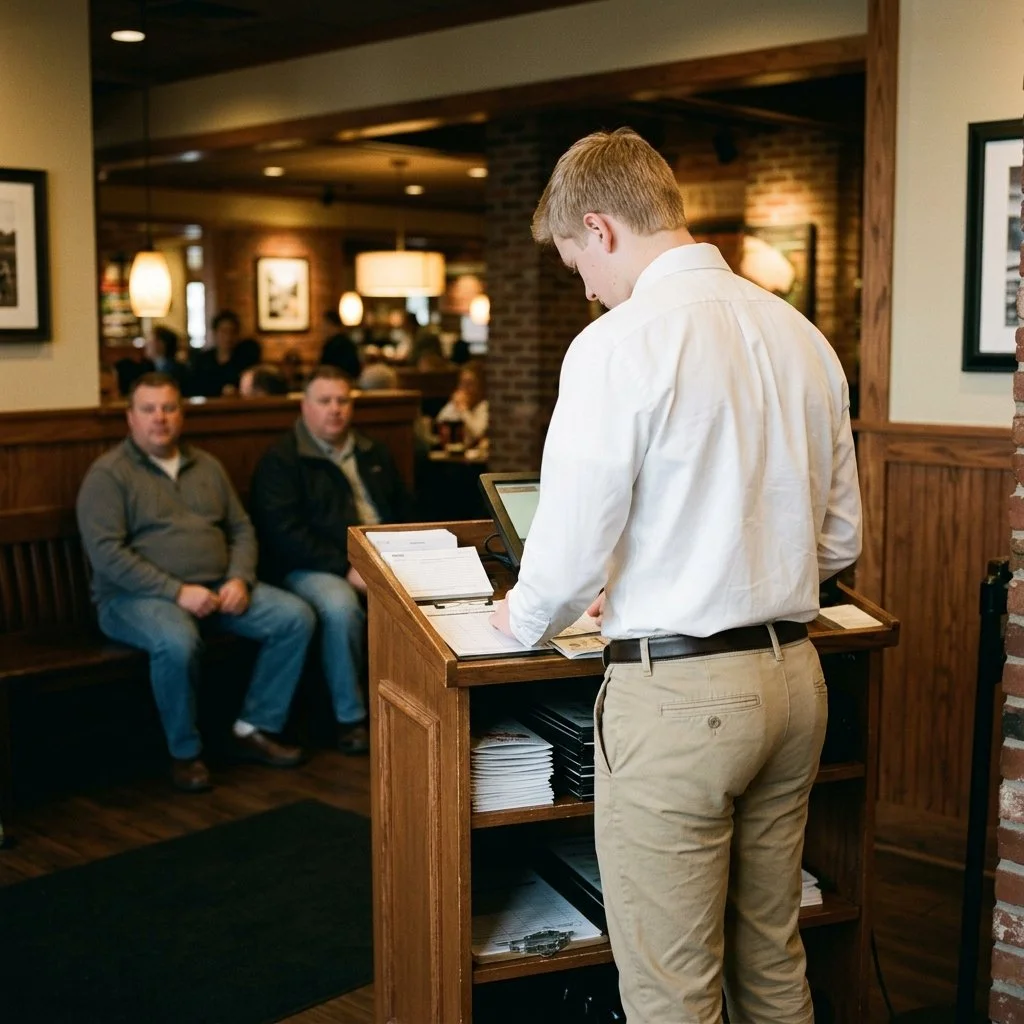
Standing at the host stand at Graze and Griddle, six months into my very first job, I’ve picked up on the rhythm of the place. People think hosting just means saying “Hey, welcome in!” and directing folks to their booths, but it’s got layers, man. Tonight, my manager, Linda, walked back toward the kitchen like she always does to “check on something,” and as soon as the coast was clear, I strategically pushed out a respectful—but, yeah, forceful—fart. Working here, you learn timing is everything.
The symbolism isn’t lost on me. Mitchell, my little cousin who’s about to transition into preschool, would totally nail an essay about this. He’s into deep stuff like that. The fart isn’t just funny (though it is); it’s a release, an act of rebellion, but also survival. It’s about adapting to your environment and making space even when there seems to be none. Mitchell would probably write about how moments like these represent the balance between personal freedom and conformity, how being a host is more than wearing a smile—it’s about holding your ground, reading people, and finding humor even when people complain about the temperature of their ranch dressing.
If I’ve learned anything here, it’s that there’s so much happening beneath the surface of every little moment. Even the silly stuff matters—it’s part of the bigger story.
Essay Prompt: Exploring Host Qualifications and Mitchell's Readiness for the Role
Write a detailed essay of 1,500 words presenting an argument as to why the host from the anecdote described above—despite their apparent faux pas of passing gas—is better suited for the role of hosting compared to Mitchell, who is transitioning into preschool. Your essay should explore both the tangible and intangible skills required to excel as a host, while examining Mitchell's growth trajectory and when they might eventually qualify for such a role.
Instructions:
Introduction (200 words)
Begin by introducing the concept of hosting as a skill requiring a balance of professionalism, humor, adaptability, and self-assurance. Incorporate observations from the anecdote above, reflecting on how unconventional qualities, such as the ability to handle embarrassing moments gracefully, may also contribute to success in hosting roles.The Host's Qualifications (400 words)
Discuss the specific qualities and actions that make the host in the anecdote better qualified for the hosting role. Consider how their ability to maintain composure, find humor, and hold their ground even when faced with awkward or challenging situations makes them an effective host. Cite the passage’s emphasis on balance, personal freedom, and reading people as proof of their qualifications.Assessment of Mitchell's Stage in Life (400 words)
Evaluate Mitchell's current stage in life, including their ongoing development in preschool. Consider factors such as interpersonal skills, emotional maturity, and life experience, and why these are fundamental to succeeding in a hosting role. Relate Mitchell's readiness to the underlying complexities that hosting entails, including their potential lack of practical experience and adaptability.When Could Mitchell Be Qualified? (300 words)
Explore the ways Mitchell could develop the necessary traits over time. Suggest milestones or achievements that might signal readiness, such as gaining communication skills, learning to deal with challenging personalities, or growing in emotional resilience. Propose ways Mitchell could bridge the gap through steps like observation, practice, and personal growth.Concluding Thoughts (200 words)
Summarize your essay by reiterating why the host described in the anecdote is currently better qualified for the hosting role. Conclude with a reflection on how Mitchell might eventually reach this level of competence through experience, maturity, and skill development.
Word Count Breakdown:
Introduction – 200 words
The Host's Qualifications – 400 words
Assessment of Mitchell's Stage in Life – 400 words
When Could Mitchell Be Qualified? – 300 words
Concluding Thoughts – 200 words
The tone of your argument can be serious or lighthearted, but ensure your essay is logical, reflective, and adheres to the word count requirements.
Introduction
Navigating the complexities of development in early childhood requires a tailored approach when addressing the needs of children with special requirements. For Mitchell, his current stage of life coincides with a critical window where focusing on preschool is essential. Preschool forms a foundation for learning, offering not only academic fundamentals but also fostering social, emotional, and motor skills that are vital for his growth. However, when special needs are at play, this stage becomes even more significant. To equip Mitchell with the tools he needs for future success, honing in on early intervention and structured preschool environments must be prioritized. These foundational years are not simply a stage but an opportunity to strengthen the pillar of skills he will rely upon in the future.
The Host's Qualifications
The importance of preschool for children with special needs cannot be overstated, and it’s vital that educators and caregivers involved in Mitchell's development are adequately qualified. It is the responsibility of these professionals to observe and nurture his skills while ensuring his unique requirements are met. Preschool teachers with training in special education employ evidence-based strategies that build essential skills in communication, self-regulation, and problem-solving while accommodating developmental delays or cognitive challenges. For Mitchell, this might mean adapting traditional teaching materials to incorporate visual aids, sensory experiences, or consistent routines that provide comfort and predictability. These specially trained educators serve as both teachers and advocates in Mitchell's day-to-day learning, ensuring that all children, regardless of their abilities, have access to inclusive, impactful early education.
Beyond the classroom, Mitchell's parents or guardians also play a crucial role in aligning preschool efforts with his home environment. Their role effectively bridges gaps between therapeutic goals and his everyday experiences, establishing consistency and maximizing the benefits offered by expertly crafted preschool programs. This collaborative approach ensures Mitchell can thrive without getting overwhelmed by the world around him.
Assessment of Mitchell's Stage in Life
Mitchell is at an age where routine, early learning, and interaction with peers hold unparalleled importance. However, his special needs add a layer of complexity to what many might see as a natural progression through educational milestones. Psychologists and pediatric development experts emphasize the preschool years as formative, especially for a child who may face challenges with communication, adaptability, or sensory processing. These hurdles are not insurmountable with the right support systems in place, but the focus on this stage must be unwavering.
Right now, preschool provides Mitchell with a safe space to explore and experiment within his abilities. Through structured activities such as group storytelling, simple games, and guided play, he gains access to opportunities to learn the social norms and emotional tools that will serve as his compass in later years. While some might compare his progress to neurotypical peers, it is crucial to remember that Mitchell’s growth is best measured by his individual milestones. Additionally, therapies like speech, occupational, or physical therapy during his preschool years further amplify efforts to meet his specific developmental needs, ensuring a holistic approach to unlocking his potential.
When Could Mitchell Be Qualified?
It is tempting yet unproductive to ask when Mitchell might catch up or match the development of his peers. Instead, the focus must remain on celebrating his progress—no matter how slow or rapid it may appear. With consistent intervention and nurturing learning environments, Mitchell might reach new developmental milestones that will eventually enable him to pursue more formal education with confidence. Early investments in his preschool years are not only beneficial but pivotal; they provide the scaffolding upon which more advanced skills can later be layered.
By addressing his needs right now, the chances of preparing Mitchell for greater independence and adaptability in later stages of his life improve significantly. However, special needs education does not follow a predictable timeline; what is certain is that skipping or underprioritizing preschool could undermine the very skills he needs to develop a sense of autonomy and purpose. With patience and structured learning, the possibility of seeing Mitchell flourish becomes a shared goal for his family, educators, and therapists.
Concluding Thoughts
For Mitchell, focusing on preschool right now is not just beneficial—it is essential. These early years set the tone for his ability to learn, communicate, and build relationships in his future endeavors. Special needs demand specialized care and planning, and preschool serves as the ideal incubator for the skills he requires. The collaborative efforts of his educators, parents, and support network will propel him toward achieving personal milestones in his own time. By prioritizing this stage of his life with intentionality and sensitivity, Mitchell is given the best possible foundation to grow into his full potential.
Math Word Problem Test - Packing Mitchell's Diaper Bag
Instructions: Solve each word problem below. Show all work clearly for full credit. Each problem involves multi-step calculations. Be thorough and organized in your reasoning.
Mitchell's diaper bag can hold up to 20 pounds of supplies. If a set of diapers weighs 5 pounds and a pack of wipes weighs 3 pounds, how many total sets of diapers and wipes can fit without exceeding the weight limit?
Mitchell drinks 8 ounces of formula per feeding. If his diaper bag holds 6 pre-filled bottles of formula, each containing 12 ounces, how much leftover formula is there in the bag after two feedings?
A pacifier is 0.4 ounces, and the bag contains 6 pacifiers. What is the total weight of all the pacifiers combined?
If a changing mat weighs 1.5 pounds and extras like hand sanitizers and creams weigh a combined 2.25 pounds, how much space remains for other items if the bag can only hold 15 pounds?
Mitchell uses 2 diapers every 3 hours during the day. If the bag holds 12 diapers, how many hours will the diapers last without replenishment?
It takes 10 seconds to take each item out of the bag and place them on a table. If there are 18 items in the bag, how many minutes will it take to empty the bag completely?
Diaper cream comes in tubes that weigh 6 ounces each. If Mitchell's dad needs to carry 3 tubes along with other supplies weighing a total of 12 pounds, what is the combined weight of all the supplies?
Each bottle warmer weighs 2.3 pounds, and the bag can fit a maximum of two bottle warmers. What is the combined weight of the warmers compared to half the bag's total weight limit of 10 pounds?
Mitchell’s feeding schedule requires 8 ounces of formula every 3 hours. If 5 bottles, each holding 12 ounces of formula, are packed, how many feedings will the bottles cover?
Baby wipes pack contains 70 wipes and weighs 10 ounces. If each diaper change uses 5 wipes, how many diaper changes can the pack of wipes support?
Mitchell’s dad starts packing diapers at a rate of 4 per minute. If he needs to fill a total of 40 diapers into the bag, how long will it take?
If a stuffed toy in the bag weighs twice as much as a blanket at 3 pounds, what is the total weight of the stuffed toy and blanket combined?
A digital thermometer weighs 0.8 pounds, and the bag contains one thermometer and 4 bottles of water, each weighing 1.2 pounds. What is the total weight of these items?
Mitchell’s dad buys a new set of teething rings for the bag. Each ring weighs 0.6 pounds. If he packs 5 rings, what is the combined weight of these items?
If the diaper bag is carried on an 8-hour outing and Mitchell needs a diaper change every 2 hours, how many diapers will be needed for the trip?
The insulated bag section keeps formula cold for 5 hours. If Mitchell’s dad packs warm formula hourly over a 12-hour period, how many insulated bottles are needed and stored at any single time?
If a burp cloth weighs 0.2 pounds and the diaper bag contains 15 burp cloths, what is the total weight of the burp cloths in the bag?
Mitchell drinks 10 ounces every 2 hours when traveling. If the outing lasts 6 hours and his dad packs bottles containing 15 ounces each, how much formula remains at the end of the trip?
A baby blanket takes up 4 cubic feet in the bag. If the bag has a total space of 30 cubic feet and other items occupy 25 cubic feet, how many additional blankets can fit in the bag?
If Mitchell’s dad folds clothing items at the rate of 2 pieces per minute and there are 14 pieces to pack, how long will it take to fold all the clothing?
Each diaper pack has 30 diapers and weighs 5 pounds. If Mitchell’s dad needs a total of 90 diapers, how much will the required packs weigh in total?
A set of toys occupies 15% of the bag’s volume, which is 10 cubic feet total. How many cubic feet remain unused if toys are the only items packed?
The cost to fill the bag with supplies is $32.50 per pound, and the final bag weighs 18 pounds. What is the total cost spent on supplies?
Mitchell’s dad alternates between 3 and 5 minutes for organizing additional items. If he spends a total of 27 minutes on packing, how many periods of 3 minutes and 5 minutes did he alternate?
If Mitchell’s diaper bag weighs 2 pounds when empty and the total weight limit of the bag is 20 pounds, how much weight can still be added once it’s partially filled with 8 pounds of supplies?
Baby wipes are sold in packs of 80 for $5. If Mitchell’s dad buys 5 packs, how many wipes will he have in total, and what will be the cost?
Mitchell’s dad replaces bottle warmers every trip. If one bottle warmer weighs 3 pounds and costs $12, how much does he spend replacing two warmers each week for 3 weeks?
If Mitchell’s diaper bag includes 3 outfits, and each outfit weighs 0.75 pounds, what is the combined weight of the clothing items?
Diapers cost $0.30 each, and wipes cost $0.05 per sheet. If 20 diapers and 100 wipes are packed, what is the total cost of these supplies?
A feeding pillow occupies twice the volume of a stuffed animal, which is 8 cubic feet. If the diaper bag’s remaining space is 40 cubic feet, how many stuffed animals and feeding pillows can be packed together?
Four-Hour Gym Workout Plan
Here is a structured minute-by-minute template to guide you through a four-hour gym workout session. Feel free to follow this plan or customize your own workout routine to align with your fitness goals and preferences.
Workout Template (240 Minutes)
Warm-Up (0–10 Minutes)
Light jogging or brisk walking (5 minutes)
Dynamic stretches, such as arm circles, leg swings, and lunges (5 minutes)
Strength Training (10–70 Minutes)
Target your upper body (e.g., push-ups, pull-ups, bench press) for 30 minutes
Focus on your lower body (e.g., squats, lunges, deadlifts) for 30 minutes
Cardiovascular Workout (70–130 Minutes)
Run or use an elliptical machine (30 minutes)
Stair climbing or high-intensity interval training (30 minutes)
Core Exercises (130–160 Minutes)
Planks, crunches, and Russian twists to strengthen your core (30 minutes)
Active Recovery (160–190 Minutes)
Perform light activities like yoga stretches or slow-paced walking (30 minutes)
Skill-Based Training (190–220 Minutes)
Practice techniques related to a specific sport or focus on agility and balance (30 minutes)
Cooldown and Stretching (220–240 Minutes)
Gradually lower your heart rate with slow walking (5 minutes)
Perform static stretches to relax your muscles and enhance recovery (15 minutes)
Remember, this is a guide to help you stay on track, but you are welcome to modify the routine to better suit your abilities, interests, and fitness levels. Stay hydrated and listen to your body throughout the workout!
Mindfulness Exercise: Reflecting on Your Goals
Take a few moments to find a quiet and comfortable space where you can sit or lie down. Close your eyes, take a deep breath in through your nose, and exhale slowly through your mouth. Allow your mind to settle and focus on the present moment.
Now, gently turn your attention inward and reflect on your personal goals. Consider the following questions as you think about what is most important to you:
What are the goals you currently want to achieve?
Think about both short-term and long-term goals in your personal, professional, or fitness life.Why are these goals meaningful to you?
Reflect on the deeper reasons behind your aspirations. How do they align with your values or bring you satisfaction?What small, achievable steps can you take today to move closer to these goals?
Break down your goals into manageable actions that you can start implementing in your daily routine.What potential challenges might you face, and how will you overcome them?
Consider strategies to address obstacles and maintain focus when faced with difficulty.How will achieving these goals positively impact your life?
Visualize the outcome of accomplishing your goals and the sense of fulfillment it might bring.
Take as much time as you need to reflect on each question, and when you're ready, write down your thoughts in a journal or notebook. This mindfulness exercise will help you connect with your intentions and create clarity as you work toward achieving your aspirations.