
(Reflection, Math, Fitness, Mindfulness) Hoops and Hustle: Navigating Two Courts at Once
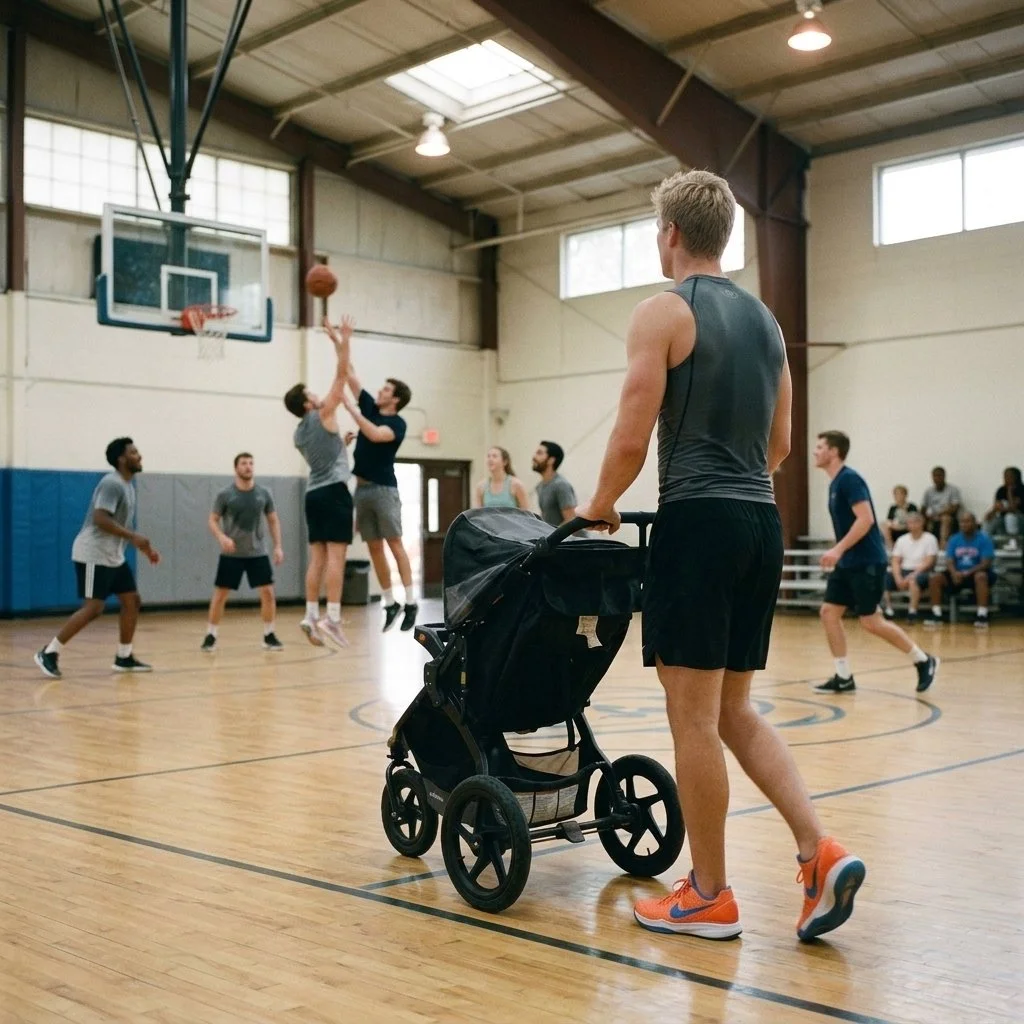
Looking after Mitchell is like stepping onto the court for the most intense basketball game of your life—no time to rest, no moments to relax. He might technically be an adult at over eighteen, but his mind operates with the wonder and unpredictability of a toddler. That means every second spent taking care of him is its own kind of fast break, demanding constant attention and quick thinking. Balancing his needs with my love for playing basketball adds a whole new layer of chaos, and finding harmony between the two requires some serious hustle.
Lately, Mitchell’s been going through an especially tough time. His focus has been scattered, and he’s needed extra support to stay grounded. For me, that means doubling down on being his full-time caretaker while also trying to keep my own head in the game—and on the court. It’s not exactly easy to balance both roles, but I’ve figured out a strategy to make it work. When I hit the local courts to play with the guys, Mitchell comes along for the ride—literally. I’ve got a souped-up stroller for him, stocked with everything he needs to stay entertained, like flashcards, activity sheets, and his favorite snacks. This isn’t just a stroller; it’s a mobile headquarters for Mitchell’s comfort and engagement.
Preparation is key, almost like heading into a big game. His juice cup and snacks are packed and ready, and I scope out a good, shaded spot to park him where he can hang out without getting too bored. Once we’re set up, I start playing, knowing full well that my game today isn’t just about layups and rebounds—it’s also about keeping Mitchell happy and secure. Between plays, I check in on him like a coach keeping tabs on their star player, making sure he’s doing okay and adjusting the plan if needed.
It’s not an ideal setup by any stretch—there’s no peace, and there’s definitely no ease—but I’ve learned to roll with it. Every game is punctuated by glances at Mitchell, quick snack breaks, and the occasional pause to engage him with an activity or just offer him some reassurance. It’s a constant juggling act, and most days, I just hope to get through it without a meltdown. Not just from Mitchell but from me too. However, when I pull it off, when Mitchell is calm, engaged, and maybe even smiling while I manage to sneak a few good shots on the court—that feels like a victory. It’s messy and far from perfect, but it’s our version of a full-court press, and in the end, if we make it work, that’s a win in my playbook.
Essay Assignment Prompt
Balancing Basketball and Mitchell’s Care: A Game Plan
Life often requires us to juggle multiple roles, responsibilities, and passions, but few spheres demand such a delicate balance as caring for someone you love while pursuing something that fuels your soul. Based on the narrative and scenarios described, this essay assignment invites you to explore the challenges, strategies, and triumphs of balancing a personal passion with caregiving responsibilities. Using the outlined sections, craft an essay that examines the intricacies of this balancing act, drawing on the prompts provided to guide your writing.
Assignment Breakdown
Introduction (200 words)
Begin by introducing the concept of balancing dual roles such as being a caregiver while also nurturing personal passions. Reflect on the unique challenges this poses, including emotional, physical, and mental demands. Frame the importance of finding harmony in these roles, using the basketball and caregiving story as an anchor.Preparing for Success (300 words)
Discuss the importance of preparation in balancing caregiving and personal pursuits. Explore how planning ahead, whether for Mitchell’s care or for basketball, parallels other life scenarios. Provide examples of ways in which detailed preparation can alleviate stress and ensure smoother outcomes. Reflect on lessons learned from preparation and forethought.Navigating Challenges on the Court (400 words)
Analyze the challenges that arise when moving between two distinct roles, such as being an engaged caregiver and maintaining a personal identity through activities like basketball. Use the specific example of mitigating meltdowns to illustrate how adaptability and prioritization are key to remaining present in both roles. Consider moments when things didn’t go perfectly and how these became opportunities for growth.The Role of Breaks and Resetting (300 words)
Highlight the importance of breaks—not just for the person being cared for, but for the caregiver as well. Explore how small moments of connection or rest can replenish emotional reserves, build a deeper bond, and improve the overall dynamic. Examine how these timeouts relate to broader principles of self-care and sustainability.Flexibility as a Superpower (400 words)
Reflect on the necessity of staying flexible when life doesn’t go as planned. Describe how changing needs, plans, or emotions require quick thinking, creativity, and the ability to adjust without resentment. Use the idea of “reading cues” and adapting game plans as an analogy for handling both caregiving and life’s unforeseen challenges.Victory in Imperfection (100 words)
Conclude your essay by celebrating the small victories amidst the chaos. Reflect on how balancing caregiving and personal passions isn’t about achieving perfection but about finding meaning and connection through consistent effort. Summarize the lessons learned from this balancing act and its broader implications for life.
Word Count Breakdown
Introduction: 200 words
Preparing for Success: 300 words
Navigating Challenges on the Court: 400 words
The Role of Breaks and Resetting: 300 words
Flexibility as a Superpower: 400 words
Victory in Imperfection: 100 words
Total Word Count: 1500 words
Instructions:
Write an essay that follows this structure, integrating personal reflections, examples, and analysis to address each section. Ensure your essay demonstrates critical thinking and emotional insight while maintaining a clear and engaging narrative style. Use vivid descriptions, comparisons, and storytelling techniques to bring your ideas to life.
Reference: Balancing Basketball and Mitchell’s Care: A Game Plan
Looking after Mitchell while weaving in my passion for basketball has taught me the art of multitasking at its most intense. It’s about planning every detail—thinking two moves ahead like a seasoned player on the court. Here’s the breakdown of how I manage these dual roles, ensuring that Mitchell’s needs are met while I grab a slice of normalcy on the hardwood.
1. Preparing for Game Day (300 words)
Before we even step out the door, preparation is the name of the game. Packing for Mitchell resembles prepping for a marathon rather than a casual outing. First on the list are essentials like diapers, wipes, extra clothes, bibs, and his beloved bottle. Mitchell needs consistent hydration and his comfort snacks—cheesy crackers and apple slices are his favorites. A small cooler bag keeps his juice boxes cool, and I always bring a few backup snacks in case the ones I have don’t catch his interest that day.
I also assemble a kit of engaging activities tailored to Mitchell’s mood. Flashcards with animals and big bold colors, activity books, and tactile toys are lifesavers for keeping him occupied. One of his favorite items lately has been a small sensory ball that lights up. I stash everything neatly in compartments within his stroller, so I always know where to grab what I need.
Finally, I scout the location ahead of time—knowing where there’s shade, where Mitchell’s stroller can be parked without being in anyone’s way, and access to restrooms is crucial. This pre-planning ensures I’m ready for whatever the day throws at us, much like visualizing plays in a basketball game.
2. On the Court: Mitigating Meltdowns (400 words)
Once we’re at the basketball court, the challenge transitions from preparation to execution. The first step is finding a spot where Mitchell can feel comfortable and at ease. His stroller becomes his “command center,” and I set it up with everything he needs within arm’s reach—from his juice cup to small toys.
During the game, my attention spreads across two courts—the physical one where I’m playing and the metaphorical one where Mitchell is vying for engagement and comfort. Between plays, I always check in on him. If I see him getting fidgety, I might crouch down and play a quick round of animal sounds with his flashcards or entertain him with a small toy briefly. The goal is to keep his attention occupied in manageable chunks of time, allowing me to sneak back into the game without completely disrupting my flow.
Sometimes, things don’t go smoothly. Mitchell might throw his toy in frustration or signal he’s in discomfort, which could mean he needs a bottle or even a diaper change. When this happens, I know it’s time to sub myself out of the game momentarily. Whether it means sprinting to the restroom for a quick pamper change or feeding him with focused care, I never allow myself to rush these moments—it’s about ensuring Mitchell’s care, even if it means missing a few extra plays.
3. Managing Bottles, Snacks, and Breaks (300 words)
Snacks and drinks are like timeouts—they help Mitchell stay grounded and refreshed. I keep his favorite sippy cup close by and make a point to hand it to him regularly. When it comes to snacks, the trick is portioning them out gradually. Offering him small quantities at a time keeps his hands and mind engaged without overwhelming him.
Sometimes, I take a break between games just to spend a little bonding time with Mitchell. It might be something as simple as sitting beside him while he flips through his activity book or sharing a quiet moment. These small pauses help rejuvenate both of us and mitigate the buildup of frustration in Mitchell. It’s in these moments that I’m reminded of why this chaotic balancing act is worth it.
4. Staying Flexible and Adapting (400 words)
The beauty and challenge of being Mitchell’s caregiver are one and the same—it’s unpredictable. There’s no fixed plan because Mitchell’s needs change minute by minute. Being in tune with him means reading his cues, from the way he fidgets in his stroller to the subtle expressions that indicate he’s feeling overwhelmed. My game plan has to be fluid, and on most days, it evolves on the fly.
Sometimes during a game, Mitchell might start to fuss or cry without warning. This is where having a backup toy or activity is critical. For example, if he seems bored of his current activity sheet, I switch to his light-up sensory ball or start a round of peek-a-boo—anything to catch his attention until he settles. There are also times when he just needs to feel close, and for those moments, I pick him up and hold him, even if it means sitting out the rest of the game.
Flexibility also means knowing when to call it a day. If Mitchell is clearly not enjoying himself and nothing helps, we pack up and head home. It’s disappointing to cut a game short, but ensuring Mitchell is comfortable and happy takes priority over the scoreboard.
5. The Victory in the Chaos (100 words)
At the end of the day, balancing basketball and Mitchell’s care isn’t about perfection—it’s about small victories. Whether it’s playing a solid 20 minutes of ball while he smiles from his stroller or navigating a potential meltdown with grace, each win feels hard-earned. The key is remembering that success looks different every day, and it’s okay to celebrate the little moments of peace and connection in the middle of the madness.
Sample Essay for the Readers
Looking after Mitchell is like stepping onto the court for the most intense basketball game of your life—no time to rest, no moments to relax. He might technically be an adult at over eighteen, but his mind operates with the wonder and unpredictability of a toddler. That means every second spent taking care of him is its own kind of fast break, demanding constant attention and quick thinking.
Balancing his needs with my love for playing basketball adds a whole new layer of chaos, and finding harmony between the two requires some serious hustle. Lately, Mitchell’s been going through an especially tough time. His focus has been scattered, and he’s needed extra support to stay grounded. For me, that means doubling down on being his full-time caretaker while also trying to keep my own head in the game—and on the court.
When I hit the local courts to play with the guys, Mitchell comes along for the ride—literally. I’ve got a souped-up stroller for him, stocked with everything he needs to stay entertained, like flashcards, activity sheets, and his favorite snacks. Preparation is key, almost like heading into a big game. His juice cup and snacks are packed and ready, and I scope out a good, shaded spot to park him where he can hang out without getting too bored. Once we’re set up, I start playing, knowing full well that my game today isn’t just about layups and rebounds—it’s also about keeping Mitchell happy and secure.
Packing Mitchell's Diaper Bag for a Day Out
Show your work for each question, no shortcuts!
Mitchell needs snacks for 6 hours at the carnival. If he eats one snack every 45 minutes, how many snacks should I pack?
Juice time! Each bottle holds 12 ounces, and Mitchell drinks 4 ounces every hour. How many bottles do I need for the day?
If Mitchell's juice cup holds 8 ounces and I refill it from bottles, how many refills will I need if he stays hydrated every hour?
Carnival parking costs $3 per hour, and we're staying for 7 hours. What's the total parking cost?
Mitchell's stroller weighs 20 pounds, and we’re adding 15 pounds of supplies. What’s the total weight?
I bring 30 flashcards for Mitchell, but he only bothers with 75% of them. How many cards does he actually use?
Snacks come in packs of 10, and I need 25 snacks. How many packs should I grab?
If each diaper lasts 3 hours and we’re out for 9 hours, how many diapers does Mitchell need?
I have room for 2 toys in the bag, but Mitchell has 8 favorites. How many do we not take?
A carnival stand charges $2.50 for a small bag of popcorn. What’s the total cost for 3 bags?
Mitchell drinks juice faster in hot weather—6 ounces per hour instead of 4. If it’s hot, how many bottles do I need for a 7-hour trip?
The diaper bag has 5 compartments. How many items can I fit if each holds 6 items?
Each activity sheet takes him 20 minutes to finish. If he completes 3, how long does he spend coloring?
I buy Mitchell a stuffed animal for $15 and a balloon for $4.25. What’s my total spend?
The cotton candy is $5 each. If I get 2 and pay with $20, what’s my change?
If Mitchell’s stroller has storage for 20 pounds and we already packed 15 pounds, how much space is left?
Mitchell spills part of his juice, losing 2 ounces. If his bottle is 12 ounces, how much is left?
There’s a merry-go-round ride every 15 minutes, and we arrive at 10 a.m. How many rides are there by 2 p.m.?
If Mitchell takes a 30-minute nap, and the carnival runs for 6 hours, what percentage of the time is he sleeping?
I hand out 3 snacks every hour. How many hours before all 30 snacks are gone?
Mitchell is 3 feet tall, and the height requirement for a ride is 3.5 feet. How much more does he need to grow to ride?
Balloons cost $3.25 each. If I buy 4, what’s the total cost?
Mitchell’s juice cup holds 10 ounces, and he drinks 2 ounces every hour. How long before it’s empty?
The stroller’s wheels spin 200 rotations per minute. How many times do the wheels spin in a 2-hour walk?
Mitchell eats snacks 4 times an hour. If we’re at the carnival for 8 hours, how many snacks do I pack?
The bag holds 5 items on each side, and there are 4 compartments. How many items can it carry in total?
Mitchell plays a ring-toss game 4 times, spending $2 per try. How much does the game cost total?
If each diaper costs $0.25 and I pack 10, how much am I spending on diapers?
The diaper bag weighs 10 pounds empty and 22 pounds full. What’s the difference in weight?
Mitchell watches a clown show for 45 minutes, then a magician for 30 minutes. How long does he spend watching shows?
Good luck, and don’t forget to double-check your work before handing it in!
Fitness Assignment: 240-Minute Cardio and Light Weight Routine
Objective
This 240-minute fitness routine is focused on heavy cardio endurance and building strength using light weights. It comprises a minute-by-minute breakdown to ensure you stay on track and maximize every session. Remember to hydrate and stretch before starting.
Minute-by-Minute Breakdown
Warm-Up (10 minutes)
Minutes 0-2: Walk at a brisk pace to elevate heart rate. Swing your arms naturally by your sides.
Minutes 3-5: Perform dynamic stretches (e.g., leg swings, torso twists, arm circles).
Minutes 6-10: Light jogging in place or high knees to further boost circulation.
High-Intensity Cardio (60 minutes)
Minutes 11-15: Jumping jacks at a steady pace.
Minutes 16-20: Burpees (as many as possible). Modify by stepping back instead of jumping if necessary.
Minutes 21-25: Speed skaters (lateral hops side-to-side).
Minutes 26-30: Rest for 30 seconds, then restart rounds of mountain climbers for the remaining 4.5 minutes.
Minutes 31-60 (Repeat 15-30): Repeat these five exercises with short rest periods (30 seconds) between each set.
Circuit Training (50 minutes)
This section incorporates cardio and light weights for toning.
Minutes 61-65: Alternating lunges with 5-10 lb dumbbells (hold weights in both hands).
Minutes 66-70: Shadowboxing with light 3-5 lb weights. Focus on speed and form.
Minutes 71-75: Jump squats (bodyweight only or hold a single light dumbbell).
Minutes 76-80: Lateral raises with 3-5 lb weights.
Minutes 81-110 (Repeat 61-80): Complete three more rounds of this circuit. Adjust weights if needed.
Steady-State Cardio (40 minutes)
Minutes 111-150: Perform a fast-paced power walk or jog around your immediate area or on a treadmill. Keep your pace steady and controlled.
Core Strength and Conditioning (30 minutes)
Minutes 151-155: Plank holds (alternate between forearm and full arm every 30 seconds).
Minutes 156-160: Bicycle crunches, focusing on slow and controlled movements.
Minutes 161-165: Russian twists (bodyweight or holding a dumbbell).
Minutes 166-180 (Repeat 151-165): Repeat this three more times. Maintain form to prevent strain.
Cool Down and Stretching (20 minutes)
Minutes 181-185: Slow-paced walking and deep breathing to bring heart rate down.
Minutes 186-200 (Static Stretching):
Hamstring stretch (2 minutes per side).
Shoulder stretch (1 minute per side).
Quad stretch (1 minute per side).
Child’s pose or cobra stretch to relieve back tension (5 minutes).
Notes
Adjust intensity based on your fitness level but aim to challenge yourself in each segment.
Keep water handy and listen to your body, resting if needed.
Stretch thoroughly to improve flexibility and reduce post-workout soreness.
Enjoy the workout and focus on consistency to achieve your fitness goals!
Group Mindfulness Exercise: Visualizing Perfect Sports Performance
Objective: Enhance focus, confidence, and mental clarity by imagining an ideal sports performance, followed by a reflective journaling activity.
Exercise Steps
Preparation (5 minutes):
Gather in a seated circle or comfortable positions.
Close your eyes and take slow, deep breaths.
Breathe in for 4 counts, hold for 4 counts, and exhale for 6 counts. Repeat 4 times to center yourself.
Guided Visualization (10 minutes):
Imagine stepping onto the field, court, or arena with total confidence.
Visualize each aspect of your performance—your movements, the energy of the game, and the flow of teamwork.
Picture every action being precise and powerful, as if you are completely in the zone. Focus on the sounds, sensations, and emotions of success.
Envision the final moments of victory, relishing the achievement and connection with your team.
Group Discussion (5 minutes):
Open the floor for participants to share how they felt during the visualization.
Encourage insights about what elements of their perfect performance stood out.
Journaling Activity (10 minutes):
Distribute journals or sheets of paper. Ask participants to reflect on the following prompts and write down their thoughts:
What did your perfect performance look and feel like?
What strengths or qualities contributed to that success?
How can you bring aspects of that visualization into your actual practice or games?
What challenges came to mind, and how can you overcome them?
Closing (5 minutes):
Conclude with a few deep breaths as a group.
Share a motivational quote or words of encouragement to carry the positive mindset forward.
Encourage everyone to review their journal entries over time to track progress and strengthen their mental game.