
(Reflection, Math, Fitness, Mindfulness) Brad's Snack Strategy for Mitchell
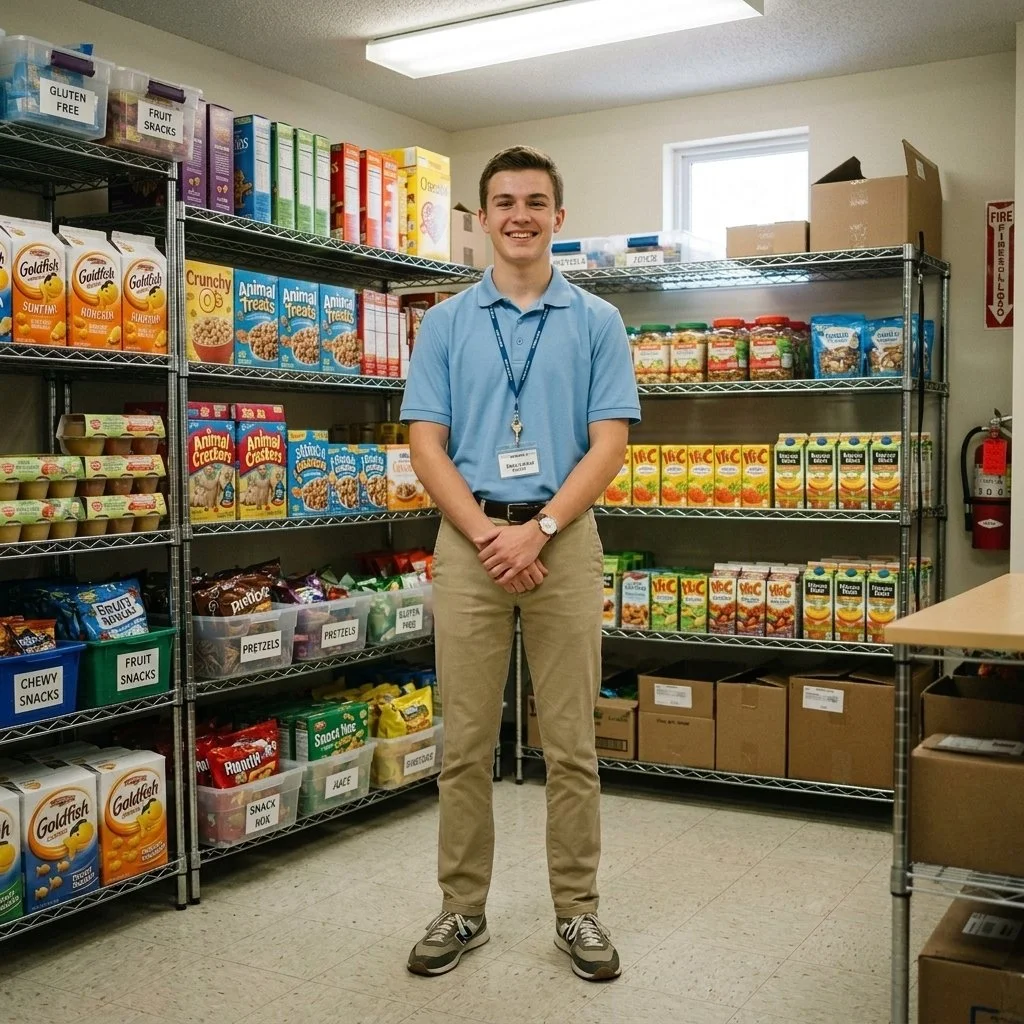
Alright, so here's the deal—I'm Brad, an 18-year-old preschool assistant, and one of my many super important duties here is to create Mitchell's snacktime calendar. Now, Mitchell is a bit of a wildcard when it comes to snacks. Over the past month, he's been all over the place—a mix of bottles, Gerber, and some big kid snacks. His behavior? Well, I’d say it's moderate. He has good days and not-so-good days, but honestly, he's been putting in some solid effort lately.
Now that it’s time to plan for the new month, I’ve been thinking, maybe we lean heavier on the big kid snacks. After all, he's shown signs that he's ready for the challenge. But here's the twist—if it were up to me? Man, I’d toss that calendar and just go day by day. Maybe some trail mix on a good day or go back to Gerber for comfort when he’s having a meltdown. But, you know, structure is important or whatever.
Essay Prompt
Imagine you are in charge of creating Mitchell's snacktime calendar for the new month. Keeping his recent progress in mind, decide what balance of snacks he should have. Will you focus on introducing more big kid snacks, stick with a comforting mix of toddler food and bottles, or maybe explore an entirely new approach? Use the breakdown below to structure your essay.
Introduction (150–200 words): Define the purpose of Mitchell's snacktime calendar and why planning his snacks is essential for balancing his nutritional needs and behavior.
Behavior and Snack Preferences (200–250 words): Discuss Mitchell's recent behavior and how it informs his snack needs. Reflect on whether his moderate behavior aligns with big kid snacks, toddler food, or a mix of both.
Snack Plan and Rationale (500–600 words): Create a detailed plan for Mitchell's snacks throughout the month. Include examples of specific snacks for various breaktimes and explain why you’ve chosen them.
Potential Adjustments (200–250 words): Anticipate changes in Mitchell's mood or behavior and how those might alter the snack plan.
Reflection (150–200 words): Conclude with your thoughts on how this personalized approach to snacks can help Mitchell grow, both nutritionally and behaviorally.
Reference Essay
When creating a snacktime calendar for a child like Mitchell, it is vital to consider their developmental stage, behavioral tendencies, and progress over time. For instance, if a child begins to enjoy elements of independence, like eating big kid snacks, it’s an opportunity to encourage that independence further. To ease them into it, a gradual introduction of snacks such as fruit slices, granola bars, or small sandwiches could replace traditional toddler options. By balancing nutritional needs with Mitchell's readiness for new challenges, a structured yet flexible approach ensures he continues to grow and thrive in a supportive environment.
Instructions for the Math Test
Before beginning the test, please read the following instructions carefully. For each problem, be sure to show all your work clearly. This means writing out each step of your calculations so that your problem-solving process is easy to follow. Partial credit may be given for correctly completed steps, even if the final answer is incorrect. Use neat handwriting, and organize your work in a logical sequence to avoid confusion. Remember, showing your work is just as important as finding the correct answer.
Mitchell's diaper bag needs 4 diapers for every 2 hours of care. If Brad prepares the bag for an 8-hour day, how many diapers does he pack?
Mitchell’s cubby has room for 3 snack boxes. If Brad needs to pack 2 apples and 1 granola bar in each box, how many total food items does Brad need?
Brad prepares two bottles for every 3 hours Mitchell is in care. If Mitchell stays for a 6-hour day, how many bottles does Brad pack?
Diapers come in packs of 12. How many packs does Brad need to buy to last Mitchell through a 30-day month if he uses 3 diapers per day?
If Mitchell drinks 4 ounces of milk every hour, how much total milk does Brad need to pack for a 9-hour day?
A snack consists of two crackers and one slice of cheese. How many total crackers does Brad need if he prepares 15 snacks for the week?
The cubby gets reorganized every 2 days. If Brad spends 15 minutes cleaning it each time, how much time does he spend cleaning it in a 10-day period?
Brad labels each of Mitchell’s items using a roll of tape. If each label uses 2 inches and the roll has 60 inches, how many labels can Brad make?
If Mitchell’s toys weigh 2 pounds each and Brad packs 5 toys, what is the total weight of the toys?
The storage room has 8 cubbies, and each cubby can hold 5 snack bags. How many snack bags can Brad store in total?
Brad uses a vacuum to clean the floor of Mitchell’s playroom. If it takes him 3 minutes to vacuum 1 square foot and the room is 12 square feet, how long does it take him to vacuum the entire floor?
Mitchell has 24 action figures, and Brad decides to organize them into boxes. If each box can hold 6 action figures, how many boxes does Brad need?
Brad wants to buy snacks for Mitchell. If each snack costs $2 and he buys 10 snacks, how much money does he spend?
Mitchell is building a puzzle with 500 pieces. If he completes 40 pieces each day, how many days will it take him to finish the puzzle?
Mitchell has 15 markers, and Brad buys him 9 more. If 4 markers dry out, how many markers does he have left?
Brad counts Mitchell’s books and finds there are 36 in total. If he arranges them evenly onto 4 shelves, how many books will be on each shelf?
Mitchell loves collecting stickers. If he has 120 stickers and gives 25 to his friend, how many stickers does he have remaining?
Brad cuts a piece of string into 7 equal parts. If the string was 21 feet long, how long is each piece?
Brad buys 3 boxes of cereal for Mitchell. If each box costs $4 and he pays with $20, how much change does he get back?
Mitchell has 5 toy cars, and each car costs $3. If Brad buys him 3 more cars, how much does he spend in total for the new cars?
Mitchell’s train set has 50 tracks. If Brad sets up 3 connected loops using 12 tracks each, how many tracks does he have left unused?
Brad fills Mitchell's water bottle with 2 cups of water each day. If he does this for a week, how many cups of water does he use in total?
Mitchell loves painting. If he uses 8 paints each week and the set has 40 paints in total, how many weeks will it take before he runs out?
Brad draws 18 shapes on a whiteboard for Mitchell to count. If 10 of them are circles, how many are not circles?
Mitchell and Brad are stacking blocks. If they build a tower with 4 blocks per layer and the tower is 8 layers tall, how many blocks do they use in total?
Mitchell spends 5 minutes reading each page of his book. If his book has 30 pages, how long does it take him to finish reading it?
Brad packs sandwiches for a picnic. If he makes 6 sandwiches and cuts each one into 4 pieces, how many pieces does he have?
Mitchell finds 42 marbles in a jar. If Brad divides the marbles evenly among Mitchell and his 2 friends, how many marbles does each person get?
Brad pours juice into glasses, filling 3 glasses with 2 cups of juice each. How many cups of juice does he use in total?
Mitchell has 8 dinosaur toys, and Brad brings home a set of 12 more. If Mitchell gives 5 to his cousin, how many does he have left?
Brad is baking cookies for Mitchell. If a batch contains 24 cookies and Brad makes 3 batches, how many cookies does he bake in total?
Mitchell collects comic books and has 50 in total. If he reads 5 books each week, how many weeks will it take to read all of them?
Brad inflates 10 balloons for Mitchell’s birthday, and each balloon takes 3 minutes to inflate. How long does it take to inflate all the balloons?
Brad cuts 48 apples into slices for Mitchell. If he cuts each apple into 6 slices, how many slices does he have in total?
Mitchell builds 6 LEGO models, and each model uses 50 pieces. How many pieces does he use altogether?
Brad measures Mitchell’s train tracks and finds that one track is 15 inches long. If they attach 8 tracks together, how long is the train track in total?
Mitchell counts 4 drawers in the storage room, and each drawer contains 8 toys. How many toys are in the drawers in total?
Brad fills party bags for Mitchell’s friends. If he prepares 5 bags and puts 7 pieces of candy in each, how many pieces of candy does he use?
Mitchell has 9 colored pencils, and Brad sharpens 6 more. If 3 pencils break, how many sharpened pencils are there now?
Brad ties helium balloons for Mitchell’s party. If he ties 5 balloons with 6 ribbons each, how many ribbons does he use in total?
### 240-Minute Gym Workout Plan – Weight Intensive (Minute-by-Minute Breakdown)
Warm-Up (20 Minutes)
Minutes 1-5: Dynamic stretches (arm circles, leg swings, torso twists).
Minutes 6-10: Light jogging or brisk walking.
Minutes 11-15: Bodyweight exercises (15 squats, 10 push-ups, 10 lunges per leg, 20-second plank).
Minutes 16-20: Resistance band warm-up (pull-aparts, overhead stretches, lateral leg raises).
Strength Training – Upper Body Focus (60 Minutes)
Minutes 21-30: Bench press – 4 sets of 8 reps (Rest 90 seconds between sets).
Minutes 31-40: Bent-over rows – 4 sets of 8 reps (Rest 90 seconds between sets).
Minutes 41-50: Overhead barbell press – 4 sets of 10 reps (Rest 60-90 seconds).
Minutes 51-60: Dumbbell curls – 4 sets of 12 reps per arm (Rest 60 seconds).
Core Training (30 Minutes)
Minutes 61-65: Russian twists with a medicine ball – 3 sets of 20 twists (10 per side).
Minutes 66-70: Plank with shoulder taps – 4 sets of 10 taps per side.
Minutes 71-75: Hanging leg raises – 3 sets of 12 reps.
Minutes 76-90: Rest and hydrate.
Strength Training – Lower Body Focus (60 Minutes)
Minutes 91-105: Squats – 5 sets of 10 reps (Increase weight as comfortable; rest 2 minutes between sets).
Minutes 106-115: Romanian deadlifts – 4 sets of 8 reps (60 seconds rest).
Minutes 116-125: Walking lunges with dumbbells – 4 sets of 12 reps per leg.
Minutes 126-130: Calf raises – 4 sets of 20 reps (30 seconds rest).
Circuit Training (30 Minutes)
Minutes 131-160 (Repeat the circuit 3 times):
Kettlebell swings – 15 reps.
Push-ups – 12 reps.
Box jumps – 12 reps.
Dumbbell thrusters – 10 reps.
Rest 1 minute after each circuit.
Cool Down (30 Minutes)
Minutes 161-170: Static stretching for the lower body (hold each stretch for 30 seconds per side):
Hamstring stretch
Quad stretch
Calf stretch
Minutes 171-180: Static stretching for the upper body (hold each stretch for 30 seconds per side):
Shoulder stretch
Tricep stretch
Side body stretch
Minutes 181-185: Seated forward fold – Hold for 2-3 minutes to relax the lower back and hamstrings.
Minutes 186-195: Foam rolling:
Focus on quads, hamstrings, calves, and back.
Minutes 196-210: Light yoga flow for relaxation and flexibility enhancement, focusing on poses like Downward Dog, Child’s Pose, and Cat-Cow stretches.
Minutes 211-240: Meditation or deep breathing exercises to fully relax the mind and body, promoting recovery and mental clarity. This cooldown period ensures optimal recovery and helps prevent soreness, leaving you refreshed and energized.
Group Mindfulness Exercise: Prayer Visualization and Reflection
Step 1 – Centering and Relaxation (Minutes 0-5)
Begin by sitting comfortably in a circle, either on chairs or a soft surface. Close your eyes and take slow, deep breaths. Focus on the breath as it enters through your nose and fills your lungs, and then slowly release it through your mouth. Clear your mind of distractions, allowing yourself to be fully present.Step 2 – Guided Visualization (Minutes 6-15)
Imagine yourself surrounded by people who have supported or inspired you throughout your life. Visualize these individuals radiating warmth, encouragement, or positivity. Next, shift your focus to one person you feel you could express gratitude, care, or forgiveness toward. This could be a coach, teammate, friend, family member, or even someone you briefly crossed paths with in the past.Step 3 – Prayer Creation (Minutes 16-25)
With the image of this person in your mind, begin thinking about what you would say to them in a prayer. What feelings do you hold toward this person? Is there gratitude, an apology, or affirmation you’ve never shared? Concentrate on expressing these thoughts with honesty and kindness.Step 4 – Writing the Prayer (Minutes 26-35)
Open your eyes and take time to write out your prayer to this person. Use a journal, piece of paper, or notes app to capture your thoughts. Be as detailed or concise as you like. This prayer is personal and doesn’t need to be perfect—it’s about connecting with your inner self and expressing unspoken emotions.Step 5 – Reflection (Minutes 36-45)
After completing the writing exercise, take a moment to reflect on how this process made you feel. If comfortable, participants can share general impressions of the exercise (without sharing the actual prayer). Finally, seal the exercise with deep breaths, gratitude, and a calm acknowledgment of how this inward reflection supports mental and emotional growth.
This mindfulness exercise encourages athletes to deepen their self-awareness and engage in meaningful reflection without judgment or external expectation.