
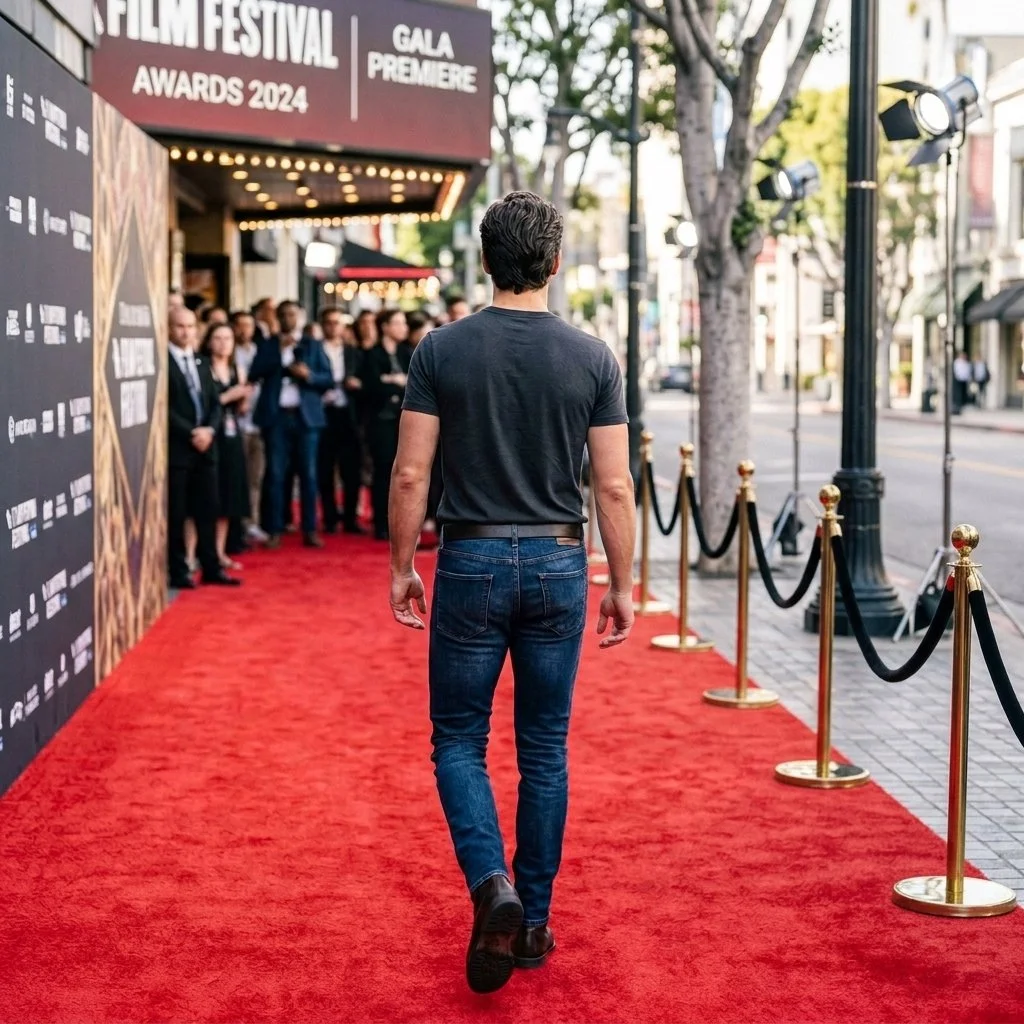
Title: Lights, Camera, Chaos - Red Carpet with Mitchell
Essay Prompt (1500 Words):
You have just turned 25 and moved to Hollywood, chasing your dream of making it big as an actor. The city is everything you’ve imagined—glamorous, overwhelming, and full of possibility. And now, after weeks of scraping by, a small, independent film you played a minor role in is having a red carpet premiere, and you’re invited. It’s your first taste of Hollywood glitz, except there’s one unexpected twist: Mitchell, your family friend, is tagging along as your “assistant” for the day.
Mitchell, he’s a "big boy" in every sense of the phrase. However, he requires extra support, including wearing Pampers for special-needs teens. He’s endlessly curious about everything around him, and between his enthusiastic spirit and a tendency to get sidetracked (leading to occasional "timeouts" when he’s overwhelmed), managing him becomes your biggest challenge and delight of the evening.
Your task is to craft a story that balances humor, heart, and chaos. Explore how Mitchell’s presence turns what should be a glamorous, self-centered evening into something memorable in entirely unexpected ways. Delve into the awkward moments, the surprising acts of kindness, and the way navigating the red carpet with Mitchell challenges your patience but ultimately shifts your perspective. How does Mitchell manage to help you in his own unique way, even while needing the occasional timeout? Use humor and specificity to firmly root your essay in their shared misadventure.
Word Count Breakdown:
Introduction (200-300 words):
Set the stage. Describe your excitement about the premiere, your nervous energy about trying to fit into the Hollywood scene, and the curveball of having Mitchell assigned as your “assistant” (read: enthusiastic tagalong). Establish his personality, quirks, and role for the evening while setting up the comedic tension.Rising Action (500-600 words):
Dive into the chaos of arriving at the premiere. Paint vivid, laugh-out-loud moments of Mitchell interacting with the event, from chasing snack trays to loudly asking when the “real celebrities” will arrive. Write about the challenges you face trying to maintain your composure while keeping Mitchell on track, including the moments when he needs timeouts to calm down after overstimulation or excitement.Climactic Moment (400-500 words):
Center the narrative on a pivotal red carpet moment—maybe Mitchell surprises you by helping smooth over a misstep, handing you tissues when you’re nervous-crying, or confidently posing for a picture that turns into the highlight of the night. Highlight how his unique perspective shifts how you view the glamorous world around you.Resolution (200-300 words):
Reflect on the night. How did Mitchell’s presence turn what seemed impossible—balancing his needs and handling the high-pressure Hollywood event—into something deeply meaningful? Wrap up with a warm, humorous nod to the balance between chaos and connection.
Short Sample Reference Essay (500 Words):
Lights, Camera, Chaos:
The trouble with red carpet premieres is that no one prepares you for what to do with your hands. Were you supposed to wave? Cross them artfully over your body? Or clutch your $14 thrift store clutch until the fake leather started to shed on your fingers? “Relax,” my mom had said over the phone that morning. Easy for her to say. She wasn’t trying to share the spotlight with Mitchell.
Mitchell—a six-foot-tall hurricane in sneakers—was staring wide-eyed at the chaos, holding my press pass like it was a Wonka ticket. “Do we get snacks, or do I wait?” he whispered with the kind of seriousness normally reserved for actual negotiations. Of course, the moment I turned to tell him we’d grab something inside, Mitchell started wandering after a platter of shrimp skewers.
Chasing him through the crowd while trying to keep my heels from snapping became the theme of the night. Every five minutes, Mitchell would stop to make a booming announcement. “MY FRIEND IS IN THE MOVIE,” he bellowed at one point, pointing to me. I froze. Somewhere, a photographer snapped a photo—I never saw it, but I could feel the embarrassment burned into my heels.
It wasn’t all chaos, though. When my nerves hit their peak, standing under the too-bright lights between camera flashes, Mitchell leaned down and whispered, “Don’t be scared. I gotcha.” His big hand, sticky from the cocktail napkin he’d murdered earlier, gave my shoulder a confident squeeze. And somehow, I wasn’t scared after that.
By the end of the night, I wasn’t just surviving—I was laughing. When Mitchell decided to sit dramatically next to a movie poster after one too many flashes, we called it his “timeout to look famous.” He was thrilled when a stranger asked if he was a cast member. “No,” he said seriously. “I’m the assistant.”
And in his own way, he was.
MATH
Under no circumstances are you to skip showing your work. This isn’t just math; it’s detective work, and we want to see every clue you followed to crack the case. Solved for x? Great—how’d you catch it? Show your notes, your messy calculations, even that half-erased tangent where you thought maybe y was guilty. Neatness is optional, but your math breadcrumbs are not. Think of it this way: if your answer waltzes in without an invitation—no context, no explanation—how are we supposed to believe it’s not crashing the party?
Mitchell needs six diapers for a premiere event that spans 12 hours. Diapers need to be changed every two hours. He decides to pack one spare. How many total diapers should Mitchell bring? Show your work.
Each diaper weighs 0.35 pounds, and Mitchell’s bag can carry up to 10 pounds. If you pack 15 diapers, how much weight is left for food and extras in the bag? Show your calculations.
You budget $4.50 for every pacifier Mitchell might “lose artistically” at the premiere. If you’re estimating losing three, what is the total amount you need? Show your work.
Mitchell insists on bringing exactly three juice boxes per hour. For a four-hour stretch before heading home, how many juice boxes are needed? Show your calculations.
His favorite snacks come in packs of four resealable bags, and you plan to pack enough for 8 rounds of snacks during the premiere. How many full packs do you need to buy? Show your work.
Each outfit Mitchell wears is 0.75 pounds. If his diaper bag already has 2 pounds of accessories and you still need to add 3 outfits, what will the total weight of the bag be? Show your calculations.
You decide to pack 10 diapers, each taking up 1.25 liters of space. If the bag can hold a maximum of 20 liters, how much storage space remains? Show your work.
Mitchell launches one pacifier every 45 minutes for dramatic effect. If the premiere lasts five hours, how many pacifiers do you need to pack to keep him appeased? Show your work.
The wipes container has 120 wipes. Each diaper change requires six wipes. How many changes can you perform before running out? Show your calculations.
Mitchell demands bibs to match every juice box, and you have planned for three different colors per hour. If the event is four hours, how many bibs do you need to pack? Show your work.
A pack of wipes costs $5.99 and contains 150 wipes. If you estimate using 30 wipes, what is the cost per wipe, and how much would you pay for the estimated usage? Show your calculations.
You packed 7 snack pouches, each containing 20 small crackers, but Mitchell averages eating 24 crackers per hour. How long before you run out of crackers? Show your work.
The changing mat takes up 5% of the bag’s total capacity. If the bag's capacity is 30 liters, how much space does the mat occupy, and how much is left? Show your calculations.
Every hour, Mitchell consumes 0.6 liters of juice. If the bag currently holds 4 liters of juice, how many hours will this last? Show your work.
Mitchell practices handing out business cards — proudly folding 4 in half every 20 minutes. If a box has 50 cards, how long until the box is empty? Show your work.
Each clean shirt weighs 150 grams, and each spare pair of pants is 200 grams. If you pack two shirts and three pairs of pants, what is the total weight of the clothing? Show your work.
A pack of four diapers costs $9.96. If Mitchell insists on packing 12 diapers, what will be the total cost of the diapers? Show your calculations.
Mitchell spills juice from two boxes into a special spill-proof cup that holds 0.75 liters. Each box contains 0.4 liters. How much juice remains after filling the cup? Show your work.
A bag of snacks holds 250 grams and contains 50 mini servings inside. If Mitchell eats 10 grams per snack break, how many snack breaks will the bag last? Show your calculations.
Mitchell’s toy weighs 0.5 pounds, and the bag currently weighs 7 pounds before adding his toy. If the total allowed weight for carry-on is 8 pounds, how much weight remains? Show your work.
An accessory costs $14.99, and you receive a discount of 20% for ordering an extra. If you buy three, what is the total cost? Show your calculations.
Mitchell wants to pack four types of crayons, with each box containing 12 crayons. If each crayon weighs 15 grams, what is the total weight of crayons packed? Show your work.
You brought 8 stuffed animals, each taking up 3 liters of space. If the bag can hold only 30 liters, how much space will the stuffed animals take, and what’s left? Show your work.
You buy 3 packs of snacks, each costing $6.45 and containing 10 individual bags. How much does each snack bag cost? Show your work.
Mitchell enjoys wearing hats — one for every two hours he’s out. If the event is nine hours, how many hats need to be packed? Show your calculations.
Spare wipes come in packs of 80, and you estimate using 8 wipes per hour. How many packs are needed for a 6-hour event? Show your work.
Each pacifier weighs 120 grams, and the limit for your total pacifier pack is 1 kilogram. How many pacifiers can you carry without exceeding the limit? Show your calculations.
Every hour, Mitchell throws one item out of the bag, with items averaging 0.25 kilograms. If he keeps this up for four hours, how much does the bag’s weight decrease? Show your work.
A bottle of water holds 1 liter, but Mitchell’s sippy cup can hold only 300 milliliters at a time. How many filling rounds can one bottle provide? Show your calculations.
A bag of wipes costs $8.75, and you’ve set aside $50 to spend on supplies. How many bags can you buy, and how much money will remain? Show your work.
This comprehensive gym session is crafted for athletes seeking to build strength, explosiveness, and endurance while honing mobility and recovery. Here’s how to maximize every minute.
0-10 Minutes: Dynamic Warm-Up
Set the tone for a productive workout with a warm-up that activates muscles and enhances mobility.
2 minutes: Jogging or light mobility drills to elevate your heart rate.
3 minutes: Dynamic stretches, including leg swings and arm circles, to loosen joints and increase range of motion.
5 minutes: Movement prep such as bodyweight squats, lunges, and inchworms to engage key muscles and promote blood flow.
10-40 Minutes: Upper Body Strength Training
Focus on building a strong upper body with compound movements and pulling variations.
Bench Press (4 sets of 8-12 reps): Build pushing power for chest, shoulders, and triceps.
Pull-Ups or Lat Pulldown (4 sets of 8-12 reps): Strengthen your back and improve pulling mechanics.
Overhead Press (3 sets of 10-12 reps): Develop shoulder stability and pressing strength.
Dumbbell Rows (3 sets of 10 reps per arm): Target the lats and improve unilateral strength.
40-70 Minutes: Lower Body Strength Training
Unleash power from the ground up with these lower-body exercises.
Squats (4 sets of 8-12 reps): Build overall leg strength and core stability.
Romanian Deadlifts (3 sets of 10 reps): Focus on hamstring and glute development.
Step-Ups with Dumbbells (3 sets of 10 reps per leg): Improve balance and work your quads and glutes.
Calf Raises (3 sets of 15-20 reps): Strengthen your calves for better explosiveness and agility.
70-100 Minutes: Power and Explosiveness Training
Drive athletic performance with explosive, full-body movements.
Power Cleans (4 sets of 6 reps): Build speed and coordination with this Olympic lift.
Box Jumps (3 sets of 10 reps): Train your vertical jump and fast-twitch fibers.
Medicine Ball Slams (3 sets of 12 reps): Strengthen your core while releasing excess energy.
Broad Jumps (3 sets of 8 reps): Boost forward explosive power and conditioning.
100-120 Minutes: Core and Stability Work
Dial in stability and core engagement for balance, posture, and injury prevention.
Plank Variations (2 minutes each): Activate your core with side planks and front planks.
Hanging Leg Raises (3 sets of 12-15 reps): Strengthen lower abs and hip flexors.
Russian Twists (3 sets of 20 twists): Develop rotational core strength.
Ab Rollouts (3 sets of 10 reps): Engage your entire core with this challenging move.
120-140 Minutes: Short Rest & Light Reconditioning
Recharge your body with focused recovery techniques.
10 minutes of foam rolling to release muscle tightness and improve circulation.
10 minutes of passive stretching for flexibility and long-term mobility improvements.
140-180 Minutes: Hypertrophy and Isolation Work
Target specific muscle groups to fine-tune strength and aesthetics.
Bicep Curls with Dumbbells (3 sets of 10-15 reps): Isolate the biceps for arm growth.
Tricep Rope Pushdowns (4 sets of 12 reps): Build arm support for pushing strength.
Lateral Raises (3 sets of 12-15 reps): Add width to your shoulders for a balanced physique.
Rear Delt Flyes (3 sets of 12 reps): Improve posture and strengthen rear shoulders.
180-210 Minutes: Cardio and Agility
Elevate your heart rate and improve agility to round out the session.
Treadmill Sprints (30 seconds on, 30 seconds rest for 15 minutes): Build cardiovascular endurance and speed.
Ladder Drills (10 minutes): Enhance footwork, coordination, and agility.
210-240 Minutes: Cool-Down and Recovery
Recover fully and prepare for your next session with intentional cooling down.
5 minutes of light jogging or walking to reduce lactic acid buildup.
15 minutes of deep stretching to release tension and increase flexibility.
10 minutes of controlled breathing exercises to calm your mind and lower your heart rate.
You've just completed a four-hour, athlete-driven workout designed to push your limits. Stay consistent, listen to your body, and fine-tune this plan to your performance goals!