
Essay Prompt:
Introduction & Context (200 words)
Mitchell’s Strengths and Needs (300 words)
Balancing Employment and Development (400 words)
Addressing the Janitorial Interview Plan (300 words)
Reflection Essay Instructions (300 words)
Introduction & Context (200 words)
Start by setting the stage with your role in Mitchell’s life and the unique joys and challenges of your shared day-to-day routine. Provide the reader with some background on Mitchell—his personality, routines, and where he thrives. Highlight the dual focus you have as his caregiver: fostering his independence while ensuring his developmental needs are fully supported. Frame the essay's core question early on—whether setting up an interview for Mitchell with the supervising janitor is the best step forward to help him grow or if focusing on his preschool-level activities at home better supports his progress.
Mitchell’s Strengths and Needs (300 words)
Dedicate this section to a compassionate and specific account of Mitchell’s abilities and challenges. Describe what makes him special, from the surprising “MVP” moments in his activities (helping clean up after snack time with remarkable focus, maybe?) to the areas where he might need extra support (his reliance on schedules or any sensory sensitivities). Incorporate Mitchell’s ongoing development and how small wins build toward long-term independence, giving insight into how his characteristics align with or diverge from workplace expectations. Here, show the reader what you think Mitchell’s superstar traits are—and how those could shine in a work setting or be nurtured in at-home programs.
Balancing Employment and Development (400 words)
Explore the tension between engaging Mitchell in potential employment, like the janitorial role at the local department store, and focusing on continuing his preschool-level developmental work at home. Could a small responsibility, like helping organize supplies under supervision, spark his growth? Or would it be overwhelming without developing foundational skills at home first? Use Mitchell’s personality quirks, routines, and limits as the framework for weighing the pros and cons. Balance optimism about Mitchell’s potential with honest realism about what’s achievable and sustainable for him now. Show the reader that the decision is not simple—this is about Mitchell’s happiness and long-term quality of life.
Addressing the Janitorial Interview Plan (300 words)
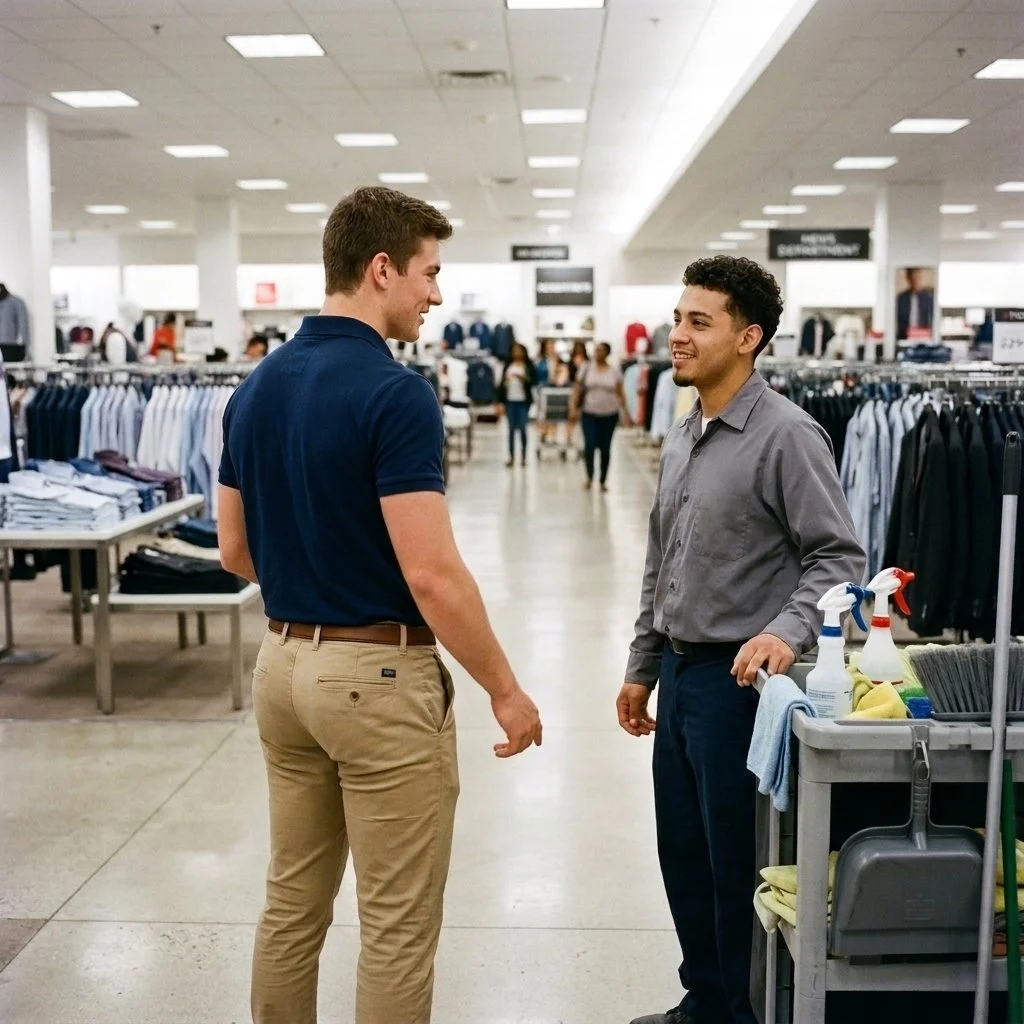
Detail the steps you would take to prepare both yourself and Mitchell for the upcoming janitorial meeting. How would you advocate for Mitchell in the interview while managing expectations? Spell out strategies for showcasing his strengths, demonstrating his potential, and addressing his needs in a way that frames him as capable in a supported environment. Maybe there’s a plan to co-create a manageable trial role. Or, perhaps you identify key strategies to ensure the environment is welcoming and appropriately aligned to Mitchell’s pace (think schedules, break spots, or “highlight reel” moments). Conclude the section by outlining whether you feel ready to proceed with the interview—and why.
Reflection Essay Instructions (300 words)
For the conclusion, pivot the focus to whoever might be writing or reading the reflection essay in response. Ask them to consider Mitchell’s story and the decision of whether to pursue the janitorial interview or focus on his preschool-level development. Set clear expectations for the reflection essay to include:
A summary of the key factors that informed the decision.
A discussion of ethical considerations in supporting individuals with special needs.
Their personal perspective on fostering independence versus safeguarding comfort and growth.
Encourage readers to envision what success looks like for someone like Mitchell and what role a caregiver, employer, or community plays in making that vision attainable.
Reference: Advocating for Mitchell's Growth: Work Opportunity or Developmental Focus?
Introduction & Context
Mitchell doesn’t just wake up and greet the day—he enters it like a headliner claiming center stage. His laugh? Infectious. His determination? Borderline legendary. Here’s the play-by-play of life with Mitchell, a young man who brings both unique challenges and MVP moments to the table, every single day. As his caregiver, my dual focus is split between two equally critical goals: nurturing his independence and supporting his ongoing developmental needs.
Mitchell thrives on routine, no question about it. Predictable snack times, structured activities, and a section of the day we’ve dubbed "Cleanup with Flair" fill his schedule. It’s both a joy and a balancing act—guiding him while letting him take the reins whenever possible. But here’s the big question we’re asking now, one that goes beyond our day-to-day lineup of highlights and hurdles. Should we push the boundaries by preparing Mitchell for a job—specifically, an opportunity to assist the janitorial team at a local store? Or are we better off doubling down on the foundational, preschool-level tasks at home that keep him progressing steadily?
This essay dives into the heart of that decision. It’s not just about a role; it’s about Mitchell’s long-term quality of life.
Mitchell’s Strengths and Needs
Everyday moments with Mitchell often deliver the kind of surprises that earn their own highlight reel. Take snack time, for instance. While other routines might breeze by unnoticed, Mitchell’s incredible focus and precision while tidying up afterward stand out. You’d swear the guy had been sponsored by a professional cleaning league. That’s a defining strength—his ability to perform tasks with concentrated energy when the structure aligns with his routine. Moments like these ignite hope that he could transfer those skills into a workplace setting, even in a small capacity.
But balancing those victories are the challenges that keep us grounded. Mitchell relies deeply on a scheduled environment. If “routine” were a sport, this kid would be an Olympic medalist, no contest. Spontaneous changes? That’s the wild card that throws him off his game. Sensory sensitivities also play a significant role in shaping his day-to-day experience. Noisy environments or certain textures can be overwhelming, sometimes derailing his otherwise stellar “performance.” Navigating these factors carefully is key to identifying what situations will set Mitchell up for success—and what could lead to frustration.
Still, his progress is undeniable. Small, consistent wins build toward a bigger picture of independence. Whether it’s learning to respond to verbal cues without hesitation or mastering tasks like organizing toys, each skill feels like a tiny victory in teaching Mitchell to advocate for himself. The question lies in whether these moments are ready to evolve into something more structured, like a formal job, or if they’re best refined further in a controlled home environment catered to incremental developmental growth.
Balancing Employment and Development
Here’s where things get tricky. On one side of the ring, we have the opportunity for Mitchell to assist the local department store’s janitorial team. A small, supported role could potentially unlock a new level of confidence for him—giving him the chance to take ownership of responsibilities and experience a workplace routine. Imagine Mitchell putting his uncanny knack for cleanup to good use in a supervised space designed for success. It feels like a natural extension of his “talent,” doesn’t it?
But it’s not all high-fives and spontaneous team chants. Stepping into a work environment comes with real challenges. For starters, there’s the sensory unpredictability. What happens if the noises of the store overwhelm him mid-shift? Or if a sudden change in tasks throws him off completely? Without a carefully designed support structure, things could unravel fast. Sure, it’s exciting to think about growth, but not at the expense of Mitchell’s confidence or comfort.
On the other side, continuing his preschool-level tasks at home offers a slower, steadier path. Here, we can maintain control over his environment and fine-tune the skills he needs most. It’s less glamorous, maybe, but progress doesn’t always need a spotlight. Focusing on foundational development might feel like hitting pause on the dream of “employment,” but it could be setting him up for much greater autonomy down the road.
Ultimately, it’s not about whether Mitchell can take on the janitorial role but whether doing so right now is the best thing for him. Could structuring a unique hybrid—home-centered skills with added exposure to external tasks—strike the balance needed to keep both his confidence and development on track? That’s the puzzle we’re working on solving.
Addressing the Janitorial Interview Plan
If we do decide to go ahead, preparation becomes the name of the game. First up? Advocating for Mitchell during the interview. The pitch isn’t about overselling or oversimplifying but showcasing his unique strengths in a practical way. “This kid is the cleanup MVP,” you’d say, “but give him a clear structure to keep that focus sharp.” It’s all about framing his skills in a way that makes sense within a supervised work environment.
Next, the game plan. There’s no winging it here. We’d co-create a trial role that respects Mitchell’s pace. Small, manageable tasks—like organizing supplies or assisting during quiet periods—would form the foundation. Clear schedules would map out expectations while incorporating sensory break spots to keep him comfortable and confident. Preparation also means managing expectations for the janitorial team. The goal? To establish a mutually beneficial setup, where both sides feel prepared for the challenges and rewards ahead.
Finally, evaluating the “readiness factor.” Without it, this interview is just practice. And practice, while important, isn’t the same as readiness. If the risks outweigh the potential benefits, then the best move might be calling time-out on the interview altogether—for now.
Reflection Essay Instructions
Think about Mitchell’s story. It’s not just about employment or education. It’s about his growth, happiness, and long-term independence. The decision at hand is no small feat. To frame your essay, start by summarizing the factors involved in potentially pursuing the janitorial role or continuing his developmental work at home. Highlight the ethical considerations that come with advocating for someone like Mitchell—balancing their independence with ensuring their comfort and development.
Next, reflect on your own views. Picture success for Mitchell—not just next week or even a year from now, but in the bigger picture. What does his happiness and autonomy look like? How would his caregivers, employers, or community need to contribute to creating that future?
End with action. Reflect on what you, as the writer or reader, can take away from Mitchell’s story to better support others with special needs. Remember, it’s not just about decision-making—it’s about building a world where people like Mitchell can thrive.
A baseball pitcher throws a ball at 90 miles per hour. If the batter is standing 60.5 feet away, how many seconds does it take for the ball to reach the batter? (Hint: Convert the speed from miles per hour to feet per second first). Show your work.
A soccer field is 120 yards long and 80 yards wide. If the team needs to isolate a rectangular training area that is 1/4 of the total field area, what are the possible dimensions of the training area? Show your work.
A lacrosse team scored 8 goals in a game. If each goal is worth 1 point and they had 25 total shots on goal, what is their shooting accuracy as a percentage? Show your work.
A hockey arena has a seating capacity of 18,500 people. If ticket prices are $75 each and the arena is filled to 85% capacity, how much total revenue does the arena generate from ticket sales? Show your work.
A baseball game lasted 3 hours and 45 minutes. If each inning takes an average of 20 minutes, how much time was left for commercials and breaks? Show your work.
A soccer player ran 9.8 kilometers during a game. Convert this distance into miles. (1 kilometer = 0.621 miles). Show your work.
A lacrosse team wins 75% of their games during the season. If they play 20 games total, how many games do they win? Show your work.
A hockey puck travels at a speed of 35 meters per second. If the distance to the goal is 50 meters, how long does it take the puck to reach the goal? Show your work.
A baseball batter has a batting average of 0.320. If they had 125 at-bats, how many hits did they achieve? Show your work.
A soccer ball is kicked into the air with an initial velocity of 25 meters per second. Using the formula h = vt - 4.9t², where h is the height in meters, v is the initial velocity, and t is the time in seconds, find the height of the ball after 1.5 seconds. Show your work.
During a lacrosse game, a player made 6 successful passes out of 15 attempts. What percentage of their passes were successful? Show your work.
A hockey player scores an average of 1.2 goals per game over 10 games. How many total goals did they score? Show your work.
A baseball diamond is a square with each side measuring 90 feet. What is the distance from home plate to second base, assuming it’s a diagonal line? Show your work and use the Pythagorean theorem.
A soccer team needs to practice penalty kicks. If each player on the 12-person team takes 5 penalty shots, how many total penalty shots will be taken? Show your work.
A lacrosse stick costs $120. If a team of 15 players orders sticks and receives a 10% team discount, what is the total cost of the order? Show your work.
A hockey league consists of 8 teams, each playing 20 regular-season games. How many total games are played in the league? (Assume every game is played between two teams). Show your work.
A baseball pitcher throws balls at an average speed of 88.7 miles per hour. Convert this speed to feet per second. (1 mile = 5280 feet, 1 hour = 3600 seconds). Show your work.
A soccer coach scheduled practice drills that last 1 hour and 15 minutes. If the team arrives 20 minutes late, and they take a 10-minute water break halfway through, how much active practice time do they have left? Show your work.
A lacrosse team earned $8,700 in ticket sales from one game. If each ticket sold for $18, how many tickets were sold? Show your work.
A hockey team scores 3.2 goals per game on average. After 25 games, how many total goals have they scored? Show your work.
A baseball outfield wall is 12 feet high. If a ball is hit and travels on a parabolic path defined by the equation y = -0.04x² + 2x, does the ball clear the wall if the wall is located 50 feet from home plate? (x is the horizontal distance from home plate in feet, y is the height in feet). Show your work.
A soccer goalie saved 22 shots out of 30 attempts. What is their save percentage? Show your work.
A lacrosse field is 110 yards long and 60 yards wide. What is the field’s total area in square feet? (1 yard = 3 feet). Show your work.
A hockey puck starts at 2°C on the ice and decreases in temperature by 0.5°C every minute. How many minutes will it take for the puck to reach -10°C? Show your work.
A baseball batter hits a line drive that travels 325 feet in 4.2 seconds. What was the average speed of the ball in feet per second? Show your work.
A soccer coach orders new uniforms for 18 players. Each uniform costs $45.75, and the coach receives a 15% discount. What is the total cost of the uniforms? Show your work.
A lacrosse game consists of 4 quarters, each lasting 15 minutes. If the game starts at 2:30 PM and there is a 10-minute halftime break, what time does the game end? Show your work.
A hockey player skates around a circular rink with a radius of 90 feet. How far does the player skate after completing 3 full laps? (Use C = 2πr for the circumference). Show your work.
A baseball team’s hitting statistics are as follows: 25 singles, 15 doubles, 5 triples, and 10 home runs. If each single is worth 1 base, each double is worth 2 bases, each triple is worth 3 bases, and each home run is worth 4 bases, calculate how many total bases the team achieved. Show your work.
A soccer team practices for 3 hours every day. If they spend 40% of the time on fitness drills, how many hours do they spend on other activities each day? Show your work.
32. Mitchell needs 6 diapers per day to conquer his schedule. How many diapers should be packed to cover 5 full days of domination? Show your work.
Each snack pouch Mitchell consumes contains 4 ounces of fuel. If you pack 3 pouches per day, how many total ounces of snack power should Mitchell's bag have for a 7-day week? Show your work.
Mitchell’s legendary hydration routine requires two 10-ounce bottles of water daily. How many total ounces of water need to be packed for a 4-day adventure? Show your work.
There's one spare outfit packed for every two days of mayhem Mitchell causes. How many spare outfits need gearing up for a full 8-day campaign? Show your work.
If Mitchell averages two epic spills per day that require wipes, and each spill takes 5 wipes to address, how many of the real MVPs (wipes) do you need to pack for 3 days? Show your work.
Each of Mitchell's favorite comfort blankets must be washed after 4 days of intense action. If you pack 2 blankets for a Monday-to-Sunday stretch, calculate how many more may need reinforcement for mid-week backup. Show your work.
The collapsible sippy cup holds 8 ounces of milk and needs one refill by halftime every day. How much milk should be packed for a 5-day hustle? Show your work.
Mitchell guarantees at least one wardrobe change a day. If you prep 3 extra outfits just in case, how many total outfits should hit the rotation for a 7-day roadshow? Show your work.
Sunscreen tubes last for 10 full-body applications, and Mitchell needs a reapply every 3 hours while outdoors. How many applications does a single 9-hour field day require, and will one tube hold the line? Show your work.
Mitchell powers through a teething biscuit every 2 hours during his crusades. If each day’s bag gets packed with 8 biscuits, do you have enough for 3 consecutive days? Show your work.
Emergency snack bags hold 10 individual rice crackers. If Mitchell smashes 15 a day, how many full bags should you load up to survive an 8-day streak? Show your work.
Mitchell’s pacifier rotation requires 1 ready to rumble and 2 backups for the week. How many total pacifiers should make the cut for a 6-day showdown? Show your work.
Each day begins with a clean burp cloth, and Mitchell’s penchant for surprise spills demands one backup every three days. How many total cloths should be rostered for a 9-day grind? Show your work.
Diaper cream usage averages 0.5 ounces per day for full coverage. If you pack a 3-ounce tube, how many days before you might run short? Show your work.
Each of Mitchell's bibs survives through 2 of his colossal meal attempts. How many bibs must you prepare for a week of 3-meal days? Show your work.
If Mitchell’s hero-level energy burns through 1 packet of baby food every 4 hours he’s awake and each day averages 12 hours of play, how many food packets does his bag need for 6 days? Show your work.
Each of Mitchell’s legendary toy distractions weighs 0.5 pounds. If you limit the diaper bag’s total fun weight to 5 pounds, what’s the max number of toys that can travel along? Show your work.
Mitchell’s wipes supply comes in 100-count packs. If he blazes through 12 wipes a day, how many packs will you need to last for 16 diaper-changing days? Show your work.
Every teething ring must cycle out after 3 days to keep Mitchell’s zen intact. How many rings should be packed for a 9-day clash? Show your work.
A single reusable storage pouch can hold 15 ounces of soft fruit snacks. If Mitchell munches 20 ounces daily, how many pouches do you need to fill each night for 4 days of action? Show your work.
Spit-ups average 2 a day, with one burp cloth per incident. If Mitchell packs no extras, how many days before his spit-up streak demands backup supplies? Show your work.
Each bottle prep session uses 1 tablespoon of formula powder. If Mitchell powers through 5 bottles a day and the formula canister holds 400 tablespoons, how many weeks does one canister last? Show your work.
Sunscreen reapplications take 1 ounce each and an average outdoor stint comes in at 6 hours. How much sunscreen should grace the field bag for a weekend tournament? Show your work.
Mitchell’s trusty all-purpose balm gets applied daily, a quarter-ounce at a time. If the tin holds 2 ounces, how many days before you run out of magic? Show your work.
Each of Mitchell’s clip-on toys keeps him entertained for 1.5 hours. If you aim for no repeats over 9 hours of travel, how many need to be packed? Show your work.
GYM
Are you ready to dominate the gym like it’s your personal Olympic arena? Here’s your minute-by-minute playbook for a 4-hour epic — because legends don’t tap out early. Brace yourself. We’re talking lifting, cardio, poolside glory, and a jacuzzi finale that screams, “Reward earned.”
Minutes 0–10 | Warm-Up
Dynamic stretches. Arm circles? Check. Lunges? Of course. It’s the pregame ritual of champions.
Light jog on the treadmill to wake up the legs. No, this isn’t the victory lap yet. It’s the intro music.
Minutes 10–40 | Upper Body Supremacy
Bench press (3 sets, 8–10 reps): And if you’re not escalating the weight like it’s a video game boss battle, are you even trying?
Pull-ups (4 sets, failure): Channel your inner action hero. Pull-ups are just aerial victory celebrations.
Shoulder press (3 sets, 10 reps): Shoulder game strong? Nothing says power like replacing stoplights with flexing poses.
Dumbbell bicep curls (3 sets, 12 reps): Unlike your ex, these gains won’t ghost you.
Minutes 40–70 | Lower Body Gauntlet
Squats (3 sets, 10 reps): It’s not leg day. It’s legacy day. Depth matters, hero.
Deadlifts (3 sets, 8 reps): Want an endorsement deal for life? Lift like you mean it.
Calf raises (4 sets, 20 reps): Every step should feel like you’re stepping into greatness.
Bulgarian split squats (3 sets, 10 reps per leg): Grant your quads MVP status. You'll either ascend or swear revenge.
Minutes 70–110 | Cardio Conquest
Rowing machine (20 minutes): Channel every wrong email you’ve received into pulling like it owes you money.
HIIT on the treadmill (20 minutes): Sprint 30 seconds, walk 30 seconds. Repeat. Because mediocrity isn’t sprinting.
Minutes 110–140 | Core Domination
Plank (3 x 1 minute): Who needs abs of steel when you’re going straight for unobtanium?
Hanging leg raises (3 sets, 15 reps): Look gravity in the face and say, “Not today.”
Russian twists with medicine ball (3 sets, 20 reps per side): Victory tastes better when it burns.
Mountain climbers (3 sets, 30 seconds): Conquer the metaphorical Everest of gym mats.
Minutes 140–200 | Pool Power-Up
Laps (20 minutes): Swim like there’s Olympic gold at the other end. Or at least snacks.
Aqua jogging (10 minutes): Yes, it looks silly. Yes, you’re still the champion of water-based cardio.
Minutes 200–230 | Jacuzzi Kickback
The final buzzer is ringing. Into the jacuzzi you go, MVP. Relax, recover, bask in the knowledge that mere mortals could never. Treat yourself like the legendary gym warrior you are. Hydrate or die-drate. Destiny never rests.
Minutes 230–240 | Cool-Down
Stretch. Breathe. Reflect. You didn’t just work out. You performed. The gym staff probably wants your autograph now. Curtain call.